

This post continues the Jupiter-in-Cancer series by examining one of its darkest counter-expressions: Andrew Kehoe, perpetrator of the 1927 Bath School disaster. Across this series, Jupiter in Cancer retrograde has behaved functionally like Jupiter in Capricorn, not because Cancer’s themes vanish, but because care, comfort, and emotional security are replaced by ambition, pressure, and instrumental ends. We have already seen this substitution at work in figures like Jimi Hendrix and Janis Joplin, where Jupiter/Cancer-rx redirected the need for belonging and emotional containment into relentless striving, excess, and exposure. What Kehoe adds to this sequence is something new: alongside this Capricornian ambition, Jupiter/Cancer-retrograde also manifests as blocked fertility and failed nourishment, not merely symbolically but materially.
That fertility theme has already appeared in a different register. In last week’s post on Sharon Tate, Jupiter/Cancer-retrograde in the 1st house denied her the ability to bring a child to term, with that promise violently cut short by murder. A similar motif appears symbolically in Tate’s first film Eye of the Devil, where a French estate suffers agricultural sterility until sacrifice is demanded to restore productivity. In Kehoe’s life, the symbolism becomes literal: failed agricultural fertility—an unproductive farm, chronic tax arrears, dependence on his wife’s inheritance, and the humiliation of economic non-viability. Jupiter/Cancer-retrograde does not nourish here; it withholds, starves, and curdles into grievance, now linked not only to ambition but to the inability to sustain life, land, or lineage.
From a technical standpoint, Jupiter remains a plausible choice for the victor of Kehoe’s chart insofar as it describes his frustrated vocation as a farmer and landowner. But it is not the most economical fit. A cleaner and more operational choice is Mercury, which better captures Kehoe’s defining competencies: mechanical aptitude, electrical skill, facility with tools, wiring, and construction. Mercury explains how Kehoe lived and how he acted—how he gained access to the school, how he wired explosives, how he executed a long-term plan requiring concealment and precision. Yet even Mercury does not fully explain why the life resolved as it did. That burden falls most convincingly on the Moon’s Configuration. Kehoe’s Moon in Scorpio, separating from Mars and applying to the Sun, shows how blocked nourishment (Jupiter/Cancer-rx), technical capacity (Mercury), and accumulated resentment converge, transforming private grievance into public catastrophe.
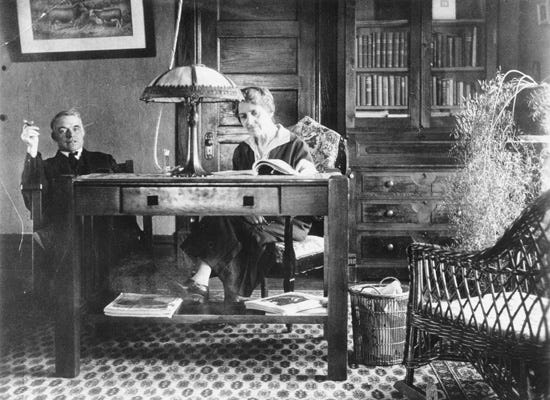
Andrew Kehoe (1 February 1872 – 18 May 1927) was an American farmer, school official, and mass murderer whose actions culminated in the Bath School disaster of 1927, the deadliest school attack in United States history. Born in Tecumseh, Michigan, Kehoe was the son of Philip Kehoe and Mary McGovern Kehoe, his birth mother. Mary Kehoe died when Andrew was still a child—sources generally place her death in the late 1870s or early 1880s—leaving him to be raised in a household later reshaped by remarriage. Philip Kehoe subsequently married Frances Wilder, who became Andrew’s stepmother. Contemporary accounts and later reconstructions consistently describe the relationship between Andrew Kehoe and Frances Kehoe as strained and openly hostile.
Kehoe was regarded from an early age as intelligent, mechanically adept, and temperamentally rigid. He showed particular aptitude for tools, wiring, and machinery, later studying at Michigan State College, where he acquired technical skills that would shape both his vocational frustrations and his capacity for meticulous planning. He was described as emotionally inflexible, resentful of authority, and prone to brooding grievances—traits that appear consistently in later recollections.
In 1911, while living away from Bath Township, Kehoe reportedly suffered a serious accident in which he was knocked unconscious and remained in a coma for approximately two weeks. The incident cannot be dated more precisely, and no medical documentation survives. Nonetheless, later acquaintances described a noticeable change in his temperament afterward, characterizing him as more irritable, bitter, and rigid. That same year, a second and far more consequential event occurred: the death of his stepmother, Frances Wilder Kehoe.
On 17 September 1911, Frances Kehoe was severely burned when an oil stove exploded as she attempted to light it. Contemporary reports describe the stove’s oil-based fuel soaking her clothing and igniting. Kehoe, who was present, attempted to extinguish the flames by throwing a bucket of water on her—an action that, in an oil-fed fire, would not suppress combustion and could instead spread burning fuel, intensifying the injuries. Frances Kehoe survived for several days before dying from her burns. Later accounts emphasize that Andrew Kehoe disliked his stepmother and that suspicions circulated locally regarding possible tampering with the stove. Given his mechanical background, commentators have noted that he would have been technically capable of such interference; however, no conclusive evidence of sabotage was ever produced, and no formal finding of foul play was made. The episode must therefore be treated as a documented fatal accident accompanied by unresolved suspicion, rather than a proven homicide, though it stands as an early and disturbing instance of Kehoe’s proximity to lethal domestic violence.
In 1912, Kehoe married Ellen (“Nellie”) Price, and the couple settled on a farm in Bath Township, Michigan. He proved an ineffective and frustrated farmer but a capable handyman, often more absorbed by machinery and electrical systems than by agriculture. Neighbors later described him as argumentative, obsessively frugal, and prone to fixation on perceived injustices. These traits intensified during the early 1920s, when Bath Township financed construction of a new consolidated school through increased property taxes.
Kehoe fixated on the school project and the taxes that supported it, eventually serving as school board treasurer, a role that deepened both his grievances and his access to the building. As his personal finances deteriorated and foreclosure loomed, he increasingly framed his failures as the result of institutional injustice. Over many months, he secretly acquired dynamite and surplus military explosives, using his technical expertise to conceal them beneath the school’s floors and crawl spaces.
On 18 May 1927, Kehoe murdered his wife and destroyed his farm with fire and explosives. Later that morning, a timed bomb detonated beneath part of the Bath Consolidated School, killing 38 children and two teachers in the initial blast. As rescue efforts were underway, Kehoe arrived in a truck packed with additional explosives and metal shrapnel and detonated it, killing himself, the school superintendent, and several bystanders. In total, the attack resulted in 44 deaths, including Kehoe, and at least 58 people were injured, many of them children. Investigators later discovered hundreds of pounds of unexploded charges hidden elsewhere in the school, indicating that total destruction had been intended.
Kehoe left behind no manifesto, only a sign wired to his farm reading, “Criminals are made, not born.” His life reveals a long arc of grievance, technical control, and emotional rigidity, with early maternal loss, a hostile step-parent relationship, and the unresolved violence of 1911 forming a shadowed prelude to his final act. Whether those early episodes reflect deliberate violence, reckless indifference, or psychological injury cannot be definitively resolved, but together they show that the Bath School disaster was not an isolated eruption of madness, but the culmination of years of resentment, preparation, and moral narrowing.
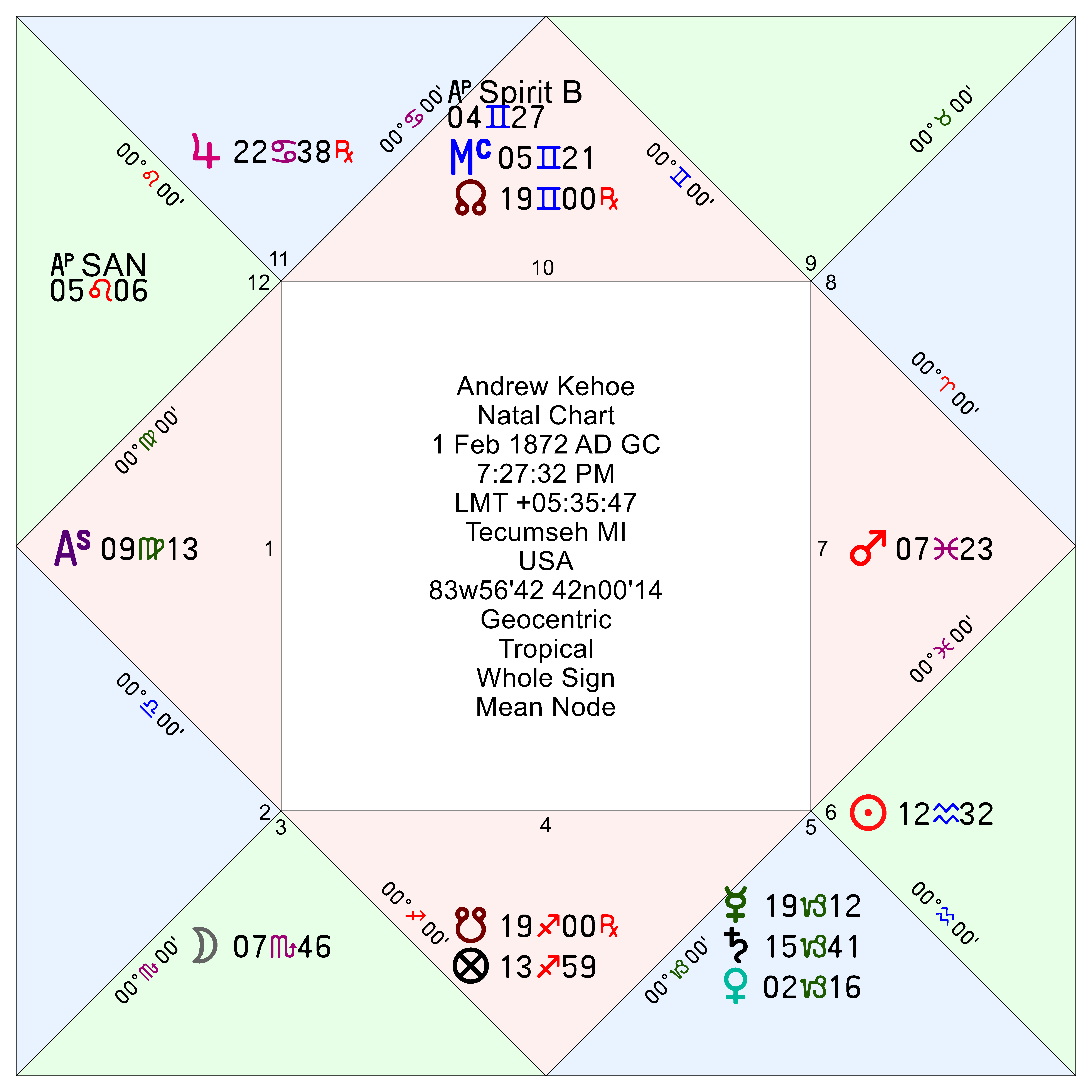
Rodden Rating X, Date w/o time
Proposed Rectification: 7:27:32 PM, ASC 9VI13’28”
The analytical models used in the sections below are part of a larger research program developed across longer white papers and case studies, where the historical sources, rules, and testing methodology are laid out in full. These database entries show the models in practice; readers who want the theoretical foundations can start with the background papers below:
Rectification Hub (I wrote the book on it!)
Soul Hub (white paper, Victor model statistical tests, Moon’s Configuration studies)
Physiognomy Hub (white paper, examples)
Victor model factors favoring Mercury/Capricorn
Sign ruler: ASC, MC, and Lot of Spirit
Bound ruler: MC and Lot of Spirit
Mercury in Capricorn as victor of the horoscope signifies the cold application of technical intelligence toward destructive ends. Trained in electrical engineering, Andrew Kehoe approached the Bath School bombing not as a crime of impulse but as an engineering project requiring planning, calculation, and precision. Mercury’s placement in Capricorn emphasizes patience, method, and attention to structural systems, qualities visible in his months-long effort to conceal explosives throughout the school basement, wire detonators, and coordinate multiple attacks into a single operation. The co-presence of Saturn reinforces the themes of severity, resentment, and punishment, while Venus adds the appearance of respectability that allowed Kehoe to function as a trusted member of the community and school board. Mercury’s application to Jupiter in Cancer retrograde suggests a conflict between technical expertise and communal welfare. The institution intended to nurture Bath Township’s children became the object of Kehoe’s grievance, and the opposition transformed Mercury’s capacity for organization into a campaign against the very community the school represented. In this figure, intellect is not directed toward education, commerce, or administration, but toward the systematic destruction of a social institution.
Physiognomy Model Factors favoring Capricorn
Rising sign + rising decan: Virgo
Ruler of rising sign + ruler of rising decan: Mercury/Capricorn
Based on the surviving photographic evidence, physiognomic analysis of Andrew Kehoe is necessarily tentative. Only a single known photograph appears to survive, and even in that image he occupies a small portion of the frame, limiting detailed assessment of facial features. Contemporary descriptions generally portray him as an ordinary-looking farmer of medium height and solid build, with no especially distinctive physical characteristics noted by those who knew him. What can be observed from the photograph is a face that appears broadly ovate rather than rectangular or elongated, with a compact, orderly presentation and restrained demeanor. The overall impression is one of plainness, self-control, and reserve rather than physical dominance or theatricality.
From an astrological perspective, the physiognomy is consistent with Virgo rising and a Virgo rising decan, both ruled by Mercury, with Mercury itself placed in Capricorn. Traditional physiognomists often associated Mercury-Virgo types with an understated appearance that draws little attention to itself, while Capricorn contributes a more angular skeletal structure and the ovate facial outline noted in several traditional sign-attribution systems. Although the photographic evidence is limited, the apparent oval shape of Kehoe’s face is broadly consistent with Capricorn, the sign occupied by the ruler of both the rising sign and rising decan. The overall effect is a face suggestive of practicality, restraint, and methodical purpose—qualities that align closely with the dominant Mercurial-Capricorn themes elsewhere in the horoscope.
Moon’s Configuration
Moon: 7°36′ Scorpio, 3rd house, ruling the 11th
Mars: 7°23′ Pisces, near the 7th cusp, ruling the 3rd and 8th
Sun: 12°32′ Aquarius, 6th house, ruling the 12th
Stage I — Moon Separating from Mars
Delineation. The Moon in Scorpio signifies suspicion, secrecy, and the accumulation of resentments; placed in the 3rd house, these qualities are directed toward local affairs, civic administration, and—by modern extension—primary education. Scorpio sharpens perception but corrodes trust, producing grievances that are remembered and nursed rather than discharged. The Moon’s rulership of the 11th channels these resentments into collective bodies, boards, and institutions, rather than private complaint. Mars in Pisces, ruling both the 3rd (the grievance itself) and the 8th (death and personal debt), transforms anger into a logic of sacrifice and dissolution, where boundaries between protest, self-harm, and annihilation blur. Positioned near the 7th cusp, Mars externalizes the conflict into open dispute with identifiable enemies. The Moon’s separation from Mars indicates that this pattern of grievance and conflict is already established and operational before the terminal act.
Biographical match. Kehoe’s core grievance concerned local taxation to fund the Bath Consolidated School, a textbook 3rd-house matter. The Moon’s rulership of the 11th is directly descriptive of his election to the school board, where he attempted to restrain expenditures as treasurer. The 11th’s association with public funds and taxation explains why the grievance took political form rather than remaining private. When these obligations became unpayable, the matter shifted into the 8th, ruled here by Mars, linking taxes to personal debt. Kehoe’s lack of children further sharpened the Moon/Scorpio resentment: without personal stake in 5th-house affairs, the school existed for others’ children, intensifying the sense of unjust extraction. Mars ruling both the grievance house (3rd) and the house of death and debt (8th), and placed on the 7th, encompasses his escalation into open conflict, including the murder of his wife, a 7th-house figure, at the outset of the final act.
Stage II — Moon Applying to the Sun
Delineation. After separating from Mars, the Moon applies to the Sun at 12°32′ Aquarius, placed in the 6th house and ruling the 12th. In classical doctrine, this is a severe terminus. Firmicus Maternus states that when the Moon moves from Mars toward the Sun, it signifies violent death, grave misfortune, and bodily ruin, often brought about by the native’s own actions. The Sun here does not mitigate Mars; it consumes and concludes the sequence. The house placements bind the sphere of labor, routine, and institutional function (6th) to self-undoing, confinement, and hidden enemies (12th), producing an ending in which no further negotiation or remediation is possible.
Biographical match. Kehoe’s final act conforms precisely to this doctrine. The grievance pursued through boards, elections, and disputes does not resolve through reform or retreat but through absolute closure. The school itself, as an institution of daily function (6th), becomes the site of the terminus, while the Sun’s rulership of the 12th describes a resolution that entails both the destruction of others and self-annihilation. There is no subsequent outlet for the Moon; the application to the Sun marks the end of both the life and the grievance. The historical record requires no auxiliary significators to explain the outcome—the Mars → Sun sequence is sufficient.
Limits of Biographical Data (Sun’s Bound Ruler)
In cases where the Moon applies to the Sun, I have been testing whether the Sun’s bound ruler—here Venus—offers a more precise delineation, effectively treating the configuration as a functional application to Venus via the Sun. In Kehoe’s case, however, the biographical record is too thin to support that refinement. While the method can sharpen interpretation where Venusian themes (relational dynamics, pleasure, conciliation, or financial reciprocity) are clearly documented, there is insufficient evidence here to justify shifting interpretive weight away from Firmicus’s primary doctrine. Accordingly, this report remains anchored to the Moon separating from Mars and applying to the Sun, without extending the sequence to the Sun’s bound ruler.
Influence of Sect
Kehoe’s horoscope is a night chart, making Mars the in-sect malefic. In traditional doctrine, an in-sect malefic is not softened into beneficence but is more regulated, strategic, and effective—capable of sustained action without immediate exposure. This fits the historical pattern: Mars in Pisces operates quietly and diffusely, allowing Kehoe to purchase, transport, and assemble explosives over many months with minimal detection, thereby facilitating a carefully prepared murder-suicide rather than an impulsive eruption. By contrast, Saturn (the out-of-sect malefic) does not dominate the sequence, and the action proceeds without early institutional containment. As for the luminaries, the Moon as the in-sect light carries and organizes the grievance through time, while its application to the Sun (the out-of-sect luminary) functions less as illumination than as termination; traditional authors (including Firmicus Maternus) emphasize the Moon’s motion toward the Sun after Mars as a sign of violent ends, without elaborating a distinct sect-based mitigation at the moment of application. Given the limited biography, it is sufficient to note that sect here enhances Mars’s capacity for covert execution while leaving the final Moon→Sun contact to operate according to its primary, destructive doctrine rather than a nuanced luminary exchange.
Early/Late Bloomer Thesis
Andrew Kehoe was born in a waning Moon phase (between Full Moon and New Moon), a preventional figure who should, under the thesis, manifest decisive life outcomes after midlife. Kehoe lived 55.29 years (1 Feb 1872–18 May 1927), placing the midpoint of life at 24 September 1899. Before that cutoff, the record shows little more than formation and drift—education without degree, itinerant work, marriage, and the accumulation of resentments—while the actions that define his historical significance occur well after midlife: sustained financial collapse, political fixation on school taxation, election to (and conflict within) the school board, clandestine acquisition and placement of explosives, and finally the 1927 attack. In other words, Kehoe’s life does not peak early; it coagulates late, with motive, means, and resolve converging decades after the midpoint. On the narrow terms of the early/late bloomer hypothesis, this is a clear late-bloomer fit: the decisive (and catastrophic) expression of the life unfolds in the second half, consistent with a waning, preventional Moon.
AI Notice: This post created with assistance from ChatGPT.
Complete biographical chronology, rectification and time lord studies available in Excel format as a paid subscriber benefit. Files are behind the paywall.