

Tonight 11-Mar-2026 at 11:29 PM EDT Jupiter in Cancer makes its direct station. It’s been a long ride since 11-Nov-2025, when Jupiter turned retrograde. Since that time, my Wednesday natal database posts have focused on horoscopes with Jupiter in Cancer retrograde. The purpose of this exercise has been straightforward: to document a pattern that has appeared repeatedly in my research—that retrograde planets often behave as though they were placed in the opposite sign. In the present case, Jupiter in Cancer retrograde frequently operates as though it were Jupiter in Capricorn, reversing the normal expression of the planet’s exalted placement.
When Jupiter is direct in Cancer—the sign of its exaltation—it normally signifies care, protection, nourishment, and social stability, both in the life of the individual and in mundane affairs. Yet when Jupiter occupies this same sign in retrograde motion, these meanings often appear inverted. Instead of protection there can be a withdrawal of protection; instead of nourishment, a weakening or collapse of support structures; instead of comfort, a contraction of Jupiter’s normally generous influence. The symbolism does not disappear, but it seems to operate through a reversed channel.
There is, however, an important exception to this rule. When Jupiter approaches acronychal rising, the planet becomes exceptionally bright in the evening sky. At that moment the normal, direct-motion meanings of Jupiter temporarily reassert themselves, even though the planet remains technically retrograde. I explored this phenomenon in the following post:
Jupiter Retrograde, Acronychal Rising, and the Recovery of Planetary Meaning
The question addressed in the present article is what happens after acronychal rising, as Jupiter continues its retrograde motion and moves toward its direct station. My working hypothesis is that the inversion effect is not constant throughout this period. Instead, the retrograde sign polarity intensifies as the station approaches, reaching its most extreme expression immediately before the planet turns direct—rather like a slingshot pulled to its greatest tension just before release.
The horoscopes below illustrate this pattern from Cancer through Sagittarius. (They also happen to be the charts I had time to review today.)
Six horoscopes illustrate the pattern. In each case Jupiter is retrograde and only days away from its direct station, allowing us to observe the inversion at its maximum strength.
1. Mikhail Gorbachev. Jupiter 10CA29 retrograde; direct station +5 days
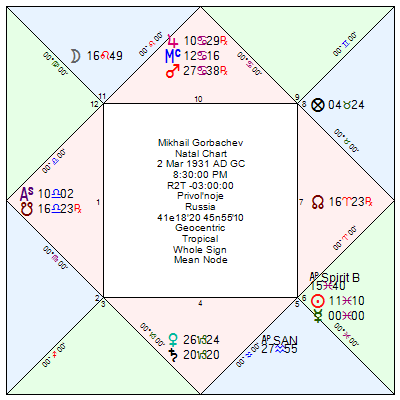
Rodden Rating DD, Conflicting/unverified
Born on 2-Mar-1931, Mikhail Gorbachev entered the world only five days before Jupiter stationed direct, with Jupiter retrograde in Cancer at the final stage of its backward motion—a moment when the planet appears to resist its sign most strongly before turning forward again. The timing places his horoscope precisely in the interval when retrograde inversion should be most visible, just before the planet releases its tension at the direct station.
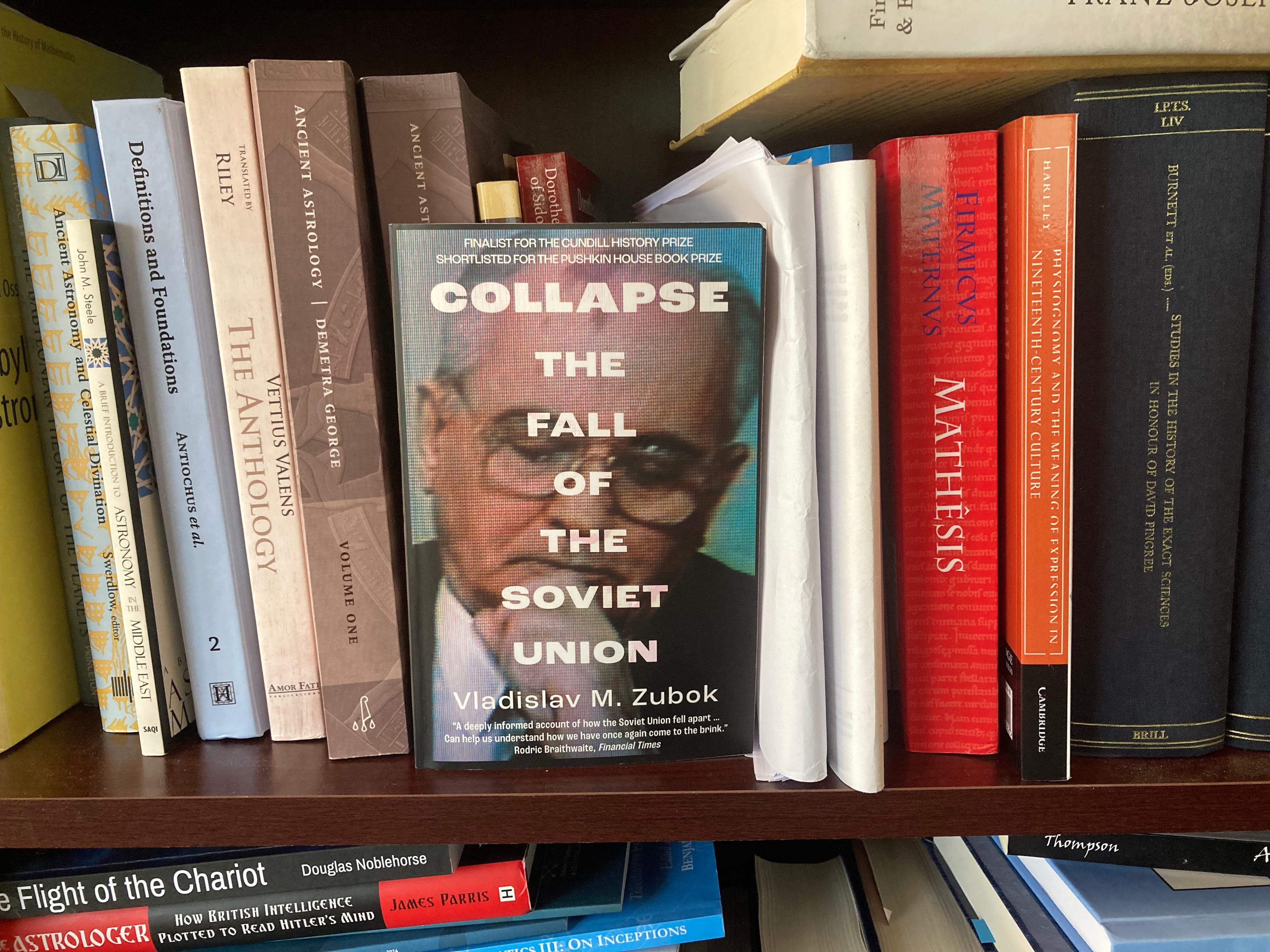
His reform program—Perestroika—was intended to modernize the Soviet system, yet as documented by Vladislav M. Zubok in Collapse: The Fall of the Soviet Union, the immediate result was the opposite of Jupiter-in-Cancer’s natural promise: the disintegration of the domestic provisioning system itself. Food shortages multiplied, state finances deteriorated, and the Soviet government progressively lost the ability to provide the basic economic security that had long sustained its legitimacy. Seen astrologically, the symbolism is striking: in the final protest of a retrograde Jupiter before its direct station, the planet appears to reject its own signification, and in Gorbachev’s case the rejection manifested as the collapse of the very structures of care—housing, subsidies, food supply, and social guarantees—that Cancer normally signifies. The dissolution of the Soviet Union in 1991 therefore reads almost like a macro-historical expression of that station: Jupiter in Cancer, pushed to the edge of its retrograde reversal, expressing its sign not through nourishment but through the dramatic and irreversible failure of the system meant to nourish an entire empire.
2. Gyorgy Lukacs. Jupiter 25LE56-retrograde. Direct Station +9 days
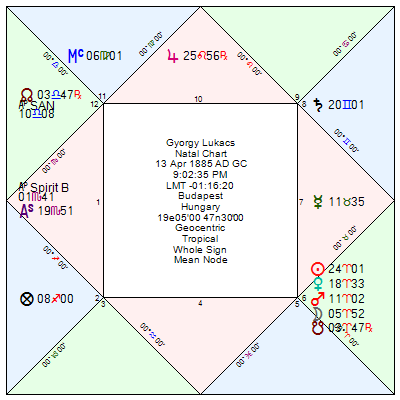
Author’s Rectification
Born with Jupiter retrograde in Leo just nine days before its direct station, György Lukács emerged as one of the most combative minds in 20th-century Marxist philosophy, a revolutionary intellectual who rose amid the chaos of postwar Hungary to champion a vision of political life that disdained Jupiter-in-Leo’s cult of heroic leadership. If direct Jupiter in Leo rules the stage, the throne, and the aura of singular solar authority, then retrograde Jupiter in Leo—functioning as Jupiter in Aquarius—turns its back on charisma and bends toward the collective, the structural, the doctrinal. Lukács’ life was an unrelenting polemic against the idea that history is shaped by radiant individuals; instead, he insisted on the primacy of class, historical totality, and dialectical method.
He briefly served as People’s Commissar for Culture in the 1919 Hungarian Soviet Republic, promoting revolutionary art that subordinated the artist to proletarian consciousness, and later spent decades battling both the Stalinist orthodoxy that demanded personal loyalty and the liberal intelligentsia that clung to romantic notions of genius. He attacked existentialism for its subjectivism, derided avant-garde modernism as decadent solipsism, and cast scorn on the “leader principle” wherever it reared its Leonine head. Jupiter retrograde in Leo, in Lukács’ case, did not simply negate Leo—it sought to invert it through the austere prism of Aquarius, where redemption comes not from a single radiant figure, but from the reorganization of thought and society in the name of historical necessity. His Jupiterian function was not to shine, but to dismantle the illusion of shining.
3. Sid Vicious. Jupiter 21VI45-retrograde. Direct Station +9 days
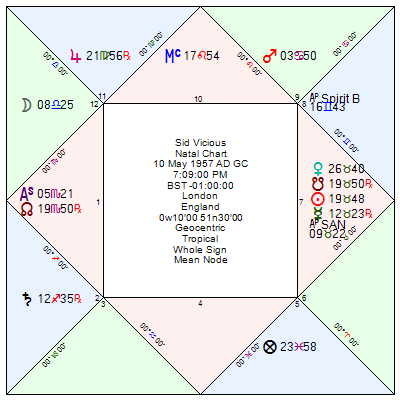
Sid Vicious, born John Simon Ritchie in 1957, was the bassist and icon of self-destruction at the heart of the Sex Pistols, the band that detonated punk’s nihilist wave across Britain in the late 1970s. Raised in a turbulent environment in London and drawn early into the city’s emerging punk scene, Vicious became less a musician than a symbol of the movement’s raw defiance. When he joined the Sex Pistols in 1977 he had little technical ability on the bass, but that deficiency hardly mattered—the band valued him as a visual and cultural embodiment of punk’s hostility toward musical professionalism and social order. His snarling stage presence, confrontational interviews, and chaotic personal life made him one of the most recognizable figures in a subculture built around shock and disruption. His relationship with Nancy Spungen, soaked in drugs and co-dependency, ended in her mysterious death in a New York hotel room in 1978 and his own overdose only months later, sealing his reputation as punk’s doomed anti-hero.
In this scorched biography we see Jupiter in Virgo retrograde rejecting Virgoan values—craft, detail, discipline, sobriety—and instead impersonating Jupiter in Pisces, drowning in emotional excess, addiction, and spiritual implosion. Where Jupiter in Virgo promises containment, Vicious became a vessel cracked wide open, leaking myth and heroin, enacting a kind of reverse sainthood through total dissolution. He didn’t ascend to any heights of precision or service; instead he enacted the Pisces script in negative: not transcendent musician, but sacrificial emblem of a scene too raw to survive. If Jupiter retrograde in Virgo seeks an escape from form, Sid Vicious was its parable—destroying his body, his band, and his sense of self in a final, incoherent gesture toward eternity.
4. Donald J. Trump. Jupiter 17LI27-retrograde. Direct Station +1 day
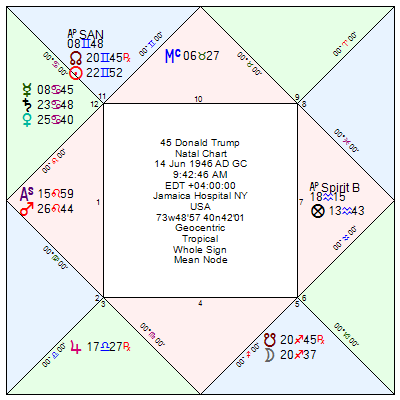
Author’s Rectification
Donald J. Trump (born 1946) is an American real-estate developer, media personality, and politician who rose to national prominence through New York real-estate projects before becoming the 45th and 47th President of the United States. Beginning in the 1970s he expanded the business empire built by his father into highly visible Manhattan properties such as Trump Tower, while cultivating a public persona centered on personal branding and aggressive deal-making. In the 2000s his celebrity expanded further through the television program The Apprentice, which reinforced his image as a decisive executive authority. Trump later carried this style into politics, winning the 2016 presidential election on a platform that rejected many conventions of diplomatic and multilateral governance. The astrological pattern in his chart points to Jupiter retrograde in Libra, a placement that in practice behaves less like Jupiter in Libra and more like Jupiter in Aries.
This inversion defines the core of Trump’s political and business persona. Jupiter in Libra normally emphasizes negotiation, diplomacy, and the balancing of competing interests. Trump instead rejects that Libran mode and operates through the Aries channel of unilateral initiative and confrontation. From his 2016 convention speech proclaiming “I alone can fix it” to his skepticism toward multilateral agreements and alliances, Trump consistently challenged the cooperative framework typically associated with Libra. Instead of mediating between parties, he asserted dominance and pushed conflicts directly into the open. Even in business his approach emphasized personal command and identity branding—Trump Tower, Trump steaks, Trump University—replacing the aesthetic collaboration typical of Libra with the bold assertion of an individual name. The result is a career in which Jupiter in Libra retrograde repeatedly expresses itself through the assertive, head-on style of Jupiter in Aries, privileging decisive action over negotiated balance.
5. O. J. Simpson. Jupiter 17SC45-retrograde. Direct Station +7 days
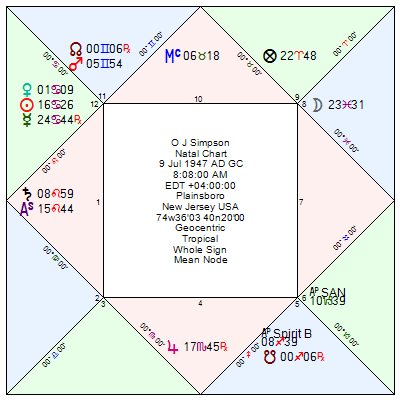
Rodden Rating AA, Quoted BC/BR
O. J. Simpson (1947-2024) was an American football star, broadcaster, and actor whose career moved from athletic fame to one of the most widely publicized legal dramas in modern American history. Rising from a difficult childhood in San Francisco, Simpson became a standout running back at the University of Southern California, winning the Heisman Trophy in 1968 before going on to a record-breaking professional career with the Buffalo Bills and San Francisco 49ers. After retiring from football he entered broadcasting and entertainment, appearing in films and national advertising campaigns while cultivating the image of a charismatic sports celebrity. That public reputation collapsed during the 1994–1995 murder trial that placed Simpson at the center of an unprecedented media spectacle, followed later by civil litigation and a prison sentence stemming from the 2007 Las Vegas robbery case. The astrological pattern in his chart points to Jupiter retrograde in Scorpio, a placement that in practice behaves more like Jupiter in Taurus.
This inversion appears clearly in the material themes that recur throughout Simpson’s later life. Jupiter in Scorpio often corresponds to strategic transformation of assets—restructuring, reinvention, and financial rebirth through crisis. Simpson’s trajectory shows the opposite tendency. Instead of converting upheaval into some new financial structure or public role, he repeatedly focused on the preservation or recovery of tangible possessions connected to his past identity. The most striking example came in the 2007 Las Vegas incident, where Simpson attempted to reclaim sports memorabilia that he believed had been taken from him—objects that represented not only financial value but the physical symbols of his athletic career. Rather than moving forward through reinvention, he attempted to repossess the artifacts of his former status. In this sense Jupiter in Scorpio retrograde manifests through the Taurus impulse to hold, reclaim, and physically possess, privileging tangible property over the transformative rebirth normally associated with Scorpio.
6. William Henry Hudson. Jupiter 10SA01-retrograde. Direct Station +3 days
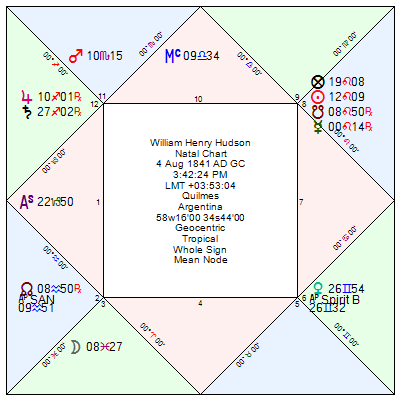
Author’s Rectification
William Henry Hudson (1841–1922) was an Argentine-born naturalist and writer who spent much of his later life in England, becoming one of the great literary interpreters of the South American landscape and its wildlife. Though widely admired today for works such as Green Mansions and A Shepherd’s Life, Hudson lived most of his life quietly and without great wealth, devoting himself to observation of nature—especially birds—and to reflective travel writing. His early years in Argentina were marked by illness and isolation, which pushed him toward solitary study of the natural world and eventually toward literature. The astrological pattern in his chart points to Jupiter retrograde in Sagittarius, a placement that in practice behaves more like Jupiter in Gemini: rather than the grand philosophical authority or institutional leadership typical of Jupiter in Sagittarius, Hudson’s Jupiter expresses itself through movement, travel, observation, and narrative curiosity.
This inversion is visible throughout Hudson’s career. Jupiter in Sagittarius would normally produce the teacher, the preacher, or the institutional philosopher—someone projecting doctrine or authority. Hudson instead rejects that Sagittarian mode and operates through the Gemini channel of wandering, describing, and reporting what he sees. His most revealing example is the novel The Purple Land, a book built not around a grand philosophical thesis but around restless travel, episodic encounters, and narrative observation across the Uruguayan countryside. The story unfolds through dialogue, shifting viewpoints, and curiosity about people and landscapes—hallmarks of Gemini rather than Sagittarius. Its publication, timed to a Jupiter direction in his life, illustrates how his Jupiter functioned not as a system-builder but as a collector and transmitter of experience. Even his naturalist writing follows this pattern: rather than presenting authoritative doctrines of nature, Hudson records conversations, journeys, bird calls, and fleeting scenes of the countryside. The result is a Jupiterian life that rejects Sagittarian proclamation in favor of Geminian narration—a philosopher not of institutions, but of movement, conversation, and the written page.
The Moment Before the Turn
Taken together, these charts suggest that retrograde Jupiter does not simply weaken the planet. Instead it often redirects its expression through the opposite sign, producing outcomes that appear inverted relative to the planet’s expected symbolism.
The final days before the direct station therefore reveal the phenomenon most clearly. As the planet slows to a standstill, the inversion reaches its greatest intensity—almost as though Jupiter is making one last argument against the sign it occupies.
Then the motion changes.
Tonight Jupiter turns direct, and the long argument between the planet and the zodiac begins to resolve itself.