

As we approach Presidents’ Day on Monday, February 16, 2026, it felt timely to pause our ongoing Jupiter/Cancer series and turn toward one of the most dramatic moments in American presidential history — the tumultuous and tragically short administration of James A. Garfield. Inspired by the 2025 Netflix limited series Death by Lightning, this post inaugurates a focused sequence of horoscopic studies on figures connected to Garfield’s rise and fall, beginning with the man who ended it: Charles J. Guiteau.
Astrologically, Guiteau’s chart encapsulates his life narrative in stark, instructive patterning. A post-Full Moon birth with a preventional Moon separating from the Sun shows early vocational striving — quests for honor through publishing, law, and religious mission — that are initiated but never sustained, leaving behind a growing core of emotional grievance. Venus as bound lord of the Sun–Mercury configuration, weakened by conjunction with the South Node, speaks to the repeated derailment of his efforts to secure recognition through legitimate channels, while Mars out of sect in Sagittarius reflects a combative orientation toward authority and debate. Saturn, in sect but domiciled in Sagittarius — the sign of its natural enemy Jupiter — reveals the difficulty Guiteau had in exercising discipline or restraint early in life, even as Saturn ultimately enfolds him in punitive resolution through isolation, trial, and execution.
Viewed through the early/late-bloomer model, Guiteau’s midpoint occurs in early 1862, just as his first earnest quests for belonging (notably at the Oneida Community) reach their culmination. Yet the full unfolding of his Moon’s configuration — the collapse of ordered vocation into resentment, the failure of Saturnian containment, the public transformation of private grievance into fatal action — clearly plays out in the second half of his life, consistent with what we would expect of a preventional, post-Full Moon native. In the posts that follow, we’ll look at how this configuration echoed across other figures in the Garfield administration, weaving celestial pattern into historical consequence.

Charles Julius Guiteau
Charles Julius Guiteau was not simply the assassin of President James A. Garfield; he was a failed striver whose life unfolded as a long, humiliating pursuit of recognition without the discipline, competence, or social grounding required to earn it. Born in 1841 in Freeport, Illinois, he lost his mother in childhood, an early rupture that left him emotionally unmoored. His relationship with his father, Luther Guiteau—a stern, religiously intense figure—was volatile and marked by recrimination and mutual disappointment. Guiteau’s most stable family bond was with his sister, Frances, who remained his primary emotional and practical support across years of instability, estrangement, and failure.
In his late teens and early twenties, Guiteau sought belonging and moral purpose at the Oneida Community in upstate New York (1860–1865), one of the best-known 19th-century American utopian communes. Oneida stood within a broader wave of idealistic communal experiments that flowered in the long 19th century—Shaker villages, Brook Farm, the Amana Colonies—rooted in religious perfectionism, social reform, and critiques of conventional marriage and property. Unlike many such communities, Oneida was tightly organized around John Humphrey Noyes’s doctrine of “Perfectionism,” with communal labor, strict moral supervision, and highly regulated social life. For Guiteau, Oneida offered exactly what he lacked: structure, belonging, and a ladder of recognition within a moral order. He failed there for the same reasons he failed everywhere else—unreliability, grandiosity, and an inability to submit to discipline. Other members found him lazy, quarrelsome, and self-dramatizing; he chafed at rules while craving status within the group. His expulsion and estrangement from Oneida proved formative: it confirmed, in his mind, not that he was unfit for communal life, but that worthy institutions unjustly rejected him.
After Oneida, Guiteau drifted through a series of half-formed ambitions—religious lecturer, writer, lawyer, political hanger-on—never sustaining success in any role. Each failure intensified his conviction that he was destined for greatness and that the world unjustly withheld the honor he believed was owed to him. His family relationships deteriorated in parallel. He quarreled bitterly with his father over money and responsibility; contemporary accounts include allegations that Guiteau took funds from his father without permission, a claim repeated by some later commentators and dramatized in recent portrayals. The historical record supports that money disputes were real and frequent; whether specific acts constituted theft or were framed that way within family conflict remains contested. What is clear is that financial dependence and resentment became another arena in which Guiteau experienced himself as wronged and misunderstood.
The political culture of patronage in the Gilded Age gave Guiteau’s fantasies a concrete structure. In the summer of 1880 he wrote, printed, and distributed a campaign speech in support of James A. Garfield (“Garfield vs. Hancock”), later inflating this trivial effort into proof that he had helped secure the election and was therefore owed a reward. After Garfield’s inauguration, Guiteau repeatedly pressed his claims on Secretary of State James G. Blaine and other officials for a diplomatic post, presenting himself as a loyal Stalwart deserving recognition. Each rebuff did not correct his self-assessment but intensified his sense of injury: he interpreted indifference as betrayal, delay as conspiracy, and ordinary political dismissal as moral treachery. As the months passed without appointment, these slights accumulated into a fixed grievance narrative in which personal failure was transmuted into righteous resentment, laying the emotional groundwork for his later claim that violent action would “set things right.”
Guiteau’s religiosity did not restrain his resentments; it transfigured them. Humiliation became persecution, and grievance became destiny. By the time he resolved to shoot Garfield in July 1881, Guiteau believed he was not committing murder but performing a divinely sanctioned act that would elevate him into historical significance and secure reward from the victorious faction.
Guiteau’s assassination of Garfield was therefore less an act of personal hatred than a bid for historical recognition—an attempt to force the world to acknowledge him as a consequential agent in national affairs. His subsequent courtroom theatrics and claims of divine mandate reveal a man who experienced notoriety as the fulfillment of a long-frustrated hunger for importance. Executed in 1882, Guiteau stands as a warning figure: a grandiose striver who could not tolerate insignificance, whose failures in family, communal life, and work were converted—through entitlement and religious delusion—into a catastrophic demand to be seen.
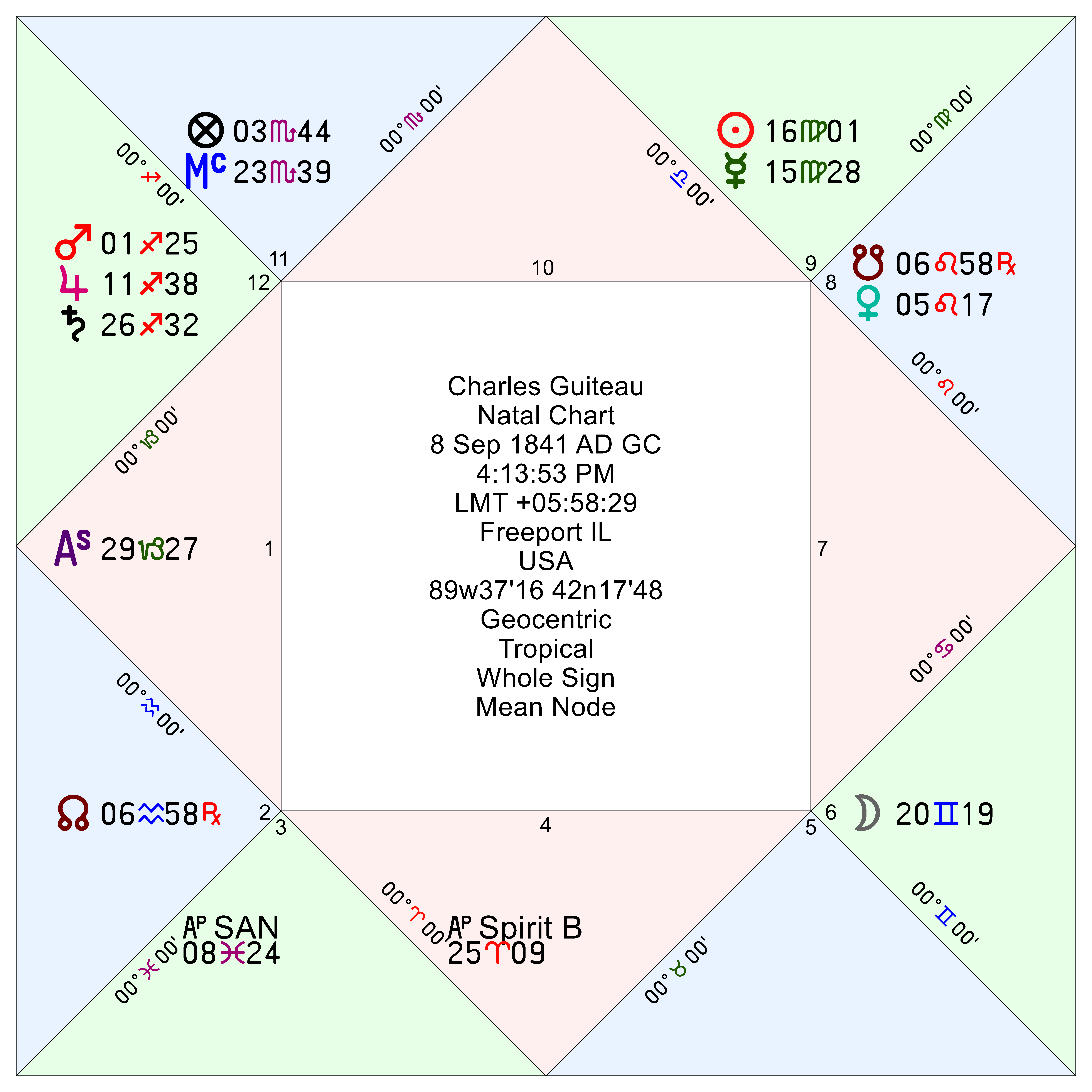
No Astrodatabank Record
Proposed Rectification: 4:13:53 PM, ASC 29CP27’18”
Complete biographical chronology, rectification and time lord studies available in Excel format as a paid subscriber benefit.
The analytical models used in the sections below are part of a larger research program developed across longer white papers and case studies, where the historical sources, rules, and testing methodology are laid out in full. These database entries show the models in practice; readers who want the theoretical foundations can start with the background papers below:
Soul Hub (white paper, Victor model statistical tests, Moon’s Configuration studies)
Physiognomy Hub (white paper, examples)
Victor Model Factors favoring Mercury/Virgo and Venus/Leo as joint victors
· Mercury: Sign ruler of Sun and Moon
· Mercury: In its own sign of rulership and exaltation
· Venus: Mercury is in Venus’ bounds
· Venus: Bound ruler of Sun and Prenatal Syzygy
Physiognomy Model factors favoring Capricorn
Photo evidence is minimal but shape of face is broadly consistent with the ovate of Capricorn, the rising sign. Mercury as ruler of the rising decan – difficult to judge as whether facial features are drawn.
Moon’s Configuration
Phase I — Moon separating from the Sun (Virgo; 8th/9th houses QS/WS)
Delineation. The Moon separating from the Sun describes Guiteau moving away from solar authority and vocation. With the Sun in Virgo, ruled by Mercury, this phase centers on the pursuit of competence across multiple domains — a “jack of all trades” impulse directed toward 9th-house affairs: publishing, lecturing, religion, and the law. These are arenas of doctrine, legitimacy, and sanctioned authority. Yet both Mercury and the Sun fall in the bound of Venus in Leo, folding themes of honor, recognition, and entitlement into Guiteau’s vocational striving. Leo here signifies not mere pleasure but claims to dignity and royal favor — the wish to be seen, elevated, and rewarded by authority. As the bound lord of the Sun–Mercury conjunction, Venus governs how these vocational and doctrinal pursuits are received and rewarded; Venus conjunct the South Node weakens this channel of reception and benefit, contributing to repeated frustration, loss of favor, and the collapse of Guiteau’s attempts to secure honor through lawful careers. The Sun/Moon conjunction in Virgo therefore describes a life attempt to secure honorable standing through learned or professional routes that promise public validation, while the separating motion indicates that these paths do not hold: the native leaves behind lawful, doctrinal, and professional means of securing honor.
Biographical match. Guiteau’s early adult life follows this pattern with unusual clarity. He repeatedly pursued 9th-house vocations without the discipline required to sustain them: religious lecturing, writing, publishing pamphlets, and studying law. Each effort was framed by him as a legitimate path to honor and standing, yet each ended in failure and rejection. His time at the Oneida Community, his later attempts at preaching and authorship, and his brief, ineffectual foray into law all belong to this solar phase: efforts to secure dignified status through recognized avenues of authority and doctrine. The separating Moon marks his abandonment of these legitimate routes after repeated humiliation. What is left behind is not merely work, but the possibility of earning honor through lawful means.
Phase II — Moon applying to Saturn (Sagittarius; 11th/12th houses QS/WS)
Delineation. The Moon’s application to Saturn in Sagittarius describes the consolidation of grievance and the movement toward loss, exclusion, and punishment. Saturn in Sagittarius signifies doctrinal rigidity, moral certainty, and punitive judgment attached to beliefs and higher meaning. In the 11th house, Saturn denies benefit from political organizations, patrons, and professional income; in the 12th, Saturn brings confinement, arrest, enemies, and ultimate destruction. The Moon’s application indicates that the emotional life becomes oriented toward Saturnian outcomes: bitterness, persecution narratives, isolation from collective bodies, and eventual subjection to the coercive power of the state. What could not be achieved through lawful authority (Sun/Mercury in Virgo, bound of Venus/Leo, weakened by Venus conjunct the South Node) is replaced by punitive confrontation with authority.
Biographical match. Guiteau’s later life is defined by precisely these losses. He fails to secure standing within political organizations and patronage networks (11th house), repeatedly rebuffed by Blaine and others, excluded from the benefits of party affiliation, and denied professional income. These rejections do not dissolve his claims to honor; they harden them into grievance. Saturn in Sagittarius gives his resentment a moral and quasi-religious framing: he interprets exclusion as persecution and elevates his personal failures into a cosmic injustice. The Moon’s application culminates in 12th-house outcomes: arrest, imprisonment, trial, and execution. The configuration shows not merely punishment after the fact, but a life trajectory in which emotional investment migrates from failed legitimacy to Saturnian confinement and destruction.
Interpretive Summary
Guiteau’s Moon configuration describes a life that begins with attempts to secure honor through legitimate doctrinal and vocational routes (Sun–Mercury in Virgo), colored by entitlement to recognition (bound of Venus in Leo) but structurally weakened by Venus conjunct the South Node, which deprives those efforts of durable favor and reward. As the Moon separates from the Sun, repeated failure in 9th-house pursuits—religion, publishing, law—marks the abandonment of lawful avenues to dignity, leaving grievance in their wake. The Moon’s subsequent application to Saturn in Sagittarius then carries that grievance into loss of standing within political organizations and professional networks (11th house) and finally into confinement and destruction at the hands of punitive authority (12th house). The configuration does not show a redemption arc but a hardening trajectory: frustrated claims to honor are converted into moralized resentment, culminating in exclusion, punishment, and death.
Influence of Sect
Guiteau’s horoscope is diurnal, placing both Mars and Venus out of sect and Jupiter and Saturn in sect. Mars in Sagittarius out of sect coheres with his documented quarrelsomeness and eventual violence, while Venus in Leo out of sect describes a distorted, socially misaligned hunger for honor and political favor. Saturn, though the in-sect malefic, is placed in Sagittarius, the domicile of his enemy Jupiter, where Saturn has intrinsic difficulty exercising command, discipline, and restraint; in a diurnal chart this weakness does not remove Saturn’s power to punish, but blunts Saturn’s capacity to regulate and contain disorder early. Instead of institutional containment through medical sequestration, Saturn allows Guiteau to circulate within political and religious spaces while unstable, failing to discipline belief or grandiosity until catastrophe forces the state’s hand. Saturn ultimately asserts itself through trial, imprisonment, and execution, but only after the failure of preventive authority. Jupiter in Sagittarius in sect situates Guiteau within the dominant ideological and political order of his time, giving him proximity to power without competence and helping explain why his delusions took the form of moralized entitlement within mainstream institutions rather than fringe radicalism.
Early/Late Bloomer Model
Guiteau lived 40 years, 9 months, 22 days (born September 8, 1841; died June 30, 1882), giving a lifespan midpoint of February 2, 1862 (age 20 years, 4 months, 25 days). Tested against the early/late-bloomer model for a post–Full Moon (preventional) birth, his major life themes do in fact concentrate in the second half after that midpoint: while he is already at Oneida by the early 1860s (he joined in 1860, and the midpoint falls during that tenure), the truly defining pattern—serial vocational failure, swelling entitlement, political fixation, and catastrophic confrontation with authority—unfolds after 1862 as he drifts through aborted careers (religious lecturing, writing/publishing, law), then converts politics into his main theater of “honor,” culminating in the summer 1880 pro-Garfield speech/pamphlet episode, the escalating job-seeking resentments in 1881, the shooting on July 2, 1881, and the terminal Saturnian sequence of arrest → trial → execution (June 30, 1882). In other words, the seed of the themes is visible before the midpoint (especially the failed attempt at belonging and recognition within an idealistic community), but the full expression and public crystallization of those themes—status-claims, grievance, and punishment—lands overwhelmingly after February 2, 1862, which is broadly consistent with the late-bloomer expectation for a preventional/full-moon-born life arc.
AI Notice: This post created with assistance from ChatGPT.