

The next figure in this Federal Reserve series brings into focus one contest that defined the New Deal years: the struggle between Henry Morgenthau Jr. and Marriner Eccles over the direction of American economic policy. From 1933 to 1940, the balance of power was unsettled. Eccles, operating through the Federal Reserve, argued for sustained deficit spending to revive demand, while Morgenthau, at the Treasury, remained wary of open-ended fiscal expansion and the long-term consequences of government debt. The debate was not merely technical—it reflected competing visions of how recovery should occur. Yet once the United States entered World War II, the terms of that debate shifted decisively. The demands of war finance—especially the need to raise capital at scale through bond issuance—moved authority toward the Treasury, and Morgenthau’s model of organized, participatory finance came to dominate the wartime economy.
This historical sequence aligns closely with the structure of Morgenthau’s horoscope, where a Jupiter–Saturn opposition governs the flow of events. The Moon’s configuration captures this movement with unusual clarity: first applying to Saturn, then to Jupiter. The initial phase corresponds to systemic breakdown—the failure of financial structures and the exposure of accounting limits—while the second phase signals the expansion of credit and the mobilization of collective resources. The timing reinforces the pattern. Morgenthau’s major Saturn period begins on 11-May-1931, the exact date of the collapse of Credit Anstalt, which marked the international spread of the Great Depression. Eleven years later, his major Jupiter period begins on 11-May-1942, just twelve days after the wartime low in the Dow Jones Industrial Average on 29-Apr-1942 and only months before the first major war loan drive on 30-Nov-1942. The sequence is precise: breakdown under Saturn, followed by stabilization and expansion under Jupiter.
The same opposition appears in a modern context during the European sovereign debt crisis of April/May 2010, when Jupiter in Pisces opposed Saturn in Virgo (retrograde). There, as in Morgenthau’s era, the limits of financial discipline were exposed—EU-imposed debt covenants proved unworkable under pressure, and the system could not sustain contraction without risking collapse. The response was not a pure enforcement of Saturnian limits, but a shift toward Jupiterian expansion, as European authorities organized collective debt mechanisms to stabilize the system. The parallel is striking. In both cases, Saturn reveals the failure of existing debt covenants and enforcement structures, and Jupiter provides the means of continuation through expanded credit. The differences are equally instructive: the 2010 episode unfolded rapidly and was narrowly targeted at specific sovereigns, while the crisis of the 1930s extended over a decade and culminated in a global reorganization of finance through wartime mobilization.
For Morgenthau, this was not an abstract cycle but the arc of his career. The Saturn period from 1931 to 1942 corresponds to crisis, constraint, and contested policy, including his opposition to Eccles and the economic contraction of 1937–1938 sometimes referred to as the Roosevelt recession. The Jupiter period that follows marks his transformation into the central figure of wartime finance, overseeing a system in which debt was no longer merely issued but collectively embraced through war bonds and national participation. That Jupiterian theme did not end with the war. After leaving the administration, Morgenthau carried the same model into his leadership of Jewish philanthropic and fundraising efforts, most notably through the United Jewish Appeal and the Israel Bond program. The opposition of Jupiter and Saturn thus defines not only the economic history of the period, but the rhythm of Morgenthau’s life itself: from breakdown to expansion, from constraint to mobilization, and from national crisis to collective response.
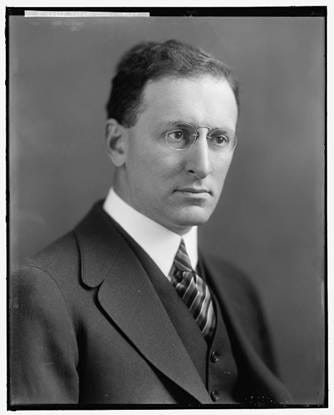
Henry Morgenthau Jr. (1891–1967) served as U.S. Secretary of the Treasury from 1934 to 1945 under Franklin D. Roosevelt, overseeing federal finance during both the New Deal and the Second World War. His tenure bridged the gap between the early, still-developing Federal Reserve system and the fully integrated fiscal–monetary coordination that emerged under wartime conditions, with a particular emphasis on mobilizing capital at a national scale.
Born on May 11, 1891, in New York City, Morgenthau was the son of Henry Morgenthau Sr., a prominent diplomat and businessman. Educated at Cornell University in agriculture rather than finance, he pursued a career as a gentleman farmer in the Hudson Valley. This background shaped his administrative style—practical, methodical, and rooted more in management than in economic theory.
Morgenthau’s rise to national office came through his personal relationship with Roosevelt. The two men became close in the 1920s as neighboring landowners, and when Roosevelt became governor of New York, Morgenthau entered state government, first in agricultural advisory roles and later as head of the State Conservation Department. After Roosevelt’s election to the presidency in 1932, Morgenthau followed him to Washington, initially as head of the Farm Credit Administration and then as Undersecretary of the Treasury. In 1934, following the death of William H. Woodin, Roosevelt appointed him Treasury Secretary.
During the New Deal years, Morgenthau occupied a central but often contested position within Roosevelt’s economic team. He was instinctively committed to balanced budgets and fiscal restraint, a stance that frequently brought him into conflict with more expansionary policymakers, most notably Marriner Eccles. Eccles argued for sustained deficit spending to stimulate demand, while Morgenthau emphasized long-term fiscal stability and caution in the use of public borrowing. Despite these reservations, he presided over a period of significant fiscal expansion as New Deal programs required increased federal spending and helped stabilize monetary conditions following the abandonment of the gold standard.
Morgenthau’s importance reached its height during World War II, when he directed the largest financial mobilization in American history. Under his leadership, the Treasury financed the war through a combination of taxation, borrowing, and mass public participation, most visibly through the war bond program. These campaigns transformed government finance into a nationwide fundraising effort, drawing millions of Americans into the direct support of the war through savings bonds marketed as both patriotic duty and personal investment. Morgenthau oversaw a system in which public confidence, messaging, and participation were as important as fiscal mechanics, making the Treasury not just a financial institution but a national fundraising apparatus.
At the same time, Morgenthau’s Treasury became involved in humanitarian and refugee policy, particularly as reports of Nazi persecution intensified. He played a central role in advancing the creation of the War Refugee Board in 1944, which coordinated efforts to provide relief to Jews and other victims of Nazi rule. Operating within the Treasury Department, this initiative reflected Morgenthau’s willingness to extend the department’s reach beyond finance into organized relief and international assistance, linking fiscal authority with humanitarian objectives.
In 1944, Morgenthau advanced what became known as the Morgenthau Plan, a proposal to deindustrialize Germany in order to prevent future military aggression. Although the plan was not implemented, it generated significant controversy and remains one of the most debated aspects of his career.
Morgenthau resigned as Treasury Secretary in 1945 shortly after the end of the war. In retirement, he extended the same organizational and fundraising skills into Jewish philanthropic work and international relief efforts. He became General Chairman of the United Jewish Appeal in 1947, helping to lead large-scale fundraising campaigns for displaced persons in Europe, and later chaired the American Financial and Development Corporation for Israel, which launched the Israel Bond program in 1951. These initiatives continued his lifelong pattern of mobilizing capital for collective purposes, now directed toward humanitarian relief and the economic development of the newly established State of Israel.
Morgenthau’s career reflects a distinctive role in American financial history. He was neither a theoretical architect like Paul Warburg nor a political strategist in the mold of Carter Glass. Instead, he functioned as a trusted administrator and organizer of capital, capable of translating national and international objectives into large-scale financial participation, whether through wartime bond drives or postwar philanthropic campaigns.
Subscribe for presentation of the horoscope and a discussion on the victor, physiognomy, the Moon’s Configuration, influence of sect, and the early/late bloomer model.
Complete biographical chronology, rectification and time lord studies available in Excel format as a paid subscriber benefit.