

Over the past several months I have been tracking the Jupiter in Cancer series—horoscopes shaped by Jupiter’s changing solar phase rather than by sign alone. James Dean was born just over a month after Jupiter’s acronychal rising, when the planet had briefly flared into evening visibility and then quickly began to lose light. That moment of prominence had already passed. What remains is Jupiter in Cancer retrograde functioning as Jupiter in Capricorn: care gives way to necessity, protection to ambition, and belonging to achievement earned without shelter. In this solar phase, Jupiter no longer nourishes; it accelerates. For Dean, advancement did not come through patronage or emotional support but through exposure, discipline, and speed, a pattern reinforced by Zodiacal Releasing, where Capricorn—the 10th from the Lot of Fortune and a house crowded with planets—coincides with his discovery by Elia Kazan and the making of his defining films. A close parallel can be seen in Jimi Hendrix, whose Jupiter in Cancer retrograde likewise reflects early deprivation and a career that unfolds with unusual compression. Like Hendrix, who suffered from a lack of consistent childhood care and comfort, Dean experienced something similar: the death of his mother at age four removed his primary source of emotional support, after which he was sent away to live with relatives while his father remained emotionally distant. Jupiter is not the victor in Dean’s chart, but it unmistakably accelerates the arc of his career, in a way that closely parallels the rapid, unsheltered rise of Hendrix.
If Jupiter explains the speed of the rise, Mars explains its meaning. Mars, retrograde in Leo and functioning as Mars in Aquarius, stands as the victor of the horoscope and the final recipient of the Moon’s application – a different by only one minute of degree. In the Moon’s configuration, emotional life separates from Venus—relationships and domestic containment fall away—and applies to Mars, committing identity to action, defiance, and risk. This logic is dramatized in Rebel Without a Cause: Jim Stark is not rebelling for a program or ideology, but reacting against hollow authority, confused moral instruction, and rules enforced without protection or coherence—his father’s helplessness, the police station’s moral vacuum, and adult institutions that demand obedience without offering guidance. Mars as victor explains why Dean’s rebellion is not rhetorical but embodied, enacted through speed, confrontation, and refusal to settle. Jupiter may have hastened the ascent, but Mars determined the outcome: a life oriented toward impact rather than duration, and a legacy forged through intensity rather than consolidation.

James Dean (1931–1955) was an American actor whose short, accelerated career reshaped postwar cinema and crystallized a new image of youthful rebellion that proved far larger than his body of work. Born in Marion, Indiana, Dean lost his mother at age four, a formative rupture that removed his primary source of emotional encouragement and artistic support. After her death he was sent to live with relatives on a farm in Fairmount, Indiana, while his father remained emotionally distant, a childhood pattern marked by discipline without nurture and responsibility without protection. From an early age Dean showed intense ambition and self-direction, gravitating toward music, theater, and performance as outlets for identity rather than comfort.
In his late teens and early twenties, Dean pursued acting with a strikingly unsheltered determination. He left UCLA against advice, moved to New York with little money, and immersed himself in the Actors Studio, submitting himself to the demanding discipline of Lee Strasberg and method acting. His approach was notably direct and ambitious: rather than cultivating social ease or patronage, Dean placed himself repeatedly before authority figures, seeking validation through mastery rather than affiliation. This strategy culminated when Elia Kazan recognized his intensity and cast him in East of Eden (1955), a role that announced Dean as a new kind of screen presence—raw, conflicted, and emotionally exposed.
Within a compressed span of roughly eighteen months, Dean completed East of Eden, Rebel Without a Cause, and Giant, three films that collectively defined his legacy. His performances gave form to postwar generational tension: resistance to authority without ideology, emotional volatility without clear resolution, and ambition stripped of traditional supports. Offscreen, this same acceleration expressed itself through risk and speed. As fame arrived, Dean became deeply involved in racing culture, identifying publicly with fast cars and competitive danger. On September 21, 1955, he purchased a Porsche 550 Spyder—quickly nicknamed “Little Bastard”—and drove it aggressively despite warnings, treating speed as an extension of identity rather than recreation.
Dean was killed nine days later, on September 30, 1955, in a collision while driving to a race in Salinas, California. He was 24 years old. His death fixed his image permanently in the cultural imagination, transforming a rapidly rising actor into a generational symbol. Unlike figures whose legacies unfold over decades, Dean’s impact derives from compression: ambition without shelter, recognition without consolidation, and intensity without duration. His life reads not as an interrupted career but as one that reached its defining expression at speed, leaving behind a legacy shaped as much by urgency and risk as by artistic achievement.
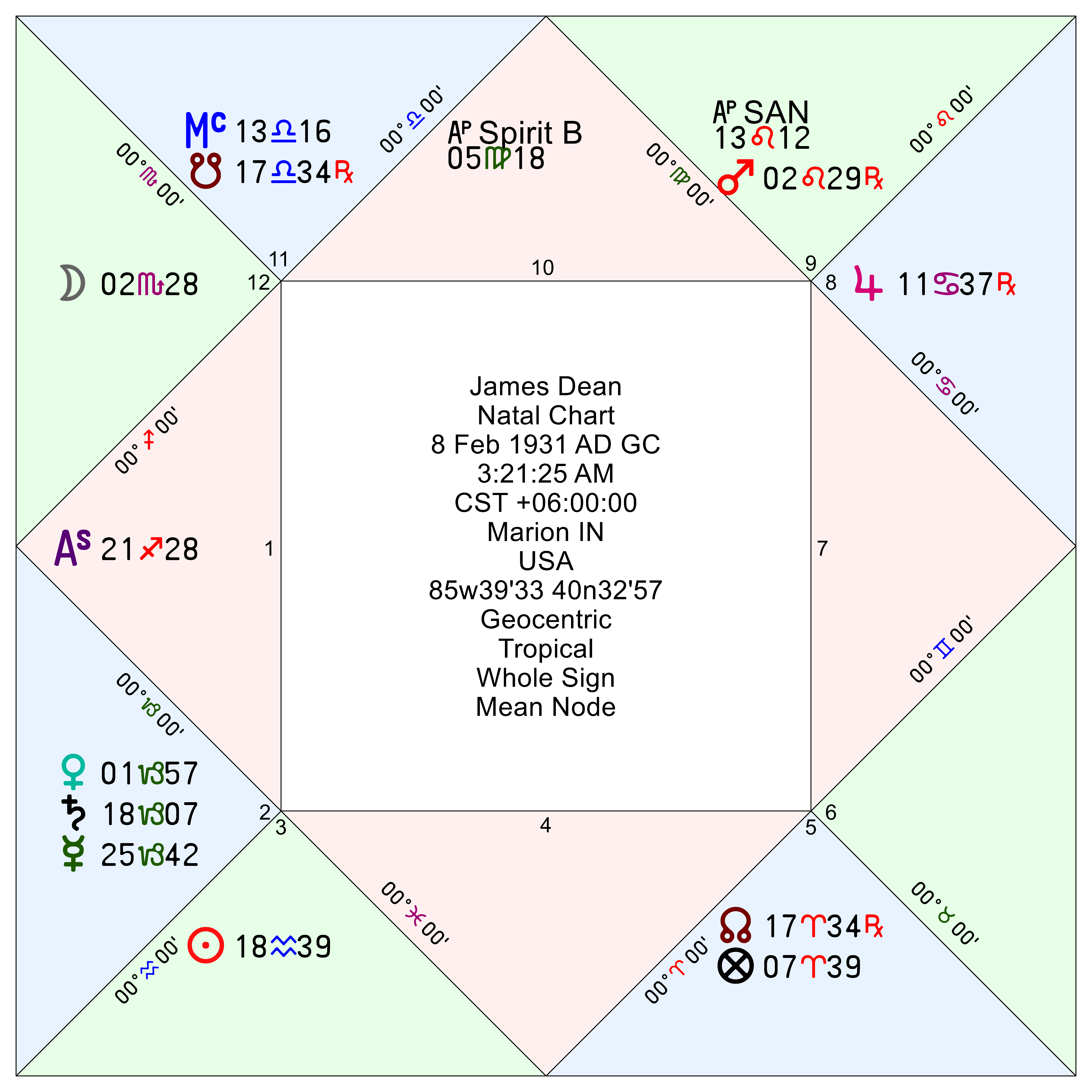
Rodden Rating AA, BC/BR in hand, 9:00 AM, ASC 12AR13. Also lists 2:00 AM
Proposed rectification: 3:21:24 AM, ASC 21SA28’58”
The analytical models used in the sections below are part of a larger research program developed across longer white papers and case studies, where the historical sources, rules, and testing methodology are laid out in full. These database entries show the models in practice; readers who want the theoretical foundations can start with the background papers below:
Rectification Hub (I wrote the book on it!)
Soul Hub (white paper, Victor model statistical tests, Moon’s Configuration studies)
Physiognomy Hub (white paper, examples)
Victor model factors favoring Mars/Leo-retrograde
• Sign ruler: Moon, Lot of Fortune
• Bound ruler: Moon
Mars in Leo, retrograde and victor of the horoscope, describes a life defined by conflict with established authority and the desire to challenge accepted social norms. Under the retrograde doctrine employed in this study, Mars in Leo functions much like Mars in Aquarius, directing its combative energies against existing structures rather than seeking a place within them. This symbolism is reflected with unusual clarity in Dean’s most famous role, Rebel Without a Cause, where youthful defiance becomes an end in itself rather than a vehicle for any coherent political or social program. Dean’s brief career transformed him into the embodiment of postwar dissatisfaction with convention, hierarchy, and expectation. Yet this Mars occupies the 8th house by quadrant houses, the place the ancients associated with decline and mortality, while also appearing in the 9th house by whole-sign reckoning, a domain concerned with ideology, belief, and the formation of cultural myths. The result is a figure whose challenge to authority transcended the particulars of his life and entered the realm of collective symbolism. More than seventy years after his death, Dean remains remembered less as a working actor than as a permanent cultural archetype of youthful rebellion, independence, and resistance to the established order.
Physiognomy model factors favoring Leo, Aquarius
Rising sign = Sagittarius
Ruler of rising sign = Jupiter/Cancer-retrograde
Rising decan = Leo
Ruler of rising decan = Sun/Aquarius
Planets in sign of rising decan = Mars/Leo-retrograde
James Dean possessed a lean, athletic build standing approximately 5 feet 8 inches tall. His physique was wiry rather than heavily muscled, contributing to the restless energy that characterized both his screen presence and public image. The face is distinctly rectangular, with broad cheekbones and a strong lower jaw that forms a firm base to the facial structure. The forehead is broad and flat, the nose straight, and the eyes set deeply beneath a pronounced brow. Particularly notable is the hairstyle, typically swept upward into a pompadour that increased the apparent height of the head and drew attention to the upper portion of the face. The overall effect is one of strength, tension, and youthful intensity rather than softness or refinement.
The physiognomy is best explained through a combination of Leo and Aquarius. Leo, the rising decan, contributes the rectangular facial structure, prominent lower jaw, dramatic self-presentation, and characteristic pompadour hairstyle. According to my research, hair swept upward from the forehead is a recurring Leonine marker, directing attention toward the head in a manner reminiscent of the Sun’s rays. Aquarius enters through the Sun in Aquarius, ruler of the rising decan. This influence is especially visible in the forehead, which assumes a broad rectangular shape resembling the blade of a bulldozer, a feature repeatedly observed in Aquarius physiognomy. The combination produces a face that is simultaneously commanding and unconventional. Leo supplies charisma and visibility, while Aquarius introduces an element of nonconformity and detachment from social expectations. Together these signatures create the appearance of a charismatic outsider, a fitting image for the cultural role Dean would eventually occupy.
Moon’s Configuration
Phase I — Moon Separating from Venus
Delineation. The Moon separating from Venus indicates that union, affection, and relational ease are encountered early but cannot serve as the Moon’s destination. Venus signifies women, attraction, and the possibility of stabilization through relationship; separation shows these themes are already present yet receding. In a nocturnal chart Venus is in sect and effective for visibility and charm, but separation denies consolidation. The emotional life experiences Venus and then moves on, without promise of continuity.
Biographical Match. James Dean’s relationships with women repeatedly follow this separating pattern. His most serious attachment, with Pier Angeli (1954–1955), was genuine and publicly acknowledged but broken by external pressures and never formalized. Two additional relationships reinforce the same geometry: an earlier New York relationship with Liz Sheridan, which dissolved as Dean’s ambitions intensified, and a brief Hollywood affair with Ursula Andress in 1955 that ended without continuation. In each case, Venus appears, matters, and then falls behind the Moon’s motion—clear biographical evidence of separation rather than fulfillment through Venus.
Phase II — Moon Applying to Mars
Delineation. The Moon applying to Mars shows the emotional life moving decisively toward action, risk, and confrontation. In Scorpio, the Moon seeks intensity and exposure; application signifies commitment rather than avoidance. The near-exactness of the application (about one minute of degree) removes mediation: impulse passes directly into action. In a nocturnal chart Mars is in sect and therefore effective. The Moon does not temper Mars; it delivers itself to Mars.
Biographical Match. As Venus recedes, Dean’s life accelerates toward Mars through speed and danger. In 1954–1955 he became increasingly immersed in racing culture, participating in competitive events and identifying publicly with fast cars and risk-taking. On 21-Sep-1955, he purchased a Porsche 550 Spyder, immediately nicknamed “Little Bastard,” and began driving it aggressively despite warnings. Nine days later, on 30-Sep-1955, while driving to a race at Salinas, he was killed in a collision near Cholame, California. The sequence is exact: relationships recede, risk advances, and the Moon’s application completes itself without delay.
Mars as Victor of the Horoscope. Mars at 2°29′ Leo, retrograde, functions as the victor and ruler of the Moon. Under the rule that retrograde planets act as though in the opposite sign, Mars Leo retrograde behaves as Mars Aquarius: rebellion against rules and limits themselves rather than a specific grievance. As victor, Mars governs the life’s outcome—speed, confrontation, and defiance—while Venus, though encountered, cannot retain authority. The Moon’s near-exact delivery into Mars marks a life oriented toward impact rather than duration, with Mars—not Venus—receiving the final say.
Interpretive Summary
James Dean’s Moon describes a life that moves away from relational containment and decisively toward action, danger, and public confrontation. Separation from Venus shows that affection, women, and social charm were present and real, yet incapable of stabilizing the life, while the Moon’s near-exact application to Mars delivers emotional vitality directly into speed, risk, and defiance. With Mars functioning as the victor of the horoscope, the sequence does not promise duration or consolidation but impact and visibility, a life designed to register intensely rather than endure quietly. Because the configuration operates in a nocturnal chart with all principal planets in sect, its effects unfold openly and are received collectively, allowing private impulse to become public symbol. Dean’s legacy, therefore, is not the tragedy of an interrupted career but the completion of a configuration whose meaning lies in how fully—and how briefly—it was lived.
Influence of Sect
Because this is a nocturnal chart, the Moon—the primary actor in the configuration—is in sect, allowing the Moon’s sequence to operate cleanly, decisively, and with real-world effect rather than confusion or inhibition. Venus and Mars, as the nocturnal benefic and malefic respectively, are likewise in sect, meaning both attraction (Venus) and danger and action (Mars) manifest concretely rather than symbolically. Sect therefore does not soften the configuration; it permits it to work. Venus is effective enough to produce real relationships and public charm, but not strong enough to retain the Moon once separation occurs, while Mars, being in sect, receives the Moon with full force and translates emotional momentum directly into action, speed, and risk. In sect, planets also exert greater influence within the collective sphere, acting in ways society is prepared to recognize and absorb rather than marginalize. In the case of James Dean, this helps explain why a brief life produced an outsized cultural imprint: the Moon’s configuration was not only operative, but socially transmissible, allowing Dean’s rebellion and fatal intensity to register across society rather than remain confined to his private circumstances.
Early/Late Bloomer Thesis
James Dean’s horoscope supports the early–late bloomer thesis when evaluated against his actual lived lifespan. Born on 8-Feb-1931 and killed on 30-Sep-1955, Dean lived approximately 24.6 years, placing the midpoint of his life around age 12, in the spring of 1943. Because he was born after a Full Moon, he belongs to the waning Moon cohort, which under the thesis predicts later emergence relative to the life actually lived. Dean’s biography conforms precisely to this expectation: there is no precocious public development before the midpoint, while his defining achievements—East of Eden, Rebel Without a Cause, and Giant—occur almost entirely in the final years of his life, with his cultural impact concentrated near its end. Measured correctly, Dean is therefore not an early phenomenon but a clear late bloomer, whose significance arrives after the midpoint and is compressed into a brief, terminal culmination rather than distributed evenly across the lifespan.
AI Notice: This post created with assistance from ChatGPT.
Complete biographical chronology, rectification and time lord studies available in Excel format as a paid subscriber benefit. Files are behind the paywall.