

Another week, another humorist. This time James Thurber, known for comic stories and drawings for the New Yorker magazine from 1927 to his death in 1961.
James Thurber’s most famous creation, Walter Mitty, is the timid, middle-aged man who escapes the irritations of daily life through heroic daydreams—pilot, surgeon, assassin, lover—only to be jolted back to reality by a nagging voice or trivial errand. The humor rests on this sharp contrast between vast interior possibility and the cramped ordinariness of modern life. Thurber’s best work turns that tension into comedy: imagination swelling beyond its confines, then collapsing under the weight of everyday obligations.
This same dynamic appears vividly in Thurber’s drawings, which are as emblematic of his style as his prose. Mercury in Sagittarius gives the images their loose, elastic, seemingly spontaneous line—figures that look tossed off yet feel psychologically precise. Everyday objects swell, distort, or turn threatening, as if the physical world were responding to the pressure of an overactive imagination. That distortion is Jupiter inflating meaning, while Saturn—present through Jupiter’s Capricornized condition—prevents refinement or structural solidity. The drawings become dreamlike, fragile expansions of the mind, perfectly matching the theme of inner worlds that cannot fully stabilize in external reality.
Astrologically, this is the signature of Mercury in Sagittarius ruled by Jupiter in Cancer retrograde, a placement that functions much like Jupiter in Capricorn. Mercury in Sagittarius favors exaggeration, projection, and tall-tale thinking; it leaps into symbolism rather than literal detail. Yet its ruler must operate within Saturn’s domain, where authority and coherence must be earned through slow construction and careful proof. Jupiter wants swift expansion; Saturn demands earned structure. In Thurber, the outcome is classic: expansive inner narratives repeatedly checked by firm external limits. “The Secret Life of Walter Mitty” is Mercury inventing meaning while Jupiter strains toward authority—only for Saturn to insist on reality’s constraints.
A comparison with Thomas Chatterton shows the same planetary mechanism operating at a different scale. Chatterton’s Rowley forgeries reveal Mercury in Sagittarius outwardly inventing fictive medieval authorship, offering instant tradition without Saturn’s long formation. His Jupiter-in-Cancer-retrograde acts like Jupiter in Capricorn: it imitates antiquity, solidity, and lineage but without the Saturnian labor behind it. When antiquarians applied scrutiny, the illusion collapsed. Thurber’s fantasies are playful rather than fraudulent, but the structural logic is similar: imaginative inflation that cannot withstand Saturn’s audit—only in Thurber the collapse becomes comic deflation instead of tragedy.
Mark Twain, by contrast, had Mercury in Scorpio conjunct Saturn, giving him a sharper, more investigative, and morally cutting voice—true satire rather than Thurber’s surreal whimsy. But Twain shared the same Jupiter condition: Jupiter in Cancer retrograde functioning like Jupiter in Capricorn. This produced the familiar cycle of speculative ventures, technological bets, and Gilded Age shortcuts—attempts to leap to financial or social solidity without the slow climb Saturn requires. When tested, these Jupiterian accelerations faltered, just as Chatterton’s medieval edifice did and just as Thurber’s daydreams do in miniature. The expression differs—tragic for Chatterton, economic for Twain, comic for Thurber—but the planetary pressure is consistent.
Seen in this light, the unifying theme among Chatterton, Twain, and Thurber is not Mercury, since each writer’s Mercury produces a distinct narrative voice, but Jupiter in Cancer retrograde behaving like Jupiter in Capricorn. In all three horoscopes, Jupiter promises expansion, authority, or meaning but must operate under Saturn’s demand for structure, patience, and verifiable solidity. Jupiter reaches for the summit; Saturn insists on the climb. Chatterton reaches for instant antiquity, Twain for instant financial stability, Thurber for instant heroic identity—each attempting shortcuts on Saturn’s mountain. Eventually Saturn calls for verification, and the inflation deflates.
This pattern is astrologically resonant again now, wtih Jupiter in Cancer retrograde since November 11. It has been a period when Jupiterian promise is filtered through Saturnian obligation: the allure of safety, tradition, or prestige pursued in ways that risk bypassing Saturn’s slow disciplines. For some, this may bring renewed overreach or nostalgic projection; for others, a clarifying moment when Jupiter’s big vision finally aligns with Saturn’s structural demands—and the work that must accompany them.
James Grover Thurber was born on December 8, 1894 in Columbus, Ohio, into a theatrically inclined family whose domestic dynamics later supplied the raw material for many of his finest stories. His father, a frustrated actor turned civil servant, and his imaginative, high-strung mother created a household where exaggeration and comic invention were part of daily life. When Thurber was seven, during the family’s summer stay in Falls Church, Virginia, a childhood game of William Tell turned disastrous. His brother William accidentally shot him in the left eye with an arrow in August 1902, an injury that permanently blinded that eye and led to progressive deterioration of the other. This trauma became the defining physical fact of his life. His compromised depth perception excluded him from many typical boyhood activities, and he spent long hours indoors, nurturing the inner imaginative world that would become his literary signature.
Thurber’s eyesight problems worsened over the years. Several surgeries—particularly those attempted in the 1920s and 1930s—failed to arrest the decline and sometimes accelerated it. Vision impairment affected his self-confidence, prevented him from completing his degree at Ohio State University, and led to repeated episodes of depression and introspection. Paradoxically, it also helped create the distinctive look of his cartoons: the shaky line, the simplified silhouettes, and the spontaneous, almost subconscious quality that made them instantly recognizable. E. B. White is said to have salvaged one of Thurber’s casual doodles from a wastebasket, convincing Harold Ross to publish it—an act that launched Thurber’s parallel career as a cartoonist. His partial blindness contributed intimately to the dreamlike atmosphere of his stories, where ordinary objects take on menacing or absurd life and domestic spaces dissolve into psychological landscapes.
After early work as a reporter in Columbus and later in Paris, Thurber joined The New Yorker in 1927, where he quickly became one of the magazine’s defining voices. His partnership with E. B. White refined the understated, ironic, and urban humor that came to characterize the publication. Thurber’s prose—by turns deadpan, surreal, and gently melancholic—found expression in books such as My Life and Hard Times (1933), The Middle-Aged Man on the Flying Trapeze (1935), and Let Your Mind Alone! (1937). His most famous story, “The Secret Life of Walter Mitty” (1939), distilled his lifelong theme: the tension between the vivid inner world and the disappointments of external reality.
Despite critical success, Thurber’s health declined in the 1940s and 1950s. Repeated operations to save his remaining sight failed; by the mid-1950s he was nearly completely blind. He adapted by dictating his stories, essays, and plays to assistants and family members. His humor began to darken. The gentle absurdities of earlier decades gave way to sharper satire and a strain of bitterness. His later writings often reveal a growing impatience with modern life—its bureaucracies, cultural fads, and the encroachments of mass media. Friends noted that Thurber, whose wit had once been buoyed by self-deprecation, became more cynical and combative in conversation. The old insecurities tied to his disability resurfaced with greater intensity as blindness closed in, and his marriage to Helen Wismer Thurber endured periods of tension under the strain of his temperament and medical needs.
In his final years, Thurber turned increasingly to the stage. The theatrical revue A Thurber Carnival, which debuted in 1960 and enjoyed considerable success, offered a retrospective of his best-loved sketches, stories, and drawings. Although he could no longer see the performances, he took pride in the show’s reception and considered it a capstone to his career. Yet even this success was shadowed by physical decline. He died on November 2, 1961 in New York City following complications from emergency surgery.
Thurber remains a foundational figure in American humor: a bridge between Mark Twain’s satirical legacy and the modernist wit of The New Yorker. His work reveals the comic unease of 20th-century life—its anxieties, illusions, and quiet heroics—with an intimacy shaped by his unique personal trials. Blindness limited his world but also sharpened his imagination; from that tension arose one of the most distinctive voices in American letters.
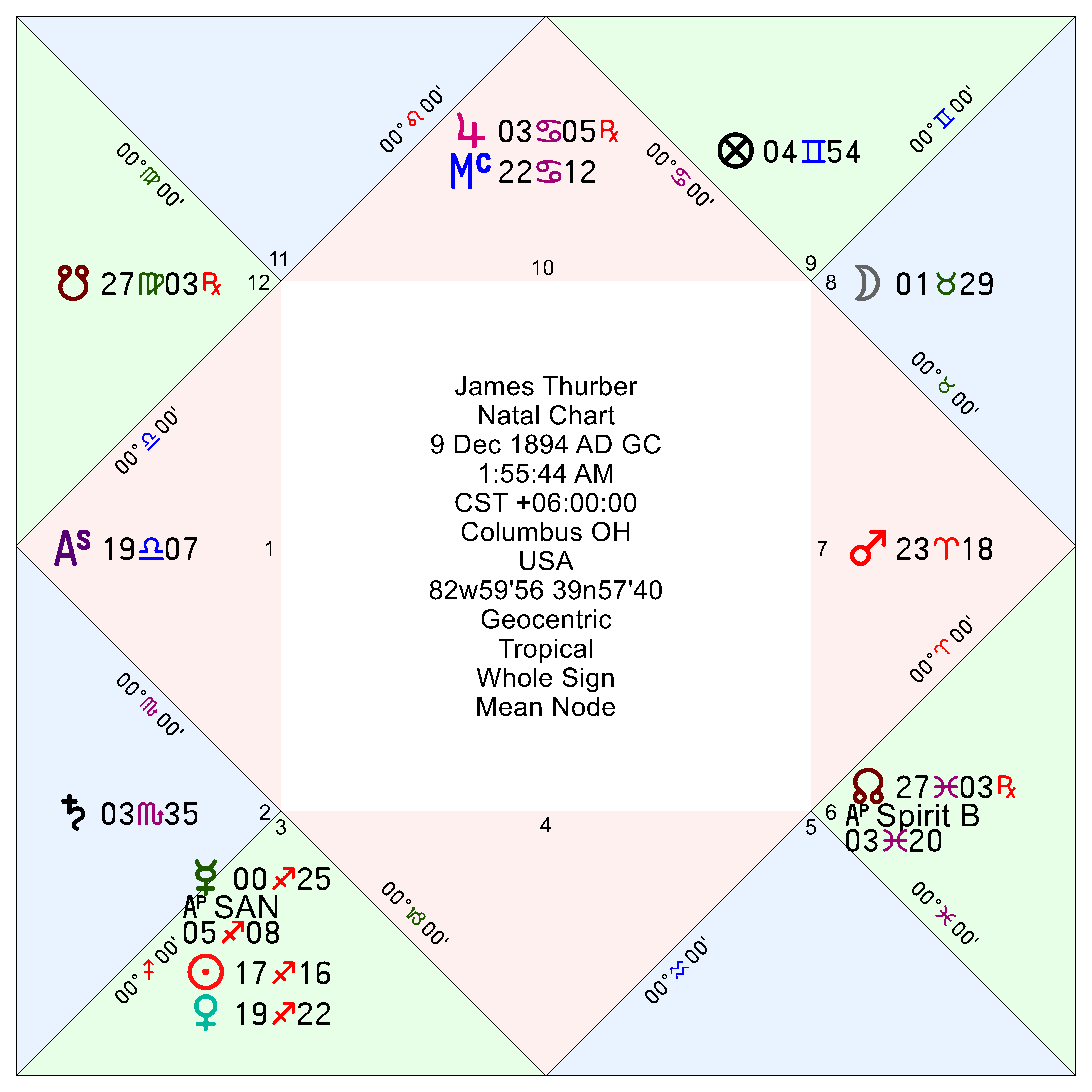
Rodden Rating DD, Conflicting/unverified, 8-Dec-1895, 11:55 PM, ASC 24VI59
Proposed Rectification: 9-Dec-1894, 1:55:44 AM, ASC 19LI07
Complete biographical chronology, rectification and time lord studies available in Excel format as a paid subscriber benefit.
The analytical models used in the sections below are part of a larger research program developed across longer white papers and case studies, where the historical sources, rules, and testing methodology are laid out in full. These database entries show the models in practice; readers who want the theoretical foundations can start with the background papers below:
Rectification Hub (I wrote the book on it!)
Soul Hub (white paper, Victor model statistical tests, Moon’s Configuration studies)
Physiognomy Hub (white paper, examples)
Victor Model factors favoring Mercury/Sagittarius
Sign ruler: Lot of Fortune
Bound ruler: Sun and Lot of Fortune
Angular from Lot of Fortune (LOF7) and Lot of Spirit (LOS10)
Frequency of career milestones during Mercury Firdaria subperiods.
Mercury in Sagittarius as victor of the horoscope signifies the ability to elevate ordinary events into stories that reveal broader truths about human nature. Thurber rarely wrote about kings, statesmen, or epic historical events. Instead, he found his material in family life, office politics, marriage, social anxieties, and the small absurdities of modern existence. Mercury supplied the powers of observation and narration, while Sagittarius encouraged him to enlarge these familiar situations into parables that spoke to universal experiences. His essays, short stories, and cartoons often begin with commonplace circumstances but gradually expose the exaggerated fears, fantasies, misunderstandings, and aspirations that shape human behavior. In this sense, Mercury in Sagittarius did not merely record the world as it was; it transformed everyday life into a form of modern folklore, allowing Thurber’s distinctly American settings to communicate lessons that readers far removed from his own circumstances could immediately recognize.
Physiognomy Model factors favoring Aries, Scorpio
Rising sign: Libra
Ruler of rising sign: Venus/Sagittarius
Rising decan: Aquarius
Ruler of rising decan: Saturn/Scorpio
Planets aspecting the Ascendant degree: Mars/Aries at 4 degrees
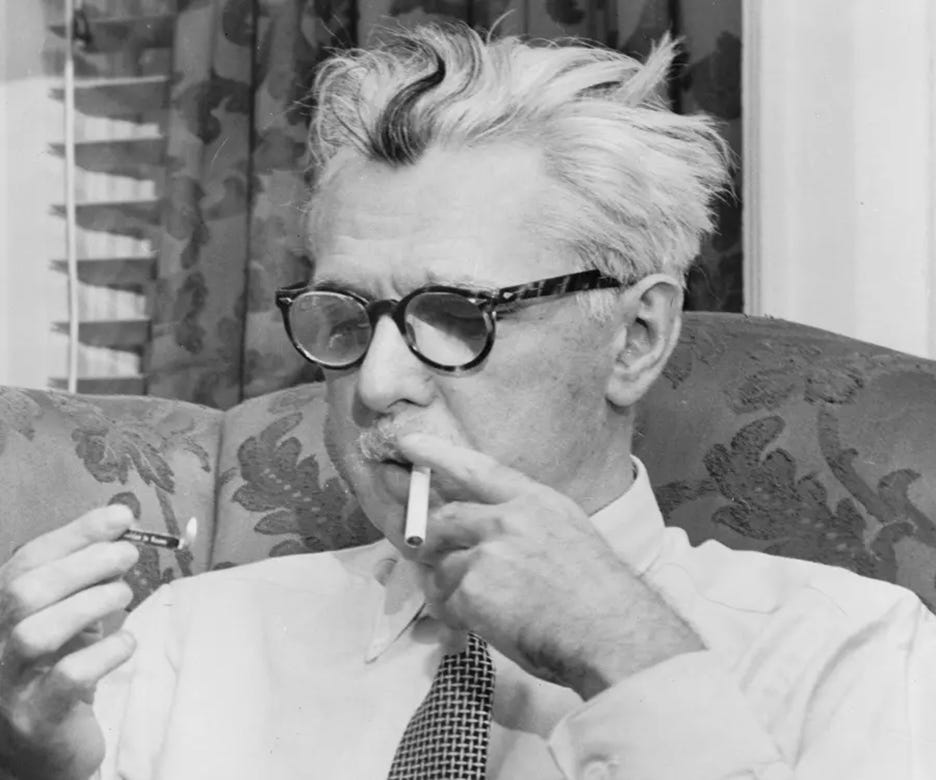
James Thurber stood approximately 6 feet 1 inch (185 cm) tall according to biographical sources, giving him a lean and elongated appearance. Photographs from middle age show a narrow, bony frame with long limbs, sloping shoulders, and a face that tapers from prominent cheekbones toward a relatively narrow chin. The nose is long and straight, the forehead high, and the eyes deeply set beneath pronounced brows. Even before the effects of age and declining eyesight became evident, his features conveyed an impression of nervous alertness and intellectual intensity rather than physical vigor. The face is neither rounded nor fleshy, but strongly skeletal in construction, with an overall appearance that emphasizes bone structure rather than softness. His expressions often combine curiosity, skepticism, and mild apprehension, fitting a writer whose humor frequently revolved around anxiety, confusion, and the absurdities of everyday life.
From an astrological perspective, Thurber’s physiognomy is shaped less by Libra rising itself than by the planets exerting influence upon the Ascendant. Mars in Aries closely opposes the Ascendant degree and contributes what John Willner describes as the bony ovate facial pattern associated with Aries. In Thurber’s case, the head narrows toward the chin while retaining width across the upper face, producing an outline that resembles an arrowhead, one of the most recognizable Aries facial signatures in Willner’s model. This Martian influence helps explain why Thurber appears more angular and skeletal than would ordinarily be expected from Libra rising alone. A second influence arises from Saturn in Scorpio, ruler of the Aquarius rising decan. In later photographs, Thurber developed a striking pattern of contrasting white and dark hair, a condition resembling pigmentary mosaicism in which isolated patches retain darker pigmentation while surrounding hair turns white. Such stark black-and-white contrasts correspond closely to Scorpio symbolism, much as the skunk’s alternating bands of dark and light fur evoke the same visual motif. Together, Mars in Aries and Saturn in Scorpio create a physiognomy that is noticeably sharper, more severe, and more visually distinctive than the softer symmetry usually associated with Libra rising.
Moon’s Configuration
Phase I — Moon Conjunct Mars (Aries, 7th house)
Delineation. The Moon in Aries conjunct Mars shows a life shaped early by events that are sudden, physical, violent, or accidental—especially those involving weapons, sharp objects, or impulsive actions. Mars is in its own sign and gives its significations with full force: courage, danger, heat, speed, and the raw, unfiltered conditions of youth. A conjunction between the Moon and Mars often signals formative wounds, inflammations, or injuries that permanently alter the native’s bodily condition or perceptual experience. In Aries, Mars rules arrows, projectiles, and impulsive childhood play, so the symbolism is unusually literal and direct. Psychologically, this combination produces lifelong reactions driven by instinct, irritability, and quick reactivity—an emotional life marked by sudden surges of intensity and periodic volatility.
Biographical Match. Thurber’s childhood accident could not be a clearer embodiment of this signature: his brother shot him in the eye with an arrow during a spontaneous game of William Tell. The symbolism is textbook Mars-in-Aries—injury through a projectile, delivered suddenly, in the context of children “playing” with weapons. The wound permanently blinded him in one eye and compromised the other over time, setting the stage for the visual instability that shaped both his writing and his drawings. The Moon, ruling bodily vulnerability, joins Mars, signifying injury, and delivers its effects decisively in childhood. This accident became the defining physical fact of Thurber’s life, initiating the entire chain of psychological, imaginative, and stylistic developments that followed.
Phase II — Mercury Changes Signs from Scorpio to Sagittarius (2nd house)
Delineation. When Mercury changes signs after the Moon’s first martial shock, the chart describes a shift in cognition, perspective, and narrative framing triggered by the early accident. Mercury leaving Scorpio’s brooding, investigative depth and entering Sagittarius opens the mind to exaggeration, humor, symbolic expansion, and tall-tale reinterpretation. In this configuration the early wound becomes the seed of a new interpretive style: instead of retreating into Scorpio’s silence or bitterness, the intellect leaps toward Sagittarian meaning-making. Mercury in Sagittarius reframes adversity as story, converts trauma into fable, and elevates hardship into something psychologically enlarged. In classical terms, this is Mercury moving from the underworld (Scorpio) into Jupiter’s hall (Sagittarius), taking on the ruler’s preference for imagination, optimism, and narrative uplift.
Biographical Match. After the accident, Thurber did not become embittered or withdrawn. Instead, he developed precisely the Sagittarian qualities Mercury promises: humor, exaggeration, symbolic play, and the ability to transform painful or humiliating experiences into narrative comedy. His entire oeuvre depends upon this shift—the movement from a wounded perceptual world to a humorous interpretive world. The eye injury did not produce Chatterton’s despair or Twain’s Scorpio-Saturn scalpel; it produced storytelling that could joke about catastrophe, inflate small domestic moments into epics of absurdity, and reinterpret life’s frustrations with comic elasticity. This is Mercury crossing the frontier into Sagittarius: a creative pivot that reframed suffering as a source of meaning and laughter.
Phase III — Moon Taurus Ingress
Delineation. When the Moon enters Taurus, it moves from the hot, reactive domain of Mars into the stable, sensual, comfort-seeking realm of Venus. This transition often indicates a softening or aestheticization of earlier wounds: the native begins to ground emotional life in artistic expression, sensual pleasures, routines, or imaginative play. The key twist here is that Taurus is ruled by Venus in Sagittarius, a benefic in a jovial, festive, party-loving sign. Venus in Sagittarius delights in humor, spectacle, tall tales, and social merriment, so when the Moon takes instruction from this Venus, the emotional life becomes imaginative, comedic, and expressive. What began as wounding Mars energy in Aries becomes reprocessed through Venusian creativity and Sagittarian exaggeration.
Biographical Match. This transition describes perfectly how Thurber converted his early trauma into a life of creativity and humor. As the Moon enters Taurus, it finds stability and an outlet in art; under Venus in Sagittarius, that art becomes playful, witty, surreal, and socially delightful. Thurber’s drawings—loose, elastic, cartoonish, and psychologically acute—are the visual equivalent of Moon-in-Taurus groundedness inflected by Sagittarian whimsy. His prose follows the same pattern: domestic absurdity rendered in a stable, almost minimalist frame, but enlivened by sudden bursts of exaggeration and comedic fantasy. The chart suggests that after the injury he found refuge not in stoicism or analysis but in a Venusian world of humor, imagination, and creative delight.
Phase IV — Moment of Birth
Delineation. The moment of birth freezes the Moon’s transition from Aries to Taurus and establishes the entire chain of planetary rulerships and dispositor relationships as the template of a lifetime. With the Moon emerging from Mars’ domain and entering Venus’, the native carries both the wound and the artistic response simultaneously. The chart captures a psyche where danger and beauty, violence and creativity, shock and humor are permanently fused. The natal moment is the tension-point between the injury that initiates the pattern and the Venusian reinterpretation that transforms it. It signals a life in which bodily frailty, imaginative compensation, and aesthetic reframing become inseparable.
Biographical Match. Thurber’s life expresses exactly this fusion: the eye injury is always present, structurally defining his experience, yet it also becomes the origin of his creativity, his humor, and his unique visual style. His blindness did not simply disable him; it generated the distorted perspectives, surreal imagery, and psychological compression that define his literary and artistic output. The natal moment therefore marks the birth of a life pattern: adversity met with wit, vulnerability transformed into comedy, and instability turned into imaginative expansion. The injury was permanent, but so was the artistic engine it ignited.
Phase V — Moon Applies to the Sextile of Jupiter (Cancer, retrograde, 10th house)
Delineation. A Moon applying to Jupiter typically brings optimism, imagination, exaggeration, and an expansive orientation toward life. In this chart, however, Jupiter is in Cancer retrograde and behaves functionally like Jupiter in Capricorn—forced to operate under Saturn’s rules. The sextile grants creative potential and intellectual breadth, but the Jupiter involved is strained: it inflates grand possibilities that cannot withstand structural testing. The aspect promises big ideas, heroic self-images, flights of fantasy, and a drive to enlarge personal experience; but since Jupiter must deliver its meaning through Saturn’s terrain, these expansions are vulnerable to collapse, exposure, or reality checks.
Biographical Match. This is Thurber’s Walter Mitty signature: the inner world bursts with epic fantasies—heroic, romantic, dramatic—but the outer world refuses to validate them. His stories inflate ordinary life into mythic dimensions, only to deflate them with a Saturnian jolt back to reality. The sextile shows the creative drive and the rich imaginative reservoir; Jupiter’s condition shows why these expansions are comic rather than triumphant. The recurring cycle in his work—grand dream → mundane interruption—is the precise expression of a Moon driven toward Jupiter but blocked by Saturn’s quiet veto.
Phase VI — Moon Applies to the Opposition of Saturn (Scorpio, 2nd house)
Delineation. When the Moon finally applies to Saturn by opposition, the emotional arc meets its limit point: hardship, melancholy, aging, loss, and the consequences of earlier exaggerations. Saturn imposes sobriety, structure, and sometimes bitterness. It brings the reckoning phase of life—where fantasies fail, ambitions meet obstruction, and the body becomes fragile. Oppositions describe tension and depletion; the Moon, having exhausted its imaginative expansions, now confronts Saturn’s demands for reality, discipline, and acceptance of mortality.
Biographical Match. This describes Thurber’s later years with uncanny accuracy. His increasing blindness, failed eye operations, and battles with frustration and irritability all reflect the Moon’s arrival at Saturn’s gate. Thurber became more caustic, more acerbic, more melancholic as he aged; the light Sagittarian humor dimmed under Saturn’s shadow. The structural decline of his health and the darkening of his emotional tone mark the consummation of the Moon–Saturn opposition: a life that began with an injury and found its voice in humor ultimately closing under the weight of limitation and loss.
Interpretive Summary
James Thurber’s Moon sequence tells the story of a life shaped first by injury and then transformed by imagination, before ending in the gravity of Saturn’s reckoning. The Moon’s conjunction with Mars in Aries delivers the literal childhood wound—an arrow to the eye—that becomes the seed of his creative identity. As Mercury steps into Sagittarius, Thurber reframes pain through meaning, developing the comedic, exaggerated, psychologically elastic narrative style that defines his work. When the Moon enters Taurus under the rule of Venus in Sagittarius, the wound becomes aesthetic engine, producing the iconic loose-line drawings and surreal domestic humor that made him famous. The applying sextile to Jupiter fuels vast inner landscapes—epitomized by Walter Mitty—yet Jupiter’s Capricornized condition ensures these expansions always collapse back into the mundane. Finally, the Moon’s approach to Saturn reveals the late-life arc: blindness, failed surgeries, irritability, and a darkening emotional tone. The configuration as a whole portrays a life where suffering becomes creativity, imagination becomes comedy, and Saturn writes the final chapter.
Influence of Sect
The figure is nocturnal, placing Venus and Mars in sect while Jupiter and Saturn operate out of sect. Mars in Aries provides a striking example of how an in-sect malefic remains capable of producing harm while operating in a manner that is more integrated into the native’s life story. The childhood arrow shot by Thurber’s brother, which permanently damaged his eyesight, was unquestionably destructive, yet it also became one of the formative events shaping his outlook, humor, and artistic development. Venus in Sagittarius, likewise in sect, broadened the appeal of his writing and cartoons, allowing readers to recognize their own hopes, anxieties, and absurdities within his work. By contrast, Jupiter in Cancer retrograde operated out of sect, diminishing Jupiter’s ability to deliver uncomplicated success. Again and again, Thurber’s stories and cartoons portray characters who pursue grand ambitions only to encounter confusion, embarrassment, or failure. Rather than the triumph traditionally associated with Jupiter, the retrograde and out-of-sect condition often manifests as noble effort ending in disappointment, a theme that became one of Thurber’s most recognizable artistic signatures. Saturn in Scorpio, also out of sect, intensified experiences of limitation and physical vulnerability, particularly through the progressive deterioration of his eyesight. The resulting balance between the planets produced a body of work in which aspiration and frustration, courage and defeat, exist in perpetual tension.
Early/Late Bloomer Thesis
Thurber was born shortly after a New Moon, placing him in the early waxing phase, which predicts the classic early bloomer trajectory: life themes tend to crystallize early, foundational injuries or conditions occur near childhood, and the essential direction of the life is set before midlife. Thurber fits this pattern with striking clarity. The eye injury at age seven determined his lifelong visual distortions, his drawing style, and the psychological tension that animates his fiction. His major creative identity—writer, humorist, New Yorker contributor—was fully established by his early thirties, long before his life’s midpoint. All major themes—injury, humor as compensatory structure, imaginative expansion, and final limitation—are front-loaded, unfolding in ways entirely consistent with the early blooming signature of a New Moon birth.
Mentions in James Hillman’s The Soul’s Code (p. 125, 205, 207)
Hillman includes Thurber’s eye injury in a list of unusual early-life events that, in hindsight, are deemed critical to the soul’s journey. He contrasts this with the developmental psychological approach, which states that such events are either sublimated, transformed, and integrated as a person grows older. Based on his acorn theory of soul development, Hillman argues these events are necessary accidents for the soul’s journey to proceed. Since I have mapped acorn theory to the astrological victor of the horoscope, we can test Hillman’s thesis with Thurber’s natal horoscope.
How is the accident promised in the natal horoscope? I have seen several cases of Venus in Sagittarius as “friendly fire” (e.g., Pat Tillman, b. 6-Nov-1976, 9:29:46 AM, Fremont, CA, ASC 18SA07, author’s rectification). For Thurber, Venus in Sagittarius is just over 3 degrees from the 3rd house cusp of siblings. His brother shot him.
Why did his brother shoot him? Because Venus/Sagittarius applies by trine to Mars/Aries, with Venus/Sagittarius signifying friendly fire from his brother and Mars/Aries the arrow itself. Besides the Moon’s aspects, the applying Venus–Mars trine is the first planet-to-planet aspect to perfect after birth.
Why did the accident occur on a Sunday afternoon in August 1902? Because this was the tail end of the Moon–Venus Firdaria subperiod, which concluded 27-Aug-1902.
Did the victor of the horoscope promise this accident? The victor is Mercury 00SA25, ruled by Jupiter by sign and bound. Mercury is co-present with the Sun and Venus in the 3rd whole-sign house, though outside moiety of orb. Mercury is also in a wide trine with Mars, outside moiety of orb. By rulership, there is no connection between Mercury (Thurber’s victor or “acorn”) and Thurber’s brother or the arrow. The salient connection is given by the Moon’s configuration: before birth the Moon is conjunct Mars, then Mercury makes its Sagittarius ingress, the Moon makes its Taurus ingress, and the Moon next applies to Jupiter. Thus the accident (Mars) precedes Thurber’s interest in writing (Mercury’s Sagittarius ingress) by sequence. Had there been reception between Mercury and Mars, I would favor Hillman’s acorn theory view of why Thurber’s accident occurred. But without reception, that argument is more difficult to make, leaving the developmental psychological approach the better fit in my view.
AI Notice: This post created with assistance from ChatGPT.
Complete biographical chronology, rectification and time lord studies available in Excel format as a paid subscriber benefit. Files are behind the paywall.