

Marriner Eccles was the first Federal Reserve Chairman to break decisively from the institution’s originally passive posture in the face of economic crisis. The Federal Reserve of the 1910s and 1920s was designed as a decentralized, largely reactive system, reluctant to intervene forcefully in markets. Eccles changes that. Under his leadership in the 1930s, the Fed begins its transformation into an active instrument of economic policy, willing to engage directly with the problem of mass unemployment and collapsing demand during the Great Depression. In this sense, Eccles marks the turning point in the Federal Reserve series: the moment when the institution shifts from observer to participant, from restraint to managed intervention.
The astrological signature of that shift is immediately visible. North Node in Gemini in the 2nd house of wealth points to a life centered on activity, exchange, and the circulation of economic life. In the companion post on John Maynard Keynes, the case will be made that Gemini—ruled by Mercury—serves as the natural significator of Keynesian stimulus itself: not theory in abstraction, but transactions, volume, and the continuous movement of money through the economy. Eccles embodies this principle in practice. His role is not to invent the theory, but to implement its logic within American institutions, translating the need for activity into policy. The Gemini emphasis suggests that economic recovery is not achieved through static balance, but through restoring the flow of exchanges that sustain production and employment.
This emphasis on activity is further refined through the victor of the horoscope, Jupiter in Aquarius retrograde, which operates here in a Leo-like manner. Rather than endorsing a purely centralized or bureaucratic solution, Eccles advances a model in which government spending initiates recovery, but relies on individuals—businesses, workers, and local actors—to carry that stimulus forward. Expansion is not imposed from above; it is activated through participation, a kind of economic “rugged individualism” supported, rather than replaced, by the state. Yet this vision is never unconstrained. Behind it stands Saturn in Virgo, acting as a limiting and structuring force—cutting through inefficiency, imposing discipline, and at times restricting what can be achieved politically or institutionally. The result is a career defined by tension: between expansion and restraint, between activation and control, and between what could be done in theory and what could be implemented in practice.
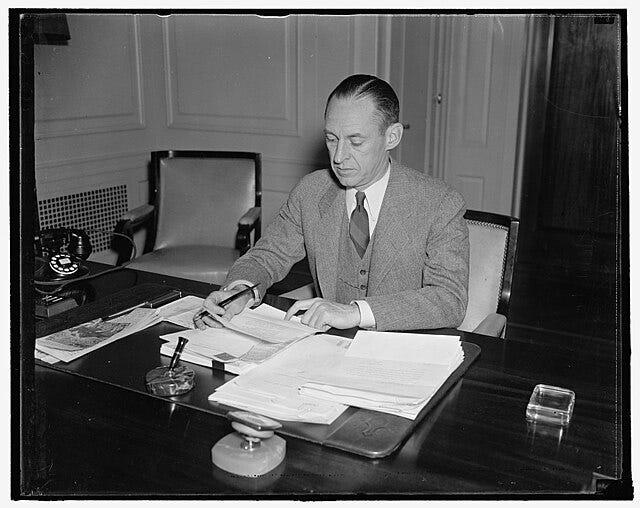
Marriner Stoddard Eccles stands as one of the most consequential figures in the transformation of the American financial system during the 20th century. A banker by background but a reformer by conviction, Eccles played a central role in reshaping the Federal Reserve into a modern central bank capable of managing economic cycles, particularly during the crises of the Great Depression and World War II.
Born on September 9, 1890, in Logan, Utah, Eccles was the son of a successful industrialist and banker, David Eccles. After his father’s death in 1912, the young Eccles assumed leadership responsibilities across a sprawling family business empire that included banking, construction, and sugar manufacturing. Despite lacking formal higher education, he proved an able and pragmatic businessman, eventually consolidating control over several banks into what became the First Security Corporation, one of the largest banking groups in the western United States.
Eccles’s early career unfolded during a period of relative economic expansion, but the onset of the Great Depression profoundly altered his outlook. Unlike many contemporaries in finance, Eccles rejected the prevailing orthodoxy of balanced budgets and minimal government intervention. Drawing on his direct experience with collapsing banks and widespread unemployment, he became convinced that insufficient consumer demand—not merely financial instability—lay at the heart of the crisis. By the early 1930s, he was advocating aggressive government spending to stimulate recovery, a position that aligned closely with emerging Keynesian ideas, even before they were widely accepted in the United States.
His ideas brought him to the attention of President Franklin D. Roosevelt, who appointed Eccles in 1934 to the Federal Reserve Board (then called the Federal Reserve Board of Governors). Within a year, Eccles became Chairman, a position he held from 1934 to 1948. During his tenure, he was instrumental in pushing through the landmark Banking Act of 1935, which centralized power in Washington and significantly strengthened the authority of the Board of Governors over regional Federal Reserve Banks. This reform marked a decisive shift away from the decentralized, banker-dominated system that had characterized the Fed since its founding in 1913.
As chairman, Eccles championed policies aimed at stabilizing the economy through coordinated monetary and fiscal action. He supported deficit spending during downturns and worked closely—though not always harmoniously—with the Treasury Department. His tenure saw ongoing tension between the Federal Reserve’s desire for monetary independence and the Treasury’s need to finance government operations, especially during World War II. Eccles backed the policy of maintaining low interest rates to support war bond issuance, effectively subordinating monetary policy to fiscal demands during the war years.
After the war, however, Eccles became increasingly concerned about inflation and the long-term consequences of continued rate suppression. This tension culminated in the Treasury-Federal Reserve Accord of 1951, which restored the Federal Reserve’s ability to set interest rates independently of the Treasury. Although Eccles was no longer chairman at the time of the Accord, he remained a key intellectual force behind the push for central bank independence.
Eccles retired from public service in 1951 and returned to Utah, where he remained active in business and public affairs until his death in 1977. His legacy endures in both institutional and intellectual terms: the Federal Reserve’s modern structure owes much to his reforms, and his early advocacy of countercyclical fiscal policy anticipated the widespread adoption of Keynesian economics in the postwar era. The Federal Reserve’s headquarters in Washington, D.C.—the Eccles Building—stands as a lasting testament to his influence.
Subscribe for presentation of the horoscope and a discussion on the victor, physiognomy, the Moon’s Configuration, influence of sect, and the early/late bloomer model.
Complete biographical chronology, rectification and time lord studies available in Excel format as a paid subscriber benefit.