

The Lunar Nodes are mathematical points marking the two places where the Moon’s orbital plane intersects the ecliptic. The North Node, or ascending node, marks where the Moon crosses the ecliptic from south to north; the South Node, or descending node, marks the opposite crossing.
Astrologers have two principal choices for calculating their positions: the Mean Node and the True Node. The Mean Node represents the averaged motion of the nodal axis, which moves continuously retrograde through the zodiac and completes a cycle in approximately 18.6 years. The True Node incorporates shorter-period perturbations in the Moon’s orbital plane, causing its position to oscillate around the Mean Node.
Historically, astronomers and astrologers worked with mean nodal motion. Beginning with the development of increasingly sophisticated lunar theories in the nineteenth century, including the work of Charles-Eugène Delaunay in the 1860s, it became possible to model periodic perturbations affecting the orientation of the lunar orbit with much greater precision. The modern True Node is based on this more detailed representation of the Moon’s instantaneous or osculating orbital plane.
Today, True Node appears to be the more common choice among Western astrologers, helped by its adoption as the default setting in many astrology software programs. I suspect many astrologers have never consciously made a choice between the two. The terminology itself encourages the assumption that “True” must be more accurate astrologically, while “Mean” sounds like an approximation that should be discarded once a more precise calculation becomes available.
But that conclusion does not necessarily follow. The question for astrologers is not simply which calculation incorporates more astronomical information. The question is which calculation produces better astrological results.
I first tested this question almost twenty years ago while writing A Rectification Manual: The American Presidency. Herbert Hoover provided an unusually useful test because the two calculations placed his Nodes in different signs: the True North Node at 29°29′ Aries and Mean North Node at 0°14′ Taurus, with the corresponding South Node at 29°29′ Libra and 0°14′ Scorpio. This made it possible to compare not only event timing but entirely different delineations by sign.
The Hoover test compared events during the North Node Firdaria, his 1930 Nodal Return, and directions of the Nodes to the angles. The Mean Node consistently produced the better result. I then expanded the timing tests to additional Presidential nativities; again, directions calculated from the Mean Node generally produced the better correspondence between astrological delineation and documented life events. The complete tests and calculations are presented in Chapter 14 of A Rectification Manual, 4th edition.
My conclusion was straightforward: use the Mean Node.
Nearly twenty years later, we have another opportunity to compare the two calculations, this time in financial markets.
The 2026 Aquarius/Leo Nodal Ingress
The Mean North Node entered Aquarius, with the Mean South Node entering Leo, on 18-Aug-2026 at 4:34 PM EDT. The True Node made the same sign transition on 27-Jul-2026.
A difference of roughly three weeks may not sound large over an 18.6-year nodal cycle. But when an ingress is being tested against a financial-market reversal, three weeks is more than sufficient to distinguish the two calculations.
And the market response around the Mean Node ingress was difficult to miss.
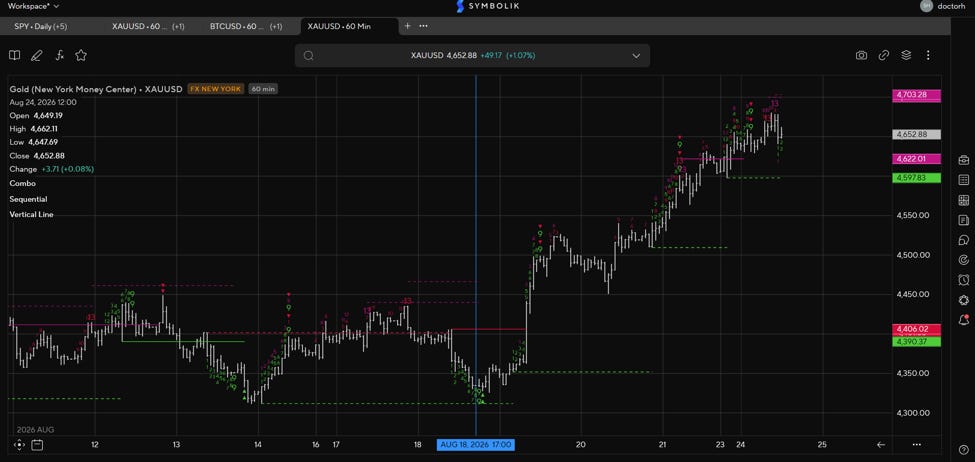
Gold recorded two minor lows on 18-Aug-2026 at 7:35 PM and 9:00 PM. These lows occurred approximately 4½ and 3 hours before the Mean Node changed signs. Last at $4654.42 (24-Aug-2026 at 11:55 AM), spot gold posted a gain of 7.5% since the Mean Nodes changed signs.
Bitcoin behaved similarly. On 18-Aug-2026 at 9:35 AM, bitcoin prices bottomed about 7 hours prior to the Mean Node sign change. After the Mean Node changed signs, bitcoin staged an explosive rally. Last at $79,046 (24-Aug-2026 at 11:57 AM), spot bitcoin prices rallied 23.5% since the morning of 18-Aug-2026.
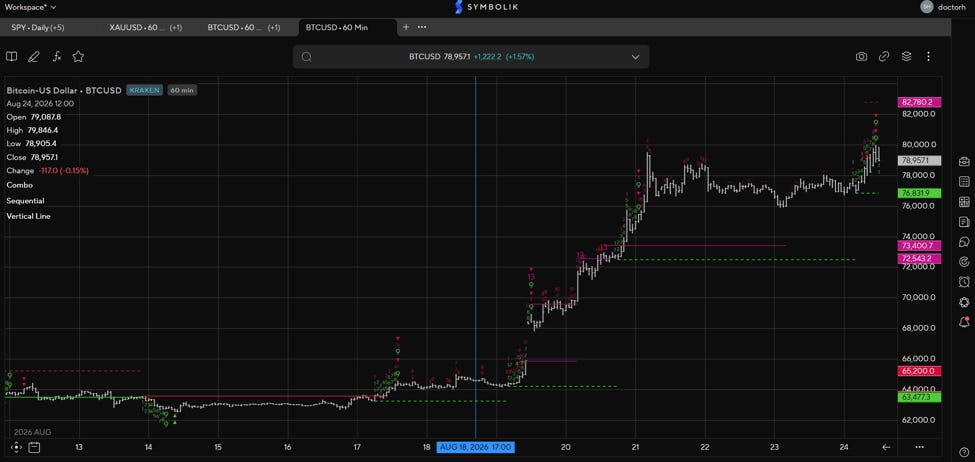
The True Node had entered Aquarius/Leo on 27 July. The Mean Node made the transition within hours of the August 18 lows in both markets.
This does not by itself prove that every market turn should occur precisely at a Mean Node ingress.
What matters is that the astrological change in condition also fits the subsequent price action.
Why Bitcoin Rallied
Before 18 August, the Mean South Node was traveling through Virgo. From 1-May-2026 through 18-Aug-2026, it occupied the bound of Mercury/Virgo.
Mercury/Virgo is associated with detailed information, calculation, coding, mathematics, and digital technology. Bitcoin is a digital asset whose existence depends upon computer code and a distributed electronic ledger. The South Node diminishes. Its passage through the bound of Mercury/Virgo therefore describes a period in which the power of a Mercury/Virgo-type asset is reduced.
When the South Node left Virgo on 18 August, that condition ended. A rock was lifted.
Why Gold Rallied
The gold delineation works differently.
The Mean South Node entered Leo on 18 August and simultaneously entered the bound of Mars/Leo, where it remains until 10-Dec-2026.
Leo is ruled by the Sun, the traditional planetary significator of gold. Mars/Leo, however, is inimical to gold. Mars represents iron, and Mars/Leo can therefore be read as an anti-gold combination: iron acting against the solar metal.
Here the South Node’s power of diminution becomes beneficial through a double negative. The South Node diminishes Mars/Leo; Mars/Leo itself is inimical to gold. Diminishing an anti-gold influence becomes supportive for gold.
Mean or True?
The Mean-versus-True Node debate ultimately cannot be settled by terminology. “True” does not necessarily mean astrologically superior, just as “Mean” does not necessarily mean astrologically deficient. They are two different mathematical treatments of the same nodal cycle.
The appropriate way to choose between them is to test them.
That was the approach I took in A Rectification Manual. Presidential nativities supplied cases in which the two calculations could be compared through sign delineation, Firdaria, Nodal Returns, directions, and transits. Those tests favored the Mean Node.
The August 2026 financial markets now provide a different kind of test. The True Node entered Aquarius/Leo on 27 July. The Mean Node entered on 18 August. Gold and bitcoin both established important lows within hours of the Mean Node transition and rallied sharply afterward, while the change in the South Node’s sign and bound provides a coherent delineation for both moves.
Nearly twenty years after my original tests, the evidence continues to point in the same direction.
If you have not yet done so already, consider adjusting your default setting for the Lunar Nodes from ‘True Node’ to ‘Mean Node.’ Your practice and your clients will thank you!