

This post continues the series of horoscopes for the individuals who form the constellation around the rise and fall of President James A. Garfield—the network of rivals, allies, patrons, and antagonists whose personal trajectories intersected with the brief but explosive moment of Garfield’s presidency. Roscoe Conkling stands at the center of that constellation not as a subordinate figure, but as a rival power in his own right: the architect of the Stalwart machine, the defender of patronage as a political instrument, and the man whose clash with Garfield over appointments detonated one of the most consequential factional ruptures in 19th-century American politics. Conkling’s career represents the high-water mark of machine politics before its collapse under reform pressure in the aftermath of Garfield’s assassination.
Although there is no evidence of direct personal interaction between Conkling and Charles Guiteau, the spoils system Conkling championed created the psychological and political conditions that made Guiteau’s expectations legible within the culture of the time. The Stalwart insistence that offices were rewards for loyalty—combined with Chester Arthur’s place on the ticket as the faction’s contribution—helped normalize the belief that political service entitled one to material or professional gain. Guiteau’s delusion that he was owed a diplomatic post thus did not arise in a vacuum; it emerged from a patronage culture in which reward and loyalty were rhetorically intertwined, even if his personal pathology radically distorted that logic. Conkling did not cause Guiteau’s act, but the political world Conkling defended supplied part of the symbolic grammar through which Guiteau rationalized his grievance.
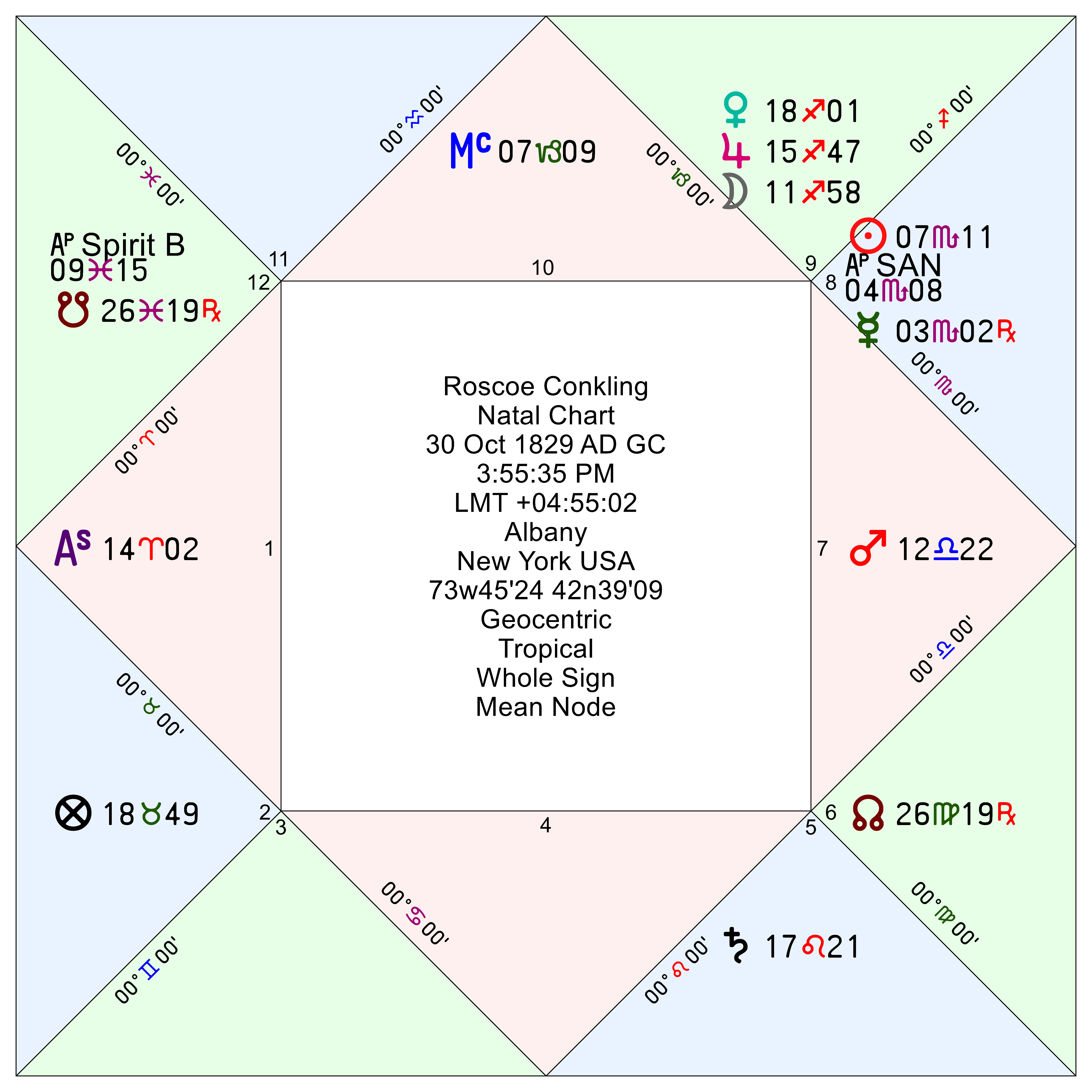
Astrologically, Conkling’s Moon’s Configuration describes the very mechanism by which that world was built and then unraveled. The Moon’s backgrounded separation from Saturn in Leo marks a prior phase of raw factional dominance and rigid alliance control—the Stalwart machine at full strength—followed by a liminal collapse of traction under reform pressure. The Moon’s application to Mars in Libra on the 7th cusp then shows how Conkling’s power migrated into open, procedural warfare with named opponents—Hayes, Garfield, and ultimately the institutions of reform themselves—culminating in juridical combat as a Supreme Court advocate after his political fall. In this sense, Conkling’s horoscope captures both the construction of the spoils system as a regime of power and its transformation into a legal battlefield once the old machine could no longer command obedience.
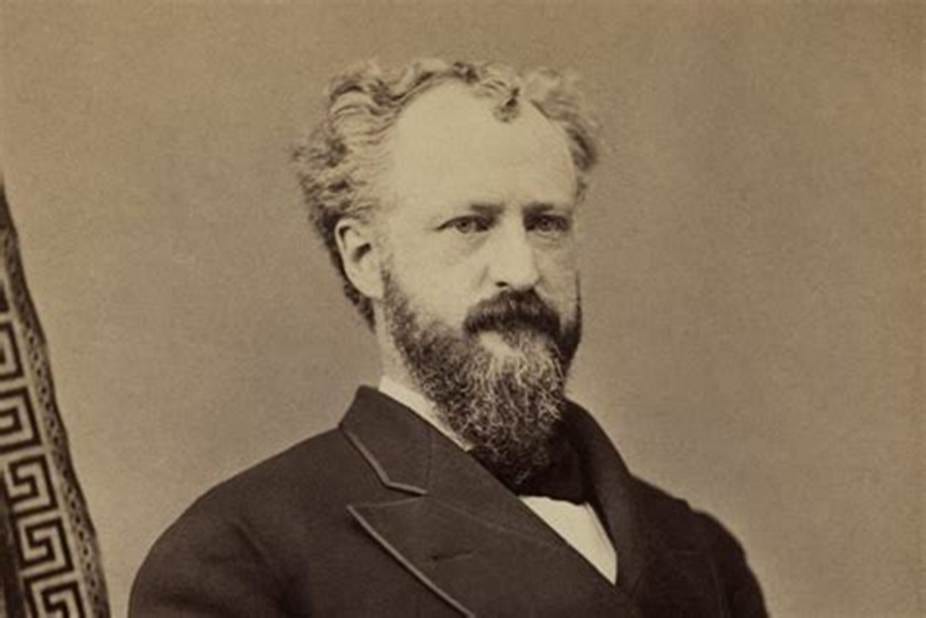
Roscoe Conkling was the towering boss of New York’s Stalwart faction and the purest embodiment of machine politics in the post–Civil War Republican Party—a figure who treated federal appointments not as administrative details but as the very substance of political power. Rising from Albany politics to Congress and then to the U.S. Senate in 1867, Conkling built his empire around the New York Custom House, the richest single reservoir of patronage in the nation. The system he perfected did not emerge in a vacuum. It was incubated during the Grant administration, which—while personally honest at the top—operated through dense networks of allies, fixers, and factional brokers who treated federal offices as political currency. Grant did not design a spoils machine, but his reliance on personal loyalty and his tolerance of party intermediaries created a permissive environment in which disciplined bosses could formalize patronage into an instrument of power.
At his height in the early and mid-1870s, Conkling enforced iron discipline within New York’s Republican organization, using Custom House jobs, post offices, and federal payrolls to build a machine that could dominate conventions, shape nominations, and bend senators to his will. The Stalwarts justified this system not merely as politics-as-usual, but as the glue that held parties together in an era of mass suffrage and weak state capacity. Against them stood the Half-Breeds, led nationally by James G. Blaine, who favored civil service reform and a looser party structure. The rivalry between Conkling and Blaine became the defining factional conflict of the Gilded Age.
Conkling’s power, however, did not follow a straight upward line after Grant. The first serious blow came under Rutherford B. Hayes, whose reform agenda targeted the New York Custom House as the emblem of machine politics. Hayes forced a showdown with Conkling and, in 1878, removed Conkling’s key lieutenants—Collector Chester A. Arthur and Naval Officer Alonzo B. Cornell—signaling that a Republican president could openly challenge the New York boss on his home ground and survive. The machine absorbed the blow and remained formidable—strong enough to mount a serious national push for Grant’s third-term nomination in 1880—but the foundations had been weakened.
The final rupture came with the election of James A. Garfield. Garfield, working closely with Blaine, again bypassed Conkling in making New York appointments, striking directly at the Custom House patronage network. Conkling’s response—the dramatic resignation from the Senate in hopes of being triumphantly re-elected—misfired. The New York legislature refused to return him, abruptly ending his formal political career. Garfield’s assassination soon after transformed patronage politics from a partisan weapon into a national scandal, and the passage of the Pendleton Civil Service Reform Act under Arthur in 1883 began the institutional dismantling of the spoils system Conkling had perfected.
Conkling lived just long enough to see his world disappear. He never married and had no children, cultivating instead a highly stylized public persona of aristocratic reserve and personal grandeur. In retirement he became a prominent attorney, arguing major cases before the Supreme Court and briefly reclaiming national visibility in law rather than politics. He died in 1888 after collapsing during the Blizzard of ’88 in New York City, a theatrical end befitting a man whose career marked both the zenith of machine politics and the moment of its irreversible decline.
No Astrodatabank Record
Proposed Rectification: 3:55:35 PM, 14AR02’33”
Complete biographical chronology, rectification and time lord studies available in Excel format as a paid subscriber benefit.
The analytical models used in the sections below are part of a larger research program developed across longer white papers and case studies, where the historical sources, rules, and testing methodology are laid out in full. These database entries show the models in practice; readers who want the theoretical foundations can start with the background papers below:
Soul Hub (white paper, Victor model statistical tests, Moon’s Configuration studies)
Physiognomy Hub (white paper, examples)
Victor Model Factors favoring Jupiter/Sagittarius as Victor
· Sign ruler of Moon, Lot of Spirit
· Bound ruler of Moon, Lot of Fortune, MC
· Trine aspect to Ascendant degree within 2 degrees
· Placed in sign of rulership
Physiognomy Model Factors favoring Leo
· Rising decan is Leo
· Saturn/Leo occupies the sign of the rising decan. Saturn/Leo as a standalone planet/sign combination is a ‘strong man’ signature consistent with Conkling’s physical strength due to an exercise regimen unusual for his time period. Saturn/Leo is also the significator for a ‘peacock’ which was commonly used by political cartoonist Thomas Nast to depict Conkling. More on the Saturn/Leo – peacock delineation in the next/upcoming post on Thomas Nast.
Moon’s Configuration
Stage I — Moon separating from Saturn (Leo, 5th house)
Delineation. Although the Moon’s most recent exact aspect to Saturn occurred earlier in Scorpio (Moon 17°21′ Scorpio square Saturn 17°21′ Leo), by the time the Moon enters Sagittarius this contact is out of sign and outside moiety of orb. As such, Saturn does not function as an operative aspect within the active configuration, but as a backgrounded condition that establishes the prior mode of constraint from which the native moves away. Saturn in Leo describes authority exercised through personal dominance, embodied presence, and performative sovereignty rather than impersonal law. As ruler of the 11th house, Saturn governs political alliances, factions, and networks of support; in Leo, these alliances are structured hierarchically and enforced through loyalty, discipline, and threat of exclusion rather than negotiation or reciprocity. The Saturnian condition thus signifies a world of rigid factional power in which authority is maintained by raw control over allies and the machinery of group allegiance.
Biographical match. Conkling’s early and peak political career expresses this Saturnian background with unusual clarity. His power as leader of the Stalwart faction rested on the enforcement of loyalty within the Republican Party, especially through patronage control centered on the New York Custom House. Political alliances under Conkling were not fluid coalitions but rigid hierarchies: loyalty was rewarded with offices and advancement, dissent punished by exclusion. His personal style—physically imposing, theatrically domineering, and publicly humiliating toward rivals—mirrors Saturn in Leo’s demand that authority be embodied and displayed rather than abstractly administered. This Saturnian mode of power reached its height in the 1870s, when Conkling’s control over party networks allowed him to dominate New York Republican politics through discipline rather than persuasion. By the time the Moon enters Sagittarius, however, this mode of authority has already begun to lose traction, setting the stage for a shift in how conflict is conducted.
Stage II — Liminal interval (Moon void of course by sign between Saturn and Mars aspects
Delineation. The Moon’s sign change from Scorpio to Sagittarius, with no immediate application before the Mars aspect, creates a liminal interval in which prior structures of constraint have lost their binding force but no new mode of action has yet taken hold. This void-of-course condition signifies a period of suspended efficacy: the old Saturnian method of enforcement no longer compels obedience, yet the Mars-driven mode of open conflict has not fully emerged. In such intervals, authority becomes unstable, tactics lose effectiveness, and outcomes become uncertain. The Moon in Sagittarius introduces ideological and expansive impulses, but without immediate anchoring to a new operative aspect, these impulses lack a clear mechanism for enforcement. The native thus passes through a phase in which prior power structures erode before a new form of contestation is consolidated.
Biographical match. This liminal condition corresponds to the erosion of Conkling’s patronage machine under the Hayes administration. Hayes’s intervention at the New York Custom House, culminating in the suspension and replacement of Conkling’s lieutenants, marked the moment when Conkling’s Saturnian method of raw alliance control ceased to function reliably. Conkling could still block nominations and mobilize senatorial courtesy, but the old machinery no longer guaranteed outcomes. His authority persisted in form but not in effect. This period is characterized by stalled tactics, institutional deadlock, and the weakening of the very mechanisms by which Conkling had previously enforced loyalty. The void-of-course condition captures this political suspension: the world in which Conkling’s dominance operated no longer held, yet the new arena of conflict—formalized, juridical confrontation—had not yet fully asserted itself.
Stage III — Moon applying to Mars (Libra, 7th house)
Delineation. The Moon’s application to Mars in Libra on the 7th cusp brings conflict into the open and relocates struggle into the domain of public adversaries, law, procedure, and negotiated legitimacy. As ruler of the Ascendant, Mars describes the native’s primary mode of action and self-assertion; in Libra, Mars does not fight through direct force but through juridical forms, institutional rules, and adversarial engagement conducted in the language of justice, rights, and propriety. The 7th cusp situates this Mars in the realm of open enemies, rivals, and formal opponents, indicating that conflict is conducted face-to-face and within recognized arenas of contest rather than through covert maneuvering. The Moon’s application to Mars thus marks a decisive shift from Saturnian domination of allies to Mars-Libra confrontation with opponents through procedural and legal means. With Venus as ruler of the Lot of Fortune, Mars’ service to Venus indicates that conflict is instrumentalized toward material advantage and the distribution of rewards, even as it claims the mantle of lawful process.
Biographical match. This Mars-Libra pattern is vividly expressed in Conkling’s late political and post-political career. His confrontation with President Garfield over New York patronage was not a private intrigue but an open institutional duel conducted through resignations, confirmations, and legislative procedure. The dramatic resignation gambit of 1881 exemplifies Mars in Libra on the 7th cusp: a public adversarial move framed entirely within constitutional form, designed to defeat an opponent through the mechanics of law and legitimacy rather than raw force. After his fall from the Senate, the same martial energy reappeared in the courtroom. Conkling’s subsequent career as a Supreme Court advocate transformed political combat into legal warfare, with constitutional argument and procedural leverage replacing patronage discipline as the primary weapons. Across both phases, conflict remains martial in intent but Libran in method: war conducted through law, rivalry structured by institutions, and power pursued under the banner of legitimacy. This sequence completes the transition begun with the waning of Saturnian alliance control, marking the emergence of a new mode of struggle that defines Conkling’s final political form.
Interpretive Summary
Roscoe Conkling’s Moon’s configuration traces a clear shift in how power is exercised across his life: from Saturnian domination of alliances (rigid factional control, enforced loyalty, and boss politics), through a liminal collapse of that method under reform pressure, into Mars-in-Libra adversarial warfare conducted through law, procedure, and public institutional conflict. His early authority rested on raw control of party networks; when that traction failed, conflict migrated into formal showdowns with presidents and, later, into courtroom combat, where legal process replaced patronage as the battlefield. The sequence describes not merely changing circumstances but a transformation in political method—from command over allies to juridical struggle against open enemies—culminating in a career defined by procedural combat in the name of legitimacy and advantage.
Influence of Sect
The diurnal sect places Saturn and Jupiter in-sect, moderating Saturn’s severity and legitimizing Jupiter’s reach, while rendering Mars and Venus out-of-sect, intensifying Mars’s adversarial harshness and marginalizing Venus’s beneficence. Saturn in-sect helps explain why Conkling’s early exercise of factional discipline and alliance control could operate with institutional legitimacy for a time; his boss politics were harsh, but initially tolerated as “normal” party governance within the Gilded Age system. Jupiter in-sect underwrites the breadth of his early political success and stature, even as Jupiter’s later affliction shows how expansion repeatedly outruns stability and collapses under constraint.
By contrast, Mars out-of-sect sharpens the cruelty and volatility of his conflicts: his confrontations with Hayes and Garfield escalate into destructive public duels rather than contained disputes, turning procedural warfare into self-sabotaging combat. Venus out-of-sect, ruling the Lot of Fortune, places material rewards and patronage outside mainstream acceptability; the spoils accruing to Conkling’s machine appear excessive and illegitimate to the wider public, feeding reformist backlash and helping make civil service reform politically viable. In sum, sect conditions explain why Conkling’s Saturnian discipline and Jupiterian rise could function temporarily within the system, while his Mars-driven conflicts and Venusian spoils ultimately alienated public sentiment and hastened the collapse of his political method.
Early/Late Bloomer Thesis
Roscoe Conkling was born shortly after a New Moon, which in this framework inclines toward an early-bloomer pattern: the native enters public life and establishes a recognizable role well before the midpoint of life. Conkling fits this criterion in formal terms. By his late twenties he had already secured local office (district attorney, mayor) and entered national politics as a U.S. Representative at age twenty-nine, with his political identity and vocational direction clearly formed before the midpoint of his lifespan (≈ 09 Jan 1859). This early establishment of a public role supports the early-bloomer designation in the narrow sense of when the life direction first consolidates.
At the same time, the substance and scale of Conkling’s defining achievements occur largely after the midpoint, complicating a clean early-bloomer classification. His rise to true national power as a U.S. Senator, factional boss of the Stalwarts, and central antagonist in the Hayes–Garfield patronage wars belongs to the post-midpoint phase of life, as do the most consequential conflicts and the transformation of his career into high-profile legal combat before the Supreme Court. In this sense, Conkling reads best as a hybrid case: early in the consolidation of political identity and entry into public office, but later in the accumulation of peak power and historical significance. The New-Moon signature thus describes an early crystallization of vocation rather than an early exhaustion of achievement, with the life’s most consequential events weighted toward the second half.
AI Notice: This post created with the assistance of ChatGPT.
