

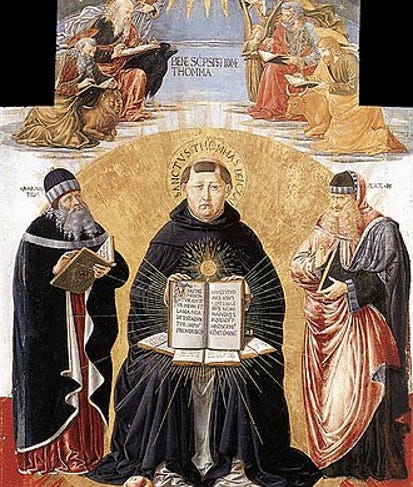
Thomas Aquinas was born near Roccasecca in the Kingdom of Sicily, probably in 1225, although both the year and the season remain uncertain. Born into a noble family, he was sent at about age five to the Benedictine monastery at Monte Cassino. Political conflict involving the papacy, Emperor Frederick II and Monte Cassino eventually disrupted this first education, and in autumn 1239 Aquinas entered the University of Naples. There he studied logic and natural philosophy and encountered the newly available writings of Aristotle and their Arabic commentators.
At Naples, Aquinas also encountered the Dominican order. His decision to join the Dominicans in 1244 defied his family’s plans for him. While he was traveling north, his brothers seized him and confined him for roughly eighteen months in an attempt to break his vocation. Aquinas refused to yield. After his release he went to Paris and then Cologne, where he studied under Albert the Great and began the apprenticeship that joined Aristotelian philosophy to Christian theology.
Aquinas returned to Paris in 1251 or 1252 to begin his public teaching career. He became a Master of Theology in 1256 amid a bitter dispute over the place of the mendicant orders within the university. Over the following two decades he taught in Paris and several Italian cities, advised the papal court, helped formulate the Dominican system of studies and composed the works upon which his reputation rests, including the Summa contra Gentiles and the unfinished Summa Theologiae.
His second Paris regency, beginning in 1269, placed him at the center of controversies over Aristotle and Latin Averroism. In 1272 he returned to Naples to establish a Dominican studium. On 6-Dec-1273, however, an unusually prolonged vision during Mass brought his writing to an abrupt end. Aquinas told his assistant that everything he had written now appeared to him as straw. He died at the Cistercian abbey of Fossanova on 7-Mar-1274 while traveling to the Second Council of Lyon.
The argument over his legacy continued after his death. The Paris condemnations of 1277 affected some positions associated with his work, but the Dominican order defended him. Aquinas was canonized in 1323, proclaimed a Doctor of the Church in 1567 and restored to a privileged position in Catholic philosophy by Pope Leo XIII in the nineteenth century.
Aquinas and the Civilization Creed
Thomas Aquinas does not possess a verified Jupiter in Leo. Why, then, include him in a series devoted to that placement?
The answer begins with Augustine of Hippo, whose horoscope does contain Jupiter in Leo. Augustine and Aquinas are frequently grouped together in philosophy courses as the two principal architects of Catholic philosophy. Augustine brought the Platonic tradition into Christianity; eight centuries later, Aquinas performed a comparable operation with Aristotle.
This series is also concerned with what might be called the civilization creed: the set of theological, philosophical and moral propositions through which a civilization explains itself. Few thinkers did more to formulate the creed of medieval Latin Christianity than Thomas Aquinas.
Aquinas did not simply defend Christian doctrine. He organized theology, natural philosophy, ethics, law and politics within an immense intellectual structure. His method was built upon distinctions, classifications and carefully ordered propositions. Objections were stated, authorities cited, answers supplied and apparent contradictions resolved. The result gave medieval Christianity a systematic account of the relationship between revelation and reason.
His influence did not end with the Middle Ages. In the 1879 encyclical Aeterni Patris, Pope Leo XIII encouraged the restoration of Christian philosophy according to the principles of Aquinas. Thomism subsequently regained a privileged position in Catholic seminaries, universities and intellectual life. Augustine may supply the direct Jupiter-in-Leo connection, but Aquinas belongs in any investigation of how a religious creed becomes an enduring civilizational system.
A Horoscope Without Birth Data
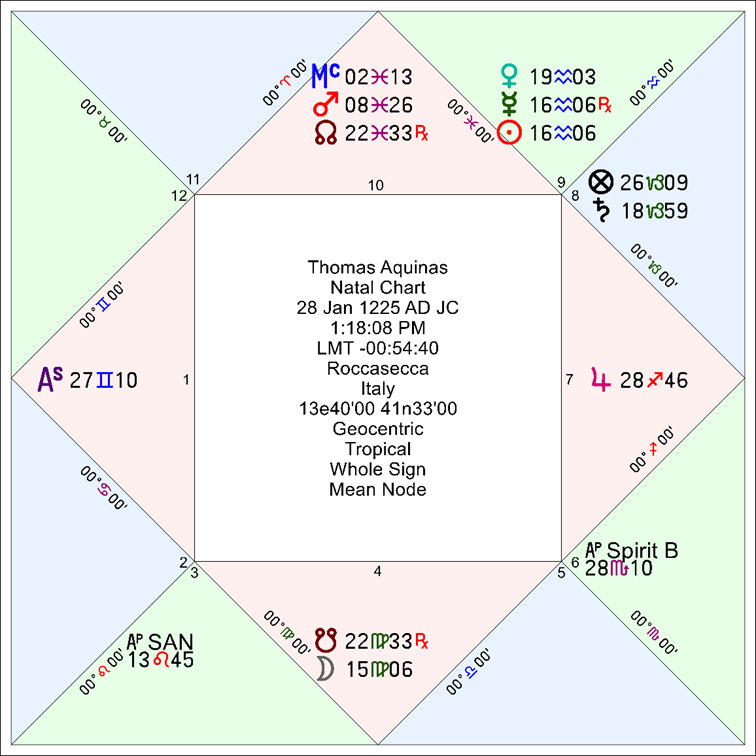
No recorded birth date or time survives for Thomas Aquinas. Even the year is disputed, with 1225 and 1227 both appearing in the biographical tradition. Some authorities who favor 1225 place his birth toward the end of that year rather than in January.
The horoscope presented here is therefore not a historical claim about when Aquinas was born. It is a divinatory experiment.
The date arose from January 28, the modern Catholic feast of Thomas Aquinas. This feast does not commemorate his birth. Aquinas died on March 7, which was formerly his feast day, but that date frequently falls during Lent. In 1969 the observance was moved to January 28, the anniversary of the translation of his remains to Toulouse in 1369.
January 28 is nevertheless a date on which the Church collectively encounters Thomas Aquinas. That made it a legitimate starting point for a divinatory inquiry, even though it supplied no evidence concerning his biological birth.
When 28-Jan-1225 was entered into the astrology software, an unusual configuration appeared: Mercury retrograde in Aquarius, almost exactly cazimi at inferior conjunction with the Sun. Venus was nearby, while Saturn and Jupiter—the rulers of the conjunction by sign and bound—were both strongly placed in signs of their rulership.
A proposed time of 1:18:08 PM placed Gemini on the Ascendant and the Sun–Mercury conjunction in the ninth house. The ruler of the Ascendant was therefore Mercury, situated in the house of religion, philosophy and higher learning.
The figure immediately presented a recognizable image of Aquinas.
Mercury in Aquarius and the Method of Thomism
Mercury signifies knowledge, interpretation, argument and intellectual method. Aquarius, ruled by Saturn, gives knowledge a systematic form. It favors axioms, classifications, rules and procedures—the architecture through which accumulated information becomes an organized body of thought.
Mercury retrograde returns to material already known. In Aquinas’s case, that material was the philosophy of Aristotle, much of which had been preserved and developed in the Islamic world before re-entering Latin Europe. Aquinas did not invent the intellectual sources upon which he worked. He recovered and reorganized them.
The solar phase adds another layer. My research suggests that a retrograde planet ordinarily displays some of the characteristics of the opposite sign. As it reaches inferior conjunction, however, it begins to recover the nature of its actual sign, a process completed after it stations direct.
Mercury retrograde in Aquarius can therefore initially behave as Mercury in Leo. At inferior conjunction it begins reclaiming Aquarius with exceptional force. In this figure, Mercury stands only seconds of arc from the heart of the Sun.
The Leo–Aquarius axis frequently describes the tension between authoritative belief and systematic knowledge. Leo establishes the creed; Aquarius organizes, tests and codifies it. Aquinas’s Mercury does not merely oppose one side to the other. At cazimi, it brings them together.
The Sun rules Leo and can be assigned to God, religious authority and the governing creed. Yet the Sun is placed in Aquarius, traditionally its sign of detriment. Divine authority has entered the territory of rational inquiry. Mercury, meanwhile, carries the intellectual procedure associated with Aquarius into the service of the Sun.
This is the central operation of Thomism. Aquinas did not subordinate revelation to philosophy, nor did he reject reason whenever it appeared to challenge doctrine. He distinguished truths available to natural reason from those known only through revelation and constructed a system in which the two could coexist because both ultimately originated in God.
Saturn and Jupiter reinforce the synthesis. Saturn rules the Sun–Mercury conjunction by sign and supplies structure, definition and logical discipline. Jupiter rules it by bound and supplies theology, doctrine and the search for higher truth. Both planets occupy signs of their rulership. Mercury therefore receives powerful support from the two principles Aquinas spent his life joining: rational order and religious meaning.
For these reasons, Mercury is unquestionably the victor of the divinatory horoscope. It describes not only Aquinas’s intelligence but the life purpose expressed through that intelligence: the reorganization of Christian theology through an Aristotelian method.
The Original Rectification
The original report examined several timing systems. Three measurements were especially notable.
Solar-arc directions brought the Sun–Mercury conjunction to the Midheaven around Aquinas’s transition into advanced university study and the intellectual environment in which he encountered Aristotle. This began the process that would eventually define his public vocation.
A much closer correspondence occurred at the end of his writing life. On 6-Dec-1273, Aquinas experienced an unusually prolonged vision while celebrating Mass. Afterward, he refused to continue dictating and reportedly told his assistant that everything he had written appeared to him as straw. Primary directions involving the Midheaven and the Sun–Mercury conjunction fell on 6 and 8 December.
The most exact solar-arc measurement brought the Ascendant to the opposition of the Sun on 7-Mar-1274, the date of Aquinas’s death. The opposition to Mercury followed two days later.
These measurements helped construct the original rectification, so they cannot all be treated as independent confirmation of the time.
An Independent Test, Ten Years Later
More than ten years after proposing the divinatory horoscope, I returned to it using zodiacal releasing from the Lot of Spirit. Zodiacal releasing played no role in selecting either the date or the time in 2015. Its results therefore supply a new and substantially more independent test: the periods divide Aquinas’s life into three coherent chapters and place a loosing of the bond almost exactly at the beginning of his second Paris regency.
None of this proves that Aquinas was born on 28-Jan-1225. Even his birth year remains uncertain. What it does provide is an unusually good test of whether a horoscope constructed on divinatory grounds can describe both the governing idea of a life and the concrete sequence of its biography.
The original rectification and a new report on the zodiacal-releasing results are attached for paid subscribers.
Three Chapters of Life
Zodiacal releasing from the Lot of Spirit divides the proposed horoscope into three principal L1 periods during Aquinas’s lifetime.
L1 Scorpio contains Aquinas’s childhood within the competing claims of his family and the Church.
At about age five he was placed with the Benedictines at Monte Cassino. His sister was killed by lightning during his childhood, while conflicts among the papacy, Frederick II and the regional nobility repeatedly affected Monte Cassino and Aquinas’s own family.
This is the least distinctive of the three periods because childhood necessarily entails dependency upon family and institutions. Nevertheless, it describes an enclosed beginning shaped by death, religious discipline, family power and political conflict.
The transition out of Scorpio is more interesting. Aquinas left the world of Monte Cassino and entered the University of Naples in autumn 1239. L1 Sagittarius began on 11-Nov-1239. Because the historical source provides only “autumn,” the move cannot be placed confidently on one side of the exact boundary. It nevertheless coincides closely with the beginning of a completely different chapter.
L1 Sagittarius contains the expansion of Aquinas’s intellectual and geographical world. At Naples he studied logic and natural philosophy and was probably introduced to Aristotle and his commentators. He encountered the Dominican order and chose to become a friar, rejecting the more prestigious ecclesiastical career his family had anticipated.
His family responded by having him captured and confined. Yet even the captivity resulted from a Sagittarian decision: Aquinas had attempted to leave the social and religious world assigned to him and join an international preaching order. After his release he traveled to Paris, studied under Albert the Great and followed Albert to Cologne. He began teaching and writing commentaries but remained fundamentally a student and apprentice.
The Sagittarius period ends on 8-Sep-1251. In 1251 or early 1252, Aquinas was selected to return to Paris as a bachelor and begin his independent public career.
L1 Capricorn therefore commences at almost exactly the correct biographical threshold. The student becomes a teacher; the apprentice becomes an authority; acquired knowledge becomes a durable intellectual structure.
The Capricorn period contains Aquinas’s entire mature career: his commentary on the Sentences, admission as Master of Theology, defense of the mendicant orders, teaching appointments across France and Italy, service to the papal court, participation in Dominican educational policy, completion of the Summa contra Gentiles, composition of the Summa Theologiae, second Paris regency, establishment of a studium at Naples and the final cessation of his writing.
The Sagittarius–Capricorn transition is the strongest L1 result. Sagittarius opened the world through education, travel and religious vocation. Capricorn transformed that education into a systematic body of work supported—and sometimes contested—by the principal institutions of medieval Christianity.
Foreshadowing and Loosing of the Bond
Within L1 Capricorn, a Cancer L2 period ran from 20-Nov-1260 to 9-Dec-1262. Zodiacal releasing identifies this as a foreshadowing period: an initial presentation of a theme that should return in amplified form when the sequence later breaks its normal order at the loosing of the bond.
During the Cancer foreshadowing period, Aquinas was called to Orvieto as lector and became closely attached to the papal court of Urban IV. He completed the Summa contra Gentiles, preached and taught within the papal environment, and was asked to address important doctrinal questions, including the projected reunion of the Latin and Greek churches.
The theme was Aquinas being summoned into an institutional center and asked to apply philosophy to a problem affecting Christian doctrine.
The Cancer loosing of the bond began on 7-Jan-1269. Aquinas arrived in Paris that same month to begin his second teaching regency.
The earlier theme now returned under more contentious circumstances. Paris had become the center of an increasingly bitter dispute over Aristotle, Latin Averroism and the limits within which pagan philosophy could be reconciled with Christian teaching. Aquinas was no longer working under relatively protected papal patronage. He was intervening in a public intellectual conflict involving university factions, ecclesiastical authority and the possibility of formal condemnation.
In 1270 Bishop Étienne Tempier condemned thirteen Aristotelian and Averroistic propositions. Aquinas responded to the surrounding controversy through sermons, treatises and a series of disputations that clarified the relationship among intellect, moral agency and Christian doctrine.
The two Cancer periods do not concern precisely the same theological question. Reunion with the Greeks is not Latin Averroism. Their common structure is nevertheless clear. In each period Aquinas is called into an institutional center to use philosophical reasoning in the service of an urgent doctrinal problem. During the foreshadowing period this occurs through papal sponsorship; at the loosing of the bond it becomes open combat in the most important university in Europe.
The beginning of the loosing of the bond only weeks—and possibly days—before Aquinas’s arrival in Paris is an impressive result.
The Completion Period
The final L2 Capricorn period began on 24-Feb-1277. This is designated as a completion period, returning to the same sign as the encompassing L1 period and bringing its principal business toward a conclusion.
Aquinas had been dead for nearly three years. Yet only eleven days after the completion period began, on 7-Mar-1277, Tempier issued a much larger condemnation of 219 propositions. Some were associated with Aquinas or could be interpreted as affecting positions he had defended.
The condemnation occurred on the third anniversary of his death. It temporarily damaged the standing of his scholarship and forced his successors to defend, distinguish and refine the intellectual structure he had left behind.
This was not the final judgment on Thomism. Aquinas’s canonization, elevation as Doctor of the Church and eventual restoration under Leo XIII still lay in the future. The 1277 condemnation instead completed the first cycle of his professional legacy.
The work constructed throughout L1 Capricorn had passed out of its author’s hands. It now existed as an institutional object that could be examined, judged, condemned and defended. The completion period did not bring Aquinas’s triumph; it brought the first formal reckoning with what he had built.
What Has Been Demonstrated?
None of these findings proves that Thomas Aquinas was born on 28-Jan-1225. The historical evidence does not permit that conclusion, and the date conflicts with traditions placing his birth either late in 1225 or sometime in 1227.
The horoscope may instead belong to Aquinas’s enduring ecclesiastical identity: not necessarily the biological man at birth, but Thomas Aquinas as encountered by the Church and preserved within Western intellectual history.
That is why the description “divinatory horoscope” matters. The claim is limited but still consequential. A feast-day chart produces an almost exact cazimi Mercury in Aquarius that describes the philosophical method of Thomism. A time chosen ten years ago places Mercury, ruler of the Ascendant, in the ninth house and generates directions to his final vision and death. Zodiacal releasing—unused in the original rectification—then divides his life into childhood formation, intellectual expansion and systematic construction, placing a loosing of the bond at his return to Paris and a completion period at the first institutional judgment of his legacy. This cannot certify the nativity of Thomas Aquinas. Even so, the horoscope has done far more than one without birth data has any right to do.
Complete biographical chronology, rectification and time lord studies available in Excel format as a paid subscriber benefit. Files are behind the paywall.