

Introduction
Last week I finished reading Michael Grant’s biography of Constantine the Great while simultaneously completing his natal horoscope, victor analysis, time lord studies, and delineation. That research will drop next Wednesday as the next installment in the Jupiter in Leo series.
Unexpectedly, the project also answered three questions I had about the astrologer Julius Firmicus Maternus. Why was he able to compose the greatest surviving Latin handbook of astrology almost exactly as Constantine’s reign came to an end, when Constantine had already embraced Christianity? Why does the Mathesis include so many delineations on moral and sexual purity? And why, only a few years later, did the same author publish a vigorous attack on pagan religious practices (for which astrology was included)?
I believe Constantine’s horoscope provides the key to answering the first two questions. The third can be explained from the changing religious policies of Constantine’s sons.
Question 1. Why was Firmicus Maternus able to write an astrological handbook under Constantine?
At first glance this seems paradoxical. Constantine publicly embraced Christianity following the Battle of the Milvian Bridge and increasingly favored the Church throughout his reign. Yet the Mathesis, the last great handbook of Hellenistic astrology written in Latin, reached completion around 334–337 CE, almost exactly contemporaneous with Constantine’s final years and his death in 337. Rather than suppressing astrology, the emperor permitted its continued practice among educated Romans.
Constantine’s horoscope offers what I believe is the missing piece of the puzzle.
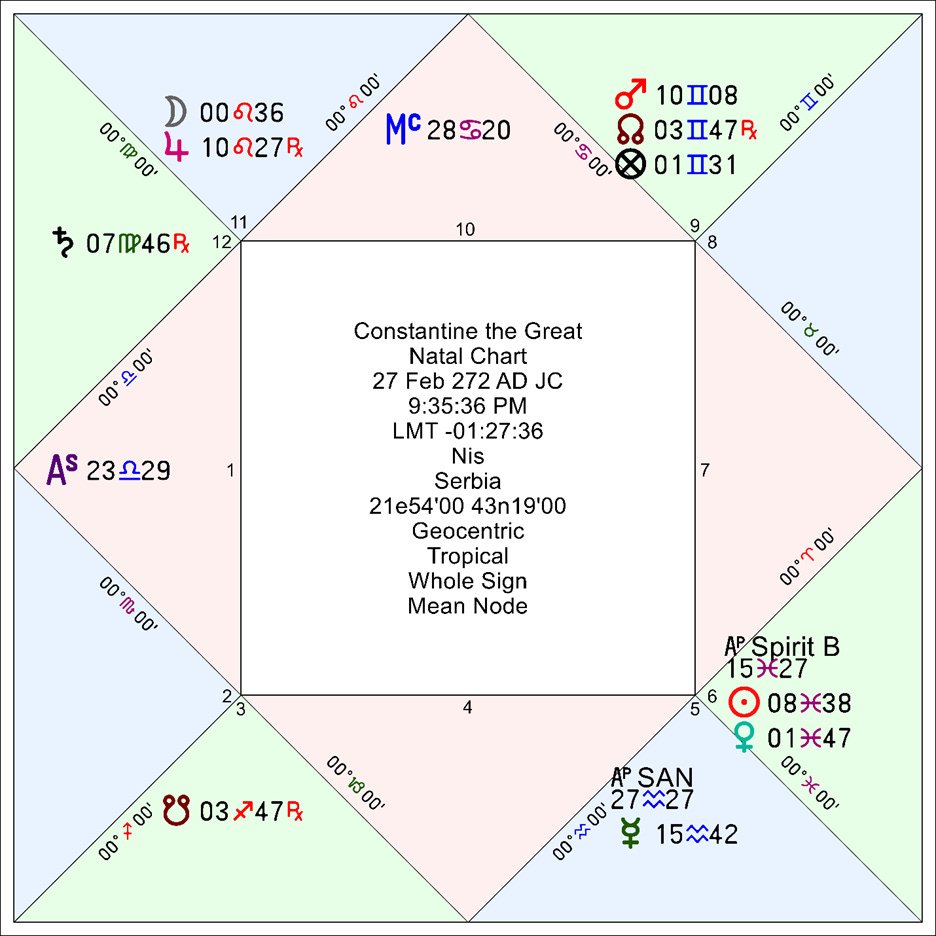
No Astrodatabank Record. Rectified by the Author.
Readers of this series know my working hypothesis that retrograde superior planets normally behave as though placed in the opposite sign. There is, however, an important exception. From the planet’s morning heliacal setting through shortly after its acronychal rising, increasing brightness in the evening sky temporarily restores the planet’s direct-motion behavior. As the planet slowly recedes from opposition with the Sun and its brightness gradually diminishes, it progressively resumes expressing the qualities of its opposite sign until it stations direct.
Constantine was born approximately one month after Jupiter’s acronychal rising, at a point when Jupiter’s brilliance in the evening sky had already begun its gradual decline. Under this interpretation, Jupiter increasingly takes on the qualities of Aquarius. While Jupiter in Leo established Christianity as the empire’s official creed, the growing influence of Jupiter in Aquarius encouraged accommodation rather than immediate religious uniformity. Constantine therefore advanced Christianity gradually while allowing much of the existing pagan religious world to continue functioning.
The historical record matches this symbolism remarkably well. Constantine endowed churches, favored Christian bishops, and convened the Council of Nicaea in 325, yet he did not immediately dismantle the existing religious order. Pagan temples generally remained open, traditional priesthoods continued to function, and even the Arch of Constantine, dedicated in 315 after his victory over Maxentius, incorporated earlier imperial reliefs depicting sacrifices to Apollo, Hercules, and other pagan deities. Christianity itself was hardly a unified political force. The Donatist controversy in North Africa and the later Arian dispute demonstrated that Christians were deeply divided among themselves. Constantine proved to be a political realist. Rather than attempting to replace one religious system with another overnight, he gradually elevated Christianity while accommodating much of the existing religious landscape.
Under such conditions, it is hardly surprising that Firmicus was able to complete the Mathesis. Astrology, traditional philosophy, and many elements of pagan culture still occupied a legitimate place within educated Roman society. The Mathesis should therefore be understood not as an anomaly, but as a product of Constantine’s transitional religious settlement.
Question 2. Why does Firmicus Maternus emphasize moral and sexual purity throughout the Mathesis?
In his introduction to the Mathesis, translator Benjamin Dykes observes:
“Indeed, taken as a whole the Mathesis is full of his expression of moral and sexual purity which is important for connecting with the Divine. It could be that the new Christian religion fitted this austere moral sense better than a lot of the other popular pagan practices he was familiar with.”
Benjamin N. Dykes, introduction to Mathesis (Minneapolis, MN: Cazimi Press, 2023), 6.
That is certainly possible. There is, however, a simpler explanation worth considering. Its repeated emphasis on moral discipline is entirely consistent with the increasingly conservative cultural climate promoted by the emperor himself.
In Constantine’s horoscope, Saturn in Virgo retrograde lies just before its acronychal rising, is near its brightest appearance in the evening sky, and therefore expresses the qualities of direct-motion Saturn in Virgo. Saturn in Virgo is naturally concerned with discipline, regulation, and law. As a refinement, Saturn’s position in the bound of Venus in Virgo focuses its efforts toward Venusian topics such as sexual conduct, marriage, chastity, and moral behavior. The bound ruler, Venus in Pisces, is both exalted and placed in her own bound, describing a ruler who sought to elevate the quality of Venusian affairs by encouraging fidelity, modesty, and higher standards of personal conduct. Saturn’s placement in the bound of Venus/Virgo therefore links Constantine’s concern for public order directly with the regulation of Venusian behavior.
The timing is especially noteworthy. Only eight years before Firmicus likely completed the Mathesis, Constantine issued a remarkable series of laws regulating sexual conduct and family life. Compared with Diocletian, Constantine extended Roman law more deeply into questions of personal morality. Whereas Diocletian’s legislation primarily sought to preserve public order and administrative stability, Constantine increasingly treated marriage and sexual relations as matters of moral discipline worthy of state intervention. His legislation strengthened protections for women against abduction and sexual assault, imposed severe penalties upon guardians who violated female wards entrusted to their care, prohibited married men from maintaining concubines, and tightened the law governing adultery by restricting who could bring accusations while increasing the seriousness of its punishment. The most notorious statute, issued on 1 April 326, ordered that servants or nurses who persuaded young women to participate in an abduction should suffer molten lead poured down their throats—a punishment intended to destroy the very mouth that had encouraged the crime. Collectively these reforms reveal an emperor who regarded sexual conduct, marriage, and family life not merely as private matters but as subjects of public morality requiring increasingly strict legal regulation.
Whether Firmicus’ moral outlook arose from personal conviction, an early attraction to Christianity, or admiration for Constantine’s program cannot be known with certainty. Yet when the Mathesis is read against the political and legal culture of Constantine’s reign—and against the symbolism of Constantine’s own horoscope—its tone of moral and sexual purity no longer seem surprising. No wonder Firmicus wrote as he did.
A Final Question for Astrologers
Astrologers familiar with the Mathesis often notice an apparent contradiction. The work was completed approximately 334–337 CE, almost exactly contemporaneous with Constantine’s death in 337. Yet only a few years later, probably between 346 and 350, Firmicus composed On the Error of Pagan Religions, one of antiquity’s strongest attacks on pagan cults. What changed?
Unlike Constantine, neither of his sons Constantius II nor Constans possesses a usable natal horoscope. Constantius II has only a recorded birth date without a birth time, while Constans lacks even a secure birth date. Consequently, no comparable astrological analysis is presently possible. Fortunately, for this question the historical record is sufficient.
The difference between father and sons is striking. Constantine gradually elevated Christianity while generally permitting pagan cults to continue. His sons adopted a noticeably more interventionist policy. Beginning in the early 340s, imperial legislation progressively prohibited animal sacrifice, specifically outlawed nocturnal sacrifices, ordered the closure of some temples, increased penalties for participation in traditional pagan rites, expanded legal privileges granted to the Christian Church, and increasingly identified imperial authority with Christian religious institutions. Provincial governors were instructed to enforce these measures, although historians recognize that enforcement varied considerably throughout the empire. Nevertheless, the overall direction of policy is unmistakable. Christianity was no longer simply the emperor’s favored religion; it was becoming the exclusive religious identity that successive emperors increasingly sought to promote.
Read against this political backdrop, Firmicus’ second book becomes much less surprising. The Mathesis, completed almost simultaneously with Constantine’s death, reflects an empire in which Christianity, astrology, classical philosophy, and many traditional cults still coexisted. On the Error of Pagan Religions, by contrast, reflects an empire whose rulers were actively dismantling that older religious order. Firmicus’ own religious convictions undoubtedly evolved during this period, but the changing political environment should not be overlooked. His two surviving works align remarkably well with two distinct phases in the Christianization of the Roman Empire: Constantine’s gradual accommodation of the pagan world, followed by the more assertive policies pursued by Constantius II and Constans.
Conclusion
Constantine’s horoscope appears to answer two longstanding questions surrounding the Mathesis. First, Jupiter in Leo retrograde, approximately one month after its acronychal rising and increasingly expressing the qualities of Aquarius, helps explain why Constantine introduced Christianity gradually rather than attempting to eradicate paganism immediately. Such an environment readily accounts for Firmicus’ ability to complete the greatest surviving Latin handbook of Hellenistic astrology almost exactly as Constantine’s reign came to an end.
Second, Saturn in Virgo retrograde, just before its acronychal rising and acting according to its direct-motion behavior, offers a compelling explanation for Constantine’s unusually strong emphasis on public morality. When read alongside the emperor’s legislation regulating marriage, adultery, guardianship, and sexual conduct, discussion of moral and sexual purity throughout the Mathesis no longer appear accidental. They reflect an intellectual climate in which such themes had become central to imperial policy.
The final question—the dramatic change in tone between the Mathesis and On the Error of Pagan Religions—requires no horoscope. The increasingly interventionist religious policies of Constantius II and Constans provide sufficient historical context. Whether Firmicus’ own convictions evolved independently or simply found fuller expression under Constantine’s sons cannot be known with certainty. Either way, his two surviving books mirror two distinct stages in the Christianization of the Roman Empire.
Further Reading
Readers wishing to pursue this subject further should begin with Benjamin Dykes’ excellent introduction to his translation of the Mathesis. It provides the best overview of Firmicus’ life, his astrological philosophy, and the historical setting in which the Mathesis was composed.
Firmicus Maternus, Julius. Mathesis. Translated and edited by Benjamin N. Dykes. Minneapolis, MN: Cazimi Press, 2023.
Dykes’ introduction is the best starting point for astrologers. He summarizes Firmicus’ life, discusses the dating of the Mathesis, examines the author’s later conversion to Christianity, and explores the strong emphasis on moral and sexual purity that runs throughout the work.
https://www.amazon.com/Mathesis-Julius-Firmicus-Maternus/dp/1934586544
Cristiana Sogno. “Astrology, Morality, the Emperor, and the Law in Firmicus Maternus’ Mathesis.” Illinois Classical Studies 30 (2005): 167–176.
The best scholarly discussion of how the Mathesis reflects Constantinian political thought. Sogno demonstrates how Firmicus adapted traditional astrology to the changing imperial ideology by treating the emperor as occupying a unique position beyond ordinary astral determination.
https://www.jstor.org/stable/10.2307/i23059378
David Potter. “Firmicus Maternus, Iulius.” Oxford Classical Dictionary. Oxford University Press, 2015.
A concise but authoritative overview of Firmicus’ life, the chronology of his two surviving works, and their place within the intellectual world of the fourth century. Potter clearly distinguishes the Mathesis of Constantine’s reign from On the Error of Pagan Religions written under Constantine’s sons.
https://academic.oup.com/edited-volume/61673/chapter-abstract/548937019
Mattias P. Gassman. “On the Error of Profane Religions: Emperors and Traditional Religion after Constantine.” In Worshippers of the Gods: Debating Paganism in the Fourth-Century Roman West. Oxford: Oxford University Press, 2020.
Gassman argues that On the Error of Pagan Religions should be interpreted within the religious policies of Constantius II and Constans rather than Constantine himself. The chapter provides an excellent account of the increasingly interventionist Christian legislation enacted after 337.
https://academic.oup.com/book/40535/chapter/347858857
Mattias P. Gassman. “Converting after Constantine: Firmicus Maternus and the Scriptures.” Journal of Early Christian Studies 31, no. 4 (2023): 595–620.
A detailed study of Firmicus’ conversion to Christianity and his use of Scripture in On the Error of Pagan Religions. Although focused more on theology than astrology, the article helps explain the intellectual transformation that accompanied the changing religious climate of the mid-fourth century.