

With the North Node now moving through Aquarius and the bound of Saturn, the Aquarius natal database turns to one of Saturn/Aquarius’s most recognizable modern manifestations: engineering, systems design and computer architecture. The placement appears in the horoscopes of people who understood that technological power resides not simply in individual inventions, but in the architecture that organizes them into functioning systems.
Ada Lovelace offers a useful break from the parade of modern tech bros. Nearly two centuries before Silicon Valley, her Saturn/Aquarius described an ability to perceive the system behind a machine. Charles Babbage conceived the Analytical Engine, but Lovelace grasped that its architecture could extend beyond numerical calculation: if information could be represented symbolically, the machine might operate upon it. Her famous suggestion that the Engine could manipulate musical notes and potentially compose elaborate music anticipated the conceptual leap from calculator to general-purpose computer.
The astrology makes the case more interesting. Mercury/Sagittarius, victor of the horoscope, supplies mathematics, symbolic thought and an expansive intellectual reach. But it is the Moon/Aries rising, separating from Mercury and applying to Saturn/Aquarius, that carries those ideas into the structure of a system. The rising Moon adds both Lovelace’s head-first temperament and a prophetic quality: intuition accumulated during the Moon’s passage beneath the horizon can burst forth at the Ascendant fully formed. In Lovelace’s case, what emerged was a conception of computing that the available machinery could not yet realize.
Lovelace also provides the first of several opportunities in this series to examine Saturn/Aquarius as a technological signature. Next week comes Jensen Huang, whose Saturn/Aquarius operates through the architecture and command-and-control systems behind modern computing; before the series is finished, Jeff Bezos will provide another variation on the same placement. Lovelace comes first chronologically—and shows just how early the Saturnian architecture of the computer age can be found.

Augusta Ada Byron was born in London on 10 December 1815, the only legitimate child of the poet Lord Byron and Anne Isabella Milbanke. Her parents’ marriage collapsed almost immediately. Lady Byron left her husband with five-week-old Ada in January 1816, and Byron departed England permanently three months later. He died in Greece in 1824, when Ada was eight; father and daughter never met again after her infancy.
Lady Byron supervised an unusually rigorous private education for her daughter, emphasizing mathematics, logic, and science. The program was partly motivated by her determination to counter what she regarded as the dangerous emotional tendencies Ada might have inherited from Byron. The result was not the suppression of imagination but its combination with mathematics. At twelve, Ada undertook an investigation of human flight, studying bird anatomy, experimenting with materials for wings, and developing plans for a flying machine in a project she called “Flyology.”
Serious illness interrupted her adolescence. Ada contracted measles in 1829 and suffered a prolonged period of impaired mobility, spending considerable time bedridden and later using crutches. By 1832 her health had improved sufficiently for her studies and social life to resume. She was presented at court the following year and began entering the scientific circles that would determine the direction of her life.
On 5 June 1833, seventeen-year-old Ada met Charles Babbage, the mathematician and inventor then attempting to mechanize mathematical calculation. Less than two weeks later, she and her mother visited Babbage and saw a working portion of his Difference Engine. While other visitors reportedly regarded the machine primarily as a mechanical curiosity, Ada was fascinated by its underlying principles. Babbage became an intellectual mentor and eventually a collaborator.
Through mathematician and science writer Mary Somerville, Ada gained further access to Britain’s scientific community. By late 1834 she was studying Babbage’s plans for the much more ambitious Analytical Engine. Unlike the Difference Engine, designed to generate predetermined classes of mathematical tables, the Analytical Engine was conceived as a general-purpose calculating machine controlled by punched cards. Its proposed division between a “store” holding numbers and a “mill” performing operations anticipated the distinction between memory and processing in later computers.
Ada’s scientific development competed with the conventional obligations of aristocratic life. On 8 July 1835 she married William King, 8th Baron King. Their first child, Byron, was born in May 1836, followed by Annabella in September 1837 and Ralph Gordon in July 1839. In June 1838 William was created Earl of Lovelace, making Ada the Countess of Lovelace, the name by which she became known to history.
After the births of her children, Lovelace deliberately returned to mathematics at a higher level. In 1839 she sought an advanced tutor, and the following year began serious study with Augustus De Morgan, professor of mathematics at University College London. Their surviving correspondence shows her wrestling with algebra, calculus, and increasingly difficult mathematical concepts, providing important evidence against later claims that her mathematical knowledge was largely superficial.
The event that established Lovelace’s historical reputation began indirectly. In 1841 Babbage presented the Analytical Engine to scientists and engineers in Turin. Italian mathematician Luigi Federico Menabrea subsequently published a French account of the machine. Lovelace translated Menabrea’s article into English in 1842 and, at Babbage’s suggestion, began adding explanatory notes of her own.
During the summer of 1843, Lovelace and Babbage worked intensively on the project. Her resulting Notes A–G were considerably longer than Menabrea’s original article and moved beyond translation into an examination of how the Analytical Engine would operate and what such a machine might ultimately accomplish.
The most famous section was Note G, which presented a sequence of operations by which the Analytical Engine could calculate Bernoulli numbers. Lovelace and Babbage collaborated closely: Babbage supplied the machine architecture and assisted with the mathematics, while surviving correspondence shows Lovelace working through the procedure, detecting an error in material supplied by Babbage, and constructing the published operational table. The result is generally regarded as the first substantial published algorithm designed for execution by a general-purpose computing machine, although Babbage himself had devised programs for the Analytical Engine earlier.
Her more consequential insight may have been conceptual rather than mathematical. Lovelace recognized that the Analytical Engine was fundamentally different from an ordinary calculating machine. If quantities inside it could represent entities other than numbers, the machine could theoretically manipulate any material whose relationships could be expressed according to formal rules. She suggested that if musical relationships could be represented appropriately, the Engine might compose elaborate pieces of music. In her memorable formulation, the Analytical Engine could “weave algebraical patterns” just as the Jacquard loom wove flowers and leaves.
This anticipated general-purpose computing. Lovelace grasped that the machine’s significance lay not simply in faster arithmetic but in manipulating symbolic representations according to programmed instructions. At the same time, she imposed an important limitation: the Engine had no power to originate anything independently and could perform only operations humans knew how to instruct it to perform. More than a century later, Alan Turing would identify this proposition as “Lady Lovelace’s objection” while discussing whether machines could think.
Lovelace’s translation and Notes appeared under the initials A.A.L. in Taylor’s Scientific Memoirs in August 1843. It was the central scientific publication of her short life. Days later she proposed a more formal partnership with Babbage in which she would assume a greater organizational role in advancing his projects. Babbage declined, although their friendship and correspondence continued.
Her ambitions extended beyond computing. In October 1844 she wrote to physicist Michael Faraday about developing a mathematical analysis of the nervous system. She envisioned a broader program she called “poetical science,” combining mathematical rigor with imagination and extending into electricity, magnetism, physiology, and the operations of the brain. Most of these projects never advanced beyond preliminary ideas.
Her later years were increasingly constrained by recurrent illness. She also became involved in horse racing and attempted to apply mathematical reasoning to predicting racing results. The enterprise proved unsuccessful and contributed to financial difficulties. By the summer of 1851 she was gravely ill with uterine cancer. She died on 27 November 1852, only thirty-six years old, and at her request was buried beside the father she had never known, Lord Byron, at the Church of St Mary Magdalene in Hucknall.
For decades Lovelace occupied a relatively minor place in the history of mathematics. Her reputation revived alongside electronic computing. In 1950 Turing brought her argument about machine originality into the modern debate over artificial intelligence, and in 1953 her 1843 Notes were republished in B. V. Bowden’s Faster Than Thought. During the late twentieth century she became the subject of competing biographies and reassessments concerning both her mathematical abilities and the respective contributions of Lovelace and Babbage.
Her name became permanently embedded in computing when the U.S. Department of Defense named its new programming language Ada in her honor around 1979–1980; Ada became an ANSI standard in 1983. The construction of Babbage’s Difference Engine No. 2 at London’s Science Museum in 1991, followed by its printer in 2002, demonstrated that Babbage’s mechanical designs could function when built according to his plans, although this was not the Analytical Engine on which Lovelace had worked.
Modern scholarship has moderated some of the more expansive claims made for Lovelace without diminishing the importance of what she accomplished. Calling her simply the inventor of computer programming obscures Babbage’s prior programs and the collaborative nature of their work. Yet reducing her to Babbage’s publicist or amanuensis is equally difficult to reconcile with the surviving manuscripts and correspondence.
Lovelace’s historical importance rests on a narrower but more durable achievement. She understood unusually early that a programmable calculating machine represented something more general than a calculator. The Analytical Engine could operate upon abstract representations according to formal instructions, potentially extending mechanical computation into domains beyond arithmetic. In an age when even the mechanical production of mathematical tables remained an ambitious technological project, Lovelace had begun to imagine the conceptual territory of the modern computer.
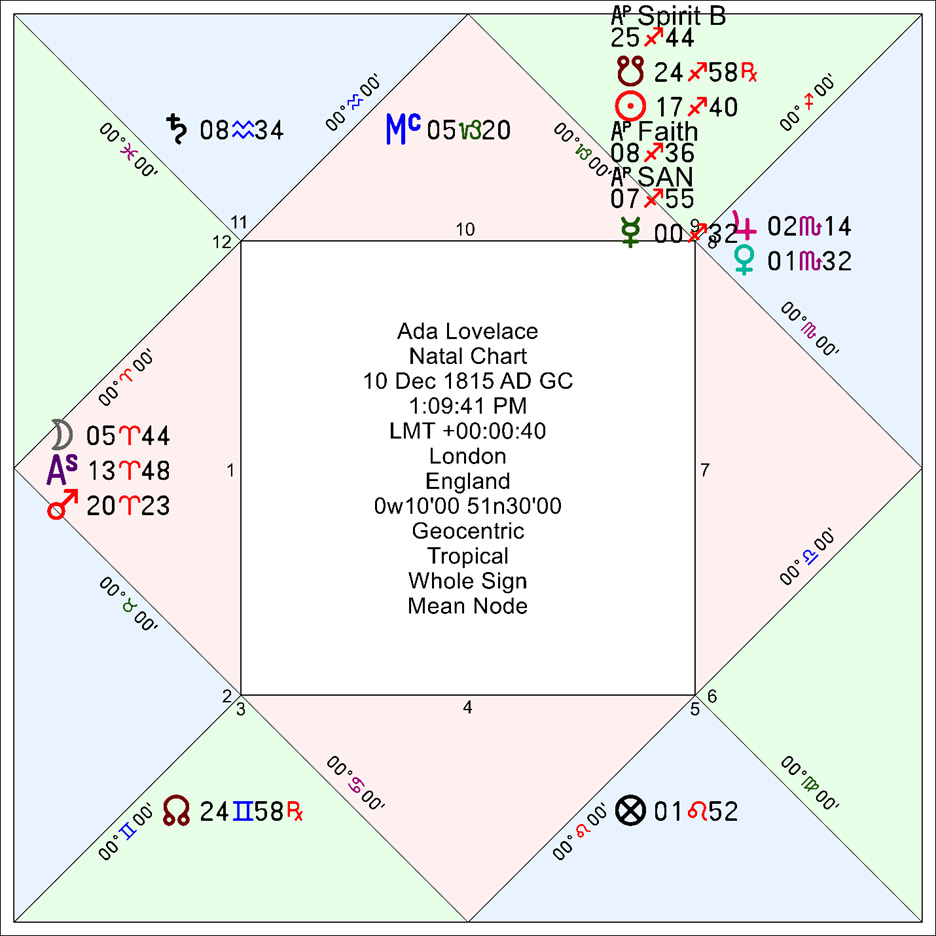
Rodden Rating B, Bio/autobiography, 1:00 PM, ASC 8AR05
Proposed Rectification: 1:09:40 PM, ASC 13AR48’02”
The analytical models used in the sections below are part of a larger research program developed across longer white papers and case studies, where the historical sources, rules, and testing methodology are laid out in full. These database entries show the models in practice; readers who want the theoretical foundations can start with the background papers below:
Rectification Hub (I wrote the book on it!)
Soul Hub (white paper, Victor model statistical tests, Moon’s Configuration studies)
Physiognomy Hub (white paper, examples)
Victor Model Factors favoring Mercury/Sagittarius
Bound ruler: Sun, Ascendant, Midheaven
Mercury/Sagittarius as Victor. Mercury in Sagittarius as victor places mathematics, symbolic systems, and the communication of complex ideas at the center of Lovelace’s life. Its house placement describes two dimensions of that work. Mercury in the 9th by whole-sign houses readily signifies advanced learning, mathematics, and the pursuit and transmission of knowledge. Mercury in the 8th by quadrant houses invokes the older meaning of the 8th discussed in the Edward Bellamy horoscope: Epicataphora, “falling down into the Underworld,” the portal through which one descends into a realm ordinarily concealed from view. With Lovelace the descent is intellectual rather than Bellamy’s almost literal journey underground: Mercury goes down the rabbit hole of Babbage’s machinery, following the mathematics into its hidden architecture until Lovelace encounters something not apparent at the surface—the theoretical possibility of a machine manipulating symbols rather than merely calculating numbers. The 9th-house Mercury therefore learns the mathematics; the 8th-house Mercury descends through it, discovering what lies on the other side of calculation.
Mercury’s ruler, Jupiter/Scorpio, lies twelve signs from Mercury in Mercury’s derived house of enemies, describing an impediment embedded within the very Jupiterian institutions and teachers responsible for higher learning. The delineation is particularly striking during Lovelace’s Jupiter return. Beginning in the summer of 1840, Augustus De Morgan gave her access to mathematics normally reserved for male university students, advancing her studies through algebra, trigonometry and calculus. Yet De Morgan also shared the prevailing assumptions of his era concerning the limitations of women as mathematicians, even while privately recognizing Lovelace’s unusual abilities. Jupiter thus performs a double role: De Morgan opens the door to advanced mathematics while simultaneously representing the male educational order that determined how far a woman was expected to proceed through it. For Mercury as victor, the dispositor provides the knowledge but also describes the resistance encountered in acquiring it.
Finally, Mercury in Sagittarius should not by itself be mistaken for prophecy. Mercury in Jupiter’s expansive sign is capable of ambitious ideas, speculation, tall tales and dreams that outrun what can be demonstrated or accomplished. Something else in the horoscope must distinguish the productive vision from the merely fanciful one. Here the Moon/Aries conjunct the Ascendant separates from Mercury and translates its light to Saturn/Aquarius. The cardinal-fire Moon supplies initiative, headstrong intuition and the willingness to pursue Mercury’s possibilities, while Saturn/Aquarius provides the theoretical structure into which those ideas can be delivered. Without that translation, Mercury/Sagittarius might have remained a dreamer; with it, Lovelace was able to infer from an unbuilt mechanical computer a larger architecture of programmable symbolic manipulation. The mechanics of this translation will be developed fully in the Moon’s Configuration below; for the victor it is enough to distinguish Mercury as the source of the mathematical vision from the lunar-Saturnian process that gave that vision structure and made it something more than speculation.
Physiognomy Model Factors favoring Aries, Sagittarius
Rising sign: Aries
Ruler of rising sign: Mars/Aries
Planets in rising sign: Moon/Aries, Mars/Aries
Rising decan: Leo
Ruler of rising decan: Sun/Sagittarius
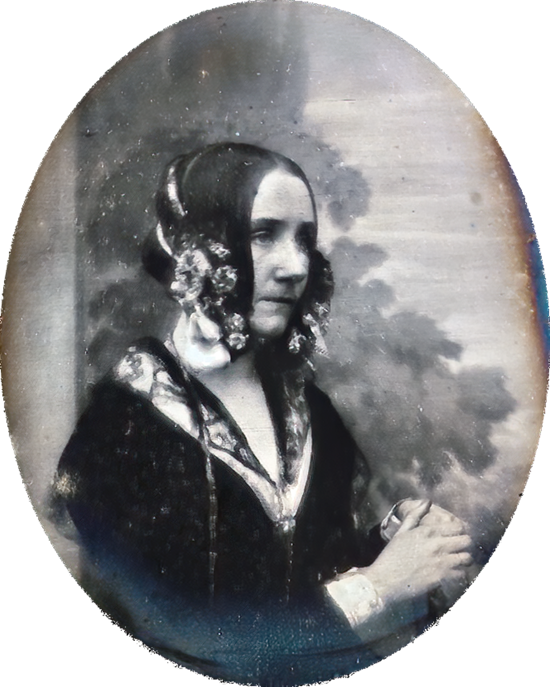
Lovelace presents a long, narrow figure with a slender neck and a distinctly tapered face. The forehead and upper face are comparatively broad, while the cheeks narrow through the lower face toward a small, pointed chin, producing a bony ovate or almost inverted-triangular outline. The daguerreotype makes the geometry particularly noticeable: the exposed neckline descends sharply into a narrow arrowhead-like point, visually repeating the taper of the face above it. Her hair is abundant and long, arranged in heavy sections and curls falling along either side of the face; even in the painted portrait, where the features are softened, the underlying facial taper remains visible.
Aries is the primary physiognomic significator, producing the bony ovate: greater width above followed by a decisive narrowing toward the chin. The pointed geometry is reinforced in the daguerreotype by the arrowhead neckline, an unusually clear visual repetition of the Aries form and a feature that appears in other representations of Lovelace as well. Sagittarius provides the secondary influence, most visibly in the length and abundance of the hair, while also tending to elongate rather than compress the overall figure. The combination therefore reads coherently: Aries supplies the bone structure, taper and point; Sagittarius stretches the form and supplies the long hair.
Moon’s Configuration
Stage 1 — Moon separates from Mercury (Sagittarius, 8th/9th)
Delineation. The Moon at 5°44′ Aries separates from Mercury at 0°32′ Sagittarius, carrying forward the significations of Mercury/Sagittarius, already identified as victor of the horoscope. Mercury signifies mathematics, calculation, symbolic language and the communication of ideas; Sagittarius enlarges its field of vision, encouraging the mind to move from the particular calculation toward what the calculation might mean. Its placement in the 9th by whole signs describes advanced learning and mathematics, while its 8th-house quadrant placement invokes Epicataphora, the descent into the Underworld discussed in the Edward Bellamy horoscope: Mercury goes down the rabbit hole, penetrating Babbage’s machinery until its underlying possibilities become visible. The Moon therefore begins its configuration by taking up precisely the mathematical and speculative material that defines Lovelace’s intellectual life.
Biographical Match. Lovelace’s education increasingly concentrated upon mathematics, culminating in her advanced studies with Augustus De Morgan and her collaboration with Charles Babbage. Her 1843 Notes demonstrate the characteristic movement of Mercury/Sagittarius from the specific toward the general. She did not stop with explaining how the Analytical Engine could calculate Bernoulli numbers; she asked what kind of machine it actually was. From the mechanics of calculation she inferred the broader principle that anything capable of symbolic representation might potentially be subjected to the Engine’s operations. Mercury supplies the mathematical material and the expansive idea, but by itself does not explain why this speculation became prophetic rather than simply another ambitious Victorian technological dream.
Stage 2 — Moon in Aries conjunct the Ascendant
Delineation. The Moon at 5°44′ Aries lies in the rising sign with the Ascendant at 13°48′ Aries, making the Moon unusually prominent in both character and bodily life. Moon/Aries is head-first: cardinal fire acts quickly, asserts itself, trusts immediate perception and pushes into territory rather than waiting for permission. A rising Moon also carries the prophetic testimony encountered elsewhere in the natal database, including H. G. Wells, Rebecca West and Henri Bergson. Having traversed the six houses below the horizon, the Moon arrives at the eastern horizon carrying a full reservoir of intuitive knowledge accumulated in darkness; at the Ascendant, that material can burst into consciousness fully formed, almost Athena-like, as prophecy rather than as a conclusion reached step by step. Yet the same position has a difficult bodily implication. At the eastern horizon the Moon crosses from the nocturnal hemisphere, where it possesses its proper sect status, into daylight; the Moon is effectively blinded by the light as it rises, associating a prominent rising Moon with bodily vulnerability and recurrent illness.
Biographical Match. The Aries quality is conspicuous in Lovelace’s intellectual self-assertion. In August 1843, at twenty-seven and in a culture offering women almost no formal standing within professional mathematics, she proposed a working arrangement with Babbage in which she would take a substantial role in advancing his projects—approaching him less as an admiring pupil than as a prospective collaborator and near-peer. The same head-first intuition helps distinguish her from a Mercury/Sagittarius that might merely generate possibilities: Lovelace was prepared to follow an idea aggressively beyond what had already been demonstrated. The prophetic side appears most clearly in her recognition that a programmable machine might manipulate symbols and even music long before any such general-purpose computer existed. The bodily testimony is equally conspicuous. Serious measles beginning in 1829 produced a prolonged period of impaired mobility and confinement, and recurrent illness continued through adulthood before her final cancer and death at only thirty-six. The combination of prophecy and physical vulnerability accords with the rising-Moon pattern previously encountered in the natal database.
Stage 3 — Moon applies to Saturn (Aquarius, 11th)
Delineation. The Moon next applies by sextile to Saturn at 8°34′ Aquarius in the 11th house, translating the light of Mercury to Saturn. This is the decisive movement of the configuration. Saturn/Aquarius signifies the architecture of systems: the rules, structures and organizing frameworks that allow many separate operations or components to function as a coherent whole. It is a configuration that will recur in a different form when examining the command-and-control systems mastered by Jensen Huang and Jeff Bezos. Here the subject is not the administration of a modern corporation but the theoretical architecture Lovelace perceived within the Analytical Engine. Mercury provides mathematics and symbolic thought; the Aries Moon seizes upon their implications; Saturn/Aquarius receives them and turns the vision toward an organized system. Saturn also lies in the bound of Venus, with Venus in superior square to Saturn, introducing Venusian subject matter into the Saturnian structure: harmony, proportion, art and music become things that might themselves be organized by the machine.
Biographical Match. This sequence reaches its clearest expression in Lovelace’s 1843 Notes. She recognized that Babbage’s machine was not simply a faster calculator but an architecture capable of receiving representations, subjecting them to formal operations and producing new ordered results. Her famous musical example makes the Venus–Saturn connection unusually concrete: if the relationships governing musical notes could be expressed appropriately, she reasoned, the Analytical Engine might operate upon them and potentially produce elaborate musical compositions. Saturn/Aquarius therefore describes more than the physical machine; it signifies Lovelace’s perception of the system behind the machine. The translation of light explains why Mercury/Sagittarius does not remain at the level of the tall tale. Mercury imagines the possibility; Moon/Aries recognizes and pursues it; Saturn/Aquarius supplies the theoretical structure that makes the intuition coherent. In this sequence lies the strongest astrological description of Lovelace’s enduring contribution: she looked at a mechanical calculator that had never been built and perceived the organizing principle of a general-purpose computer.
Influence of Sect
The figure is diurnal, placing Jupiter and Saturn in sect while Venus and Mars are out of sect. Saturn/Aquarius in sect bonifies the Moon’s Configuration, allowing the structure and theory received from the Moon’s translation of Mercury’s light to become useful to society at large: Lovelace perceived in Babbage’s proposed machine an organizing architecture whose significance extended well beyond the calculation of mathematical tables. Jupiter/Scorpio in sect nevertheless maltreats Mercury, which it rules, by limiting the scope of knowledge available to it; as discussed above, this appears concretely through Augustus De Morgan, who advanced Lovelace’s mathematical education while also sharing contemporary assumptions about the proper limits of women’s participation in higher mathematics. The out-of-sect benefic Venus/Scorpio is more difficult to establish biographically. Given the destruction of much of Lovelace’s correspondence by her mother, a relationship with Babbage that exceeded accepted social boundaries cannot be ruled out, and the repetition of Venus/Scorpio in Babbage’s own horoscope is suggestive, but any specifically romantic interpretation must remain purely speculative in the absence of documentary evidence. The harsher testimony of the two out-of-sect planets is more securely found in illness and mortality: Venus occupies Scorpio, traditionally associated with the reproductive organs, while Lovelace died following uterine cancer; Mars/Aries, out of sect and ruler of the 8th house of death, occupies the rising sign itself. The latter is a stark testimony—death “comes to” the native—often describing unusual exposure to peril or a life cut short, as occurred when Lovelace died at only thirty-six.
Early/Late Bloomer Model Assessment
Lovelace was born after a New Moon, so the model predicts an early bloomer, with the more consequential developments of her life occurring before the midpoint of her lifespan. She lived 36 years, 11 months, 17 days, or 37 years rounded. Her chronological midpoint falls on approximately 4 June 1834, giving a midpoint age of about 18½ years, or 19 years rounded, in the calendar year 1834. The model works reasonably well. Before the midpoint she had already developed the unusual mathematical and mechanical interests visible in her childhood “Flyology,” entered London scientific society, met Charles Babbage on 5 June 1833, viewed the Difference Engine shortly afterward, and by late 1834 was studying material related to the Analytical Engine. Her single most important published achievement—the 1843 Notes—came after the midpoint, so this is not a perfect early-bloomer case if judged solely by peak accomplishment. But the decisive intellectual orientation had already formed before age nineteen: Babbage, mathematics, machinery, and the Analytical Engine were all established before the midpoint, while the later work largely developed the trajectory set during the first half of life.
Complete biographical chronology, rectification and time lord studies available in Excel format as a paid subscriber benefit. File is behind the paywall.