

Alfred Dreyfus enters the broader Jupiter in Cancer series under unusually difficult conditions. Jupiter is exalted in Cancer, placed in its own bounds, and joined to the Moon through mutual reception by sign — a combination which ordinarily suggests that emotional, legal, and social matters flow toward preservation, sympathy, and eventual success. Yet this chart immediately warns readers not to interpret Jupiter in Cancer too simplistically. The victor of the horoscope is not Jupiter but Mars in Virgo in the 6th house, redirecting the entire life narrative toward military bureaucracy, institutional conflict, captivity, and subordination rather than easy Jupiterian triumph. Dreyfus therefore becomes one of the most paradoxical examples in the series: a figure whose chart promises eventual vindication, but only after immense suffering and prolonged institutional warfare.
The core difficulty lies in the Moon’s placement in Pisces in the 12th house and Jupiter’s rulership of both a benefic and malefic domain. The Moon signifies imprisonment, exile, hidden enemies, and emotional dissolution with almost frightening literalness, while Jupiter simultaneously rules both the 9th house of law and the 12th house of secret enemies. This dual rulership creates the central paradox of the Dreyfus Affair: the same state and legal structures that condemned Dreyfus eventually became the instruments of his rehabilitation. Jupiter in Cancer therefore does not manifest here as uninterrupted protection, but rather as a gradual moral correction emerging from within corrupted institutions themselves. The mutual reception between Moon and Jupiter prevents the suffering from disappearing into obscurity. Instead, Dreyfus’s imprisonment expands into a national moral crisis that forces France to confront the foundations of its legal and political order.
This dynamic differs sharply from other Jupiter in Cancer figures examined previously in this series. In the horoscope of Coco Chanel, the Moon/Pisces–Jupiter/Cancer mutual reception amplified aesthetic mood into commercial mythology, allowing personal style and emotional atmosphere to circulate outward through fashion and luxury culture. In Jiddu Krishnamurti, the same Jupiterian circuitry elevated a hidden spiritual figure into an international religious movement through patronage and ideological projection. In Dreyfus, however, the Moon–Jupiter conduit operates through persecution, legal conflict, and collective conscience. Here Jupiter in Cancer does not distribute luxury or spiritual idealism; it distributes national shame, judicial reckoning, and historical memory.
Mars as victor ensures that conflict, accusation, tribunals, and institutional struggle dominate the native’s destiny, while Jupiter guarantees that the struggle eventually transcends the individual and acquires collective meaning. Dreyfus’s imprisonment on Devil’s Island therefore becomes more than personal tragedy. Through the mutual reception of Moon and Jupiter, private suffering is transformed into a public test of national conscience. The horoscope ultimately describes not merely the destruction and rehabilitation of one officer, but a crisis through which the French Republic itself was forced to confront the moral consequences of nationalism, antisemitism, and state power.
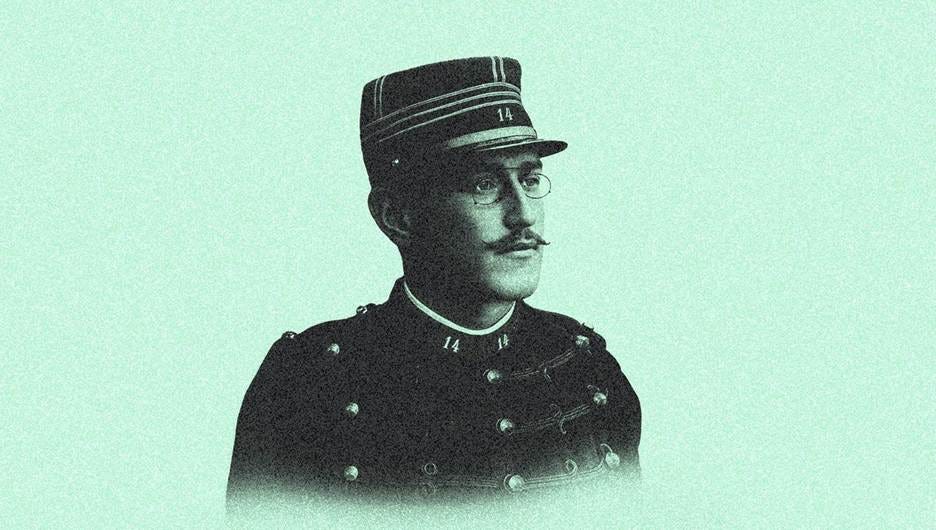
Alfred Dreyfus was the French artillery officer whose wrongful conviction for treason unleashed one of the greatest political and judicial crises in modern European history. What became known as the Dreyfus Affair divided France for more than a decade, shattered public trust in the Army, exposed the depth of modern political antisemitism, and permanently altered debates over nationalism, civil liberties, and state power. For later scholars of European nationalism and totalitarianism, the Dreyfus Affair represented an early warning sign of the forces that would culminate decades later under Vichy France and The Holocaust.
Dreyfus was born in Mulhouse in Alsace during the final years of the Second French Empire. His youth was shaped by the trauma of the Franco-Prussian War, which ended in catastrophic French defeat and the annexation of Alsace-Lorraine by the newly unified German Empire. The loss of the region produced an atmosphere of humiliation and revanchism throughout France, where hatred and suspicion of Germany became deeply embedded in political culture. For many French patriots, military service became both a patriotic obligation and a means of national redemption. Dreyfus’s family relocated to Paris after the annexation, and the experience of witnessing his native region absorbed into Germany profoundly shaped his decision to pursue a military career. Entering the Army at age eighteen, Dreyfus rose steadily through the artillery branch and eventually became the only Jewish officer serving on the French Army General Staff — a prestigious but politically dangerous position in a society where antisemitic sentiment simmered beneath the surface of republican ideals.
In 1894 French military intelligence discovered the “bordereau,” a memorandum intercepted from the German embassy in Paris containing references to sensitive military information. Because the document dealt partly with artillery matters — one of Dreyfus’s specialties — suspicion quickly fell upon him. Weak handwriting comparisons, institutional prejudice, and political pressure combined to make Dreyfus the ideal suspect. The actual author of the bordereau was Major Ferdinand Walsin Esterhazy, but military authorities instead built their case against Dreyfus through manipulated evidence, secret dossiers withheld from the defense, and forged supporting documents. At a closed military trial in December 1894, Dreyfus was convicted of treason and sentenced to life imprisonment.
Perhaps no moment better symbolized the emotional violence of the Affair than the public degradation ceremony of 05-Jan-1895 at the École Militaire in Paris. Before a massive crowd screaming “Death to the Jews!” Dreyfus was marched into the courtyard while officers tore the insignia from his uniform, ripped away his rank markings, and shattered his ceremonial sword before the public. Witnesses recalled Dreyfus repeatedly shouting his innocence and proclaiming loyalty to France even as the crowd treated him as the embodiment of national betrayal. The scene fused military ritual, mob fury, and antisemitic hatred into one of the most infamous spectacles in modern French history. Among those deeply affected by the atmosphere surrounding the Affair was Theodor Herzl, then a journalist covering events in Paris. The Dreyfus Affair strongly reinforced his growing conviction that European Jews could never rely upon assimilation alone for security. Within a year he published Der Judenstaat, helping launch the modern political Zionist movement.
After the degradation Dreyfus was deported to solitary confinement on Devil’s Island, where he endured years of brutal physical and psychological isolation. Confined under tropical conditions, frequently denied human contact, and at times chained to his bed at night, Dreyfus nevertheless continued insisting upon his innocence in letters to his wife Lucie. French authorities hoped the remoteness of Devil’s Island would permanently bury both the man and the controversy. Instead, the case slowly unraveled from within the Army itself. In 1895 Lieutenant Colonel Georges Picquart became head of military intelligence and initially accepted the verdict against Dreyfus. But after reviewing newly intercepted communications, especially the “petit bleu,” Picquart concluded that Esterhazy — not Dreyfus — had authored the bordereau. His discoveries should have exonerated Dreyfus immediately. Instead, Picquart’s superiors suppressed the evidence, reassigned him to Tunisia, falsely accused him of misconduct, and eventually imprisoned him as well. The Army hierarchy had become more concerned with preserving institutional honor than correcting injustice.
The Affair exploded into a national crisis during 1897 and 1898 as France split into hostile political camps. Monarchists, nationalists, clericals, and antisemitic leagues largely rallied behind the Army, while republicans, secularists, liberals, and intellectuals increasingly demanded revision of the verdict. The defining public intervention came from Émile Zola, whose famous open letter “J’Accuse…!” appeared on the front page of the newspaper L’Aurore on 13-Jan-1898. Zola accused senior military officials of obstruction of justice, antisemitism, and knowingly condemning an innocent man. He intentionally exposed himself to prosecution for libel in the hope that a public trial would force hidden evidence into the open. Although Zola was convicted and fled temporarily to England, his intervention transformed the Affair into an international cause célèbre and demonstrated that intellectuals could shape modern political opinion through direct public engagement.
By 1898 the Army’s case began collapsing under the weight of forged evidence and internal contradictions. Colonel Henry’s fabricated documents were exposed, leading to his confession and suicide, while the French judiciary gradually moved toward revision of the original verdict. Dreyfus was brought back from Devil’s Island for a second trial at Rennes in 1899, but in one of the most astonishing verdicts in legal history, the military court again convicted him despite overwhelming evidence of innocence. The judgment revealed how deeply institutional pride and political fear still dominated sections of the Army. A presidential pardon later that year secured Dreyfus’s release, though it stopped short of clearing his name. Determined to achieve complete vindication, Dreyfus continued the struggle while publishing Cinq années de ma vie (“Five Years of My Life”) in 1901, a memoir recounting his imprisonment and moral ordeal.
Final exoneration arrived on 12-Jul-1906 when the French Court of Cassation annulled the conviction without retrial and restored Dreyfus to the Army with the rank of major and the Legion of Honour. Picquart was likewise rehabilitated and promoted to brigadier general. Yet the importance of the Dreyfus Affair extended far beyond the fate of a single officer. The crisis permanently weakened the political authority of the French Army, accelerated the separation of church and state, strengthened republican legal institutions, and exposed the dangers posed by nationalism fused with conspiracy theories and racial hatred. Among later thinkers who reflected upon the Affair was Hannah Arendt, whose The Origins of Totalitarianism treated the Dreyfus Affair as a revealing precursor to the political antisemitism that would devastate Europe in the twentieth century. In modern historical memory, Alfred Dreyfus stands not merely as a wrongfully accused officer, but as one of the defining symbols of the individual crushed — and ultimately vindicated — by the machinery of the modern state.
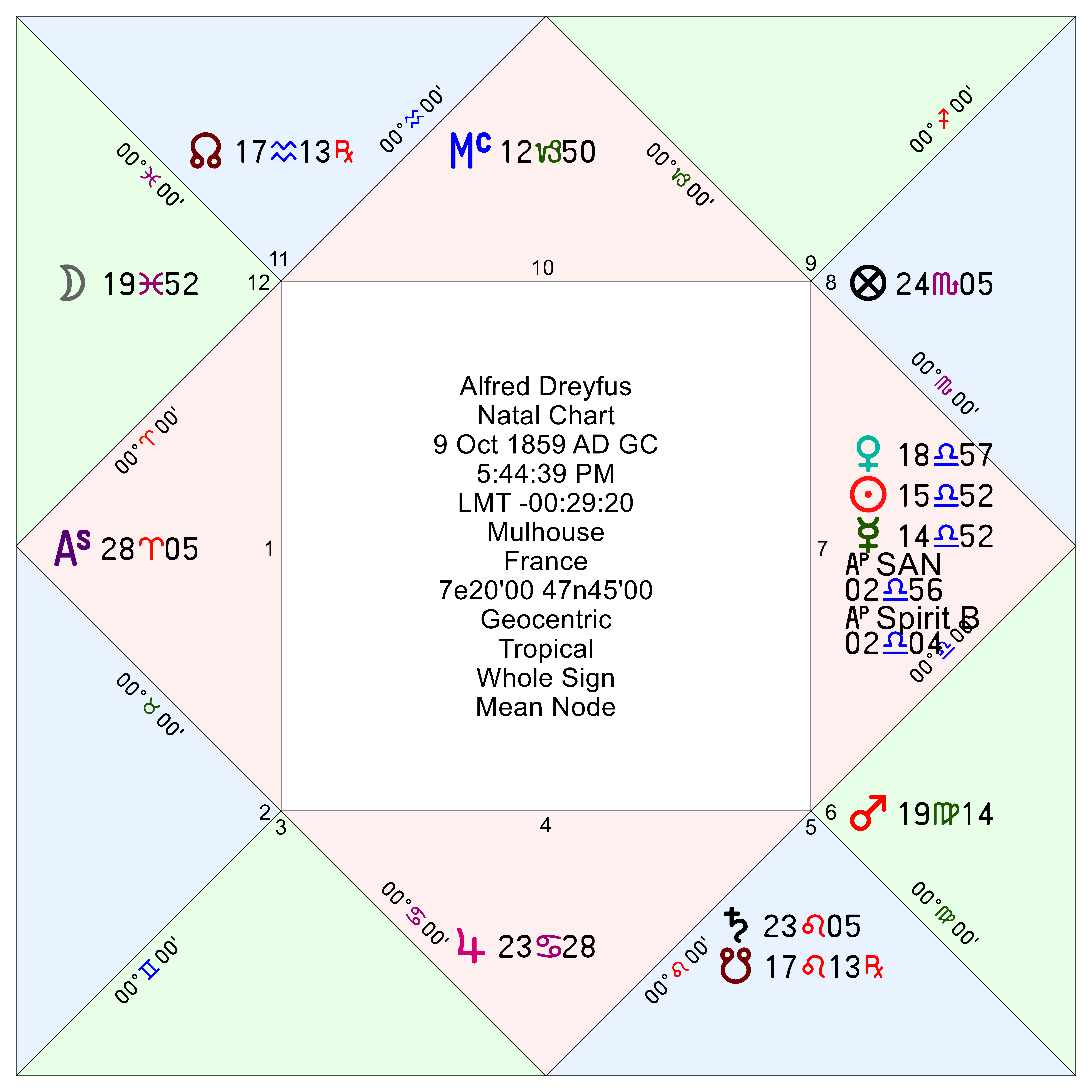
Rodden Rating AA, BC/BR in hand, 3:00 PM, ASC 9AQ25
Proposed Rectification: 5:44:39 PM, ASC 28AR04’56”
The analytical models used in the sections below are part of a larger research program developed across longer white papers and case studies, where the historical sources, rules, and testing methodology are laid out in full. These database entries show the models in practice; readers who want the theoretical foundations can start with the background papers below:
Rectification Hub (I wrote the book on it!)
Soul Hub (white paper, Victor model statistical tests, Moon’s Configuration studies)
Physiognomy Hub (white paper, examples)
Victor Model Factors favoring Mars/Virgo
Sign ruler: Ascendant, Lot of Fortune
Bound ruler: Moon
Mars in Virgo in the 6th house as victor of the horoscope is one of the clearest signatures that Alfred Dreyfus would become defined not by battlefield glory, but by subordination to a military institution that ultimately consumed him. Mars naturally signifies soldiers, warfare, conflict, and the military profession, yet its cadent placement in the 6th redirects martial symbolism away from public heroism toward bureaucratic service, confinement, and unequal power relationships. Virgo further emphasizes paperwork, technical systems, procedural mechanisms, and the highly specialized world of artillery and General Staff administration.
The 6th house is particularly revealing when understood not merely as illness or servitude, but as the house of prisoners of war — a logic derived from its cadency from the 7th house. Since the 7th signifies open enemies, legal disputes, and declared conflict, the 6th “falls away” from those conditions, symbolizing persons removed from direct conflict and placed into states of captivity, dependency, or institutional control. Dreyfus fits this symbolism with extraordinary precision: his military identity became defined less by active warfare than by imprisonment at the hands of the very military establishment he served.
Mars is not angular and publicly triumphant; it is cadent, private, and obscured within institutional machinery. Had Mars been angular, the biography might emphasize battlefield command, combat leadership, or military victories. Instead, Mars in the 6th produced a soldier whose fate became bound to military bureaucracy, tribunals, confinement, and the status of a captive subordinate trapped within the system of war rather than celebrated upon its front lines.
Physiognomy Model Factors favoring Cancer, Virgo
Ascendant sign: Aries
Ascendant sign ruler: Mars/Virgo
Rising decan: Sagittarius
Rising decan ruler: Jupiter/Cancer
Alfred Dreyfus possessed a lean, elongated body type combined with a refined but somewhat drawn facial structure. His head and face show a pronounced ovate tendency, especially visible in the smooth contour running from forehead to jawline without strong angular interruption. The forehead is high and rounded, while the cheeks remain relatively flat and understated rather than fleshy or strongly projected. His skin appears smooth and even-textured, giving the face a restrained softness despite the severity of expression. The nose is narrow and elongated, the lips thin and compressed, and the mustache further accentuates the horizontal narrowness of the lower face. The eyes are calm and somewhat withdrawn in expression. Even in military uniform, the physiognomy conveys less of the battlefield commander and more of the administrative or intellectual officer — controlled, meticulous, and internally focused.
Astrologically, the physiognomy is strongly shaped by the combined influence of Cancer and Virgo. Jupiter in Cancer rules the Sagittarius rising decan and contributes the ovate facial shape, smooth skin texture, and overall softness of contour despite the native’s otherwise austere appearance. Cancer’s influence often produces a face that appears emotionally receptive or quietly sympathetic beneath external restraint, which is noticeable in Dreyfus despite the rigidity imposed by military bearing. At the same time, Mars in Virgo ruling the Aries rising decan introduces the more drawn and attenuated qualities of the physiognomy. Virgo narrows and refines the features, producing the characteristic compression of the nose and lips relative to the broader facial frame. This Virgo influence also creates the impression of precision and nervous control visible throughout the face, especially in the tightly organized structure of the mouth, mustache line, and mid-face. The result is a striking blend: Cancer softens the facial envelope while Virgo contracts and disciplines the individual features within it.
Moon’s Configuration
Phase I: Moon separating from Mars (Virgo, 6th House)
Delineation. The Moon in Pisces in the 12th house separating from Mars in Virgo in the 6th house forms one of the clearest configurations for persecution, captivity, and institutional warfare imaginable in a natal horoscope. The Moon in the 12th signifies isolation, sorrow, exile, hidden enemies, confinement, and the dissolution of ordinary social identity. Pisces intensifies the emotional and sacrificial dimensions of the placement, often producing circumstances in which the native becomes overwhelmed by forces larger than himself. Mars in Virgo in the 6th house as victor of the horoscope redirects martial symbolism away from battlefield glory toward bureaucratic systems, accusations, tribunals, and subordination within military hierarchy. The separating opposition indicates that the native’s life narrative begins with rupture, hostility, and forced removal from normal social existence.
The 6th house placement of Mars is especially important because the 6th may signify prisoners of war and institutional captivity through its cadency from the 7th house. Since the 7th governs open enemies, legal disputes, and declared conflict, the 6th “falls away” from those activities, symbolizing persons subdued, captured, or trapped within systems controlled by others. The Moon’s separation from Mars shows the emotional scars left by accusation, humiliation, and confinement, while the Pisces-Virgo axis creates tension between helpless suffering and cold bureaucratic procedure. The configuration suggests a native whose personal identity becomes overwhelmed by institutional struggle and whose suffering unfolds largely outside ordinary public life, in hidden or restricted conditions.
Biographical Match. The symbolism corresponds with extraordinary precision to the life of Alfred Dreyfus and the early stages of the Dreyfus Affair. Dreyfus’s career was defined not by battlefield command or military triumph, but by entanglement within the bureaucratic machinery of the French Army General Staff. The accusation of treason in 1894 emerged through paperwork, intercepted documents, handwriting analysis, secret dossiers, and internal military procedure — all strongly resonant with Mars in Virgo. The degradation ceremony of 05-Jan-1895, where his insignia were ripped from his uniform before a crowd screaming antisemitic slogans, vividly reflects the Moon separating from Mars through public humiliation imposed by military authority.
The symbolism became even more literal with Dreyfus’s imprisonment on Devil’s Island. The Moon in Pisces in the 12th house describes exile, isolation, emotional suffering, and confinement with almost frightening exactness. Removed from France and placed under brutal solitary conditions, Dreyfus became less a soldier in active service than a captive subordinate trapped within the machinery of war and state power. His legacy ultimately became inseparable from imprisonment, legal persecution, and institutional captivity — exactly the kind of martial expression expected from a cadent Mars in the 6th rather than an angular Mars associated with military glory.
Phase II: Moon applying to Jupiter (Cancer, 4th House)
Delineation. After separating from Mars, the Moon applies to Jupiter in Cancer in the 4th house, creating a profound shift in the narrative of the horoscope from persecution toward restoration. Jupiter in Cancer is exalted and exceptionally powerful, signifying protection, moral legitimacy, sympathy, legal rehabilitation, and eventual preservation after suffering. Since Jupiter rules both the 9th house of law and judiciary and the 12th house of hidden enemies, the symbolism becomes remarkably layered: the same institutional world that initially participates in the native’s destruction ultimately becomes the instrument of redemption. The Moon’s application to Jupiter suggests that emotional suffering gradually expands into a broader moral and legal cause that cannot remain hidden indefinitely.
Particularly important is the mutual reception by sign between the Moon in Pisces and Jupiter in Cancer. This reception creates a circulating conduit between suffering and protection, ensuring that the Moon’s condition is continuously amplified and carried into Jupiter’s domain of legality, morality, and collective conscience. Rather than allowing the 12th-house suffering to disappear in obscurity, Jupiter enlarges and publicizes it. Jupiter in the 4th house further suggests that the ultimate resolution concerns the moral foundations of the nation itself — the “ground” or root of society. The configuration indicates that the native’s suffering eventually forces a broader reckoning concerning justice, institutional legitimacy, and national conscience.
Biographical Match. This configuration corresponds closely to the gradual transformation of the Dreyfus Affair from an internal military prosecution into an international moral crisis. Although Dreyfus initially suffered in near-total isolation, his imprisonment eventually generated widening public sympathy and legal reconsideration. The more severe his suffering became, the more the Affair expanded beyond the Army into the judiciary, the press, intellectual circles, and the political life of France itself. Figures such as Georges Picquart and Émile Zola helped transfer Dreyfus’s plight from the hidden world of military secrecy into the open sphere of public morality and legal debate.
The mutual reception between Moon and Jupiter is especially evident in the way Dreyfus’s personal suffering became inseparable from questions about the moral legitimacy of the French Republic. The Affair ceased to concern merely one officer accused of treason and instead evolved into a national referendum on antisemitism, military authority, judicial corruption, and republican law. Jupiter ruling both the 9th and 12th houses manifested with extraordinary literalness: the same legal and governmental structures that once condemned Dreyfus through secret evidence eventually overturned the conviction and restored his honor. His final exoneration in 1906 therefore represented more than personal vindication. It became an attempt by France itself to restore confidence in the moral and legal foundations of the Republic after years of institutional disgrace.
Influence of Sect
Sect helps explain why the horoscope of Alfred Dreyfus produces both extreme injury and eventual vindication, but only after prolonged delay and institutional struggle. The figure is nocturnal, making Jupiter and Saturn out of sect while Venus and Mars are in sect. Jupiter in Cancer retains enormous essential dignity and therefore still promises eventual legal restoration, moral sympathy, and rehabilitation through the judiciary. Yet because Jupiter is out of sect, its ability to operate freely within the political and legal order is constrained. Justice functions imperfectly and slowly, making it difficult for Dreyfus to find judges or institutional authorities willing to openly support him. The judicial process repeatedly stalls, reverses itself, or compromises under political pressure before Jupiter can fully manifest its restorative power.
Saturn in Leo likewise operates out of sect, placing the anti-Dreyfus faction outside the dominant current of political and moral legitimacy. The military establishment, nationalist leagues, and clerical reactionaries behave like a political force increasingly disconnected from the broader ethical direction of the Republic, even while temporarily exercising enormous influence. Out-of-sect Saturn therefore manifests not primarily through weakness, but through rigidity, fear, paranoia, and authoritarian overreach. Mars, by contrast, is in sect and is the victor of the horoscope, helping transform the case into a socially visible and politically mobilizing conflict rather than a forgotten private destruction. Venus in Libra is also in sect and in domicile, offering some support through law, fairness, public sympathy, and eventual reconciliation; however, Venus is combust, showing that justice remains compromised and partially overwhelmed by political power. The overall sect balance therefore produces a chart in which the forces of rehabilitation ultimately prevail, but only after years of institutional distortion and prolonged human suffering.
Special Situation: Saturn Conjunct the South Node
A special condition modifies Saturn’s role in the chart: Saturn is conjunct the South Node by 5 degrees 52 minutes. Rather than intensifying Saturn, the South Node eventually diminishes and drains Saturn’s capacity for sustained action. The conjunction therefore suggests that the power of Dreyfus’s enemies would remain active for a limited but measurable period before beginning to lose force. Using the symbolic timing principle of one degree equaling one year for fixed signs, the conjunction corresponds remarkably well to the historical chronology of the Affair. From the degradation ceremony of 05-Jan-1895 — the fullest public manifestation of Saturn in Leo through humiliation, military ceremony, and mob hatred — until the general amnesty law of 27-Dec-1900 is almost exactly six years. During this interval the anti-Dreyfus faction dominated the political and legal landscape through prosecutions, forged evidence, suppression of Picquart, the Esterhazy acquittal, and the Rennes retrial. Yet by the close of 1900 the momentum of Saturn’s enemies had begun to exhaust itself. The amnesty law did not exonerate Dreyfus, but it curtailed the ability of the anti-Dreyfus faction to continue waging open political warfare. In this way the South Node ultimately acts as a point of depletion, gradually draining the longevity and sustainability of Saturn’s campaign against him.
Early/Late Bloomer Thesis
Alfred Dreyfus lived approximately 75 years, placing the midpoint of his life at roughly age 37–38. This midpoint falls around 1897–1898, precisely when the Dreyfus Affair reached its most explosive and transformative phase. Because Dreyfus was born shortly after a New Moon, his horoscope falls within the category associated with the “early bloomer” thesis. At first glance, Dreyfus may appear to contradict the model because the defining public victory of his life — full exoneration in 1906 — did not occur until age forty-six after years of imprisonment, humiliation, and political struggle. Yet the deeper chronology suggests that the most important phase of worldly ascent occurred relatively early. The trauma of the Franco-Prussian War pushed Dreyfus toward a military career while still young, and by his mid-thirties he had already risen into one of the most prestigious positions available within the French Army as the only Jewish officer serving on the General Staff.
Before age 37–38, the trajectory is unmistakably upward: military education, advancement through the artillery branch, marriage, family formation, and entry into elite state institutions. After the midpoint, however, the chart no longer describes new worldly ascent so much as survival, rehabilitation, and symbolic transformation. The second half of Dreyfus’s life became dominated by imprisonment, legal appeals, political controversy, memoir writing, and eventual moral vindication rather than fresh professional achievement. In this sense, Dreyfus fits the early bloomer model not because his life unfolded easily or continuously upward, but because his principal rise within the structures of worldly power occurred unusually early, while the latter half of life became devoted largely to recovering honor and preserving historical legacy after catastrophic interruption.
AI Notice: ChatGPT contributed to this article.
Complete biographical chronology, rectification and time lord studies available in Excel format as a paid subscriber benefit. They are behind the article paywall.