

Last week I introduced the natal Jupiter/Leo series with the following delineation: beliefs which occupy the symbolic center of society; for the United States, state-supported religion.
Another way to explore this theme is simply to listen to it. The horoscopes of the late Romantic composers Anton Bruckner, Gustav Mahler, and Richard Wagner all contain Jupiter in Leo in its own bound. This week, let’s sample four of Bruckner’s compositions associated with successive transit cycles of Jupiter through Leo.
After achieving early success with a choral composition, Bruckner devoted himself primarily to orchestral music. His symphonic style is distinguished by its monumental use of brass instruments—a Leo astrological signification I have often observed in the horoscopes of brass musicians, from orchestral performers to jazz horn players. Music historians have compared Bruckner’s brass writing to a cathedral choir, the priest elevating the Host, or simply a public proclamation of faith and authority. You decide.
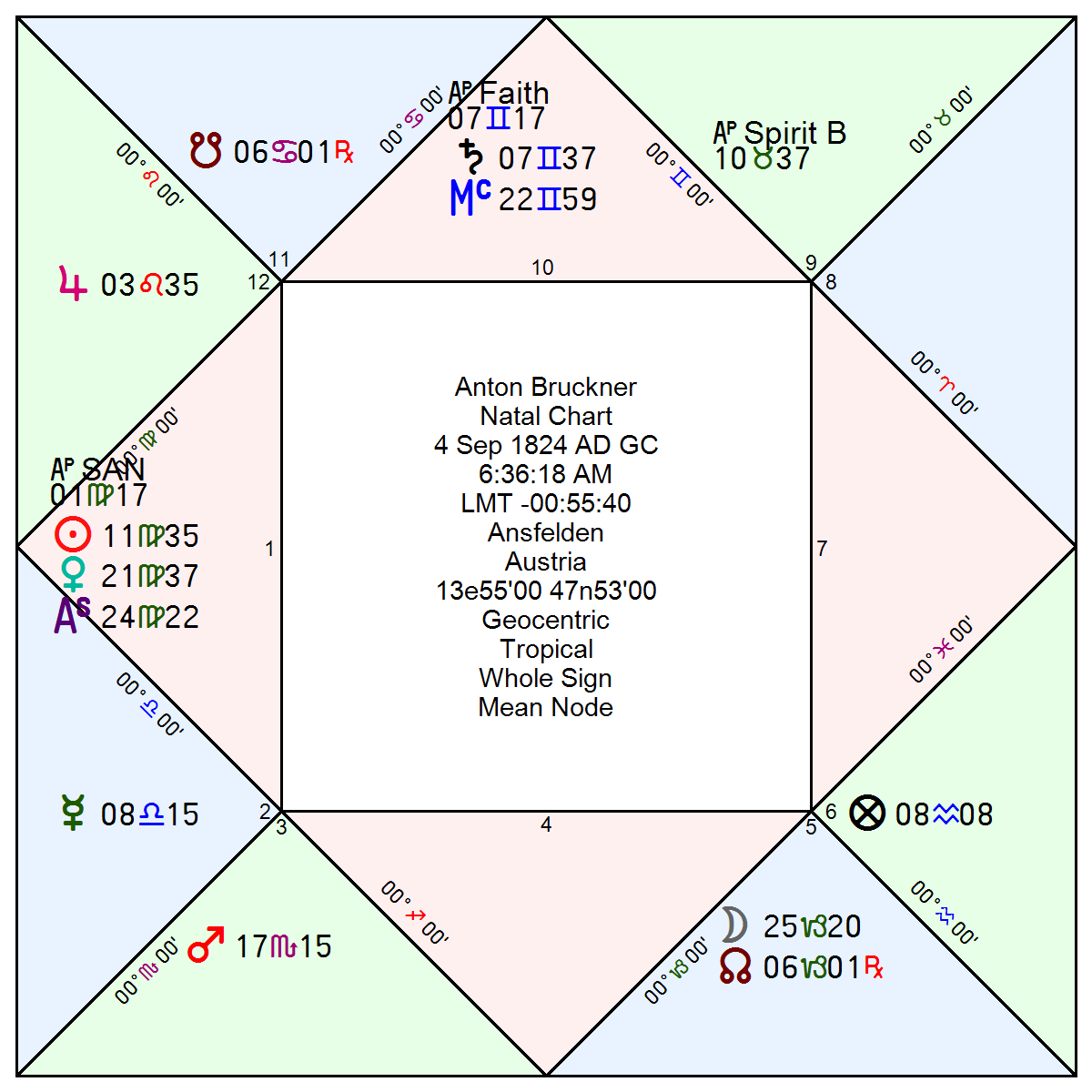
Rodden Rating: AA, BC/BR in hand, 4:15 AM, ASC 28LE25
Proposed Rectification: 6:36:18 AM, ASC 24VI22’44”
Transit: Jupiter/Leo: 29-Jun-1860 to 26-Jul-1861
Ave Maria (choral). Composed and premiered during this transit; first performance 12-May-1861.
Transit: Jupiter/Leo: 12-Jun-1872 to 15-Nov-1872; 16-Jan-1873 to 7-Jul-1873
tSymphony No. 3. Completed in 1873 and presented by Bruckner to Richard Wagner at Bayreuth in September 1873, who accepted its dedication. Nicknamed the "Wagner Symphony." Please note the partile conjunction of Bruckner's Jupiter (3°35′ Leo) and Wagner's Jupiter (3°41′ Leo)—a difference of just six minutes of arc!
Transit: Jupiter/Leo: 21-May-1884 to 18-Oct-1884; 26-Feb-1885 to 15-Jun-1885
Symphony No. 7. Premiered in Leipzig on 30-Dec-1884, with revisions continuing into 1885. Sometimes nicknamed the "Lyric Symphony," it brought Bruckner the greatest public success of his career.
Transit: Jupiter/Leo: 4-Sep-1895 to 1-Mar-1895; 18-Apr-1893 to 28-Sep-1896.
Symphony No. 9. Dedicated "To the beloved God," Bruckner worked on this symphony during the final year of his life. He died on 11-Oct-1896, leaving the work unfinished.
Anton Bruckner (1824–1896) occupies a unique place in Western music as one of history’s greatest symphonists and perhaps its most deeply spiritual composer. During his lifetime he was revered throughout Europe as a virtuoso organist and improviser, yet as a composer he endured decades of misunderstanding before finally achieving widespread recognition in his sixties. Today his nine symphonies stand alongside those of Beethoven, Brahms, and Gustav Mahler as monuments of the orchestral repertoire, admired for their architectural grandeur, profound spirituality, and extraordinary command of the orchestra.
Born on 4 September 1824 in the Austrian village of Ansfelden, Bruckner was the eldest son of a village schoolmaster. Like many musicians of modest background in nineteenth-century Austria, he entered teaching while simultaneously pursuing church music. His formative years were spent at St. Florian Abbey, first as a choirboy and later as organist. The monastery became the spiritual center of his life. Its vast Baroque architecture, magnificent organ, daily liturgy, and centuries-old musical traditions profoundly shaped his imagination. Long after achieving fame in Vienna, Bruckner requested that he be buried beneath the great organ at St. Florian, a wish fulfilled after his death.
Bruckner’s musical gifts were extraordinary. Before he was known as a composer, he had already earned an international reputation as one of Europe’s finest organ improvisers. Audiences and fellow musicians marveled at his ability to construct elaborate fugues and contrapuntal fantasies spontaneously at the keyboard. During his professional examinations he repeatedly astonished examiners with demonstrations of technical mastery that bordered on the unbelievable. His contrapuntal command, built upon years of rigorous study with Simon Sechter, became one of the defining characteristics of his mature style. Unlike many Romantic composers who relied primarily upon inspiration, Bruckner united seemingly limitless imagination with an almost encyclopedic knowledge of musical architecture.
Although he composed sacred works throughout his career, including three great Masses, Bruckner ultimately devoted himself to the symphony. His mature orchestral style remains unmistakable: immense musical structures unfolding over vast spans of time, cumulative climaxes of overwhelming emotional power, and some of the most magnificent brass writing ever conceived. Rather than employing brass merely for brilliance or military display, Bruckner transformed the brass choir into a vehicle for sacred proclamation. His climaxes have often been compared to cathedral choirs, the elevation of the Host during the Mass, or the ringing of church bells across an Alpine landscape. The influence of Johann Sebastian Bach’s contrapuntal discipline combined with Richard Wagner’s harmonic language to produce music that was simultaneously ancient in spirit and revolutionary in sound.
No relationship proved more consequential than Bruckner’s admiration for Richard Wagner. At a time when European musical life had become sharply divided between followers of Wagner and those of Johannes Brahms, Bruckner openly declared his allegiance to Wagner’s artistic ideals. The two composers met at Bayreuth in 1873, where Wagner accepted the dedication of Bruckner’s Third Symphony, thereafter known as the “Wagner Symphony.” Yet this public association carried a heavy professional cost. Vienna’s influential critic Eduard Hanslick, the intellectual champion of the Brahms circle, became one of Bruckner’s fiercest opponents, ridiculing his symphonies as shapeless, excessive, and incomprehensible. Because Hanslick exercised enormous influence over conductors, audiences, and musical institutions, Bruckner often found it extraordinarily difficult to secure performances of his works despite the admiration of many fellow composers and musicians.
Perhaps the greatest paradox of Bruckner’s life lies in the striking contrast between the absolute confidence of his music and the profound insecurity of the man who composed it. His symphonies project unwavering authority, yet Bruckner himself remained painfully shy, socially awkward, and burdened by unusually low self-confidence. He constantly sought reassurance from friends, students, and conductors regarding his compositions, frequently doubting his own artistic judgment even after producing works now regarded as masterpieces. His insecurity became especially evident following hostile reviews, which affected him deeply and often undermined his confidence for years afterward.
This lack of self-assurance had lasting consequences for the history of his music. Unlike Beethoven, who vigorously defended his scores, or Brahms, who rejected outside interference, Bruckner often accepted suggested revisions from conductors, former students, publishers, and well-meaning admirers. Some recommendations improved matters of practical performance, but many introduced cuts, altered orchestration, modified transitions, or reshaped entire movements in ways that compromised the architectural unity of the original compositions. Bruckner frequently acquiesced because he feared his symphonies might otherwise never be performed. As a result, several works survive today in multiple authentic, authorized, and posthumously edited versions, creating one of the most complex editorial histories in classical music. Modern scholarship has devoted decades to disentangling Bruckner’s own intentions from alterations introduced by others, and conductors continue to debate which versions most faithfully represent his artistic vision.
Bruckner’s personal life reflected many of the same insecurities. Although deeply religious and personally kind, he possessed few social graces and often appeared awkward in sophisticated Viennese society. He never married despite repeatedly proposing to young women, many of them decades younger than himself. Every proposal ended in rejection. Friends frequently remarked upon the contrast between the giant musical intellect capable of constructing symphonic cathedrals and the humble, uncertain man who struggled with ordinary social relationships.
His psychological difficulties have likewise attracted considerable attention. Following a severe nervous collapse in 1867, Bruckner underwent several months of treatment at a sanatorium. Throughout much of his adult life he displayed obsessive-compulsive behaviors, particularly compulsive counting rituals involving windows, leaves, buttons, paving stones, and other everyday objects. While modern writers often speculate about retrospective psychiatric diagnoses, contemporary evidence leaves little doubt that anxiety and compulsive behaviors formed a persistent part of his personality. Yet these struggles never diminished either his faith or his astonishing creative powers.
Recognition finally arrived late in life. The triumphant Leipzig premiere of the Seventh Symphony in 1884 transformed Bruckner’s reputation almost overnight, bringing international acclaim after decades of neglect. Honors followed from Emperor Franz Joseph I, including the Order of Franz Joseph, an imperial pension, and an honorary doctorate from the University of Vienna. Even in old age, however, Bruckner continued revising earlier symphonies while devoting himself to the monumental Ninth Symphony, dedicated simply “To the beloved God.”
Bruckner died in Vienna on 11 October 1896, leaving the finale of the Ninth Symphony unfinished. He was buried beneath the great organ at St. Florian Abbey, where visitors today can stand directly above his tomb while hearing the instrument that shaped his imagination from childhood. His music has since undergone one of the great re-evaluations in Western art. Once dismissed by critics as naïve, repetitive, and excessively devotional, Bruckner is now recognized as a composer of extraordinary originality whose symphonies unite intellectual rigor, spiritual contemplation, and overwhelming sonic grandeur in a manner unmatched by any other composer. Few artists have created works of greater public confidence while privately possessing so little confidence in themselves.
The analytical models used in the sections below are part of a larger research program developed across longer white papers and case studies, where the historical sources, rules, and testing methodology are laid out in full. These database entries show the models in practice; readers who want the theoretical foundations can start with the background papers below:
Rectification Hub (I wrote the book on it!)
Soul Hub (white paper, Victor model statistical tests, Moon’s Configuration studies)
Physiognomy Hub (white paper, examples)
Victor Model Factors favoring Mercury/Libra
Sign ruler: Sun, Ascendant, Midheavan, Prenatal Syzygy
Bound ruler: Prenatal Syzygy, Lot of Spirit.
Dignity: In generosity with Venus/Virgo
Mercury, the victor of the horoscope, describes the technical foundation upon which Bruckner’s musical genius was built. Placed in Libra, a Venus-ruled sign, Mercury enters into generosity with Venus in Virgo, allowing intellectual discipline and artistic beauty to operate in mutual support despite the absence of a Ptolemaic aspect. Rather than merely signifying music itself, Mercury points to Bruckner’s extraordinary command of musical structure, counterpoint, and improvisation. His legendary ability as an organ improviser, together with years of rigorous study under Simon Sechter, enabled him to construct fugues and symphonic architectures of exceptional complexity while maintaining remarkable formal coherence.
Mercury’s placement in the 2nd house naturally emphasizes cultivated talents and acquired skills, suggesting that Bruckner’s greatest gifts arose through disciplined study and technical refinement rather than effortless inspiration alone. Libra, a cardinal sign characterized by speed and responsiveness, is well suited to the finger dexterity demanded of a virtuoso keyboard musician and improviser, while Venus’s rulership contributes sensitivity to proportion, balance, and musical beauty. Throughout Bruckner’s life, dynamic timing consistently confirms Mercury’s importance. Whether activated by Firdaria, primary directions, or transits, Mercury periods repeatedly coincide with major developments in his musical career. Particularly striking is the transit of Mercury to the Lot of Spirit on 12 May 1861, the date of the premiere of his Ave Maria, marking his first public success as both composer and conductor. Mercury thus signifies not only Bruckner’s technical mastery, but also the unfolding of the vocation through which his artistic calling became publicly recognized.
Physiognomy Model Factors favoring Virgo
Rising sign: Virgo
Ruler of rising sign: Mercury/Libra
Planets in rising sign: Venus/Virgo (within 3 degrees of Ascendant), Sun/Virgo
Rising decan: Taurus
Ruler of rising decan: Venus/Virgo
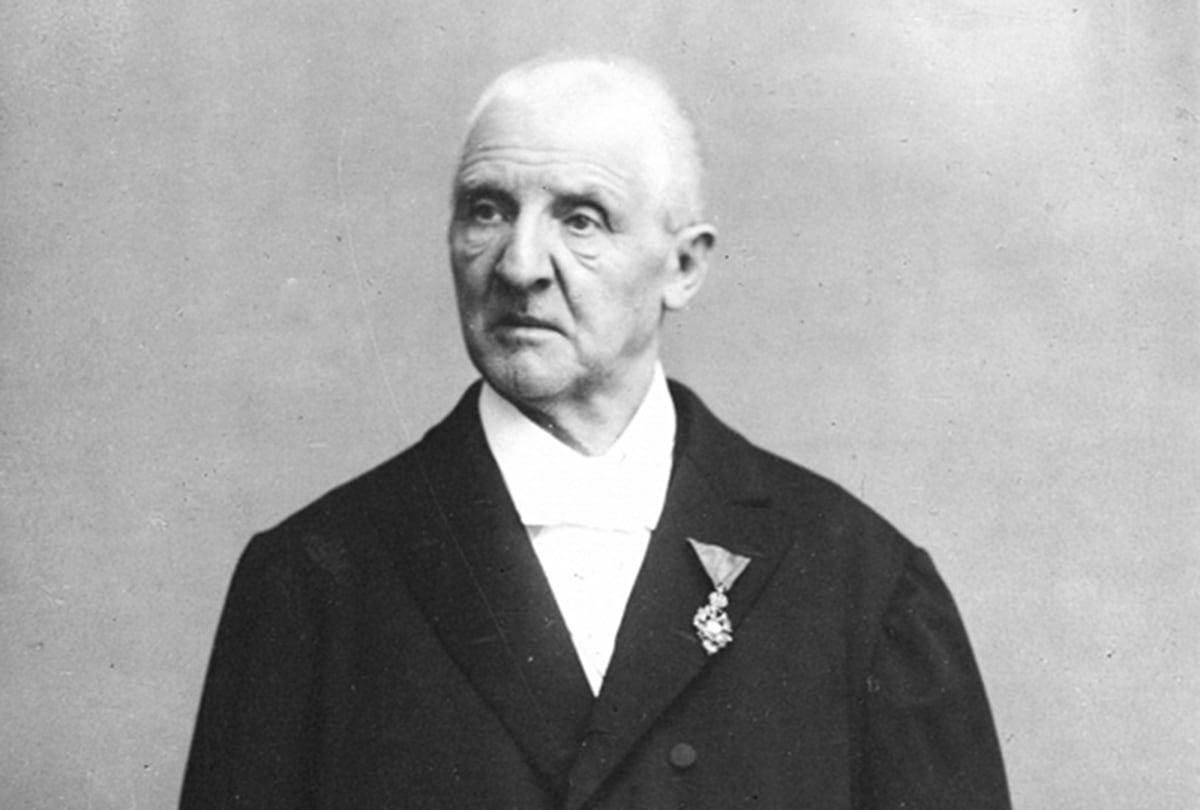
Anton Bruckner possessed a medium build with a broad forehead, thinning hair, and a face that projected quiet reserve rather than outward charisma. His features are well proportioned and symmetrical, with a rounded jaw, modest chin, and a straight, unobtrusive nose that neither dominates nor recedes. The mouth is relatively narrow and lightly defined, producing a restrained rather than expressive appearance. Even in later life, his complexion remains remarkably smooth, with comparatively few deep facial lines, lending an impression of youthfulness that contrasts with his advancing age. Nothing in his appearance seeks attention. Instead, his face conveys modesty, order, composure, and an absence of theatricality, qualities reinforced by his conservative dress and understated presentation.
Bruckner’s physiognomy is strongly Virgoan, consistent with Virgo rising together with the Sun and the significator Venus in Virgo. A useful comparison is John D. Rockefeller, whose Venus also occupies Virgo. Although Rockefeller’s facial features are somewhat more attenuated—with a narrower nose and mouth relative to the width of the face—both men share what is perhaps the most characteristic Virgo quality: an unmistakable plainness of feature. Their faces are neither rugged nor strikingly handsome, nor do they possess the dramatic asymmetries often associated with Mars or Saturn. Instead, the features appear refined, orderly, and almost deliberately unembellished. Even the relative absence of pronounced wrinkles contributes to a youthful appearance, though in later life this same lack of strong facial definition can create an impression of visual blandness, as if the face has remained understated while the personality and accomplishments have become anything but. In Bruckner’s case, this understated physiognomy stands in remarkable contrast to the monumental scale and overwhelming emotional power of the symphonies he created.
Moon’s Configuration
Phase I: Moon Separating from Venus (Virgo, 1st house)
The Moon begins its configuration by separating from Venus in Virgo in the 1st house, describing a personality marked by modesty, self-effacement, and a lifelong tendency toward self-criticism. Venus in Virgo rarely expresses confidence through self-assertion, instead seeking worth through diligence, refinement, and continual improvement. Bruckner’s chronic lack of self-esteem, his painful sensitivity to criticism, and his willingness to defer to the opinions of conductors, students, and publishers all reflect this symbolism. Rather than defending his artistic vision with unwavering confidence, he repeatedly questioned his own judgment, contributing to the unusually complex revision history of his symphonies. Venus in Virgo also describes his obsessive concern with perfection, resonating with the compulsive counting rituals and obsessive-compulsive behaviors documented throughout his adult life.
Yet Venus also signifies the artistic vocation itself. Joined by mutual generosity with Mercury in Libra, the victor of the horoscope, Venus continually directed Bruckner toward the disciplined cultivation of musical mastery. Whenever insecurity threatened to overwhelm him, he returned to the keyboard, rigorous contrapuntal study, and organ improvisation, allowing technical excellence to restore the confidence that his personality so often lacked. His extraordinary command of counterpoint and keyboard technique thus became not merely a professional accomplishment, but the means through which he repeatedly rebuilt his sense of purpose.
Phase II: Moon Changes Signs
After separating from Venus, the Moon leaves Capricorn and enters Aquarius, marking an important shift in the expression of the life. Capricorn emphasizes discipline, hierarchy, and painstaking self-development; Aquarius turns attention outward toward institutions, professional networks, patrons, and the broader intellectual community. Bruckner’s career illustrates this transition. Having spent decades in relative obscurity as a provincial teacher, organist, and student of composition, he gradually entered the wider musical world of Vienna and the leading artistic circles of Central Europe. The sign change therefore marks the movement from private preparation to public engagement, where the success of his career increasingly depended upon conductors, critics, fellow composers, imperial patrons, and musical institutions rather than upon solitary study alone.
Phase III: Moon Applying to Jupiter (Leo, 11th/12th houses)
The Moon ultimately applies, within moiety, to the opposition of Jupiter in Leo. Although the aspect is out of sign, its influence is unmistakable, directing the latter portion of Bruckner’s life toward public recognition and association with distinguished colleagues. Jupiter in Leo signifies the honors that arrived only after decades of neglect, including the imperial pension awarded by Emperor Franz Joseph I, the Order of Franz Joseph, the honorary doctorate from the University of Vienna, and the international acclaim following the triumph of the Seventh Symphony. It also signifies relationships with towering musical figures, most notably Richard Wagner and, by extension, Gustav Mahler, whose own career would become deeply connected with Bruckner’s symphonic legacy.
The opposition, however, reminds us that these benefits were accompanied by corresponding tensions. Placed in the 12th house by whole-sign reckoning, Jupiter suggests that the very association which elevated Bruckner’s artistic standing also generated hidden obstacles. His public allegiance to Wagner, culminating in the dedication of the Third Symphony, aligned him with the Wagnerian camp during the bitter Wagner–Brahms controversy that divided musical Vienna. While Wagner himself remained an admirer, Bruckner’s identification with Wagner provoked sustained opposition from Eduard Hanslick and the Brahms circle, making performances of his symphonies substantially more difficult to secure. Thus the final phase of the Moon’s configuration brought both the recognition he sought and the unseen professional burdens that accompanied his closest artistic alliances.
Influence of Sect
As a diurnal nativity, Jupiter and Saturn are in sect, while Venus and Mars are out of sect. Jupiter’s constructive influence ultimately proves decisive. Although recognition came only after decades of neglect, Jupiter in Leo eventually fulfilled its promise through imperial patronage, an annual pension from Emperor Franz Joseph I, an honorary doctorate from the University of Vienna, and lasting public acclaim. Jupiter also moderates the final phase of the Moon’s configuration, ensuring that Bruckner’s greatest honors arrived late rather than never.
Saturn likewise benefits from sect despite occupying the 10th house of profession. In Gemini, Saturn signifies criticism expressed through words, reviews, and public commentary, most notably the sustained attacks of Eduard Hanslick and the Brahmsian establishment. Yet because Saturn is in sect, these obstacles ultimately disciplined rather than destroyed Bruckner’s career. His music endured severe criticism, but it was never silenced or suppressed. The result was professional delay rather than permanent failure.
By contrast, Venus in Virgo operates out of sect, directing its difficulties toward personal rather than artistic matters. The same Venus that bestowed musical refinement also manifested as chronic self-doubt, an understated physical appearance, and repeated romantic disappointments. Bruckner’s socially awkward courtships and repeated marriage proposals to much younger women never resulted in lasting companionship, illustrating the diminished social ease often associated with an out-of-sect Venus.
Mars in Scorpio, although dignified by domicile, likewise operates outside the sect of the chart. Placed in the 3rd house, it points less toward physical conflict than toward disputes arising through communication, teaching, publishing, and intellectual exchange. Bruckner’s career became entangled in the bitter Wagner-Brahms controversy, while disagreements over the editing and revision of his symphonies continued throughout his life and well after his death. The interventions of devoted students and conductors, particularly those who altered his scores in the name of improving them, transformed artistic collaboration into a lasting source of controversy. Mars therefore expresses itself not through open combat, but through enduring disputes over how Bruckner’s music should be transmitted and understood.
Early/Late Bloomer Thesis
Born shortly after the New Moon, Bruckner qualifies as an Early Bloomer under this model. He lived 72 years, placing the midpoint of his life at approximately age 36 (1860). By this time he had already established the essential foundations of his career through appointments as a church organist, mastery of counterpoint under Simon Sechter, an international reputation as an organ improviser, and, shortly thereafter, the premiere of Ave Maria (12 May 1861), which marked his first public success as both composer and conductor.
The second half of Bruckner’s life largely represents the expansion and recognition of talents established before the midpoint. His numbered symphonies, association with Richard Wagner, imperial pension, honorary doctorate, and international acclaim following the Seventh Symphony all built upon an artistic identity that had already matured. Bruckner therefore supports the Early Bloomer model: vocational development occurred before the midpoint, while widespread public recognition followed only after decades of perseverance.
Complete biographical chronology, rectification and time lord studies available in Excel format as a paid subscriber benefit. File is behind the paywall.