

October 20 marks the 172nd birthday of the French poet Arthur Rimbaud (1854–1891), providing an occasion for a pop-up horoscope outside the current House of Wisdom series. Rimbaud is remembered for a poetic career compressed almost entirely into his adolescence: The Drunken Boat, A Season in Hell, and much of the work later collected as Illuminations were written before he abandoned literature at about age twenty-one. What happened next is less widely known. Rimbaud traveled through Europe and Java, enlisted in the Dutch colonial army and deserted, worked at a quarry in Cyprus, entered the coffee trade in Aden and Harar, traveled with commercial caravans in East Africa, and eventually participated in an expedition to sell rifles to Menelik II of Shoa.
Rimbaud’s horoscope raises a useful question about the relationship between the victor of the horoscope and the Moon’s configuration. Venus/Libra is the victor and provides a clear match to the poetry, art, and sexual relationships for which Rimbaud is remembered, yet the Moon neither separates from nor initially applies to Venus. Instead, it separates from Jupiter/Capricorn, passes through a void-of-course interval, and applies to Mars/Sagittarius. The resulting chronology veers far away from the Venusian identity by which history remembers him: poverty and material necessity give way to wandering, physical labor, commerce, foreign travel, weapons, violence, and ultimately the amputation of his leg. Only after separating from Mars does the Moon apply to Venus, offering a possible astrological signature for the return of the poet after the man’s active life had run its course. Rimbaud therefore suggests a refinement to the Moon’s Configuration model: when the victor is not directly wired into the Moon’s initial sequence of separation and application, the lived biography may follow a very different trajectory from the vocation or identity for which the native is ultimately remembered.
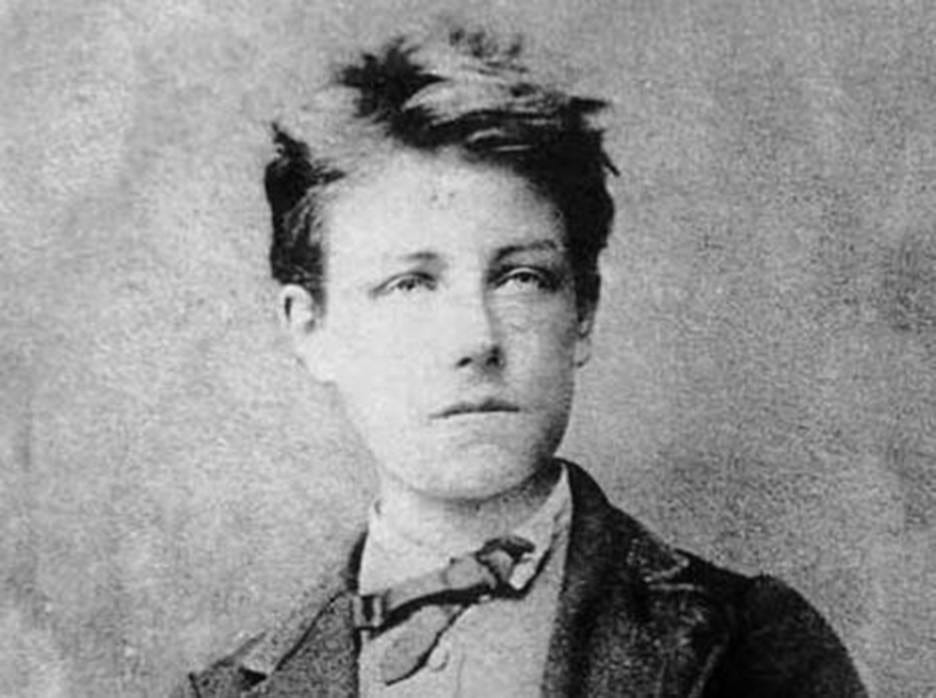
Arthur Rimbaud (1854–1891) was a French poet whose literary career was concentrated almost entirely in his adolescence. Born in Charleville in the Ardennes on October 20, 1854, he was the son of Frédéric Rimbaud, a career army officer, and Marie-Catherine-Vitalie Cuif. His father left the family when Arthur was about six, and Rimbaud was thereafter raised principally by his strict and religious mother. He excelled at school, particularly in languages and Latin composition, and began writing poetry while still a student. His first published poem appeared in 1870, when he was fifteen.
The Franco-Prussian War disrupted Rimbaud’s education in 1870 and coincided with an increasingly rebellious period. He repeatedly left Charleville, traveling to Paris and through northern France and Belgium; during one journey he was arrested and subsequently returned home. At the same time, his development as a poet accelerated. In May 1871, in letters to Georges Izambard and Paul Demeny, Rimbaud formulated his theory of the poet as a “seer,” arguing that the poet should deliberately disorder the senses in order to reach forms of perception unavailable through ordinary experience. During the summer of 1871 he wrote Le Bateau ivre (The Drunken Boat), which became one of his best-known poems. The original biography in this file identifies both the “Letter of the Seer” and The Drunken Boat as central works of 1871.
In September 1871 Rimbaud traveled to Paris after establishing contact with Paul Verlaine, an established poet ten years his senior. Their relationship became both literary and sexual and contributed to the collapse of Verlaine’s marriage. Rimbaud and Verlaine subsequently traveled through Belgium and lived together in London, frequently in poverty and amid heavy drinking. Their relationship ended violently in Brussels on July 10, 1873, when Rimbaud attempted to leave and Verlaine shot him in the wrist with a pistol. Verlaine was arrested, prosecuted, and imprisoned.
Rimbaud returned to his family’s farm at Roche and completed Une Saison en enfer (A Season in Hell), published in 1873. Combining prose and verse, the work examined his recent experiences as well as questions of poetry, rebellion, sexuality, religion, and personal failure. It was the only book Rimbaud himself arranged to have published. He subsequently worked on the prose poems eventually collected as Illuminations, some of them during another stay in London in 1874 with the poet Germain Nouveau. Rimbaud met Verlaine for the last time in 1875; after another quarrel, the two permanently separated. By approximately age twenty-one, Rimbaud had abandoned poetry and literature.
Rimbaud’s abandonment of literature was followed by several years of travel and irregular employment. He studied languages and moved through Germany, Austria, Italy, the Netherlands, Java, Cyprus, and other locations. In 1876 he enlisted in the Dutch colonial army, sailed to Java, deserted, and made his way back to Europe. He subsequently worked in various occupations, including teaching and manual labor. This period marks a clear division in his biography: the poetry that later established his reputation had already been written, while Rimbaud increasingly directed his attention toward travel, languages, employment, and commerce.
In 1880 Rimbaud reached Aden, then a British-controlled port at the entrance to the Red Sea, where he entered the employ of a French trading firm. He soon traveled to Harar in present-day Ethiopia and became involved in commerce between the East African interior and Red Sea ports. His business activities included coffee, hides, ivory, and other commodities. Rimbaud learned regional languages and acquired detailed knowledge of the geography, peoples, and commercial routes of the Horn of Africa. His work required long journeys with trading caravans through areas rarely visited by Europeans.
Rimbaud’s African years were not limited to routine commercial employment. He undertook journeys into the interior, experimented with photography, and prepared a report on the Ogaden that was published by the Société de géographie in Paris. After leaving regular employment, he pursued independent trading ventures. The largest of these involved transporting a caravan of rifles and ammunition to Menelik II, king of Shoa and later emperor of Ethiopia, in 1886–1887. The expedition required months of travel and produced disappointing financial results. Rimbaud subsequently returned to Harar and continued his commercial activities.
While Rimbaud was pursuing commerce in Arabia and East Africa, his literary reputation began to grow in France. Verlaine included him in Les Poètes maudits in 1884, presenting Rimbaud to a new literary audience, and Illuminations was published in 1886. Rimbaud therefore became increasingly known as a poet while taking little part in the development of his own reputation. His work was absorbed into the Symbolist movement and later influenced Surrealists and other twentieth-century writers and artists. The contrast between his short period of literary production and his subsequent rejection of literature became a central feature of the Rimbaud legend.
In February 1891 Rimbaud developed severe pain and swelling around his right knee while in Africa. As his condition deteriorated, he left Harar and made the difficult journey to the coast before returning to France. At Marseille his right leg was amputated in May 1891 because of a cancerous tumor. The disease continued to spread, and after a brief period at the family farm at Roche he returned to Marseille for treatment. Rimbaud died there on November 10, 1891, at age thirty-seven and was buried in Charleville.
Rimbaud’s biography divides into two distinct periods. During the first, extending through his teens and early twenties, he produced the poetry on which his reputation rests, developed his theory of the poet as visionary, conducted his turbulent relationship with Verlaine, and then abandoned literature. During the second, he traveled widely and built a new life centered on languages, exploration, trade, and commerce in Arabia and East Africa. By the time his poetry was gaining wider recognition in France during the 1880s, Rimbaud had already spent years pursuing a life largely disconnected from literature.
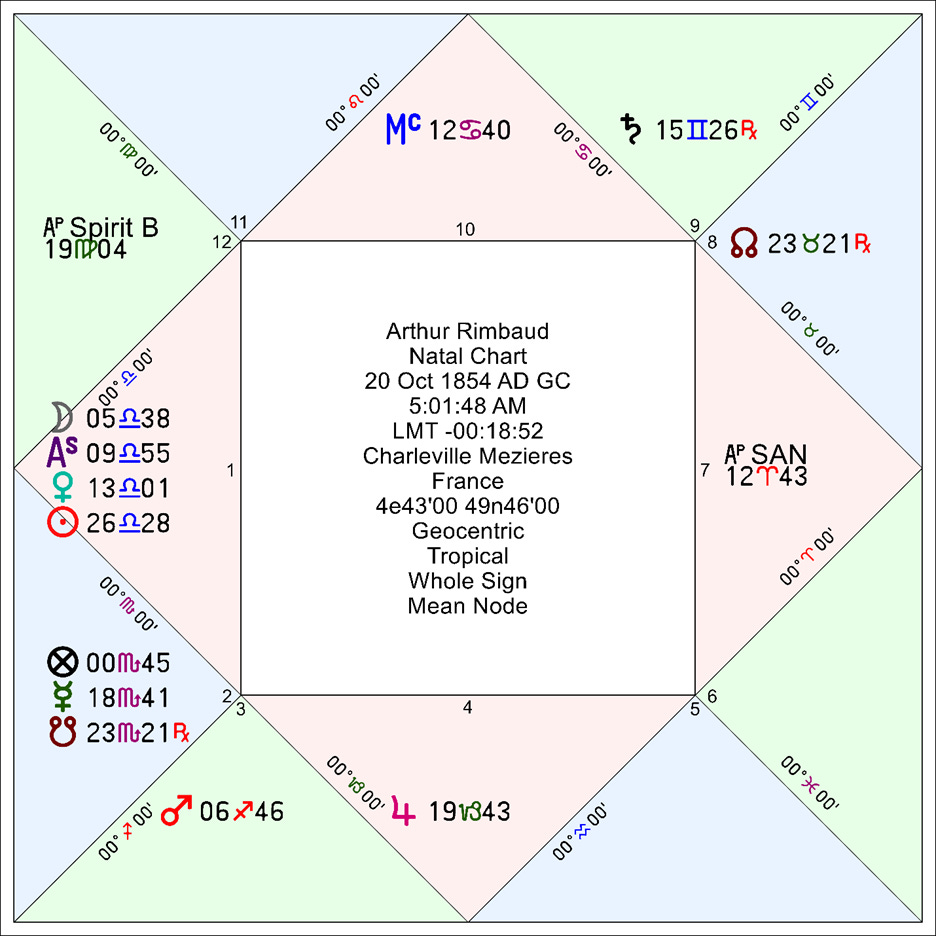
Rodden Rating AA, BC/BR in hand, 6:00 AM, ASC 20LI24
Proposed Rectification: 5:01:48 AM, ASC 9LI54’58”
The analytical models used in the sections below are part of a larger research program developed across longer white papers and case studies, where the historical sources, rules, and testing methodology are laid out in full. These database entries show the models in practice; readers who want the theoretical foundations can start with the background papers below:
Rectification Hub (I wrote the book on it!)
Soul Hub (white paper, Victor model statistical tests, Moon’s Configuration studies)
Physiognomy Hub (white paper, examples)
Victor Model Factors favoring Venus/Libra
Sign ruler: Sun, Moon, Ascendant
Bound ruler: Sun, Midheaven
Position: Angular in 1st house near Ascendant degree
Victor of the Horoscope. Venus/Libra is the victor of Rimbaud’s horoscope. Venus is in her own sign and placed near the Ascendant degree, giving her both essential dignity and a direct connection with Rimbaud’s identity and life direction; she also rules both the Sun and Moon in Libra. The delineation matches the principal interests of his early life: art, poetry, beauty, and sexual relationships. Poetry joined the artistic and erotic significations of Venus, while his relationship with Paul Verlaine made sexuality inseparable from the period in which his major literary work was produced. Venus/Libra therefore describes not simply Rimbaud’s occupation as a poet but the combination of artistic production, aesthetic experimentation, and sexual experience for which his youth became known. The earlier victor analysis reaches the same result under both the Ibn Ezra and Antiochus/Porphyry approaches, identifying Venus/Libra as the victor.
Physiognomy Model Factors – undetermined match
Rising sign: Libra
Ruler of rising sign: Venus/Libra
Planets in rising sign: Moon/Libra, Venus/Libra
Rising decan (identical to rising sign)
The surviving photograph shows Rimbaud as a slender young man with a relatively long, narrow face that tapers toward the chin. The forehead is broad and high relative to the lower face, the temples narrow gradually into moderately prominent cheekbones, and the jaw is comparatively fine rather than square or heavy. His nose is long and straight, the mouth is small to medium in width with fairly thin lips, and the chin is narrow but defined. The eyes appear moderately deep-set beneath relatively straight eyebrows. Overall, the face combines an elongated upper and middle section with a narrowing lower section; there is little heaviness or breadth in the jaw and lower cheeks.
With Libra rising and Venus/Libra close to the Ascendant, John Willner’s model would lead us to look for the compressed ovate facial type. The photograph provides only a partial match. There is some ovate structure in the smooth taper from the upper face toward the chin, but the face appears longer and narrower than the term compressed ovate would suggest; neither the cheeks nor the jaw produce a strongly compressed outline. Age is an important qualification in this case. The familiar Étienne Carjat portrait was taken when Rimbaud was about seventeen, and the full physiognomic characteristics associated with the Ascendant may not become established until after puberty and, in some individuals, well into the twenties. Because Rimbaud died at thirty-seven and the best-known surviving portraits show him during adolescence, the photographic record gives us a poor test of his mature astrological physiognomy. I would therefore classify the Libra compressed-ovate match as possible but inconclusive, rather than treating the youthful portrait as evidence either confirming or rejecting the model.
Moon’s Configuration
Stage 1 — Moon separates from Jupiter/Capricorn
Delineation. Before entering Libra, the Moon in late Virgo separates from an out-of-sign trine to Jupiter at 19CP43 in the 4th house. Jupiter is in its fall in Capricorn, where its significations of protection, prosperity, education, and advancement are constrained by material necessity, scarcity, discipline, labor, and ambition. In the 4th house, this can signify deficient care and comfort within the family of origin, including poverty or material insecurity, followed by a drive toward self-reliance and material independence. Capricorn also has a martial component because Mars is exalted there, allowing Jupiter/Capricorn in the 4th to describe a father associated with military service, discipline, and prolonged absence. Although the trine provides an unobstructed connection between the planets, Jupiter’s fall limits what Jupiter can provide; the separating aspect makes these family and material circumstances an antecedent from which Rimbaud’s subsequent life develops.
Biographical Match. Rimbaud’s father, Frédéric Rimbaud, was a career army officer who was frequently absent and permanently left the household when Arthur was about six. Rimbaud was thereafter raised by his strict and religious mother under reduced material circumstances. Jupiter/Capricorn continued to manifest through Rimbaud’s later search for material independence. His major Firdaria changes from Saturn to Jupiter on 20 October 1874, immediately preceding his abandonment of literature in 1875; during the Jupiter period he moved through teaching, manual labor, military service, quarry work, and eventually commercial employment. During the Jupiter/Sun subperiod he supervised stoneworkers at a quarry in Cyprus, while the Jupiter/Venus period beginning in December 1879 coincided with his movement into the coffee trade in Aden and subsequently Harar. Jupiter/Capricorn therefore links the limited care and material security of the family of origin with the adult drive toward work, money, commerce, and economic self-sufficiency.
Stage 2 — Moon enters Libra and becomes void-of-course
Delineation. After separating from Jupiter, the Moon leaves Virgo and enters Libra, where it becomes co-present with Venus at 13LI01 near the Ascendant. Yet the Moon does not immediately apply to Venus. Instead, it remains void-of-course until it reaches the application to Mars/Sagittarius, creating an interval in which the Moon has entered the sign of its eventual Venusian destination without yet being directly connected to Venus by aspect. The distinction is important: the artistic and aesthetic influence of Venus/Libra is present in the Moon’s environment and contributes to Rimbaud’s intuitive and imaginative disposition, but Venus is not yet directly wired into the Moon’s chronological flow. The sign change from Virgo to Libra therefore introduces the Venusian setting in which Rimbaud’s poetic identity develops, while the void-of-course condition indicates that this artistic capacity does not provide a continuous trajectory for the subsequent life.
Biographical Match. Rimbaud’s adolescence provides a close match to this combination of Venusian presence and discontinuity. Poetry, artistic experimentation, and his relationship with Verlaine became defining features of his youth, consistent with the Moon’s entry into Libra and co-presence with a dignified Venus near the Ascendant. Yet these activities did not develop into a sustained adult vocation. Rimbaud produced the poetry on which his reputation rests while still very young and then abandoned literature at about twenty-one. He subsequently moved through countries, languages, temporary occupations, military service, manual labor, and commercial ventures. The void-of-course interval therefore does not signify the disappearance of the Venusian artistic drive; rather, it describes the absence of a direct connection between that drive and the continuing narrative of the life. Venus remains present, but the Moon passes through Libra without applying to Venus before its next engagement with Mars. Only after the Mars sequence is completed does the Moon finally apply to Venus, consistent with the later and especially posthumous return of Rimbaud’s poetic identity.
Stage 3 — Moon applies to Mars/Sagittarius
Delineation. The Moon next applies to the sextile of Mars at 6SA46 in the 3rd house. Mars introduces conflict, severance, weapons, physical danger, burning, cutting, and decisive action, while Sagittarius adds long-distance movement and foreign environments; the 3rd connects these themes with writing, communication, journeys, and associates. Mars also rules Scorpio, the 2nd whole-sign house, connecting the planet with livelihood, possessions, and commercial activity. Because the aspect is a sextile, Mars need not signify only injuries suffered by Rimbaud: its significations can become activities he actively pursues, including travel, physical labor, commercial risk, military service, and eventually the trade in weapons.
Biographical Match. Mars appears repeatedly across Rimbaud’s chronology. His relationship with Verlaine combined literature, travel, quarrels, and violence, culminating on 10 July 1873 when Verlaine shot Rimbaud in the wrist. Rimbaud subsequently abandoned writing, traveled extensively, enlisted in the Dutch colonial army, and eventually became involved in transporting rifles and ammunition to Menelik II in East Africa. The Mars major Firdaria began in October 1886 and encompassed the remainder of his life. Its final manifestation was physical: in 1891 Rimbaud developed a cancerous growth around the knee and underwent amputation of his right leg. Mars signifies cutting, while Sagittarius traditionally governs the thighs and the region adjacent to the knee. Mars/Sagittarius therefore describes the increasingly active, mobile, risky, and physical character of Rimbaud’s later life, culminating in surgical cutting.
Stage 4 — Moon applies to Venus/Libra
Delineation. After separating from Mars, the Moon remains in Libra and eventually applies to Venus at 13LI01. Venus is in her own sign, near the Ascendant, co-present with the Moon, and the victor of the horoscope. The sequence is significant: Venus does not directly participate in the Moon’s principal Jupiter-to-Mars narrative but awaits the Moon after its engagement with Mars has been completed. The artistic significator therefore becomes the Moon’s destination only after the martial sequence has run its course. Because Mars describes the final phase of Rimbaud’s physical life and Venus follows Mars in the Moon’s sequence, the application can be read as a posthumous return to the artistic identity represented by Venus/Libra.
Biographical Match. Rimbaud’s reputation as a poet developed largely after he had abandoned literature and continued after his death. Verlaine brought renewed attention to him through Les Poètes maudits in 1884, and Illuminations was published in 1886 while Rimbaud was occupied with commerce in Africa. The separation between the living man and his literary identity was substantial: the biographical source records that his sister Isabelle did not know until after Rimbaud’s death that her brother had been a poet. After his death in 1891, however, the Venusian part of the horoscope became the basis of his continuing public identity. His poetry was republished, interpreted, and incorporated into the literary canon, while the adolescent poet rather than the African merchant became the Rimbaud remembered by later generations. The Moon’s eventual application to a dignified Venus near the Ascendant therefore supplies a final stage to the configuration: the life ends under Mars, but the posthumous identity returns to Venus.
Influence of Sect
Rimbaud’s horoscope is nocturnal, making Venus the in-sect benefic, Mars the in-sect malefic, and Jupiter the out-of-sect benefic. Sect sharpens the Moon’s configuration by differentiating the effectiveness of these planets. Venus benefits from sect, increasing the ability of Rimbaud’s Venus/Libra victor to extend his poetry beyond the circumstances of his own life and achieve broad social and cultural reach, particularly after his death. Jupiter, by contrast, is out-of-sect as well as in its fall in Capricorn, marginalizing Jupiterian activities: conventional education, social advancement, prosperity, and respectable professional standing never become the principal basis of his reputation, while his later pursuit of money and commerce remains peripheral to how he is remembered. Mars is in-sect and therefore moderated rather than allowed its most destructive expression. Rimbaud could actively engage martial significations through military service, physical risk, travel, and the arms trade without being destroyed by them; even Verlaine’s shooting of Rimbaud produced a wrist wound rather than a fatal injury. Mars ultimately retained its capacity to harm through the cancer, surgery, and amputation that preceded Rimbaud’s death, but its in-sect condition helps explain why martial activity could function productively for substantial portions of his life before reaching that final destructive expression.
Early/Late Bloomer Assessment
Rimbaud was born after a Full Moon and therefore should conform to the late-bloomer pattern. His Moon at 5LI38 is in the fourth-quarter waning phase and is approaching the next New Moon at the Sun at 26LI28; however, the Moon remains more than 20 degrees from the Sun and therefore lies outside the Sun’s 15-degree bond. The model should consequently remain operative despite his birth relatively late in the lunation cycle. Rimbaud presents an interesting test because his literary precocity initially makes him appear to contradict the model: his first poem was published at fifteen, his principal poetic innovations occurred in his teens, and he had essentially abandoned literature by twenty-one. Yet his broader life trajectory supports a late-bloomer interpretation. The adolescent poet failed to establish a sustained profession or public reputation during his youth; instead, his mature life was built later through travel, employment, trade, and commerce in Arabia and East Africa, while his standing as a poet expanded only after he had stopped writing and continued to grow after his death. Rimbaud therefore suggests that the early/late-bloomer model measures the timing of mature life development and societal recognition rather than simply the age at which talent first appears: his talent manifested early, but the full consequences of his work arrived late and, in substantial measure, posthumously.
Complete biographical chronology, rectification and time lord studies available in Excel format as a paid subscriber benefit. Files are behind the paywall.