

The central argument of this Jupiter in Leo series is that the placement signifies more than celebrity, confidence, or public recognition. Jupiter governs religion, philosophy, law, and systems of meaning; Leo places those beliefs near the center of political and cultural authority. The result is what I have called “the official creed”: a religious or philosophical system that receives public legitimacy, institutional protection, and the power to organize society’s understanding of what is true, noble, and lawful.
I had planned to begin the philosophical section of the series with Constantine the Great, whose patronage transformed Christianity from a persecuted religion into one supported by Roman imperial power. A biography needed for that study is still making its way to me through interlibrary loan—Mercury retrograde; sorry!—so Constantine will have to wait his turn.
We will proceed instead with Augustine of Hippo, the most important Christian writer to emerge after Constantine placed the Church under imperial protection. Constantine supplied Christianity with political legitimacy; Augustine supplied it with an intellectual system. His writings on sin, grace, free will, history, political authority, and the nature of the Church helped establish the conceptual framework through which Western Christianity understood itself for more than a millennium. With Jupiter in Leo as victor of his horoscope, Augustine offers an unusually complete example of belief becoming doctrine and doctrine acquiring civilizational authority.
The following week I will turn to Thomas Aquinas. Aquinas did not have Jupiter in Leo, but introductory philosophy courses routinely place Augustine and Aquinas together as the two foundational architects of Christian philosophy. Treating them consecutively will allow us to compare Augustine’s synthesis of Christianity and Platonism with Aquinas’s later synthesis of Christianity and Aristotle.
After Aquinas, the likely sequence is Constantine followed by Thomas Hobbes, both born with Jupiter in Leo. Hobbes will also complete a natural pairing with Machiavelli, whose horoscope was published on June 24: the two political philosophers usually encountered after Augustine and Aquinas in the academic survey of Western thought. Together these figures will test Jupiter in Leo across religion and political theory, from the imperial sponsorship of Christianity to the modern state’s claim to define and enforce the terms of public order.
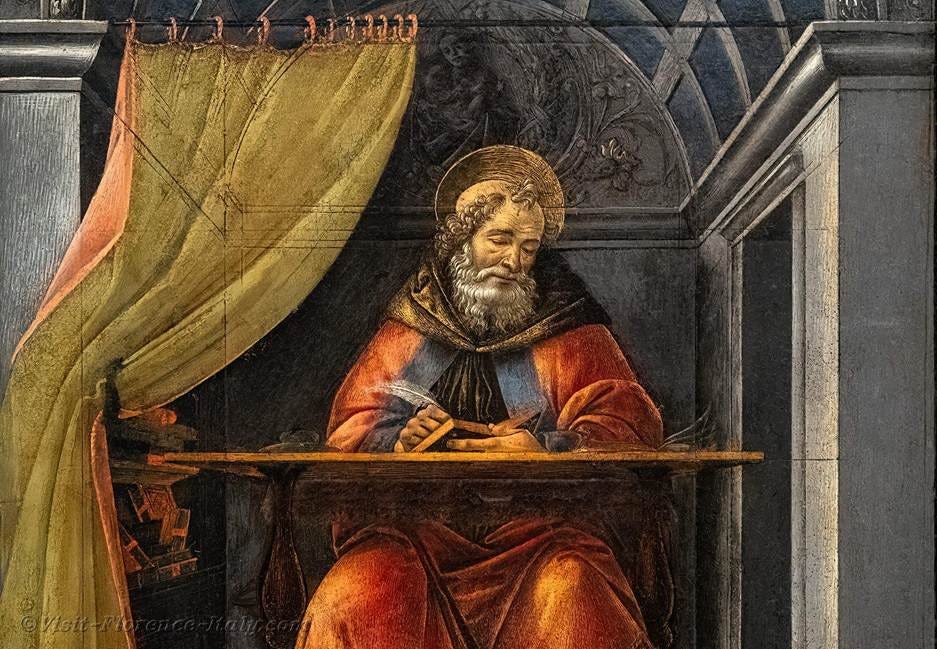
Augustine was born on 13 November 354 in Thagaste, a provincial town in Roman North Africa, in what is now Algeria. His father, Patricius, was a modest landowner and municipal official who remained a pagan until late in life; his mother, Monica, was a committed Christian whose determination to recover her son for the Church became one of the central relationships of his life. The family belonged to the Romanized provincial class, and Augustine’s education prepared him for advancement through rhetoric, teaching, and imperial service.
After studying locally and at nearby Madauros, Augustine went to Carthage to complete his education in rhetoric. He was intellectually ambitious, sexually active, and conscious of the social distinction that mastery of language could bring. At about eighteen he began living with an unnamed woman who remained his companion for more than a decade and bore their son, Adeodatus. Although Augustine later described this period through the language of sin and disordered desire, the relationship itself was stable by the standards of late Roman concubinage.
Reading Cicero’s now-lost Hortensius awakened Augustine’s desire for philosophical wisdom. Christianity initially disappointed him: he found the Latin Bible stylistically crude and could not reconcile its teachings with the existence of evil or his conception of God as a material being. Manichaeism offered what appeared to be a more rational alternative. Its division of reality between principles of light and darkness allowed Augustine to explain evil without making either God or the human will fully responsible for it.
Augustine remained a Manichaean “hearer” for approximately nine years while teaching rhetoric at Thagaste and Carthage. During this period he also consulted astrologers and accepted the premise that celestial configurations could disclose individual destinies. Doubts accumulated as Manichaean cosmology proved unable to withstand his growing knowledge of philosophy and astronomy. His meeting with the celebrated Manichaean bishop Faustus was especially disappointing: Augustine admired Faustus’s eloquence but discovered that he could not answer the intellectual objections Augustine had hoped he would resolve.
In 383 Augustine left Carthage for Rome, deceiving Monica so that he could depart without her. He soon obtained a more prestigious appointment as professor of rhetoric at the imperial court in Milan. This was the summit of the secular career for which he had been trained, placing him near the political and cultural center of the western empire. Yet he arrived in Milan intellectually dissatisfied, professionally ambitious, and incapable of committing himself to a settled philosophy or way of life.
In Milan he encountered Bishop Ambrose, initially approaching him as a celebrated public speaker. Ambrose’s allegorical interpretation of Scripture showed Augustine that Christianity did not require the crude literalism he had previously rejected. Latin translations of Neoplatonic writings also enabled him to conceive of God as immaterial and evil as a deprivation of good rather than an independently existing substance. Platonism removed many of his intellectual objections to Christianity, but it did not solve what he considered the deeper problem: his inability to govern his own will.
His personal life intensified the conflict. Monica arranged a socially advantageous marriage for him, but the prospective bride was not yet old enough to marry. Augustine therefore sent away the woman who had lived with him for years; she returned to Africa after promising sexual fidelity to him, while Adeodatus remained with his father. Unable to remain continent while waiting for the marriage, Augustine took another mistress. The episode exposed the distance between the philosophical life he admired and the habits he was unwilling to surrender.
The crisis came in Milan in 386. Accounts of other men abandoning position and marriage for Christian asceticism forced Augustine to confront his divided will. While weeping in a garden, he heard a childlike voice repeating, “Take and read.” He opened Paul’s epistles and encountered a passage commanding the abandonment of revelry, sexual indulgence, and rivalry and the putting on of Christ. Augustine interpreted the moment as a divine command. His resistance ended, and his friend Alypius joined him in renouncing their former ambitions.
Augustine withdrew from public teaching and spent several months with friends at Cassiciacum, where he composed philosophical dialogues reflecting his developing synthesis of Christianity and Platonism. Ambrose baptized Augustine, Alypius, and Adeodatus during the Easter vigil of 387. Augustine then began the journey back to Africa with Monica, but she died at Ostia while they waited to sail. Their final conversation, later presented in Confessions as a shared ascent toward eternal wisdom, became Augustine’s culminating portrait of the mother whose religion he had resisted and ultimately adopted.
Returning to Africa in 388, Augustine established a small religious community at Thagaste and intended to pursue a life of study, prayer, and contemplation. Adeodatus, whom Augustine remembered as exceptionally intelligent, died while still young. Augustine’s own withdrawal from public life also proved temporary. During a visit to Hippo in 391, he attended a service at which Bishop Valerius spoke of the congregation’s need for a priest. The crowd identified Augustine and pressed him into ordination.
As a priest, Augustine founded another religious community, preached, interpreted Scripture, and entered the theological disputes dividing North African Christianity. Valerius made him coadjutor bishop in 395, and Augustine succeeded him as bishop of Hippo in 396. He held that office for the remainder of his life. Although Hippo was not one of the most prestigious sees, Augustine’s sermons, letters, books, and participation in church councils gave him an influence extending far beyond his diocese.
His Confessions, written around 397–400, turned his compromised past into the foundation of his religious authority. Addressed to God but intended for public circulation, the work recounts his movement through sexual desire, professional ambition, Manichaeism, astrology, skepticism, and Platonism toward Catholic Christianity. Its subject is not simply autobiography but the instability of a will seeking happiness in temporary things. Augustine presents conversion as the recovery of a life whose meaning had remained hidden from the person living it.
Much of his episcopal career was occupied by the Donatist controversy. The Donatists maintained a rival North African church descended from Christians who had refused to accept clergy accused of compromising during imperial persecution. Augustine argued that the validity of the sacraments did not depend upon the minister’s personal purity and that the universal Church could contain both righteous and sinful members. After years of persuasion and public debate, he came to support imperial laws coercing Donatists into Catholic unity. Augustine insisted that coercion could not itself produce faith but believed that external pressure might break hardened habits and make genuine reconsideration possible.
The sack of Rome by the Visigoths in 410 produced another challenge. Pagans blamed Christianity for weakening the empire by suppressing the gods who had once protected it. Augustine answered in The City of God, composed between 413 and 426. Across twenty-two books, he rejected Rome’s claim to sacred permanence and divided humanity between two communities formed by opposing loves: the earthly city founded upon the love of self and the City of God founded upon the love of God. No empire, nation, or visible institution could be identified completely with either city; they remained intermingled until the final judgment.
In the later phase of his career, Augustine became the principal opponent of Pelagius and his followers. Pelagius emphasized moral responsibility and the human capacity to obey God’s commands. Augustine feared that this reduced salvation to an achievement of the will and underestimated humanity’s inherited bondage to sin. He responded by developing increasingly forceful doctrines of original sin, infant baptism, predestination, and the absolute necessity of divine grace. These controversies shaped the form in which much of Western Christianity would understand the Fall and salvation.
Augustine continued writing almost until his death. In the Revisions, composed late in life, he reviewed his works chronologically, identifying statements he wished to clarify or correct without pretending that his intellectual development had been seamless. The project reflects a habit visible throughout his writing: Augustine repeatedly returned to his earlier arguments, treating self-examination as a permanent obligation rather than a stage completed at conversion.
In 429 the Vandals crossed into North Africa and rapidly overwhelmed Roman resistance. They besieged Hippo in 430 while Augustine was ill. He spent his final days reading the penitential Psalms and died on 28 August 430 at the age of seventy-five. Hippo eventually fell, but Augustine’s library and writings survived.
Augustine brought memory, time, language, desire, sexuality, evil, political power, historical change, free will, grace, and biblical interpretation into a single Christian framework. His life joined two careers that he later portrayed as opposites. The professional rhetorician learned to control an audience through language; the bishop redirected that training toward preaching, controversy, and theology. The result was not the rejection of rhetoric but its conversion into an instrument for defining the intellectual world of Latin Christianity.
No Astrodatabank Record
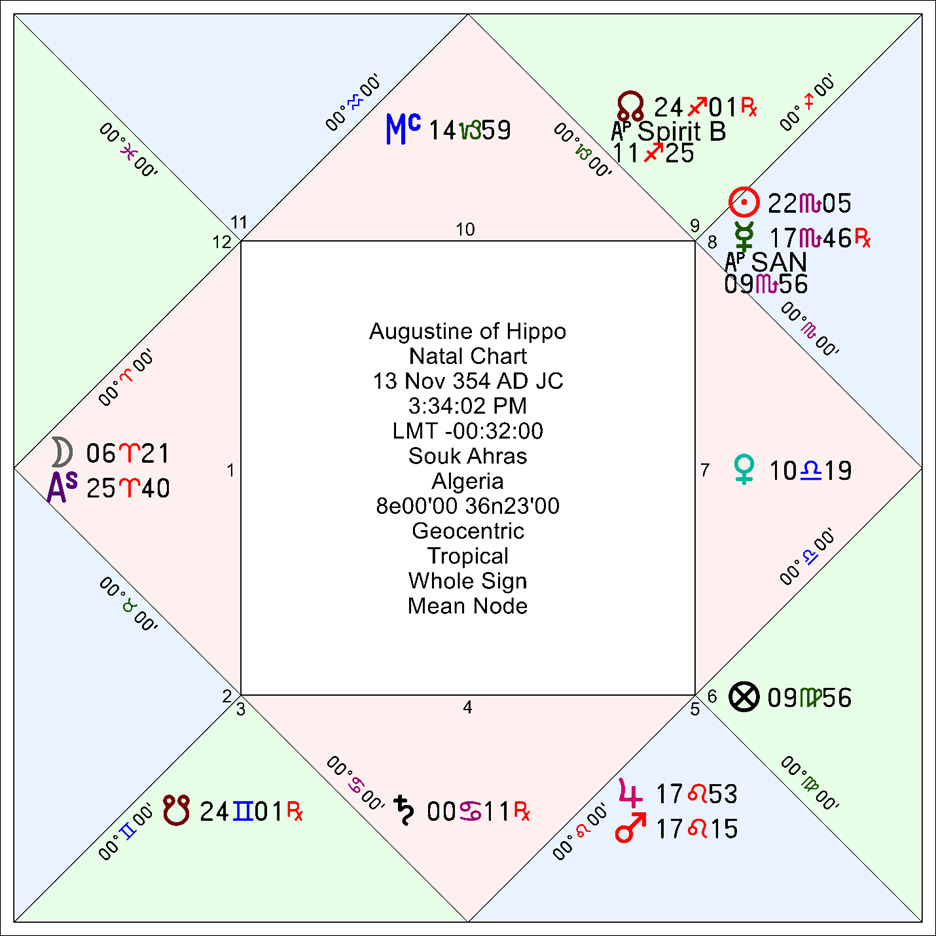
Proposed Rectification: 3:34:02 PM, ASC 25AR40’52”
The analytical models used in the sections below are part of a larger research program developed across longer white papers and case studies, where the historical sources, rules, and testing methodology are laid out in full. These database entries show the models in practice; readers who want the theoretical foundations can start with the background papers below:
Rectification Hub (I wrote the book on it!)
Soul Hub (white paper, Victor model statistical tests, Moon’s Configuration studies)
Physiognomy Hub (white paper, examples)
Victor Model Factors favoring Jupiter/Leo
Sign ruler: Lot of Spirit
Bound ruler: Sun, Lot of Spirit
Notable Configuration: Both Augustine and Billy Graham have Aries rising with a strong 9th house emphasis. For Graham, the 9th house contained North Node, Mars, and the Moon. For Augustine, the North Node, Lot of Spirit, and Lot of Fortune all ruled by Jupiter/Leo the victor.
Jupiter in Leo is the victor of Augustine’s horoscope, directing his intellectual gifts toward the construction of an authoritative Christian worldview. Jupiter expands, synthesizes, and legislates belief; in Leo, it seeks to establish a commanding center around which an entire culture can organize its moral and religious life. Augustine did this not merely by defending Christianity but by defining the terms through which the Western Church would understand sin, grace, free will, salvation, political authority, and the movement of history. Confessions transformed his personal conversion into a model for Christian self-understanding, while The City of God subordinated Rome and every temporal power to a universal sacred history. Even his rejection of astrology carries the Leo signature: competing sources of cosmic authority had to yield to the sovereignty of the Christian God. Augustine’s Jupiter in Leo therefore operated as an official creed, converting one bishop’s theology into a governing structure of belief that endured long after the institutions of the Roman world had collapsed.
Physiognomy
(limited to physical description because of lack of confirming visual documentation)
No reliable contemporary portrait or detailed description of Augustine’s face survives, so the familiar high forehead, intent eyes, and neatly trimmed beard belong to later Christian iconography rather than documented physiognomy. The written evidence instead suggests a physically sensitive but durable man: illness repeatedly interrupted his life, a chest complaint once weakened the powerful voice upon which his career as a rhetorician depended, and he records suffering an excruciating toothache. Yet he lived to seventy-five, preached frequently, traveled on church business, and maintained an extraordinary workload into old age. Possidius describes his clothing, footwear, and bedding as modest but adequate—neither luxurious nor ostentatiously austere—while his restrained diet and disciplined routine suggest a body carefully governed rather than neglected. What emerges is not a recoverable face or build but a recognizable physical presence: an aging, frequently strained scholar-bishop whose endurance proved greater than his constitution initially promised.
Moon’s configuration
Stage 1: Moon Separates from Saturn/Cancer Retrograde
Delineation: Saturn in Cancer imposes a rigid division upon matters of origin, belonging, nourishment, and embodied life. It can classify one substance as pure and another as corrupt, enclosing the individual within a defensive system that explains evil by separating spirit from matter, light from darkness, and the saved community from the contaminated world outside it. Retrogradation reverses Saturn’s commitment to this structure: what initially promises protection and certainty is reconsidered, found inadequate, and ultimately rejected. The Moon’s separation shows the native emerging from an adopted system of fear, exclusion, and absolute moral categories whose boundaries can no longer contain his developing understanding of human nature.
Biographical Match: Augustine spent approximately nine years as a Manichaean “hearer,” attracted by its division of the universe between the opposing principles of light and darkness. The doctrine relieved the individual of some responsibility for evil by locating it in an alien material principle, a solution that initially appealed to Augustine’s struggle with his own desires. His confidence deteriorated when Manichaean teachers could not defend their cosmology, culminating in his disappointing encounter with Faustus. Augustine eventually reversed the Saturn/Cancer premise: matter was not intrinsically evil, creation was fundamentally good, and evil was a privation of good arising through the corrupted will. After separating from Manichaeism, he repeatedly returned to its arguments in order to dismantle the system he had once defended.
Stage 2: Mercury Retrograde Separates from Jupiter and Applies to Mars
Delineation: Mercury carries the doctrine of Jupiter to Mars, translating an established religious system into words directed toward rebels, schismatics, and heretics. Jupiter in Leo signifies the authoritative creed of the universal Church, while Mars in Leo signifies proud religious opponents advancing rival claims to spiritual authority. Mercury retrograde in Scorpio is especially suited to revisiting rejected doctrines, penetrating their concealed premises, and answering opponents through close investigation and adversarial argument. Yet Mars is not simply attacked: its mutual reception with the Sun—Mars ruling the Sun in Scorpio and the Sun ruling Mars in Leo—provides a mechanism through which rebellion can be received, contained, and redirected. Because the Sun occupies Jupiter’s bound, solar authority remains subordinated to Jupiter’s doctrine, allowing the heretic represented by Mars to be tamed and reintegrated into the Church.
Biographical Match: Augustine’s episcopal career was conducted largely through sermons, letters, public debates, and theological works directed against religious opponents. He drew Jupiter’s Catholic doctrine into Mercury’s language and carried it toward the Manichaeans, Donatists, Pelagians, Arians, and other challengers to orthodoxy. His former membership gave him an intimate understanding of Manichaean arguments, which he later used against their teachers; in 404 the Manichaean Felix publicly conceded defeat after debating Augustine and entered the Catholic Church. His opponents were not always converted personally, but his writings repeatedly absorbed their challenges into more precisely formulated Christian doctrines concerning evil, grace, free will, the sacraments, and the nature of the Church. Mercury’s movement from Jupiter to Mars therefore describes Augustine preaching official doctrine to heretics, while the Mars–Sun mutual reception shows those opponents being mastered, contained, or brought within the expanding authority of Latin Christianity.
Stage 3: Moon Applies to Venus
Delineation: The Moon’s application to Venus directs the life toward relationship, desire, reconciliation, and love. With the Moon in Aries opposing Venus in Libra, the configuration initially polarizes personal appetite against the claims of partnership: desire is urgent and self-directed, while Venus seeks union with another. Yet Venus in Libra can progressively elevate attraction into concord, forgiveness, and the restoration of broken relationships. What begins as erotic attachment may therefore be redirected into agape—a nonsexual love expressed through mercy, pastoral care, communal life, and the reconciliation of people divided by conflict.
Biographical Match: The early expression was unmistakably sexual. Augustine began a long relationship in youth, fathered Adeodatus, remained with his unnamed partner for approximately fifteen years, and took another mistress after sending her away. His conversion transformed rather than eliminated the underlying Venusian movement toward love. He renounced marriage and sexual relations, adopted celibacy, founded religious communities, and made properly ordered love central to his theology: sin arose when human beings loved created things above God, while redemption restored those loves to their proper order. As bishop, the same Venus appeared through pastoral care, friendship, forgiveness, communal life, and repeated efforts to reconcile religious opponents with the Catholic Church.
Influence of Sect
Because Augustine’s horoscope is diurnal, Jupiter and Saturn operate in sect while Venus and Mars operate out of sect. Jupiter in Leo, as victor, places Augustine’s Christian doctrine behind the political power of the empire and gives it a reach extending far beyond his provincial bishopric, while Mars in Leo signifies the rival claimants to religious authority—Manichaeans, Donatists, Pelagians, and Arians—who occupied the position of defeated or excluded political parties. Saturn retrograde in Cancer is improved by sect not because rejection of Manichaeism was common, but because Augustine was able to turn his separation from its rigid dualism into a disciplined and constructive theology: he rejected matter as intrinsically evil while retaining a severe account of fallen human nature, reorganizing Saturnian pessimism within a unified Christian creation governed by providence. The same in-sect Saturn supported monastic discipline, episcopal administration, and the patient intellectual labor required to define doctrinal boundaries over several decades. Venus in Libra, although dignified, is out of sect and therefore initially expresses love through compromised or socially marginal arrangements: concubinage, sexual appetite outside marriage, the dismissal of his longtime partner, and another mistress taken while awaiting marriage. After conversion, Venus is not extinguished but displaced from sexual partnership into celibate friendship, monastic community, pastoral charity, and agape. Its out-of-sect condition remains visible, however, in Augustine’s difficulty achieving concord by purely Venusian means: his desire to reconcile religious opponents with the Church eventually included imperial coercion, making peace and unity dependent upon the political power supplied by Jupiter and the disciplinary force of Saturn.
Early/Late Bloomer Model Assessment
Augustine was born after a New Moon and should therefore conform to the early-bloomer model. The midpoint of his life falls around 5 October 392, by which time the essential direction of his life had already been established: he had pursued philosophy, spent nine years among the Manichaeans, developed a successful career in rhetoric, converted to Christianity in 386, received baptism in 387, founded a religious community in Africa, and was ordained a priest in 391. His elevation to the episcopacy and the composition of Confessions, On the Trinity, and The City of God occurred after the midpoint, but these were the institutional and literary expansion of choices already made. The first half supplied the conversion, vocation, intellectual method, and personal experience; the second half converted them into doctrine and ecclesiastical authority. Augustine is therefore a strong match for the model: he did not achieve his greatest public influence early, but the governing pattern of his life became unmistakable before its midpoint.
Complete biographical chronology, rectification and time lord studies available in Excel format as a paid subscriber benefit. Files are behind the paywall.