

Ayn Rand occupies an important place in the intellectual history of American capitalism. Born in Russia, where her family’s property was confiscated following the Bolshevik Revolution, she emigrated to the United States in 1926 and developed a philosophy of rational self-interest, individual achievement, and opposition to collectivism. Her novels The Fountainhead (1943) and Atlas Shrugged (1957) provided fictional models of the independent creator, entrepreneur, and industrialist who refuses to subordinate personal achievement to the demands of society.
Rand’s influence extends well beyond the libertarian movement. Her defense of entrepreneurial independence and laissez-faire capitalism has attracted generations of business leaders, including figures associated with Silicon Valley. Peter Thiel, the subject of next Wednesday’s article (28-Oct-2026), represents one contemporary connection to this intellectual tradition, although his political philosophy differs from Rand’s in important respects. Another prominent admirer was Alan Greenspan, the former Federal Reserve chairman, who belonged to Rand’s inner circle during the development of Objectivism. Greenspan’s horoscope has previously been examined in the Financial Astrology collection.
Astro-Databank records a C-rated birth time of 3:30 PM, corresponding to an Ascendant at 7°21′ Leo. This study moves the birth time back to 2:05:23 PM which yields an Ascendant of 23°52′ Cancer. With Ayn Rand’s style of rugged individualism a classic Leo trait, the rectification proposes Leo as the sign for the Lot of Spirit, not the rising sign itself.
The analysis that follows considers the relationship between Rand’s formative experiences, the development of Objectivism, and the planetary configurations governing her horoscope. Particular attention is given to the contrast between individual initiative and centralized authority, the role of philosophical conviction in her personal relationships, and the timing of her literary and intellectual success. These themes also provide a basis for evaluating the proposed rectification against the major turning points in her biography.
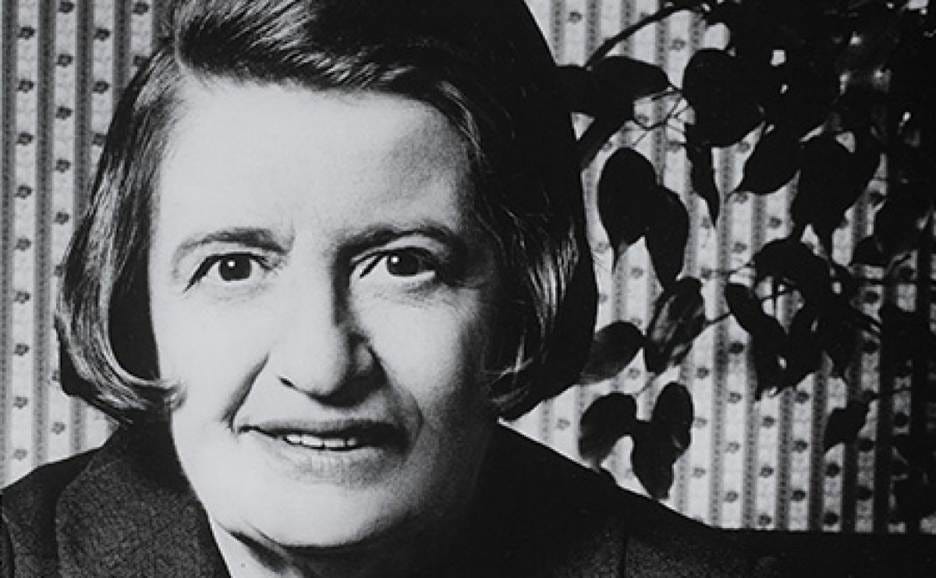
Ayn Rand was a Russian-born American novelist and philosopher whose defense of individualism, rational self-interest, and capitalism made her one of the most controversial intellectual figures of the twentieth century. Her novels The Fountainhead (1943) and Atlas Shrugged (1957) presented uncompromising protagonists who refuse to subordinate their ambitions and achievements to the demands of society. Her philosophy, which she called Objectivism, rejected collectivism and altruism as moral obligations while elevating reason, productive achievement, and individual freedom.
Born Alisa Zinovievna Rosenbaum on 2 February 1905 in St. Petersburg, Russia, Rand grew up in a prosperous Jewish family. Her father owned a pharmacy, and her early years were spent in relative comfort. The Russian Revolution of 1917 transformed the family’s circumstances when the Bolsheviks confiscated her father’s business. The family subsequently fled to Crimea, where Rand witnessed further revolutionary upheaval before returning to Petrograd in 1921. She studied history and philosophy at Petrograd State University, graduating in 1924, and developed an enduring hostility toward communism and the political suppression of individual rights.
In January 1926, Rand left Soviet Russia with permission to visit relatives in the United States. She had no intention of returning. After arriving in New York and spending several months with relatives in Chicago, she moved to Hollywood, where she found employment in the motion-picture industry. She met actor Frank O’Connor while working as an extra on Cecil B. DeMille’s The King of Kings, and the couple married on 15 April 1929. Rand became an American citizen in March 1931.
Her early writing career involved years of financial uncertainty and repeated rejection. Her play Night of January 16th reached Broadway in 1935, followed by the publication of her first novel, We the Living, in 1936. Drawing heavily on her experiences in Soviet Russia, the novel portrayed the destruction of personal ambition and romantic relationships under communist rule. Her next major work, The Fountainhead, was rejected by numerous publishers before appearing in May 1943. Its protagonist, architect Howard Roark, embodied Rand’s ideal of creative independence and resistance to social conformity. The novel gradually became a commercial success and was adapted into a 1949 Hollywood film starring Gary Cooper and Patricia Neal.
Rand devoted much of the following decade to Atlas Shrugged, published on 10 October 1957. The novel imagined a United States in which its most productive industrialists, inventors, and entrepreneurs withdraw their talents from a society increasingly hostile to individual achievement. Through the character of John Galt, Rand presented her mature philosophical defense of reason, capitalism, and rational self-interest. Although the novel received sharply divided critical reviews, it attracted a substantial readership and established Rand as a prominent advocate of laissez-faire capitalism.
During the 1950s, Rand developed a close intellectual and personal relationship with Nathaniel Branden, a younger admirer who became the principal organizer and public spokesman for Objectivism. Their relationship developed into an extramarital affair, conducted with the knowledge of their respective spouses. Branden established an organization devoted to teaching Rand’s philosophy, while the two collaborated on publications and lectures that expanded the Objectivist movement. Their partnership ended acrimoniously in 1968 after Rand discovered that Branden had concealed another romantic relationship. She publicly repudiated him, and the Nathaniel Branden Institute subsequently closed. The rupture also ended her longstanding friendship with Barbara Branden, Nathaniel’s former wife.
Following Atlas Shrugged, Rand concentrated on nonfiction, publishing For the New Intellectual (1961), The Virtue of Selfishness (1964), and Capitalism: The Unknown Ideal (1966). Through essays, lectures, interviews, and her own periodicals, she criticized collectivism, government intervention, religious faith, and prevailing intellectual trends. Her uncompromising positions attracted devoted followers while generating persistent opposition from both the political left and traditional conservatives.
Rand’s later years were marked by declining health and personal loss. She underwent surgery for lung cancer in 1974, and Frank O’Connor died in November 1979 after more than fifty years of marriage. Rand continued to write and occasionally lecture, making her final major public appearance in November 1981. She died at her Manhattan apartment on 6 March 1982, aged seventy-seven.
Rand’s influence extended well beyond literature. Her defense of entrepreneurial independence and opposition to collectivism helped shape strands of American libertarian and free-market thought, while her fictional heroes became enduring models of the self-directed individual. Her work remains influential among business leaders, political activists, and readers drawn to her vision of personal achievement, even as critics continue to challenge its philosophical assumptions and its treatment of human relationships.
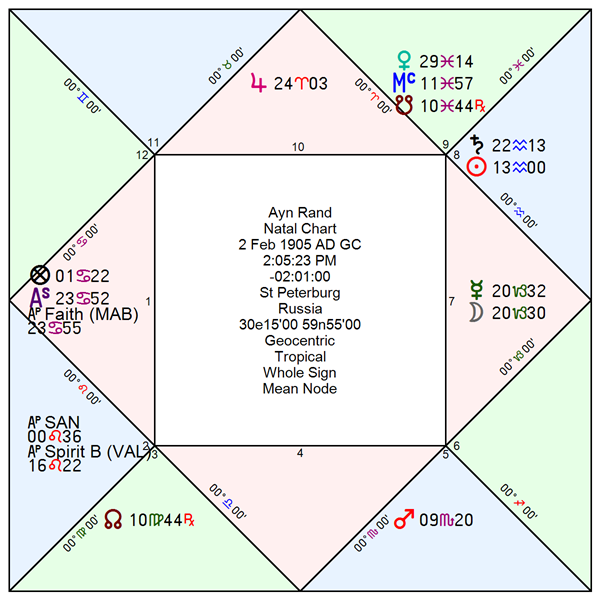
Rodden Rating C, Original source not known, 3:30 PM, ASC 7LE21
Proposed Rectification 2:05:23 PM, ASC 23CA52’53”
Permission: I grant the unlimited use of this rectified horoscope by the public. Credit ‘Regulus Astrology LLC’ and include an accompanying link to this webpage.
The analytical models used in the sections below are part of a larger research program developed across longer white papers and case studies, where the historical sources, rules, and testing methodology are laid out in full. These database entries show the models in practice; readers who want the theoretical foundations can start with the background papers below:
Rectification Hub (I wrote the book on it!)
Soul Hub (white paper, Victor model statistical tests, Moon’s Configuration studies)
Physiognomy Hub (white paper, examples)
Victor Model Factors favoring Jupiter/Aries
Sign ruler: Midheaven
Bound ruler: Sun, Ascendant, Prenatal Syzygy
Position: Superior square to the Ascendant degree
Jupiter/Aries — Victor of the Horoscope. Jupiter at 24°03′ Aries is the victor of Ayn Rand’s horoscope, signifying the rugged individualism that became the defining principle of her philosophy and fictional heroes. Jupiter/Aries favors forthright action directed by the individual will, pursuing objectives without attempting the Libran compromise of balancing competing interests. Jupiter occupies the bound of Mars, whose placement at 9°20′ Scorpio, strong and fortified in its own domicile, reinforces determination, strength, and an affinity with industrial processes and productive enterprise. With Cancer rising, Jupiter forms a nearly exact superior square to the Ascendant, placing its principles at the forefront of Rand’s character and personal expression. Jupiter occupies the 10th house by whole signs and the 11th by quadrant houses, connecting individual achievement with public recognition, intellectual alliances, and organized movements. Its rulership of the 9th house of philosophy by whole signs and the 10th house of career by quadrant houses unites Rand’s philosophical convictions with her professional identity. Jupiter also rules the 6th house, associated with the working class in mundane astrology, extending its significance to the relationship between individual enterprise, productive labor, and the industrial economy. Taken together, these configurations identify Jupiter/Aries as the organizing principle of Rand’s life: the independent individual who creates, produces, and acts according to personal conviction rather than subordinating achievement to collective demands.
Physigonomy Model Factors favoring Cancer, Scorpio
Rising sign: Cancer
Ruler of rising sign: Moon/Capricorn
Rising decan: Scorpio
Ruler of rising decan: Mars/Scorpio
Planets in sign of rising decan: Mars/Scorpio
Physical Appearance. Ayn Rand’s physiognomy is distinguished by a broad, rectangular face, a strong jawline, and a comparatively wide forehead, giving her an imposing, somewhat masculine presence. Her features are substantial rather than delicate, with a straight, prominent nose, firmly defined mouth, and large, dark eyes whose direct, intense gaze conveys an impression of determination and scrutiny. Her dark hair is closely arranged around the head, with a pronounced sweep of bangs across the forehead, particularly evident in photographs from her younger years. The skin appears smooth and luminous, providing a contrast to the angular structure of the face. Although her features soften somewhat with age, the underlying rectangular proportions and penetrating expression remain consistent throughout her life.
Astrological Signification. In John Willner’s physiognomic model, Scorpio is the primary significator of Rand’s appearance, with Cancer providing a secondary influence. Scorpio produces the rectangular facial structure clearly evident in her photographs, contributing to the masculine quality of her appearance. The prominent bangs sweeping across her forehead resemble the pincers of a scorpion, another characteristic Scorpio feature, while her intense, penetrating gaze reinforces the same identification. Cancer is most apparent in the smooth, luminous quality of her skin, a classic Cancerian trait. However, Cancer typically produces an ovate facial shape, which is not evident here. The predominance of the rectangular rather than ovate form, together with the hairstyle and intensity of expression, makes Scorpio the stronger physiognomic significator, with Cancer contributing primarily to the complexion.
Moon’s Configuration
Stage 1. Moon separating from Mars (Scorpio, 5th)
Delineation. The Moon at 20°30′ Capricorn in the 7th house separates from a sextile with Mars at 9°20′ Scorpio in the 5th house. Although the planets occupy signs configured by sextile, their separation of 11°10′ exceeds William Lilly’s Moon–Mars aspect moiety of 9°30′, placing the aspect outside its effective range. Mars is strongly fortified in its own domicile of Scorpio, signifying force, coercion, and the capacity to seize or control resources. The 5th house is the second house from the 4th, governing the father’s financial resources, property, and material possessions. The separating Moon–Mars configuration therefore signifies an earlier experience involving the forcible seizure of the father’s property. The wide separation suggests that this event belongs to an early phase of life, followed by a break in circumstances before the Moon’s immediate application to Mercury.
Biographical Match. Rand’s father, Zinovy Rosenbaum, owned a successful pharmacy in St. Petersburg, providing the family with a comfortable standard of living. Following the Bolshevik Revolution of 1917, communist authorities confiscated his business, destroying the family’s principal source of income and contributing to their subsequent impoverishment. The seizure of her father’s property by revolutionary force corresponds directly to Mars/Scorpio in the 5th house, the second from the 4th. Rand was twelve years old when the revolution began, making this an early formative experience. The subsequent displacement of the family and Rand’s eventual departure from Soviet Russia in January 1926 mark the discontinuity separating this experience from her later intellectual and philosophical development.
Stage 2. Moon applying to Mercury (Capricorn, 7th)
Delineation. The Moon immediately applies to a conjunction with Mercury at 20°32′ Capricorn, only 2 arcminutes from perfection. Mercury/Capricorn signifies a methodical, practical, and disciplined approach to knowledge, emphasizing observation, logical reasoning, and the systematic organization of experience. Unlike a philosophy founded upon Platonic ideals or abstract forms existing independently of material reality, Mercury/Capricorn seeks to establish principles through the rational examination of the observable world. Both the Moon and Mercury occupy the 7th house, within approximately 4 degrees of its cusp, connecting these intellectual principles with debate, argumentation, and direct engagement with others. The conjunction also suggests that intellectual agreement and disagreement become important determinants of personal relationships, with philosophical convictions governing the selection and rejection of associates.
Biographical Match. Rand’s Objectivist philosophy rests upon an epistemology that emphasizes reason, logic, and the objective identification of reality. Her rejection of mysticism, religious faith, and philosophical idealism corresponds closely to Mercury/Capricorn’s practical and systematic approach to knowledge. These principles were developed through her novels and subsequently elaborated in nonfiction essays, lectures, and Introduction to Objectivist Epistemology. The 7th-house emphasis is evident in Rand’s extensive participation in philosophical debates and her insistence upon intellectual consistency among friends and associates. Her relationships with Nathaniel and Barbara Branden illustrate the extent to which philosophical and moral judgments governed her personal life. The rupture of 1968 demonstrates how disagreement and perceived dishonesty could transform intellectual partnership into permanent estrangement.
Stage 3. Moon applying to Jupiter (Aries, 10th/11th)
Delineation. Following its conjunction with Mercury, the Moon applies to a square with Jupiter at 24°03′ Aries, the victor of the horoscope. Jupiter/Aries signifies rugged individualism, independent initiative, and forthright action directed by personal conviction rather than compromise between competing interests. The square introduces a forceful and potentially contentious expression of these principles, rejecting the Libran ideal of balancing opposing claims in favor of the individual’s right to pursue independently chosen objectives. Jupiter occupies the bound of Mars, whose fortified placement in Scorpio reinforces determination and connects Jupiterian individualism with industrial production and enterprise. Jupiter’s position in the 10th house by whole signs, its rulership of the 9th house of philosophy, and its nearly exact superior square to the Cancer Ascendant make it a dominant influence upon Rand’s public identity. The Moon’s application from Mercury to Jupiter indicates that systematic reasoning and epistemology ultimately serve the expression of Jupiter’s individualist philosophy.
Biographical Match. Rand’s literary and philosophical career culminated in the defense of the independent individual against the demands of collective society. Howard Roark in The Fountainhead and John Galt in Atlas Shrugged embody Jupiter/Aries through their refusal to compromise their productive and intellectual independence. Her advocacy of laissez-faire capitalism similarly elevates the entrepreneur, inventor, and industrialist as creators of wealth whose achievements should not be subordinated to political or social demands. The Moon’s progression from Mercury to Jupiter mirrors the relationship between Rand’s epistemology and her broader philosophy: reason establishes the means by which reality is understood, while rational self-interest and individual achievement supply the moral and political objectives. The square reflects the confrontational character of her public advocacy, which frequently rejected compromise with competing philosophical positions. Jupiter’s prominence in the 10th house by whole signs confirms that these principles became the defining subject of her literary reputation and professional career.
Influence of Sect
Rand’s horoscope is diurnal, placing Jupiter and Saturn in sect while Venus and Mars are out of sect. Jupiter benefits from this condition, giving her philosophy of rugged individualism a relatively broad scope of influence within society, extending well beyond her lifetime to contemporary Silicon Valley entrepreneurs and political figures, including the current U.S. vice president, JD Vance. Yet Saturn/Aquarius, signifying top-down command-and-control statism, socialism, and collectivist ideology, is likewise in sect. Thus, at least by sect, the collectivist principles of Rand’s ideological opponents possess a comparable capacity to exert influence across society, establishing a persistent contest between individual liberty and centralized authority. Mars/Scorpio, although fortified by domicile, is out of sect, aggravating its destructive potential, as demonstrated by the forcible confiscation of her father’s pharmacy and the resulting damage to the family’s financial circumstances. Venus/Pisces is similarly out of sect, introducing a tendency toward excessive artistic idealism despite its exalted condition. This is epitomized by the closing scene of The Fountainhead, in which Dominique Francon ascends a construction elevator toward Howard Roark atop his skyscraper, transforming architectural achievement into an almost transcendent romantic ideal. Such imagery could appear overwrought to the more pragmatic sensibilities of mid-twentieth-century American audiences.
Early/Late Bloomer Assessment
Born on 2-Feb-1905, after a Full Moon, Ayn Rand is classified as a late bloomer under the lunar-phase thesis. She died on 6-Mar-1982, giving her a longevity of approximately 77 years and a lifespan midpoint at age 39, in 1943. The first half of her life was dominated by the Russian Revolution, emigration to the United States in January 1926, and a prolonged struggle to establish herself as a writer. Her early successes included the Broadway production of Night of January 16th in September 1935 and publication of We the Living in 1936, but neither established her lasting reputation. The Fountainhead, published in May 1943, appeared just three months before her lifespan midpoint, although its commercial success developed primarily afterward. The second half of her life brought substantially greater recognition, beginning with the film adaptation of The Fountainhead in 1949 and culminating in Atlas Shrugged, published on 10-Oct-1957 when Rand was fifty-two. She subsequently developed Objectivism into an organized philosophical movement, publishing For the New Intellectual (1961), The Virtue of Selfishness (1964), and Capitalism: The Unknown Ideal (1966), while extending her influence through lectures, essays, and public debate. Although the rupture with Nathaniel Branden in 1968 disrupted her intellectual circle, her philosophical influence continued to expand beyond her lifetime. Rand therefore provides a strong match to the late-bloomer thesis: the first half of her life was principally devoted to preparation and struggle, while the second brought her defining literary achievements, philosophical authority, and enduring public influence.
Complete biographical chronology, rectification and time lord studies available in Excel format as a paid subscriber benefit. File is behind the paywall.