

The performance of Jupiter in Cancer is regulated by the Moon’s configuration, since the Moon rules Cancer. Mussolini is the first of several horoscopes I present that demonstrate how a maltreated Moon degrades the behavior of Jupiter. This despite Jupiter’s placement in Cancer, sign of its exaltation. For Mussolini, Jupiter initially signifies his activity in the Socialist Party, where he rose to become editor of Avanti!, the national daily newspaper of the Socialist Party. But World War I changed Mussolini. After the war, he decried Socialists who accused Italian WWI veterans of being capitalist dupes instead of heroes. Here is where the power of Mercury in Leo, as victor of the horoscope, asserts its rulership over Mussolini, with Mercury placed in the Sun’s sign of Leo—favoring hero worship. With respect to the Moon’s configuration - here the Moon separates from Saturn and applies to Mars in a condition known as besiegement - Jupiter in Cancer actually shoots itself in the foot because Jupiter is the bound ruler of Saturn. Saturn in Gemini signifies restraint but Saturn at 7GE34 is placed in the bound of Jupiter which lessens Saturn’s restraint via lenient treatment of criminial activity by the courts (Jupiter in the 9th house of the law). This, in turn, clears the way for Mussolini and his Fascist followers to follow the path of violence.
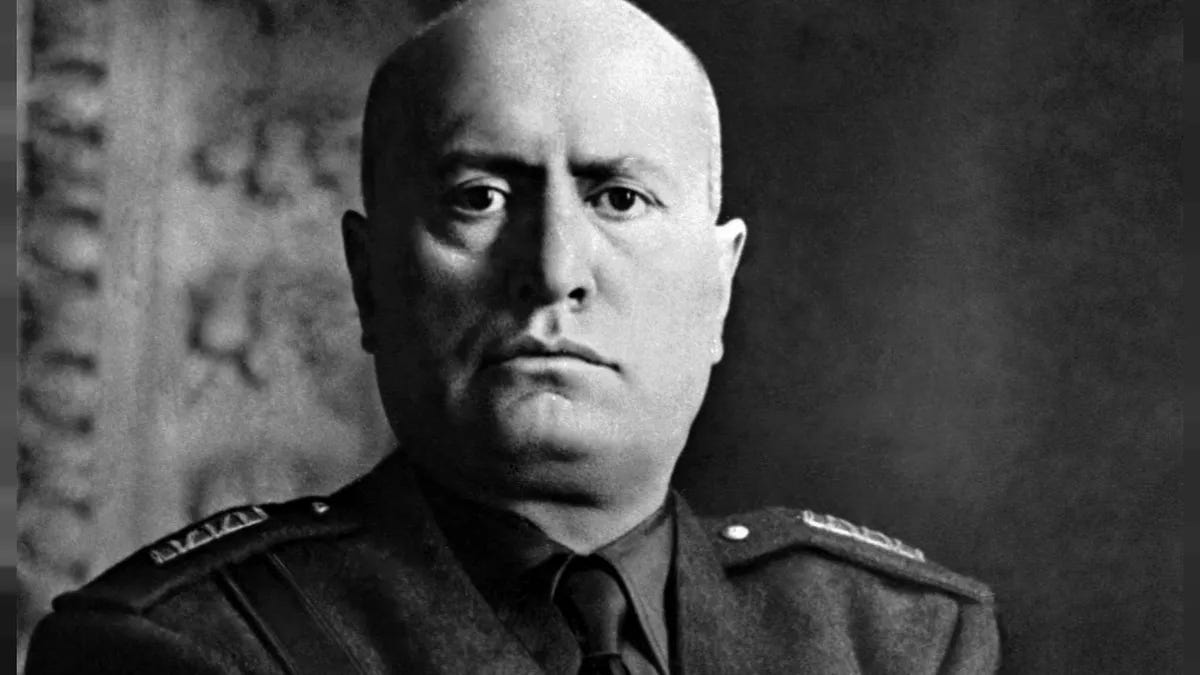
Benito Mussolini was the founder of Italian Fascism and ruled Italy as Prime Minister from 1922 until his downfall in 1943. Born on July 29, 1883, in Predappio, Romagna, to a blacksmith father and a schoolteacher mother, Mussolini’s early life was shaped by socialism, anti-clericalism, and class conflict. A gifted orator and journalist, he rose quickly in the ranks of the Italian Socialist Party but was expelled in 1914 for advocating Italy’s entry into World War I. His pro-war stance reflected a key transformation: from internationalist socialism to nationalist revolution.
In 1919, he founded the Fasci di Combattimento, a movement composed largely of disgruntled war veterans. By capitalizing on postwar chaos, fears of Bolshevism, and the weakness of liberal democracy, Mussolini positioned himself as a restorer of national strength. His infamous March on Rome in October 1922 forced King Victor Emmanuel III to appoint him Prime Minister. Over the next few years, Mussolini dismantled parliamentary institutions and established a dictatorship centered on the Duce cult of personality.
Fascist Italy under Mussolini promoted militarism, censorship, and corporatist economics while suppressing dissent through secret police and political violence. He annexed Ethiopia in 1936, intervened in the Spanish Civil War on behalf of Franco, and aligned Italy with Nazi Germany in the Rome–Berlin Axis. Though Mussolini initially hesitated to enter World War II, he declared war on Britain and France in 1940, hoping for quick victories. Instead, Italy suffered repeated military defeats, and in July 1943, he was deposed and arrested.
After a brief rescue by German commandos, Mussolini headed the puppet Italian Social Republic in the Nazi-occupied north. As Allied forces closed in, he attempted to flee but was captured and executed by Italian partisans on April 28, 1945. His body was hung in Milan's Piazzale Loreto — a symbolic reversal of the Fascist spectacle. Mussolini's legacy remains a subject of intense debate: to some, he was a modernizer and nationalist; to most, the prototype of twentieth-century totalitarianism.
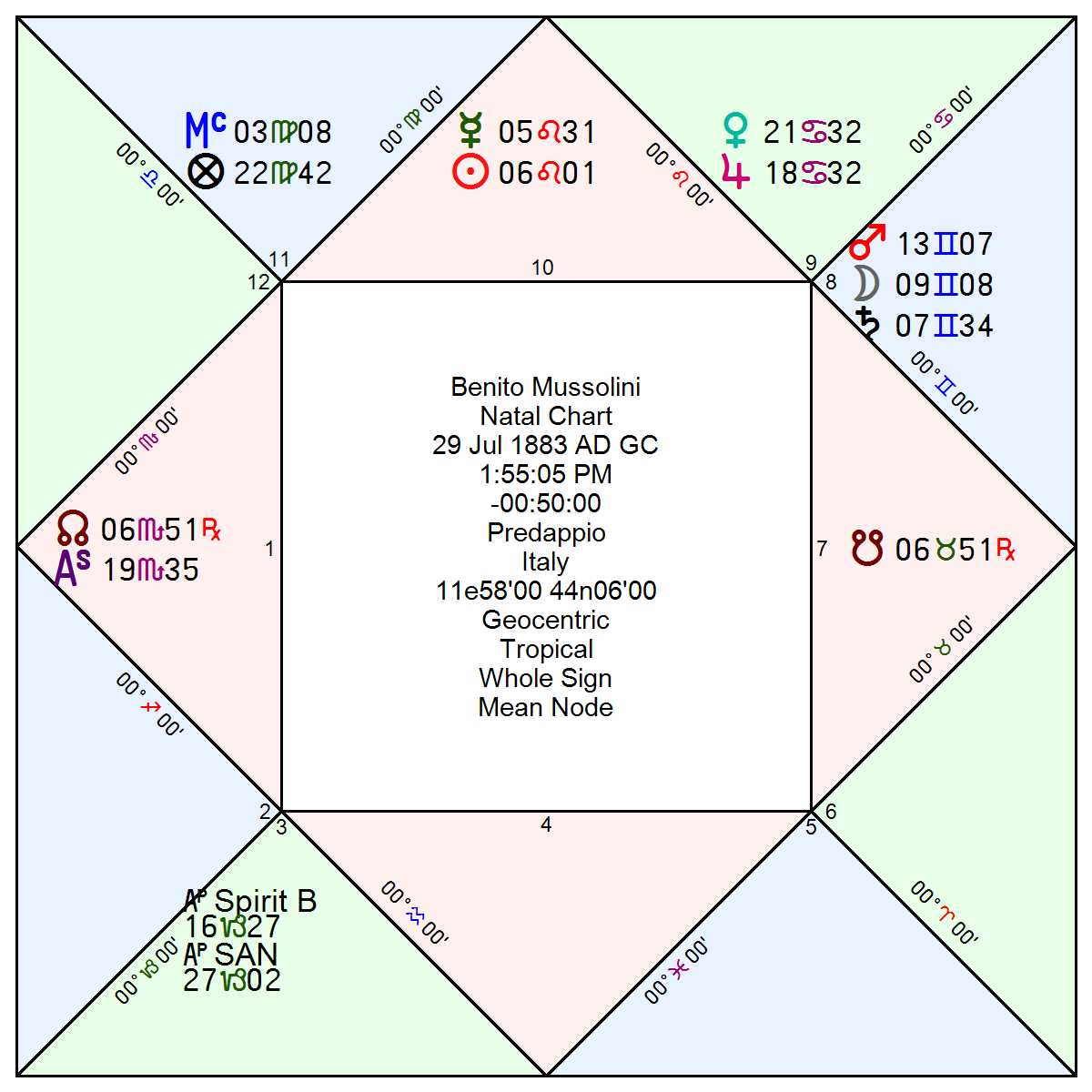
ADB Rodden Rating AA, BC/BR in hand, 2:00 PM, ASC 20SC32
Proposed rectification: 1:55:05 PM, ASC 19SC35’02”
The analytical models used in the sections below are part of a larger research program developed across longer white papers and case studies, where the historical sources, rules, and testing methodology are laid out in full. These database entries show the models in practice; readers who want the theoretical foundations can start with the background papers below:
Rectification Hub (I wrote the book on it!)
Soul Hub (white paper, Victor model statistical tests, Moon’s Configuration studies)
Physiognomy Hub (white paper, examples)
Victor Model factors favoring Mercury/Leo
Sign ruler of Midheaven, Moon and Lot of Fortune
Bound ruler of Midheaven
Placement in 10th house (whole sign houses)
Combust but received by the Sun
At the bendings
Mercury at 5° Leo emerges as the victor of the horoscope, directing the native’s life through communication, persuasion, and the projection of personal authority. Although Mercury is combust the Sun at 6° Leo, the condition is moderated by reception, with the Sun receiving Mercury into its domicile. Traditional authors compare such reception to the Sun extending an umbrella over the planet, protecting it from the full destructive effects of combustion and allowing its significations to remain operative. In Leo, Mercury does not merely communicate; it performs. Speech becomes a vehicle for command, self-dramatization, and the cultivation of public attention. The result is a life organized around rhetoric, slogans, journalism, political oratory, letters, manifestos, and propaganda. Mercury in Leo seeks to shape collective opinion through forceful expression, preferring grand declarations to technical argument and public spectacle to private deliberation. Mussolini’s rise from journalist and newspaper editor to one of the twentieth century’s most recognizable political speakers illustrates this symbolism with unusual clarity, as words became the primary instrument through which he acquired, exercised, and maintained power.
Physiognomy model factors favoring Scorpio, Cancer
Rising sign: Scorpio
Rising sign ruler: Mars/Gemini
Rising decan: Pisces
Rising decan ruler: Jupiter/Cancer
Jupiter/Cancer trine the Ascendant degree = 1 degree 3 minutes.
Mussolini presents a compact, powerful physique with a broad chest, thick neck, and heavy torso. His body appears stocky rather than slender, with little of the elongated or wiry quality often associated with Mercurial types. His face is rectangular to slightly oblong, dominated by a broad forehead, wide cheek structure, and a strong square jaw. The underlying geometry of the face is unmistakable: a large cranial vault, pronounced jawline, thick neck, and a generally massive construction that conveys solidity rather than delicacy. Contemporary accounts place him at approximately 5’7” (170 cm), but photographs often make him appear physically larger because of his dense build, erect posture, and unusually broad upper body.
In John Willner’s astrological physiognomy, several features point toward a mixture of Scorpio and Cancer. The rectangular facial outline and especially the square jaw correspond closely to Willner’s Scorpio model, which frequently produces angular or forceful lower-face structures. The eyes are dark, penetrating, and fixed in expression, another traditional Scorpio signature noted by historical physiognomists. Cancer is visible in the unusually smooth skin, rounded cranial shape, and soft fullness of the facial tissues despite the underlying angular framework. The body itself appears thick and substantial rather than light or gangly, supporting a strong Jupiter-Cancer influence. This is one reason the commonly cited birth time with the third decan of Scorpio rising is problematic: that placement would give Gemini a much stronger role in bodily appearance through the Moon, yet there is little evidence of the narrow shoulders, elongated limbs, animated facial mobility, or lighter frame typically associated with Gemini types. Instead, the physical evidence suggests a stronger Cancer contribution to bodily form layered upon an unmistakably Scorpio facial structure.
Moon’s Configuration: Moon separates from Saturn and applies to Mars
In Benito Mussolini’s nativity, the Moon lies between Saturn and Mars in Gemini, forming a separating conjunction with Saturn and applying to a conjunction with Mars. There is no void-of-course or out-of-sign consideration; both aspects are tight and operative within the same sign. The Moon’s besiegment condition gives Mussolini’s emotional and political life a pendulum-like rhythm: restraint or control (Saturn) inevitably gives way to violence and aggressive assertion (Mars). The condition is made more volatile by the fact that Mars is the out-of-sect malefic, being in a diurnal chart, which intensifies its destructive potential. Saturn, however, is slightly softened due to its placement in the bound of Jupiter and in the 9th house of the law, which opens a window for restraint, negotiation, or clemency to emerge — albeit often temporarily or ineffectively.
Saturn → Moon → Mars: Chronological Examples of Restraint Giving Way to Violence
1. August 3, 1921 – Treaty of Pacification → October 28, 1922 – March on Rome
This sequence is emblematic of the Moon’s configuration. The Treaty of Pacification with Socialist forces — Saturn’s effort at legal and political restraint — was rejected by Mussolini’s own Fascist squads, who saw it as weakness. Their march on Ravenna showed Saturn’s limitations. Mussolini, sensing the mood, allowed Mars to prevail: he unified the paramilitary groups under tighter control and staged the March on Rome the following year, culminating in his rise to power.
2. November 4, 1925 – Matteotti Trial Verdict → April 7, 1926 – Assassination Attempt
The socialist deputy Giacomo Matteotti had been kidnapped and murdered in June 1924 by Fascist squad members. In November 1925, after prolonged public outcry and political unrest, the Fascist killers received light sentences — Saturn’s leniency through the judiciary (9th house bound of Jupiter). But peace was short-lived. Less than five months later, on April 7, 1926, Mussolini was nearly assassinated by 15-year-old Anteo Zamboni at a public parade in Bologna. The Moon’s application to Mars is here fulfilled in the literal image of a bullet grazing Mussolini’s nose — both martyrdom and omen.
3. 1938–1939 – Anti-Jewish Laws and Appeasement → 1940 – Entry into WWII
Mussolini initially sought to moderate Nazi ambitions by offering legalistic justifications for Italy’s own racial laws (Saturn). Yet despite these moves, he faced increasing pressure from Hitler and his own inner circle. Ultimately, Mussolini gave in to Mars: he entered World War II in June 1940, not out of strategic advantage but due to the momentum of ideological aggression and militarist fervor.
4. July 25, 1943 – Fall from Power → April 28, 1945 – Execution by Partisans
After the Allied invasion of Sicily, Mussolini was deposed and arrested by the King — a final assertion of Saturnian restraint. For a time, he was imprisoned and removed from the Fascist apparatus. But the Moon’s application to Mars still had to be fulfilled. Freed by German commandos and installed as puppet ruler of the Italian Social Republic, Mussolini presided over a final spasm of civil war violence. As the tide turned, he attempted to flee — but was captured and executed by Italian partisans on April 28, 1945, shot by gunfire and hung by his heels in Milan.
Summary of Moon’s Configuration
Mussolini’s Moon configuration demonstrates a recurring historical rhythm: from legal or institutional restraint (Saturn), symbolized by treaties, trials, or even arrests, to violent eruption (Mars) embodied by assassination attempts, street-level purges, war declarations, and his own execution. This pattern often reflects the limits of Saturn’s power — its capacity to impose order is persistently undermined, bypassed, or outright shattered by the insistent force of Mars in a day chart.
The Moon’s role in translating light between these two planets shows how Mussolini’s political instincts and emotional temperament vacillated between controlled statesmanship and ruthless aggression, with each episode of calm merely the prelude to greater conflict.
Influence of Sect
The diurnal nature of the figure modifies the expression of the planets in important ways. Jupiter and Saturn, both in sect, become more constructive than they otherwise would be. Jupiter in Cancer in the 9th house provided Mussolini with a measure of intellectual and institutional legitimacy, allowing him to maintain a working relationship with elements of Italy’s educational, cultural, and religious establishment even while consolidating authoritarian power. His willingness to tolerate figures such as Benedetto Croce illustrates how Jupiter’s protective influence could extend political cover through respected institutions, though the arrangement remained uneasy and ultimately fragile. Saturn in Gemini likewise benefits from being in sect, softening its tendency toward confinement, legal restriction, and punishment. Rather than becoming trapped by the law, Mussolini frequently demonstrated an ability to evade or manipulate legal constraints, preserving freedom of movement where others might have encountered barriers. By contrast, Venus in Cancer is out of sect, reducing its ability to generate genuine goodwill or lasting affection. Public displays of patriotism, cultural unity, and national sentiment often functioned more as instruments of political theater than as sources of social harmony. Mars in Gemini, however, is the out-of-sect malefic and therefore operates with greater severity. The result is a tendency for disputes, ideological conflicts, and political rhetoric to escalate into intimidation, coercion, and violence, reinforcing the aggressive tone that characterized both Mussolini’s rise to power and the maintenance of his regime.
Early/Late Bloomer Thesis
Benito Mussolini was born on July 29, 1883, and died on April 28, 1945, giving him a longevity of approximately 62 years and a life midpoint of roughly 31 years. Because he was born shortly after a Full Moon, the early/late bloomer thesis predicts that his most significant achievements and historical impact should occur after the midpoint of life. The record largely supports this expectation. Before age 31, Mussolini worked as a schoolteacher, journalist, socialist agitator, and newspaper editor, developing the rhetorical and organizational skills that would later define his career. Although these years established the foundation of his political identity, they did not make him a major national figure. After the midpoint, however, his career accelerated dramatically. At age 39 he became Prime Minister following the March on Rome (1922), subsequently transformed Italy into a Fascist dictatorship, dominated Italian politics for two decades, intervened in the Spanish Civil War, conquered Ethiopia, forged the Rome–Berlin Axis, and entered World War II. The achievements and failures for which he is remembered almost entirely belong to the second half of life. While the formative groundwork was laid before the midpoint, Mussolini’s rise to international prominence, exercise of power, and enduring place in history occurred afterward, making him a persuasive example of the late-bloomer pattern associated with births following the Full Moon.
AI Notice: ChatGPT contributed to this article.
Complete biographical chronology, rectification and time lord studies available in Excel format as a paid subscriber benefit. They are behind the paywall.