

Long before the American technology revolution produced the entrepreneurs and scientists we know today as the Tech Bros, someone first had to teach Americans the fundamentals of science. In the early nineteenth century, scientific education in the United States remained in its infancy. Even prestigious universities such as Yale offered little systematic instruction in chemistry, geology, and mineralogy. Before America could become a world leader in scientific discovery and technological innovation, it needed laboratories, textbooks, scientific journals, trained instructors, and a public capable of understanding the basic principles of the physical world. Two men played important roles in laying that foundation: Benjamin Silliman at Yale and Josiah Holbrook through the American Lyceum movement.
In my research on the Regulus USA National Horoscope, I associate the Ascendant Distribution through the bound of Saturn in Aquarius, from 18 March 1827 to 24 June 1830, with the development of Scientific Education in America. This period coincided with the early expansion of the Lyceum movement, pioneered by Josiah Holbrook, which brought lectures on science and other subjects to communities outside the university system. Holbrook had studied under Silliman at Yale, providing a direct historical connection between the two men. While Holbrook advanced scientific education in the public arena, Silliman performed a parallel function within higher education, establishing scientific instruction at Yale, founding the American Journal of Science, and developing the teaching resources necessary to train succeeding generations. Silliman’s influence also extended well beyond the university classroom through his widely attended public lectures on chemistry and geology.
The historical correspondence with Saturn in Aquarius is significant. Saturn signifies the establishment of durable institutions, educational disciplines, and systematic methods, while Aquarius connects these structures to the broader organization and advancement of society. During this Ascendant Distribution, scientific instruction was becoming more accessible and better organized, both through Holbrook’s expanding network of local lyceums and through the continuing development of scientific education at established colleges. These were not yet the conditions that would produce modern technological industries, but they helped establish the intellectual infrastructure upon which those industries would eventually depend.
Silliman’s natal horoscope provides an additional connection to this national development. Although he has no planets in Aquarius, his prenatal syzygy at 5AQ05 falls in the bound of Mercury in Aquarius, linking the horoscope’s preceding lunation to the dissemination and organization of scientific knowledge. More importantly, the most active period of his career as a scientific educator occurred during a Zodiacal Releasing Level 1 Aquarius period, which encompassed the USA horoscope’s Saturn/Aquarius Ascendant Distribution of 1827–1830. This overlap connects Silliman’s individual career with the larger national chronology. His work at Yale, together with Holbrook’s efforts to bring science to the general public, illustrates an important stage in America’s transition from a society dependent upon European scientific expertise toward one capable of educating its own scientists and eventually producing the technological innovators of the modern era.
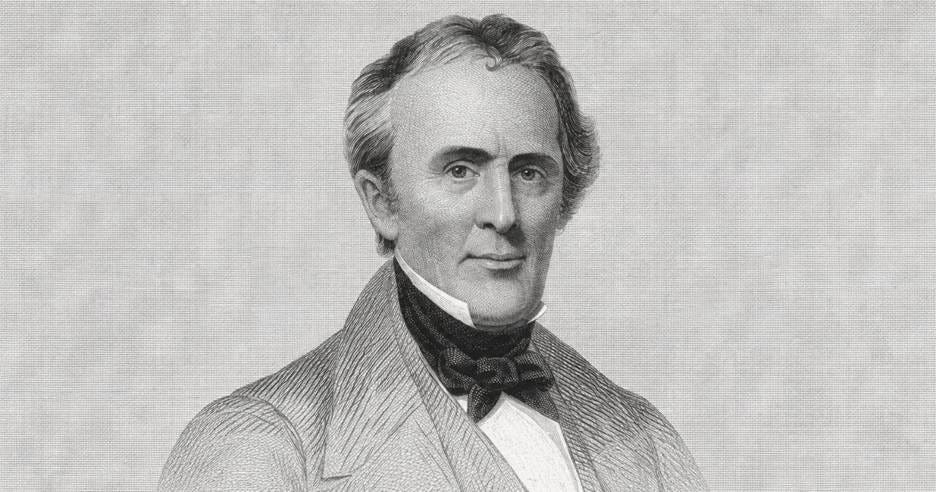
Benjamin Silliman was an American chemist, geologist, educator, and one of the principal architects of scientific education in the United States. During a career spanning more than fifty years at Yale College, he helped transform an institution devoted primarily to classical education and theology into a center for scientific research and instruction. He founded the American Journal of Science in 1818, helped establish several of Yale’s scientific institutions, and became one of the most widely recognized public lecturers on science in nineteenth-century America.
Silliman was born on 8 August 1779 in Trumbull, Connecticut, into a prominent family associated with the American Revolution. His father, General Gold Selleck Silliman, had been captured by British forces in May 1779, three months before Benjamin’s birth, and remained a prisoner until the following April. His mother, Mary Fish Noyes Silliman, managed the family’s affairs during her husband’s absence. The elder Silliman died on 21 July 1790, when Benjamin was ten years old.
Silliman entered Yale College in 1792 at the age of thirteen and graduated in 1796. He subsequently studied law under Simeon Baldwin, received his master’s degree from Yale in 1799, and served as a college tutor. In 1802, he was admitted to the Connecticut bar. His professional future appeared to lie in the law until Yale president Timothy Dwight persuaded him to accept the newly established professorship of chemistry and natural history. Silliman had virtually no formal scientific training, making the appointment a substantial departure from his intended profession.
On 26 October 1802, Silliman departed New Haven for Philadelphia to study chemistry under James Woodhouse at the University of Pennsylvania. He returned to Yale and delivered his first chemistry lectures in 1804, inaugurating formal scientific instruction at the college. In 1805–1806, he traveled to Europe, where he continued his scientific education, met prominent European scientists, and acquired books, laboratory apparatus, and mineral specimens. These purchases helped establish the collections and instructional resources upon which Yale’s scientific programs would develop.
Silliman’s interests soon expanded beyond chemistry to mineralogy and geology. Following the fall of the Weston meteorite in Connecticut on 14 December 1807, he helped investigate the event and published a scientific account of the meteorite, contributing to the emerging acceptance that stones could fall to Earth from space. He developed public scientific lectures in New Haven and, by 1813, had established a systematic course of instruction in geology and mineralogy at Yale. He also participated in the founding of Yale’s Medical Institution, becoming one of its original faculty members.
On 17 September 1809, Silliman married Harriet Trumbull, daughter of Connecticut governor Jonathan Trumbull Jr. Their marriage produced nine children, five of whom survived to adulthood. Among them was Benjamin Silliman Jr., born on 4 December 1816, who would follow his father into chemistry and geology and later contribute important scientific research to the development of the American petroleum industry. Family life also brought repeated bereavements, including the deaths of two young sons in 1819 and 1820.
In July 1818, Silliman published the first issue of the American Journal of Science and Arts, subsequently known as the American Journal of Science. The journal provided American scientists with an important means of communicating research in chemistry, geology, mineralogy, and natural history. For decades, it was commonly called Silliman’s Journal, reflecting his personal identification with the publication. Its establishment was a major step toward developing an independent American scientific community at a time when European institutions dominated scientific publishing.
During the 1820s and 1830s, Silliman’s reputation expanded beyond Yale. He published Elements of Chemistry in 1830 and conducted scientific investigations for both government and private clients, including studies of sugar production and Virginia gold mines. In 1832, he played a leading role in establishing Yale’s Trumbull Gallery, an early institutional art collection. His public lectures on chemistry and geology attracted audiences in Hartford, Boston, Philadelphia, and other American cities, bringing scientific knowledge to audiences well beyond university classrooms.
On 3 January 1840, Silliman delivered the inaugural lecture at Boston’s Lowell Institute, beginning a celebrated series on geology. That same year, he became president of the newly formed Association of American Geologists, an organizational predecessor of the American Association for the Advancement of Science. His standing as both a scientist and public educator was now firmly established.
Silliman’s religious convictions remained important throughout his scientific career. He sought to reconcile geological discoveries concerning the Earth’s history with his Christian understanding of creation. His approach reflected an era in which geology was increasingly challenging traditional interpretations of biblical chronology, while many American scientists continued to regard the investigation of nature as compatible with religious faith.
His social and political views were more complicated. Silliman publicly criticized slavery and supported gradual emancipation and colonization, yet he had grown up in a slaveholding household, personally controlled enslaved labor, and benefited financially from investments and professional relationships connected to slavery. Recent research by Yale has documented these contradictions, including his family’s involvement in slavery and his later professional connections to the slaveholding South.
In 1846, Silliman relinquished active editorial responsibility for the American Journal of Science, transferring much of its management to younger scientists. The following year, he helped establish Yale’s Scientific School, subsequently renamed the Sheffield Scientific School. His career increasingly involved the creation and preservation of scientific institutions rather than the direct instruction of students.
Silliman suffered a major personal loss on 13 January 1850 with the death of his wife Harriet. In 1851, he traveled to Europe with his son Benjamin Jr. and, on 17 September of that year, married Sarah Isabella McClellan Webb. He continued to lecture publicly, including a course in geology at the Smithsonian Institution in 1852. In 1853, he retired from regular teaching at Yale, and Benjamin Jr. succeeded him in the professorship of chemistry.
Silliman remained professionally active during his final decade. In 1863, he was elected one of the original members of the National Academy of Sciences, established during the presidency of Abraham Lincoln. He also maintained interests in educational administration, scientific organizations, and business, including service as president of the American Mutual Life Insurance Company.
Benjamin Silliman died in New Haven on 24 November 1864, aged eighty-five. His legacy extended beyond his own scientific investigations. Through his lectures, publications, teaching, collections, and institutional leadership, he helped establish the foundations of professional science in the United States. The scientific institutions he built or helped develop, and the journal he founded, continued to shape American scientific education and research long after his death.
No Astrodatabank Record
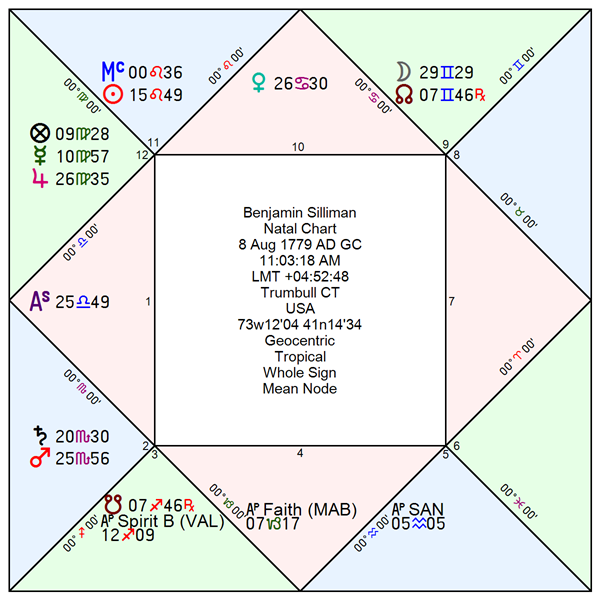
Proposed rectification: 11:03:18 AM, ASC 25LI49’16”
Permission: I grant the unlimited use of this rectified horoscope by the public. Credit ‘Regulus Astrology LLC’ and include an accompanying link to this webpage.
The analytical models used in the sections below are part of a larger research program developed across longer white papers and case studies, where the historical sources, rules, and testing methodology are laid out in full. These database entries show the models in practice; readers who want the theoretical foundations can start with the background papers below:
Rectification Hub (I wrote the book on it!)
Soul Hub (white paper, Victor model statistical tests, Moon’s Configuration studies)
Physiognomy Hub (white paper, examples)
Victor Model Factors favoring Saturn/Scorpio
Bound ruler: Sun, Moon. Recall Valens says when the same planet is the bound ruler of both luminaries, look no further for the victor.
Benjamin Silliman devoted his life to unlocking the secrets of the physical world by bringing nature’s most powerful and destructive forces under scientific control. As a chemist and geologist, he harnessed the heat of Mars to penetrate the solid structures of Saturn, transforming potentially destructive energy into an instrument of scientific discovery. This interpretation is reinforced by the conjunction of Saturn at 20SC30 and Mars at 25SC56, with Mars separating from Saturn. Their mixed reception establishes a reciprocal relationship: Mars rules Saturn by domicile, while Saturn rules Mars by bound. Mars supplies the intense heat and transformative energy, while Saturn imposes the limits and controls necessary to harness that power for productive purposes. Saturn also rules the fourth house by both whole sign (Capricorn) and quadrant cusp (Aquarius), directing Silliman’s scientific interests toward geology, mineralogy, and the physical structure of the Earth. The configuration finds a nearly literal expression in his experiments with the oxyhydrogen blowpipe, which concentrated intense heat to melt minerals previously considered resistant to fusion. The investigation of the Weston meteorite, which fell on 14 December 1807 during his first Saturn return, provides another manifestation: a violent, fiery event subjected to the disciplined procedures of scientific recovery, chemical analysis, and classification. In both cases, Saturn in Scorpio transforms the destructive power of Mars into an instrument of scientific discovery.
Physiognomy Model Factors favoring Gemini, Virgo
Rising sign: Libra
Ruler of rising sign: Venus/Cancer
Rising decan: Gemini
Ruler of Rising decan: Mercury/Virgo
Planets in sign of rising decan: Moon/Gemini
Benjamin Silliman presents a slender, somewhat angular physique, with narrow shoulders and a relatively elongated neck. His face is distinctly elongated and oval, with a high forehead, prominent cheekbones, and a long, tapering lower face terminating in a narrow, rounded chin. The nose is long and slender, with a narrow bridge, while the lips are thin and compressed. His eyes are moderately deep-set beneath gently arched eyebrows. Overall, the portrait conveys an impression of length and narrowness rather than breadth or fullness, with relatively delicate facial features set within a longer facial framework.
The principal astrological significators of Silliman’s physiognomy are Gemini and Virgo, both ruled by Mercury. In John Willner’s model, Gemini produces an elongated facial structure and a long nose, both clearly evident in Silliman’s portrait. Virgo contributes facial features that appear drawn or attenuated, particularly the narrow dimensions of the nose and lips relative to the overall width of the face. The combination produces a distinctly Mercurial appearance: Gemini determines the elongated facial outline and length of the nose, while Virgo refines the individual features, giving them a slender, compressed quality. The two signs operate together to produce the narrow, elongated physiognomy visible in Silliman’s portrait.
Moon’s Configuration
Stage 1: Moon in Gemini, Ninth House, Separating from the Square of Jupiter in Virgo, Twelfth House. The Moon in Gemini in the ninth house describes Silliman’s lifelong commitment to scientific education, but also reveals an important mismatch between the intellectual level of the institution and the nature of the work he was required to perform. In traditional astrology, the Moon rejoices in the third house, associated with elementary learning and everyday communication, while the Sun rejoices in the ninth house of higher education, philosophy, and advanced scholarship. Some traditional authors therefore regard the Moon in the ninth as debilitated, occupying an environment more appropriate to the Sun. In Silliman’s case, this displacement finds a concrete expression: although appointed professor at Yale, he entered an institution where scientific education was scarcely developed and had to introduce the fundamentals of chemistry, geology, and mineralogy before advanced scientific research could flourish. Jupiter in Virgo reinforces this educational mismatch. As the natural significator of higher learning, Jupiter seeks broad intellectual understanding, philosophical synthesis, and the advancement of knowledge. Yet in Virgo, the domicile and exaltation of Mercury, Jupiter is in detriment, compelled to pursue these ambitions through detailed analysis, elementary instruction, and practical methods rather than advanced theoretical inquiry. Its placement in the twelfth whole-sign house further suggests an educational enterprise operating under difficult or underdeveloped circumstances, although its eleventh-house quadrant position connects that enterprise to institutional patronage and support. The Moon’s separation from Jupiter’s square describes Silliman’s movement away from this deficient educational environment and the tension between the aspirations of higher learning and the elementary work required to achieve them. Indeed, Silliman himself had little formal scientific training when appointed in 1802 and was obliged to acquire the knowledge he would subsequently teach. Rather than pursuing original research within an established scientific environment, much of his career was devoted to building the foundations of scientific instruction. The Moon’s subsequent application to Mercury in Virgo, which rules Jupiter, suggests that the solution to Jupiter’s difficulties would ultimately come through Mercurial methods: experimentation, classification, teaching, and the systematic organization of scientific knowledge.
Stage 2: Moon Changes Signs from Gemini to Cancer. The Moon’s movement from Gemini into Cancer marks a transition from the acquisition and communication of scientific knowledge toward its cultivation within a broader educational community. Leaving Mercury’s domicile and entering its own, the Moon acquires greater autonomy and emphasizes nurturing, protection, family, and the development of others. Silliman’s scientific career was not confined to laboratory investigation or classroom instruction. He sought to establish institutions capable of sustaining scientific education across generations, while extending the benefits of scientific knowledge beyond the traditional university population. His public lectures, scientific publications, and efforts to create permanent educational resources reflect this transition from intellectual activity toward the cultivation of an enduring scientific community.
Stage 3: Venus in Cancer Applying to the Sextile of Jupiter in Virgo. Venus in Cancer introduces the importance of women, family relationships, and the extension of educational opportunities to those traditionally excluded from higher learning. This symbolism finds a particularly clear expression in Silliman’s unusually progressive views concerning women’s education. As early as 1795, while still a Yale student, he criticized the intellectual disadvantages imposed upon women by their lack of educational opportunities. In 1808, he offered chemistry lectures attended by both men and women, including Harriet Trumbull, whom he married the following year. Venus in Cancer signifies the protection and cultivation of women, while its applying sextile to Jupiter connects these concerns directly to education and the expansion of knowledge. His marriage into the prominent Trumbull family also strengthened the familial and institutional relationships that supported his subsequent career. The Venus–Jupiter connection thus describes an important subsidiary theme: the extension of scientific education beyond the conventional boundaries of the male university establishment.
Stage 4: Moon Briefly Void of Course in Cancer, Then Applying to the Sextile of Mercury in Virgo, Twelfth House. Following its sign change, the Moon experiences a brief void-of-course interval before applying to Mercury in Virgo. This interruption is followed by a return to Mercurial activity, indicating that Silliman’s educational and institutional ambitions ultimately find their fulfillment through scientific investigation, writing, classification, and the systematic communication of knowledge. Mercury occupies its own domicile and exaltation in Virgo, emphasizing analytical precision, experimental methodology, and the organization of scientific information. Its connection with the Moon is evident in Silliman’s development of scientific curricula, laboratory instruction, textbooks, mineralogical collections, and especially the American Journal of Science, founded in 1818. The journal provided an enduring mechanism for communicating scientific discoveries and organizing the growing American scientific community. The Moon’s application to Mercury therefore describes the practical means through which Silliman transformed the rudimentary scientific instruction of his early career into a permanent educational and publishing enterprise.
The Mercury–Jupiter Loop. The configuration contains a recurring relationship between Mercury and Jupiter. The Moon initially separates from Jupiter’s square but eventually applies to Mercury, which rules Jupiter by domicile. Thus, the Moon’s movement toward Mercury ultimately leads the delineation back to Jupiter. This loop describes the reciprocal relationship between elementary scientific instruction and the larger purposes of higher education. Mercury supplies the methods, experiments, textbooks, publications, and organized knowledge necessary for Jupiter to fulfill its educational mission. In turn, the expansion of higher learning creates further opportunities for scientific investigation and communication. This relationship summarizes Silliman’s institutional legacy: he introduced the fundamentals of modern science into a university environment and established the educational foundations upon which succeeding generations could pursue increasingly specialized research. Jupiter’s placement in the twelfth whole-sign house, but the eleventh quadrant house, adds the importance of institutional networks, patrons, and scientific associations to this process. Mercury is also co-present with the Lot of Fortune at 9VI28 in Virgo, linking Silliman’s livelihood and material opportunities to scientific education, publication, and the exchange of knowledge. His career demonstrates how Mercurial methods could serve Jupiterian ambitions, transforming elementary scientific instruction into an enduring system of higher education.
Influence of Sect
Sect. Silliman’s horoscope is diurnal, placing Jupiter and Saturn in sect while Venus and Mars are out of sect. Jupiter in sect describes a society broadly receptive to the advancement of scientific knowledge, even as Jupiter’s detriment in Virgo reveals the deficiencies of existing scientific education. Saturn in sect, as victor of the horoscope, signifies the social acceptance of Silliman’s authority to impose order, discipline, and control upon the potentially destructive forces of nature. This distinction becomes particularly important because Mars in Scorpio, although powerful in its own domicile, is out of sect, making its intense heat, combustion, and capacity for violence potentially dangerous and difficult to manage. Yet Mars occupies Saturn’s bound, while Saturn occupies Mars’s domicile, establishing a mixed reception through which Saturn can harness and regulate martial energy. Silliman’s experiments with the oxyhydrogen blowpipe, which concentrated enormous heat while requiring careful control of combustible gases, provide a concrete manifestation of this arrangement: the out-of-sect Mars supplies the hazardous force necessary for discovery, while the in-sect Saturn renders its application disciplined and productive. Venus out of sect, meanwhile, describes the resistance Silliman encountered in a society that restricted women’s access to scientific education, despite his willingness to include them in his lectures. Taken together, sect reveals a society prepared to support scientific advancement and disciplined experimentation, yet less willing to extend the same educational opportunities to women.
Early/Late Bloomer Assessment
Benjamin Silliman was born after a Full Moon, placing him in the late-bloomer category under this model, with the majority of his defining accomplishments expected in the second half of life. He lived approximately 85 years (8-Aug-1779 to 24-Nov-1864), placing his longevity midpoint at about age 43, on 2-Apr-1822. The chronology provides mixed support for this prediction. Well before the midpoint, Silliman had abandoned law for science, introduced scientific instruction at Yale in 1804, investigated the Weston meteorite in 1807, established systematic instruction in geology and mineralogy in 1813, and founded the American Journal of Science in 1818, when he was thirty-eight. These were foundational achievements that established his vocation and much of his enduring historical reputation. The second half of life brought greater national recognition, including publication of Elements of Chemistry in 1830, the inaugural Lowell Institute lectures and presidency of the Association of American Geologists in 1840, the establishment of Yale’s Scientific School in 1847, and election to the National Academy of Sciences in 1863. Yet these later accomplishments largely expanded and institutionalized the scientific enterprise he had already established before the midpoint. Although a modest majority of the selected professional milestones occurred after 1822, their significance was not predominantly concentrated in the second half of life. Silliman therefore represents a borderline failure of the late-bloomer thesis: his national authority matured late, but his defining professional achievements began early.
Complete biographical chronology, rectification and time lord studies available in Excel format as a paid subscriber benefit. File is behind the paywall.