

Easter weekend invites reflection not only on redemption, but on the conditions that make a message of redemption necessary. As the most prominent evangelical itinerant preacher of the mid-20th century, Billy Graham brought that message to a global audience—preaching in person to more than 200 million people, with total reach exceeding two billion through radio and television. In the horoscope of Graham, the condition that made such a message resonate is unmistakably shown by Jupiter in Cancer retrograde. Normally a placement of nourishment, protection, and moral cohesion, Jupiter in Cancer—when retrograde—functions more like a compromised Jupiter in Capricorn, pointing instead to failure in the very structures meant to sustain spiritual life. Here is a world not properly fed, not properly guided, and therefore vulnerable to decay.
From that cause flows the effect: Mars in Sagittarius in the 9th house as victor. If Jupiter describes the condition of the world, Mars describes the response—a forceful, itinerant proclamation aimed at correcting it. Ruled by that same compromised Jupiter, Graham’s Mars does not merely preach; it confronts. His sermons carried a tone of urgency and decision, often rising to a dramatic intensity that is difficult to capture on the page but unmistakable in delivery—salvation presented not as a distant ideal but as an immediate necessity. The Sagittarius–9th house emphasis sends this message outward across borders, reflected in his global crusades and lifelong travel, while Mars supplies the fire, rhythm, and rhetorical pressure that compelled audiences to act. This dynamic—Jupiter as moral failure, Mars as corrective proclamation—defines the architecture of his life’s work.
There is also a timely resonance here. Graham’s Jupiter in Cancer falls in the bound of Mercury, just as Jupiter does at present in the current sky, making his horoscope an instructive case of how the bound ruler modifies Jupiter’s expression. In Graham’s life, Jupiter in the bound of Mercury manifested as a relentless focus on diagnosing hidden moral corruption and translating it into a message that could move masses. Mercury in Scorpio, especially colored by Saturn’s prior influence, does not soften Jupiter’s condition—it sharpens it, giving it language, edge, and consequence. The result is a message that is investigative in tone, fixed in conviction, and uncompromising in its conclusions: the world is not merely drifting, but fallen—and must be called back.
Finally, Graham’s life offers a striking confirmation of this Jupiter through Zodiacal Releasing. When releasing from Spirit moved to a Cancer Level 1 period on 22 January 1973—activating his Jupiter in Cancer retrograde—the Watergate scandal began to unravel. By 1974, upon reading the transcripts of Richard Nixon, Graham was shaken to the core, realizing he had profoundly misjudged Nixon’s character. This marked one of the lowest points of his life: a personal confrontation with the very moral corruption his preaching had long warned against. The same Cancer activation, in a different chart, produced a different outcome—when Jimi Hendrix entered a Cancer Level 1 period, with Moon and Jupiter in Cancer retrograde in the 8th, he died 77 days later from a drug overdose. In both cases, Zodiacal Releasing underscores the same principle: Jupiter in Cancer retrograde signifies a domain of moral vulnerability that, when activated, demands reckoning—whether through public scandal, personal crisis, or final collapse.
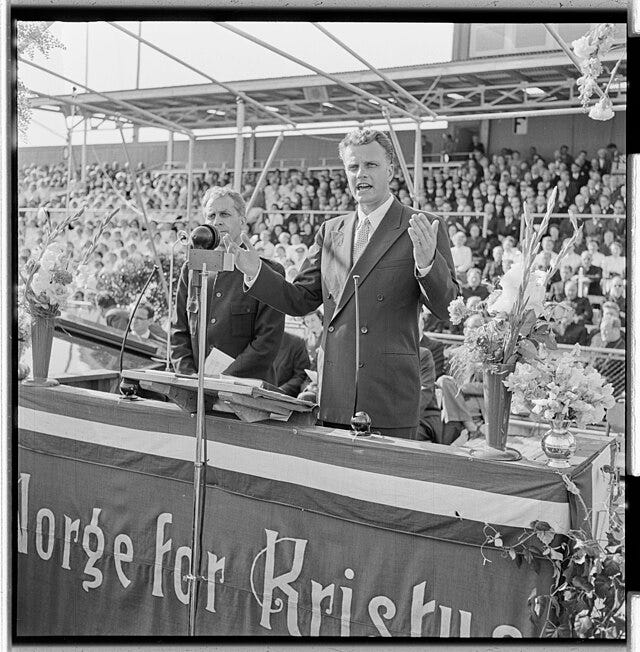
Born William Franklin Graham Jr. on November 7, 1918, near Charlotte, North Carolina, Billy Graham was raised on a dairy farm in a conservative Presbyterian household. His early religious life was conventional rather than fervent, but this changed decisively in 1934 when, at age sixteen, he attended a revival led by Mordecai Ham and experienced a conversion that set the course for his life’s work. After brief enrollment at Bob Jones College, Graham transferred to Florida Bible Institute and later graduated from Wheaton College in 1943, where he met his future wife, Ruth Bell Graham. Her upbringing in a missionary family in China reinforced Graham’s emerging sense that his ministry would extend beyond the United States.
Following graduation, Graham entered ministry at a moment when evangelical Protestantism was reorganizing itself for the modern age. His early rise came through the interdenominational organization Youth for Christ, where he worked alongside the intellectually inclined evangelist Charles Templeton. Templeton’s embrace of higher criticism and his challenge that Graham reconsider the literal authority of Scripture forced a defining decision. In 1949, Graham resolved this internal conflict by affirming the Bible as the literal word of God, a choice he later credited with giving his preaching both clarity and authority. By abandoning intellectual doubt in favor of declarative certainty—summarized in phrases such as “The Bible says”—Graham found a rhetorical style that resonated powerfully with mass audiences.
That same year, Graham’s career reached a turning point with the Los Angeles Crusade of 1949. Originally planned as a brief revival, the event extended to eight weeks due to overwhelming attendance and national media coverage. Newspaper publisher William Randolph Hearst played a pivotal role in amplifying Graham’s visibility, transforming him almost overnight into a national figure. From this point forward, Graham would operate not merely as a regional preacher, but as the leading evangelist of the postwar era.
In 1950, Graham founded the Billy Graham Evangelistic Association (BGEA), which became the institutional foundation of his global ministry. Unlike earlier revivalists such as Charles Grandison Finney and Dwight L. Moody, Graham fully embraced modern communications technology. Through his radio program Hour of Decision, televised crusades, and extensive print distribution, he expanded his reach to audiences numbering in the hundreds of millions. Major crusades in London in 1954 and New York in 1957 confirmed his status as an international religious figure, while his ability to adapt revivalist methods to the age of mass media distinguished him from his predecessors.
Graham’s influence extended beyond the pulpit into the political sphere, earning him the informal title “Pastor to the Presidents.” Beginning with Harry S. Truman and continuing through successive administrations, he developed relationships with numerous American presidents, including Dwight D. Eisenhower, Lyndon B. Johnson, and most notably Richard Nixon. These relationships granted him unusual access to political power and positioned him as a religious advisor during moments of national significance, including presidential inaugurations and funerals.
This proximity to political authority, however, carried risks. Graham’s close association with Nixon culminated in a personal and public crisis during the Watergate scandal. In 1974, after reviewing transcripts of Nixon’s tape recordings, Graham expressed deep disappointment and regret over his earlier support. The episode marked a turning point in his public life, leading him to adopt a more cautious stance toward political involvement and to emphasize the independence of his ministry from partisan concerns.
Parallel to his domestic prominence, Graham developed a far-reaching international ministry that operated within the broader context of the Cold War. He preached in more than 185 countries and territories, including appearances in Eastern Europe and the Soviet Union at a time when religious expression was heavily restricted. His visits to these regions, along with later appearances in China, positioned him as a symbolic bridge between ideological worlds. While claims that he directly influenced the religious climate preceding the Fall of the Berlin Wall remain debated, his presence nonetheless coincided with a broader reemergence of public religious expression in the final decades of the Cold War.
Throughout his career, Graham distinguished himself from later generations of televangelists by maintaining strict standards of personal and financial conduct. At an early stage, he eliminated the practice of “love offerings” and placed financial oversight under the control of an independent board. In contrast to figures such as Jim Bakker and Jimmy Swaggart, whose ministries were damaged by scandal, Graham’s reputation remained largely intact. The limited financial scrutiny that arose in 1977 prompted further reforms and contributed to his role in establishing the Evangelical Council for Financial Accountability, reinforcing norms of transparency within evangelical institutions.
In his later years, Graham gradually withdrew from active preaching, with his final large-scale crusade held in New York in 2005. By the time of his death in 2018 at the age of ninety-nine, his lifetime reach was without precedent: he had preached in person to more than 200 million people and, through radio and television, to audiences exceeding two billion worldwide. His crusades resulted in millions of recorded professions of faith, making him the most widely heard Christian evangelist in modern history.
Despite these achievements, Graham’s place within American religious historiography remains somewhat ambiguous. While figures such as Jonathan Edwards, Charles Finney, and Dwight L. Moody are firmly embedded within the traditional framework of the First, Second, and Third Great Awakenings, Graham is only tentatively associated by some historians with a Fourth Great Awakening in the mid-20th century. This hesitation reflects not the scale of his influence, which was comparable to or greater than his predecessors, but rather his theological orientation. His emphasis on biblical literalism and personal conversion placed him at odds with the more socially oriented concerns of mainline Protestant denominations, situating him instead within the evangelical and fundamentalist movements that reshaped American religion in the postwar era.
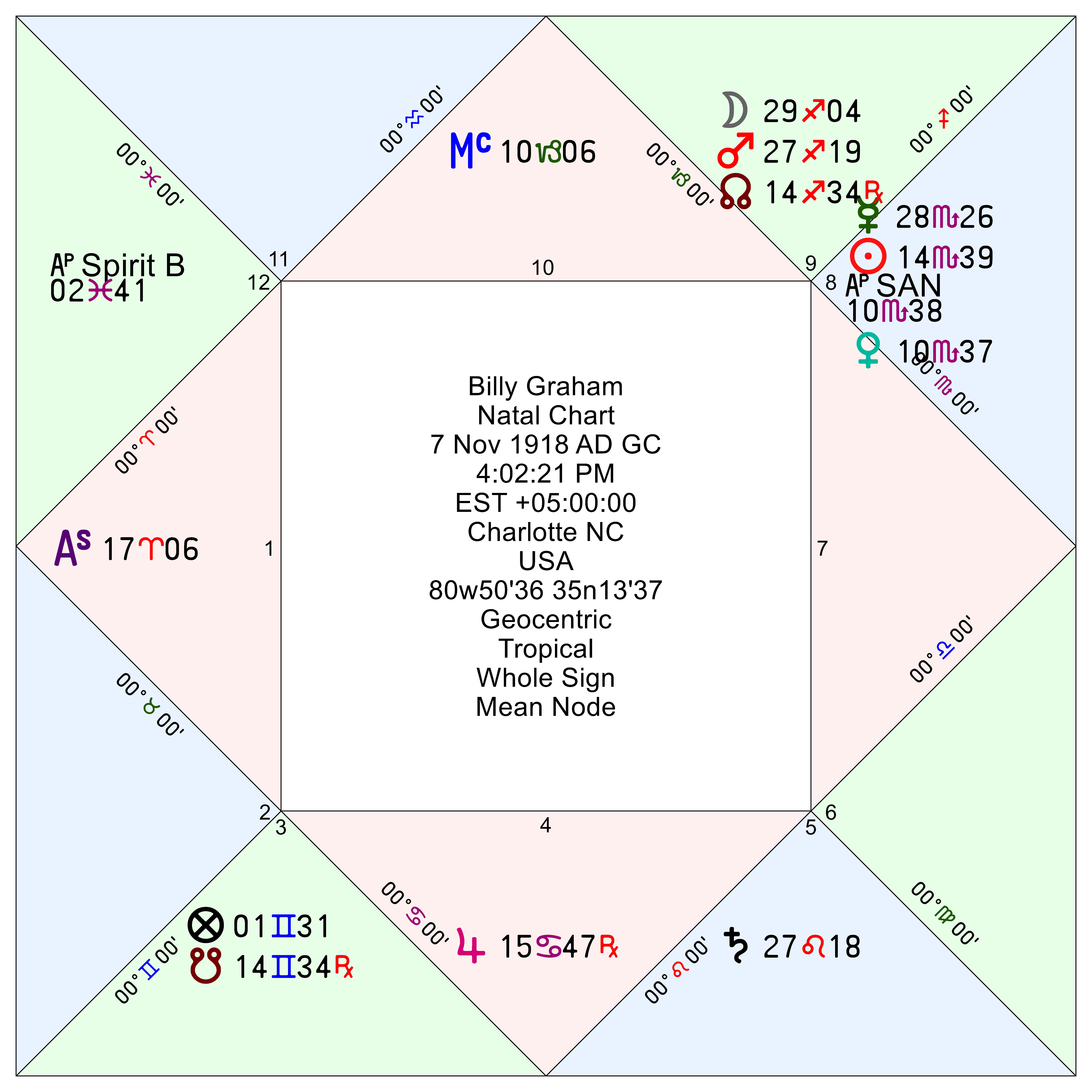
Rodden Rating AA, Quoted BC/BR, 3:30 PM, ASC 4AR31
Proposed Rectification: 4:02:21 PM, ASC 17AR06’20”
The analytical models used in the sections below are part of a larger research program developed across longer white papers and case studies, where the historical sources, rules, and testing methodology are laid out in full. These database entries show the models in practice; readers who want the theoretical foundations can start with the background papers below:
Rectification Hub (I wrote the book on it!)
Soul Hub (white paper, Victor model statistical tests, Moon’s Configuration studies)
Physiognomy Hub (white paper, examples)
Victor Model Factors favoring Mars/Sagittarius as Victor
Sign ruler: Ascendant, Sun, Prenatal Syzygy
Bound ruler: Moon
With Mars at 27° Sagittarius in the 9th house as victor, the defining tone of Billy Graham’s horoscope is not merely “evangelism,” but evangelism as confrontation—a charged, urgent proclamation delivered with the force of moral battle. Mars in Sagittarius does not teach; it declares, warns, and compels, turning doctrine into a call to arms. In Graham’s case, this emerged in a preaching style that was unmistakably dramatic—sermons rising to a near-prophetic intensity, punctuated by phrases such as “The Bible says…” or “God says…,” delivered not as interpretation but as verdict. Audiences were not invited into reflection so much as pressed toward decision, often under the weight of impending judgment and salvation framed as an immediate necessity. The rulership of Mars by a retrograde Jupiter at 15° Cancer reveals the underlying cause: a perceived moral collapse of the social body, with Jupiter in Cancer—normally a sign of nourishment and protection—functioning instead like a compromised Jupiter in Capricorn, signaling decay in the very institutions meant to sustain spiritual life. From this diagnosis flows the Martian response: a global campaign of corrective proclamation. The 9th house placement carries this mission outward geographically, and Graham’s career fulfills it literally—his extensive international crusades, including gatherings such as the 1983 Conference of Itinerant Evangelists, reflect a life spent carrying this urgent message across borders. What distinguishes Graham is that this configuration did not produce abstract theology or quiet pastoral care, but a theatrical, almost apocalyptic rhetoric, where the preacher stands as a herald, the world as a field of crisis, and the audience as participants in a moment demanding immediate, irreversible choice.
Physiognomy Model factors favoring Leo, Scorpio
Rising sign: Aries
Ruler of rising sign: Mars/Sagittarius
Rising decan: Leo
Ruler of rising decan: Sun/Scorpio
Planets in sign of rising decan: Saturn/Leo
Billy Graham’s physical presence matched the force of his preaching. Standing over six feet tall, he carried himself with a broad, upright frame suited to the scale of the crowds he addressed. But it is the face that leaves the strongest impression. The lower jaw is prominent and squared, giving the face a distinctly rectangular structure rather than a long or oval one. The chin is firm, the mouth set, and the cheeks do little to soften the overall geometry. In photographs taken mid-sermon, the intensity becomes unmistakable: the eyes narrow and fix forward, the brow tightens, and the entire face appears engaged in the act of proclamation. This is not a reflective or passive expression. It is a face built for emphasis—one that conveys pressure, urgency, and conviction even in stillness.
Astrologically, this physiognomy points to Leo as the primary significator through the rising decan. The pronounced lower jaw corresponds closely with the fixed-sign model described by John Willner, where Leo produces a rectangular facial structure anchored in the mandible. This immediately distinguishes the chart from an Aries rising decan, which tends toward a longer, more tapered face mirroring the shape of a pointed arrowhead. Instead, the fixed quality dominates: the features are set, stabilized, and resistant to elongation. Layered onto this is the influence of Scorpio through the Sun as ruler of the second decan of Leo. Here we find the source of the penetrating gaze and the sense of contained intensity that defines his expression. The result is a physiognomy that mirrors the message—Leo providing the structure of authority, Scorpio the depth of focus—producing a public figure whose very face communicates certainty, gravity, and an unyielding sense of purpose.
Moon’s Configuration
Mercury applies to Saturn; Saturn overcomes Mercury at the superior square aspect
Delineation. Mercury applying to the superior square of Saturn describes a moment of intellectual crisis resolved through constraint. Mercury in Scorpio probes, questions, and seeks hidden truth, but when overcome by Saturn in Leo—especially in fixed signs—the result is not open-ended inquiry but a decisive hardening of thought. Saturn in Leo imposes authority over interpretation, producing a rigid, “black-and-white” framework in which ambiguity is eliminated in favor of certainty. In matters of belief, this configuration signifies the imposition of doctrinal absolutism: knowledge is no longer explored but fixed, declared, and defended. The superior square indicates that Saturn dominates Mercury, subordinating inquiry to authority and transforming flexible reasoning into a controlled and disciplined system of thought.
Biographical Match. This configuration corresponds closely to Billy Graham’s late-1940s struggle over the authority of Scripture, particularly his exchanges with Charles Templeton. Faced with intellectual doubts and higher criticism, Graham chose to resolve the tension not by continued inquiry but by an act of submission: accepting the Bible as the literal word of God. This decision, made immediately prior to the 1949 Los Angeles Crusade, became the foundation of his preaching method. By abandoning ambiguity and adopting a fixed interpretive framework—summarized in phrases like “The Bible says”—Graham gained the clarity and authority that would define his public voice. The Mercury–Saturn square thus marks the decisive intellectual turning point that made his later success possible.
Stage 2 - Moon applies to Mars (Sagittarius, 9th house)
Delineation. The Moon in Sagittarius in the 9th house represents the public at large, particularly in contexts of religion, spiritual journeys, and large-scale travel. Mars, also in Sagittarius in the 9th house, is the victor of Graham’s horoscope and signifies his vigorous, dramatic, and confrontational evangelical style. The Moon’s application to Mars symbolizes a direct pull between the masses and an active religious mission, amplified by Mars-in-Sagittarius rhetoric that compels belief rather than invites reflection. This is evangelism as urgency—movement, proclamation, and moral demand.
Biographical Match. This configuration aligns with Graham’s explosive rise beginning with the 1949 Los Angeles Crusade, where his newly crystallized message met a mass audience ready to receive it. His preaching style—forceful, declarative, and emotionally charged—translated theological certainty into public action, drawing enormous crowds across the United States and abroad. The 9th house emphasis is evident in his relentless travel schedule and global crusades, while Mars provides the dramatic intensity that made these events unforgettable. The public did not merely hear Graham—they were confronted by him.
Stage 3 - Moon applies to Saturn (Leo, 5th House)
Delineation. Saturn in Leo represents the rich, powerful, and socially prominent—figures whose authority shapes public life. The Moon’s application to Saturn indicates the public’s pathway to such individuals through shared religious experience. The movement from Mars to Saturn shows a transition from mass mobilization to structured influence, where the energy of evangelism begins to intersect with institutional power.
Biographical Match. Crowds attending Graham’s crusades frequently included or led to introductions to influential figures, including heads of state, royalty, and business leaders. These connections were often indirect at first—arising from the reach of his public ministry—but became increasingly formalized over time. The Moon’s application reflects how Graham’s message, carried by the public, entered elite circles and established his presence among the powerful.
Stage 4 - Mars applies to Saturn
Delineation. Mars in Sagittarius applying to Saturn in Leo represents Graham himself deliberately directing his mission toward the centers of power. Where the Moon describes introduction through the public, Mars signifies intentional engagement. The fiery evangelist now operates within structured hierarchies, bringing moral urgency into dialogue with authority.
Biographical Match. Graham’s reputation as the “pastor to presidents” reflects this phase. His relationships with leaders such as Dwight D. Eisenhower and Richard Nixon were not accidental but cultivated through his growing influence. He moved from addressing crowds to advising those in power, carrying his message directly into the highest levels of political life.
Stage 5 - Moon Transition: Sagittarius to Capricorn
Delineation. As the Moon leaves Sagittarius and enters Capricorn, it becomes void of course, carrying forward the momentum of prior actions without initiating new major directions. The out-of-sign sextile to Venus in Scorpio suggests a subtle reorientation toward structure, management, and the consolidation of resources, but without the immediacy or intensity of earlier phases. Capricorn introduces discipline, organization, and long-term planning, while the void-of-course condition indicates a liminal period between his active period as an itinerant evangelist and his later years when he consolidated the reach of his ministry.
Biographical Match. This transition corresponds to a later phase in Graham’s life when the frenetic pace of global crusades gave way to a more measured and institutional approach. While he continued to preach internationally, increasing attention was given to the organizational and financial structure of his ministry, including oversight of the Billy Graham Evangelistic Association and related entities. The shift reflects a move from charismatic expansion to administrative consolidation—less dramatic, but essential for sustaining his legacy.
Stage 6 - Moon in Capricorn applies to Venus (Scorpio, 8th house)
Delineation. Venus in Scorpio in the 8th house signifies shared resources, financial entanglements, and potential scandals tied to secrecy or moral compromise. The Moon’s application would normally suggest a stronger engagement with these themes, but because it occurs under a legitimate void-of-course condition, the influence occurs after a delayed period of time.
Biographical Match. The primary example is the 26 June 1977 Charlotte Observer investigation into the World Evangelism and Christian Education Fund (WECEF), which raised questions about financial oversight. The episode led Graham to strengthen accountability measures, including his role in founding the Evangelical Council for Financial Accountability in 1979. While notable, this incident remained isolated and did not alter the central trajectory of his ministry, consistent with the delayed activation of the void-of-course Moon’s applying to the sextile of Venus.
Influence of Sect
In a diurnal chart, the influence of sect in Billy Graham’s horoscope is unusually clear, with both Saturn and Jupiter operating in-sect and therefore expressing their significations broadly across society, while Mars and Venus, as out-of-sect planets, act with greater intensity but narrower scope. Saturn in Leo, as the in-sect malefic, describes Graham’s sustained engagement with prominent figures—presidents, political leaders, and cultural elites—but also extends beyond individuals into a wider social condition: the imposition of fixed, authoritative frameworks of belief. This aligns closely with the Mercury–Saturn dynamic already identified, where biblical interpretation becomes rigid, declarative, and “black-and-white,” a mode of thought that Graham not only embodied but encountered widely in the culture, evidenced by the mass appeal of his message and the absence of any shortage of followers receptive to uncompromising religious certainty. Jupiter in Cancer retrograde, functioning like a compromised Jupiter in Capricorn, represents the complementary condition: not authority, but moral decline within the social body. As the in-sect benefic, Jupiter signifies that this perceived moral laxity was not isolated but widespread, furnishing the very conditions that made Graham’s message resonant—he was preaching into a society he understood as spiritually weakened and in need of correction. By contrast, Mars in Sagittarius, though the victor, is out-of-sect and therefore operates with heightened sharpness: his rhetoric takes on a more extreme, urgent, and sometimes harsh tone, characterized by pleading appeals and warnings of judgment, and as ruler of the 8th house of death, this intensity is reflected in the very real death threats he received, particularly during the heightened tensions of the mid-1980s. Yet like a “minority party,” this Martian extremity does not define the whole of society, even as it electrifies his delivery. Venus, also out-of-sect and closely tied to the Sun, functions similarly: it signifies moments of comfort, reconciliation, and pastoral care—seen in Graham’s role as a national consoler during crises such as the aftermath of the September 11 attacks and his support of leaders during the Gulf War periods—but these expressions, while emotionally powerful, do not dominate the broader arc of his life. Instead, they operate episodically, intensifying moments of collective suffering without displacing the larger Saturn–Jupiter framework of widespread moral concern and authoritative religious response.
Early/Late Bloomer Thesis
Billy Graham’s placement within the early/late bloomer framework aligns closely with expectation. Born on November 7, 1918, just days after a New Moon, he falls into the category of an early bloomer, where major life direction and public recognition are expected to emerge prior to the midpoint of life. Graham lived to age 99 (1918–2018), placing his midpoint at approximately age 50 (around 1968, using rounded years). The biographical record strongly supports early development: his religious conversion occurred at age 16 (1934), his decisive theological commitment to biblical literalism at age 30 (1949), and his national breakthrough with the Los Angeles Crusade also at age 30. By his late 30s, he had already conducted major international crusades (London 1954, New York 1957), and by his early 40s had firmly established himself as the leading evangelist of the postwar era, with expanding global reach and growing connections to political leadership. In other words, the core architecture of his life—message, method, audience, and institutional base—was fully formed well before the midpoint. After age 50, the pattern shifts from emergence to consolidation: his relationships with U.S. presidents deepened, his global influence expanded into Cold War contexts, and his role evolved into that of elder statesman and national consoler rather than rising figure. Later events, including the 1974 break with Richard Nixon and the 1977 financial scrutiny episode, represent adjustments within an already established trajectory rather than new directions. Overall, Graham’s life conforms strongly to the early bloomer model: decisive formation and public ascendancy occurred well before midlife, followed by decades of sustained influence rather than late emergence.
Complete biographical chronology, rectification and time lord studies available in Excel format as a paid subscriber benefit. Files are behind the paywall.