

C. S. Lewis does not have Jupiter/Leo in his horoscope, but he nevertheless belongs on the margins of the Jupiter/Leo series through an important chain of influence. As a teenager, Lewis encountered Arthur Rackham’s illustrations for Richard Wagner’s Siegfried and the Twilight of the Gods, an experience he later associated with the awakening of his fascination with “Northernness”—the Norse myths and sagas that became a lasting influence on his imagination. The connection is significant because Wagner himself has Jupiter/Leo, making Lewis an example of how a planetary signature can operate through cultural transmission rather than direct natal placement.
Lewis’s newly rectified horoscope also offers several strong tests of techniques currently under development at the House of Wisdom. Jupiter/Scorpio emerges as the victor, placed in the 5th house of children, creativity, and entertainment and ruling both the 9th house of religion and the 6th house, traditionally associated with animals—a striking combination for the creator of The Chronicles of Narnia. His Moon’s Configuration traces an equally recognizable sequence: the Moon separates from Saturn/Sagittarius, describing the failure of scientific materialism to contain his understanding of reality; passes through a void-of-course interval; and finally applies to Mercury/Sagittarius, as Lewis emerges as a storyteller and communicator of religious ideas.
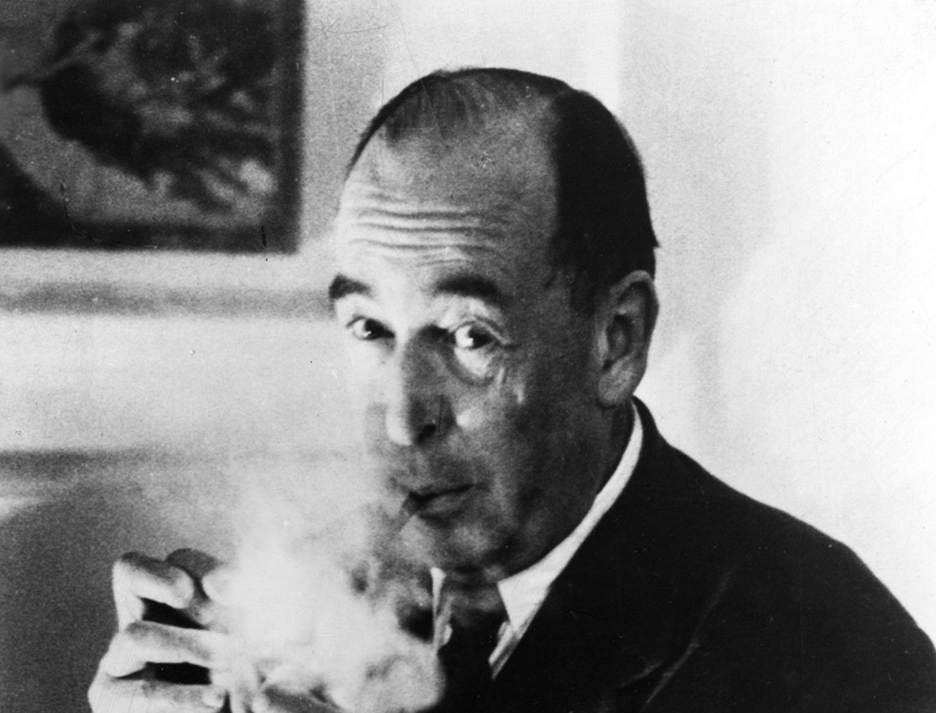
Clive Staples Lewis was born on November 29, 1898, in Belfast, Ireland, the younger of two sons of solicitor Albert James Lewis and Florence Augusta Hamilton Lewis. Known throughout his life to friends and family as “Jack,” Lewis grew up in a book-filled household and, with his brother Warren, invented elaborate imaginary worlds populated by talking animals. His childhood was disrupted by the death of his mother from cancer in 1908, when Lewis was nine, followed by an unhappy succession of English boarding schools. During adolescence he abandoned the Christianity of his upbringing and became an atheist.
Lewis entered University College, Oxford, but his education was interrupted by the First World War. He enlisted in the British Army in 1917 and served as a second lieutenant on the Western Front. On April 15, 1918, he was wounded during the Battle of Arras and returned to England; his close friend Paddy Moore was killed in the fighting. After the war Lewis resumed his studies at Oxford, achieving first-class honors in classics, philosophy and English. In 1925 he was elected a Fellow of Magdalen College, Oxford, where he taught English language and literature for the next twenty-nine years.
Lewis’s religious development became one of the defining episodes of his life. His youthful atheism gradually weakened under the influence of philosophy, literature and conversations with friends, particularly Owen Barfield and J. R. R. Tolkien. In 1929 Lewis abandoned atheism for belief in God. Two years later, following an important September 1931 conversation with Tolkien and Hugo Dyson, he accepted Christianity and subsequently became a practicing Anglican. Lewis later reconstructed this intellectual and spiritual journey in his autobiography Surprised by Joy.
Lewis’s friendship with Tolkien also placed him at the center of the Inklings, the informal Oxford literary circle whose members read and criticized one another’s works. Beginning in the 1930s, Lewis developed simultaneously as a literary scholar, novelist and Christian writer. The Allegory of Love (1936), his study of the medieval tradition of courtly love, established his scholarly reputation. He followed it with the science-fiction novel Out of the Silent Planet (1938), the first installment of what became his Space Trilogy. His academic work remained grounded in medieval and Renaissance literature even as his popular writing moved increasingly toward theology, fantasy and Christian apologetics.
The Second World War transformed Lewis from an Oxford scholar into a national public figure. Beginning in 1941, he delivered a series of BBC radio broadcasts explaining Christianity to a wartime audience. These talks eventually formed the basis of Mere Christianity. During the same period he published The Problem of Pain (1940), The Screwtape Letters (1942) and later The Great Divorce (1945), using argument, satire and imaginative fiction to address questions of morality, suffering, temptation, free will and salvation. By the 1940s Lewis had become one of Britain’s best-known Christian intellectuals.
His largest popular success came with The Chronicles of Narnia. Beginning with The Lion, the Witch and the Wardrobe in 1950, Lewis produced seven Narnia books in six years. The stories combined elements of medieval romance, classical mythology, fairy tale and Christian symbolism within an imagined world governed by the lion Aslan. The final volume, The Last Battle, appeared in 1956 and won the Carnegie Medal. Narnia ultimately gave Lewis an audience far beyond the universities and churches in which his earlier reputation had been established.
Lewis’s academic career also reached a new stage late in life. After nearly three decades at Oxford, in 1954 he accepted the newly created Chair of Medieval and Renaissance Literature at Magdalene College, Cambridge. He began teaching there in 1955 while continuing to maintain his Oxford home, The Kilns. The appointment confirmed his standing not simply as a popular Christian writer but as an important historian and critic of medieval and Renaissance literature. His major scholarly work English Literature in the Sixteenth Century, Excluding Drama appeared in 1954.
Lewis’s private life changed dramatically in his fifties through his relationship with the American writer Joy Davidman Gresham. The two began corresponding and met in person in 1952. They entered a civil marriage in April 1956, initially in part to allow Davidman to remain in Britain, but their relationship developed into a genuine romantic marriage. Soon afterward she was diagnosed with cancer. Following a period in which her illness unexpectedly went into remission, Lewis and Davidman enjoyed several years together before she died on July 13, 1960. Lewis’s struggle with bereavement produced A Grief Observed (1961), one of his most personal books.
Lewis’s own health deteriorated during his final years, and he resigned his Cambridge position in 1963. He died at The Kilns on November 22, 1963, one week before his sixty-fifth birthday. His death received comparatively little immediate public attention because it occurred on the same day as the assassination of President John F. Kennedy and the death of Aldous Huxley. Lewis nevertheless left an unusual dual legacy: within the academy he was a scholar of medieval and Renaissance literature, while outside it he became one of the twentieth century’s most widely read Christian apologists and fantasy writers. His continuing reputation rests especially on Mere Christianity, The Screwtape Letters, The Great Divorce, Surprised by Joy, A Grief Observed, the Space Trilogy and The Chronicles of Narnia.
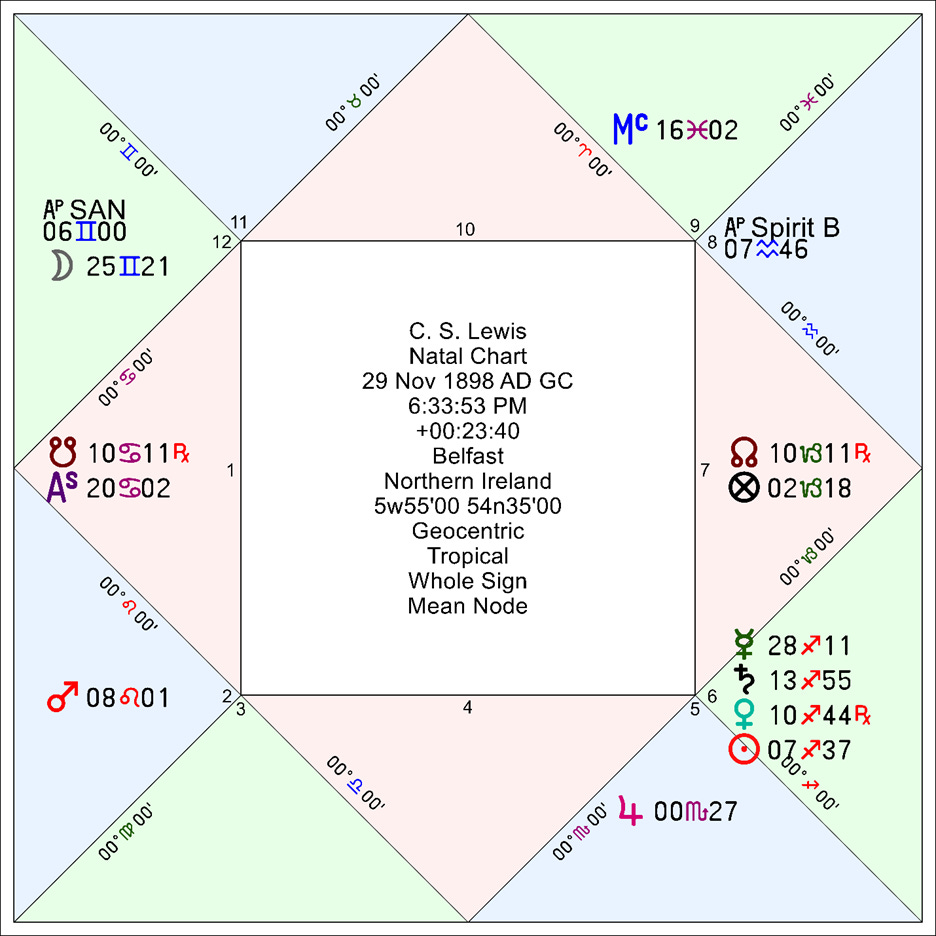
Proposed Rectification Range:
6:33:53 AM to 6:42:38 PM; ASC 20CA02’24” to 21CA38’50”
This is a preliminary rectification range. No final rectified Ascendant was identified.
The analytical models used in the sections below are part of a larger research program developed across longer white papers and case studies, where the historical sources, rules, and testing methodology are laid out in full. These database entries show the models in practice; readers who want the theoretical foundations can start with the background papers below:
Rectification Hub (I wrote the book on it!)
Soul Hub (white paper, Victor model statistical tests, Moon’s Configuration studies)
Physiognomy Hub (white paper, examples)
Victor Model Factors favoring Jupiter/Scorpio
Sign ruler: Sun, Midheaven
Bound ruler: Sun, Ascendant, Prenatal Syzygy
Jupiter/Scorpio as Victor. Jupiter/Scorpio emerges as the victor of the horoscope, directing Lewis’s life toward the exploration and communication of religious and philosophical truth while giving that Jupiterian vocation a distinctly Scorpionic concern with death, evil, suffering, secrecy, conflict, and the darker dimensions of religious experience. Placed in the 5th house, Jupiter connects this vocation with creativity, children, storytelling, and entertainment. These themes converge most clearly in The Chronicles of Narnia, literature written for children in which children themselves are the principal protagonists; the numerous television and film adaptations of Lewis’s works subsequently extended this 5th-house expression into mass entertainment, with another major Narnia film scheduled to debut in 2027. Jupiter’s rulership of the 9th house makes religion, theology, philosophy, higher learning, and the search for ultimate truth central to his life purpose, while its rulership of the 6th house introduces another conspicuous feature of his creative work: animals, traditionally assigned to the 6th and 12th houses, populate Lewis’s imaginative worlds, particularly Narnia, where talking animals become central characters rather than incidental figures. The Firdaria provide additional support for Jupiter as victor: its major period encompassed Lewis’s establishment at Oxford, meeting Tolkien, rejection of materialism, and movement from atheism toward belief in God, while later Jupiter minor periods coincided with expansions of scholarly reputation and, most importantly, the 1950 publication of The Lion, the Witch and the Wardrobe. Jupiter therefore describes not merely Lewis’s religious beliefs but the governing trajectory of the life: religious and philosophical inquiry expressed through imaginative literature for children and entertainment, producing a body of work whose audience continued to expand long after his death.
Physiognomy Model Factors favoring Gemini, Cancer, Pisces
Rising sign: Cancer
Ruler of rising sign: Moon/Gemini
Rising decan: Pisces
Ruler of rising decan: Jupiter/Scorpio
C. S. Lewis had a broad, fleshy face with a rounded head, smooth complexion, full cheeks, and heavy jowls that became increasingly pronounced with age. The face nevertheless has some vertical extension rather than being purely circular, particularly through the forehead, nose, and lower face. His eyebrows form conspicuous curved arcs, emphasizing the rounded quality of the upper face, an effect sometimes reinforced by his round eyeglasses. The mouth is relatively broad, while the chin is soft rather than sharply projected; in later photographs the fullness beneath the jaw produces a noticeable double chin and gives the lower face a somewhat triangular outline. His overall appearance is substantial and soft rather than angular or sharply muscular.
The Cancer Ascendant provides the primary physiognomic signature, corresponding to Lewis’s rounded head and face, smooth and fleshy appearance, full cheeks, and the pronounced crescent-like curvature of the eyebrows. The Ascendant ruler, Moon in Gemini, modifies the Cancerian roundness by elongating the face, accounting for the greater vertical dimension visible through the forehead, nose, and lower facial structure. The Pisces third decan of Cancer supplies a further secondary signature: the fluid triangular form associated with Pisces in the Willner model appears in the widening and softness of the lower face, particularly Lewis’s heavy jowls and pronounced double chin. The combined physiognomy of Cancer, Gemini, and Pisces therefore supports an Ascendant in the third decan of Cancer.
Moon’s Configuration
Stage 1 — Moon Opposes Saturn (Sagittarius, 6th house)
Delineation. The Moon at 25°21 Gemini in the 12th house separates from an opposition with Saturn at 13°55 Sagittarius in the 6th house. Saturn signifies restriction, skepticism, doubt, boundaries, and the attempt to impose order and limits, while Sagittarius concerns religion, philosophy, and comprehensive systems of belief. Saturn does not function comfortably as a command-and-control planet in fiery Sagittarius: its attempt to establish firm boundaries around what may be known or believed is weakened, allowing religious and metaphysical possibilities to survive efforts to contain reality within a materialist framework. The 6th–12th house axis further places this conflict across two difficult houses, suggesting a prolonged confrontation with doubt, isolation, suffering, and questions that resist easy resolution.
Biographical Match. Lewis spent his youth as an atheist and materialist, but eventually concluded that materialism could not adequately explain the entirety of human experience. Reason, consciousness, morality, imagination, and the experience of longing presented problems that a purely material account of reality could not satisfactorily contain. The Moon’s separation from Saturn therefore describes the intellectual background from which Lewis emerged: skepticism initially provided the boundaries of his worldview, but those boundaries ultimately proved inadequate. His movement away from materialism opened the intellectual space in which first theism and subsequently Christianity could become possible.
Stage 2 — Void of Course
Delineation. The Moon’s opposition with Saturn exceeds the 10°30′ Moon–Saturn aspect moiety given by William Lilly, so the Moon is already void of course at the nativity. It remains void before reaching its next effective planetary configuration, producing an interval between the breakdown of the Saturnian framework and the emergence of the subsequent Mercurial expression. The void-of-course condition therefore signifies delay: the first configuration does not immediately deliver the native into the final expression promised by the next planet.
Biographical Match. Lewis’s development followed precisely such an extended intermediate course. The collapse of materialism did not produce an immediate conversion to Christianity, nor did his eventual conversion immediately produce the literary identity for which he became famous. His intellectual development proceeded through successive stages—atheism, philosophical questioning, idealism, theism, and finally Christianity—while his mature career as Christian apologist and imaginative storyteller developed afterward. The void-of-course interval therefore describes a prolonged period in which the old intellectual framework had ceased to satisfy him but the final form of his vocation had not yet fully emerged.
Stage 3 — Moon Opposes Mercury (Sagittarius, 6th house)
Delineation. The Moon next applies to an opposition with Mercury at 28°11 Sagittarius in the 6th house. Mercury signifies language, writing, speech, learning, argument, and storytelling, while Sagittarius directs these Mercurial activities toward religion, philosophy, morality, and questions of ultimate meaning. The opposition indicates tension between the Moon’s imaginative and experiential faculties and Mercury’s rational and verbal faculties, but it also binds the two together: ideas and beliefs must be translated into language, argument, narrative, and image. With Mercury in Sagittarius, communication becomes the principal vehicle through which a religious and philosophical worldview is transmitted.
Biographical Match. Lewis ultimately became above all a storyteller and communicator of ideas. He expressed Christianity through academic scholarship, philosophical argument, BBC broadcasting, correspondence, allegory, satire, fantasy, and children’s literature. Mere Christianity and The Problem of Pain employ direct argument; The Screwtape Letters and The Great Divorce turn theological problems into imaginative narratives; and The Chronicles of Narnia communicates religious and moral ideas through stories whose principal characters are children and animals. The Moon’s final application to Mercury therefore describes the mature resolution of the configuration: after the failure of materialism to contain his understanding of reality and an extended period of intellectual development, Lewis finds his characteristic vocation by converting philosophical and religious ideas into words and stories.
Influence of Sect
The horoscope is nocturnal, making Saturn the out-of-sect malefic and Jupiter the out-of-sect benefic. Saturn’s contrary-to-sect condition intensifies the difficulties associated with the Moon’s separation from Saturn: Lewis’s rejection of materialism placed him increasingly at odds with the dominant intellectual trajectory of the twentieth-century West, particularly as scientific materialism and secularism gained influence in postwar society. His Christian response therefore remained a minority position within the broader intellectual culture rather than becoming part of its governing consensus. The same nocturnal condition qualifies Jupiter/Scorpio as victor. Jupiter can still govern the principal accomplishments and direction of the life, particularly Lewis’s religious, philosophical, literary, and educational work, but as the out-of-sect benefic its Jupiterian vision likewise operates outside the prevailing cultural mainstream. Sect therefore reinforces a central feature of the horoscope: Lewis achieved extraordinary influence as a defender and imaginative interpreter of Christianity precisely as the surrounding Western culture was moving increasingly toward secular and materialist explanations of reality.
Early/Late Bloomer Model Assessment
C. S. Lewis supports the late-bloomer thesis. He was born shortly after a Full Moon, which places him on the waning half of the lunation cycle and predicts that the more consequential accomplishments of the life should accumulate after its midpoint. The proximity to the Full Moon requires some caution, but the Moon at 25°21 Gemini lies just beyond the 15° bond of the Sun, so the luminaries are sufficiently separated for the model to remain operative. Lewis lived to age 64, placing his longevity midpoint at approximately age 32, in 1931—an unusually meaningful dividing line in his biography. His first half established the necessary foundations through Oxford, his fellowship at Magdalen, his friendship with Tolkien, and his movement away from materialism toward theism, but his conversion to Christianity occurred in September 1931, almost exactly at the midpoint. The achievements responsible for his enduring reputation then accumulated overwhelmingly in the second half: the Inklings, The Allegory of Love, the wartime BBC broadcasts, The Screwtape Letters, Mere Christianity, the Space Trilogy, The Great Divorce, and, beginning in 1950, The Chronicles of Narnia. Lewis therefore provides an unusually clear expression of the model: the first half of life establishes the intellectual and professional foundation, while the second half produces the mature religious identity and the body of work upon which his lasting fame rests.
Complete biographical chronology, rectification and time lord studies available in Excel format as a paid subscriber benefit. File is behind the paywall.