

Cesare Lombroso enters the Regulus Astrology database through two distinct but overlapping tracks: first, as part of the ongoing Jupiter in Cancer series, and second, under the physiognomy section for his historical role in attempting to apply bodily form to the classification of criminal behavior. Best known for The Criminal Man (1876), Lombroso sought to ground criminality in observable physical traits, arguing that the body itself revealed the moral condition of the individual. While his conclusions ultimately failed under scientific scrutiny, his effort represents one of the most ambitious—and controversial—attempts to formalize physiognomy within a legal and medical framework.
Astrologically, Lombroso provides another example of Jupiter in Cancer retrograde functioning as Jupiter in Capricorn in the sign of its fall. In this formulation, Jupiter—normally associated with moral philosophy, law, and higher reasoning—becomes inverted, producing a doctrine centered on immorality rather than virtue. For Lombroso, this manifests as a sustained effort to explain criminal behavior not through ethical reasoning or social context, but through the physical body itself. Criminality becomes something embedded, visible, and fixed—an inversion of Jupiter’s usual role as a guide to higher order and justice. As in other Jupiter/Cancer-retrograde cases, the philosophical impulse remains strong, but its conclusions are distorted, grounding moral judgment in material form rather than abstract principle.
So why did Lombroso get it so wrong? The answer lies in the 12th house, where planets often produce exaggerated or distorted effects relative to their true significance. With Cancer on the cusp of the 12th, the Moon becomes the ruler of this distortion, and its condition is decisive. The Moon in Taurus, separating from the opposition of Mars and conjunct the North Node, shows an obsessive fixation on the physical body—particularly the faces and skulls of criminals. This fixation does not merely observe; it amplifies. Through the Moon’s rulership of the 12th, Lombroso overestimates what he sees, projecting significance onto physical traits beyond what they can sustain. This distortion feeds directly into Jupiter in Cancer retrograde in the 12th, where moral judgment becomes exaggerated into a doctrine of inherent criminal immorality. In this way, the Moon acts as the engine of cognitive error: what begins as empirical observation is inflated into certainty, producing a system that mistakes intensity of perception for truth.
The Moon’s configuration brings this dynamic into sharper focus. Lombroso is born just after a Full Moon, and although the Moon appears to apply to a trine with Saturn in Libra, the degree separation is well outside William Lilly’s moiety for a Moon–Saturn aspect. As a result, the aspect does not perfect, and the Moon is properly treated as void-of-course. This is critical: the Moon, having separated from Mars in Scorpio—signifying direct engagement with criminals—attempts to carry its observations toward Saturn, the planet of legal judgment and classification, but fails to complete the connection. The symbolism is exact. Lombroso’s ambition to translate physical observation into reliable legal judgment never succeeds. Saturn’s out-of-sect condition further narrows the pathway, limiting the acceptance of his method within broader society. What remains is a system rich in observation but unable to secure the authority of law—an interpretive structure that reaches toward judgment but cannot fully arrive there.
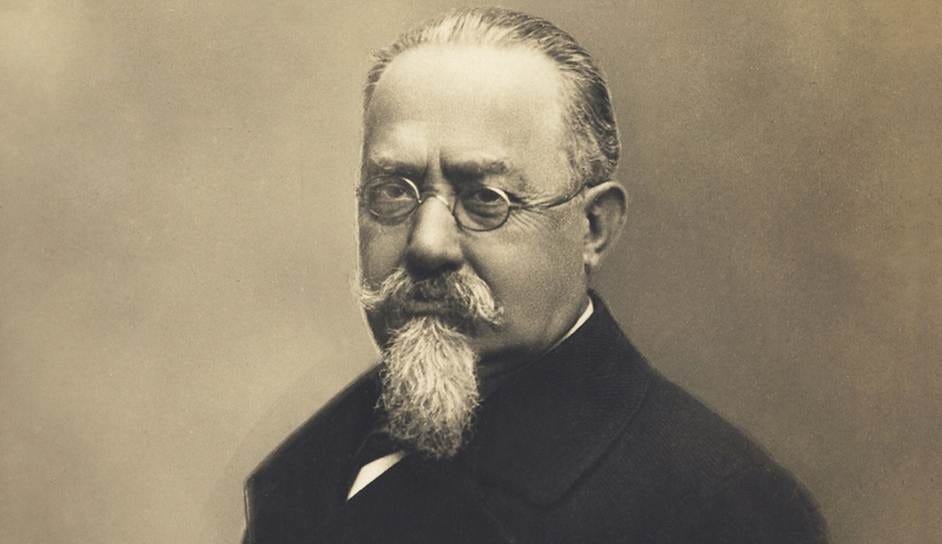
Cesare Lombroso was an Italian physician, psychiatrist, and criminologist who became a controversial 19th century figure for his attempt to link physical appearance with criminal behavior. Born on November 6, 1835, in Verona, then part of the Austrian Empire, Lombroso was raised in a Jewish family and showed early intellectual promise. He studied medicine at the universities of Pavia, Padua, and Vienna, immersing himself not only in clinical medicine but also in emerging fields like psychiatry, anthropology, and neurology.
Early Career and Influences. Lombroso’s early work coincided with a period of rapid change in European science. Influenced by evolutionary ideas following Charles Darwin and the rise of positivism, he sought to apply empirical methods to the study of crime. During his service as a physician in the Italian army, he began observing soldiers and prisoners, noting patterns he believed connected physical traits to deviant behavior.
The “Born Criminal” Theory. In his most famous work, L’Uomo Delinquente (The Criminal Man), first published in 1876, Lombroso argued that criminals are not simply shaped by environment or choice, but are “atavistic” individuals—biological throwbacks to earlier stages of human evolution. He organized the physical characteristics he observed into three broad groupings: first, cranial and skeletal irregularities such as asymmetrical skull structure, elongated jaws, and flattened noses, which he interpreted as evolutionary regressions; second, facial markers of intensity or coarseness, including thick eyebrows, bulging eyes, long earlobes, and curly hair, which he associated with what he considered primitive vitality or excess instinct; and third, physiological or behavioral traits, such as low sensitivity to pain and scanty beard growth, where his theory extended beyond visible form into claims about the nervous system. Lombroso’s crucial step was to treat these traits cumulatively: the presence of five or more, in his view, marked an individual as a “born criminal,” effectively converting a loose set of observations into a fixed diagnostic threshold.
Academic Career and Expansion of Ideas. Lombroso became a professor at the University of Turin, where he expanded his research into broader areas including mental illness, genius, and even paranormal phenomena. He classified criminals into types—such as “born criminals,” “insane criminals,” and “criminaloids”—and argued that punishment should be tailored according to biological predisposition rather than moral guilt alone.
Criticism and Decline of His Theory. Despite his influence, Lombroso’s theories began to face strong criticism by the late 19th and early 20th centuries. Critics pointed out serious methodological flaws, including small and biased sample sizes, confirmation bias in selecting physical traits, and a failure to account for social and economic factors. Later research in criminology, psychology, and sociology demonstrated that criminal behavior is far more complex and cannot be reduced to physical appearance, and Lombroso’s biological determinism came to be seen as overly simplistic.
Later Life and Legacy. Lombroso continued writing and teaching until his death on October 19, 1909, in Turin. Although his core theory has been discredited, his legacy remains significant in the history of criminology. He is often credited with helping to establish criminology as a scientific discipline by shifting focus from purely legal definitions of crime to empirical study of offenders, while also serving as a cautionary example of how scientific authority can be misapplied when theory outruns evidence.
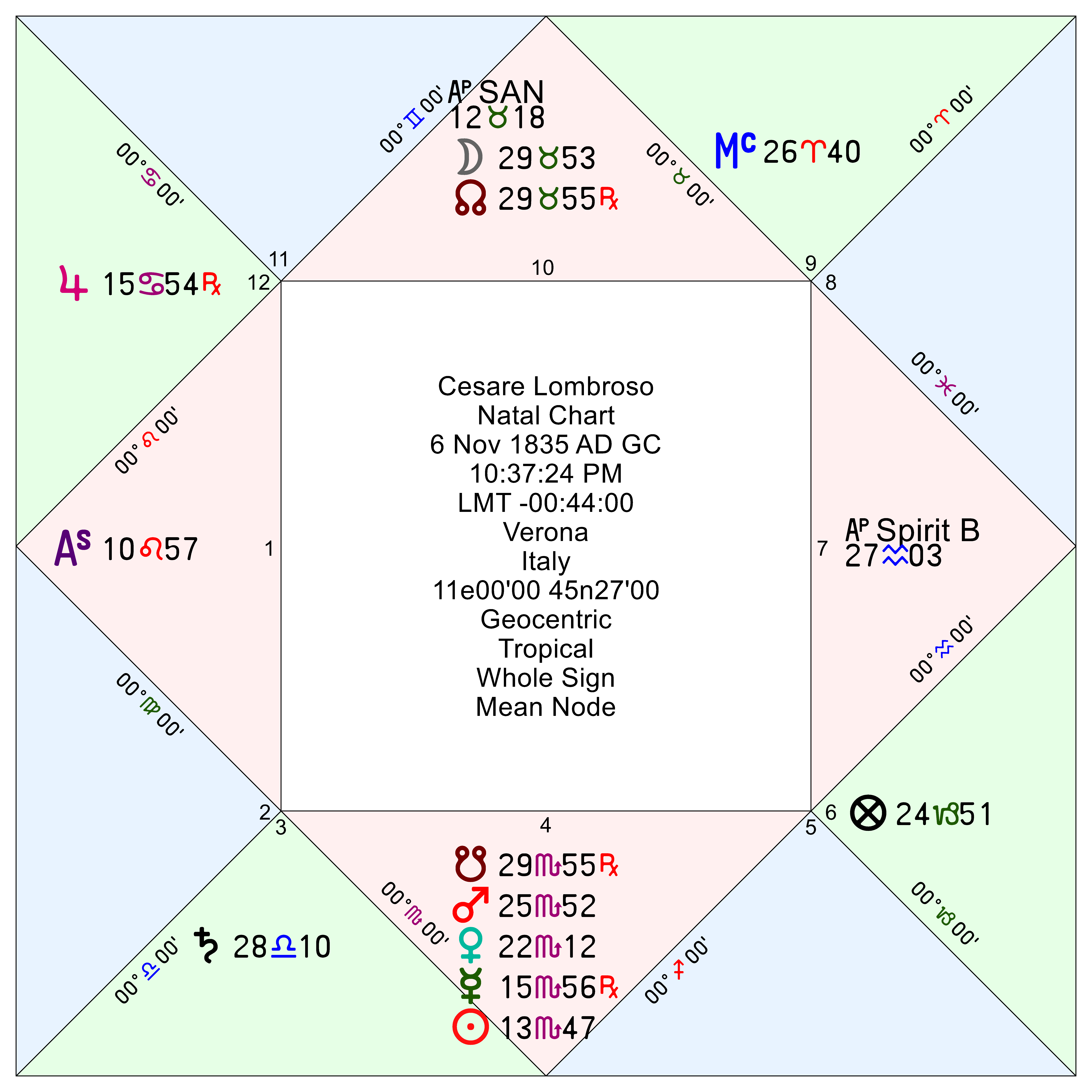
Rodden Rating B, Bio/autobiography. 11:00 PM, ASC 15LE12
Proposed rectification: 10:37:24 PM, ASC 10LE57’36”
Complete biographical chronology, rectification and time lord studies available in Excel format as a paid subscriber benefit.
The analytical models used in the sections below are part of a larger research program developed across longer white papers and case studies, where the historical sources, rules, and testing methodology are laid out in full. These database entries show the models in practice; readers who want the theoretical foundations can start with the background papers below:
Rectification Hub (I wrote the book on it!)
Soul Hub (white paper, Victor model statistical tests, Moon’s Configuration studies)
Physiognomy Hub (white paper, examples)
Victor Model Factors favoring Saturn/Libra as Victor
Sign ruler: Lot of Fortune, Lot of Spirit
Bound ruler: Lot of Fortune, Midheaven, Prenatal Syzygy
Essential Dignity: exaltation
Special Configuration: 10th from the Lot of Fortune (sign and bound ruler Saturn)
Saturn in Libra as victor, placed near the IC at the bottom of the chart, brings the symbolism of legal judgment down to its final and most conclusive expression—the “end of the matter.” In Libra, Saturn is exalted, operating through the language of law, balance, and formal judgment; yet positioned at the IC, this judgment is rendered as a foundational condition, fixed and unquestioned, rather than something open to deliberation. In Lombroso’s case, this signature aligns with his attempt to resolve the problem of criminality at its root by assigning guilt or innocence through visible physical traits alone. The chart thus reflects a system in which judgment is not the outcome of a legal process, but a predetermined conclusion embedded in the body itself—Saturn in Libra delivering verdicts with apparent authority, but doing so at a level that bypasses the complexity of human behavior.
Physiognomy Model Factors favoring Capricorn, Cancer.
The face presents a clear synthesis of Cancer and Capricorn traits, consistent with a rising decan ruled by Jupiter in Cancer (retrograde), producing a blending rather than a dominance of one sign over the other. The overall facial structure is ovate—typical of cardinal signs—yet the bone structure is firm and well-defined, especially through the jawline and lower face, pointing to Capricorn’s influence. This is reinforced by the presence of a chin beard, a classic Capricorn marker; however, its execution is unusual. Rather than forming a narrow or elongated point, the beard is rounded and full, closely echoing the circular form associated with the Moon in Cancer. This rounding softens what would otherwise be a more austere Saturnine presentation, creating a visual compromise between structure and fullness. The eyes, partially obscured by spectacles, sit beneath a steady brow that conveys restraint rather than intensity, further supporting a Saturnine composure moderated by lunar softness. The result is a face that does not resolve cleanly into a single typology, but instead reflects a dual signature: Capricorn providing structure, boundary, and definition, while Cancer introduces curvature, softness, and a subtle reflective quality that rounds out the overall expression.
Moon’s Configuration
Phase I – Moon separating from Mars (Scorpio, 4th House)
Delineation. The Moon in Taurus separating from the opposition of Mars in Scorpio describes an initial condition of confrontation with violence, extremity, and the raw realities of human behavior. Mars in Scorpio signifies crime, brutality, and hidden transgressions, while the Moon in Taurus, grounded in the physical body and material observation, receives this influence through direct exposure. The Moon’s placement in the bound of Mars links the Moon’s attention to Mars-signified topics, ensuring that even as the Moon separates from Mars, the native continues to think about criminals and acts of violence. Intensification comes through the Moon’s conjunction with the North Node, which amplifies the focus on physical traits and lived experience. Together, these factors show a mind that remains fixed on crime not as an abstract concept, but as something encountered through the body and preserved in observation.
Biographical Match. Lombroso’s early career as an army surgeon and later work in prisons and asylums brought him into direct contact with criminals, madmen, and the dead. His collection of skulls—often obtained through autopsy and excavation—reflects a sustained engagement with the physical remains of those who had committed violent acts. The famous 1870 autopsy of the brigand Giuseppe Villella, where Lombroso identified cranial anomalies, marks the clearest expression of this phase: an encounter with criminality that he interpreted through the body itself. This moment set the foundation for his lifelong attempt to link physical form with criminal behavior.
Phase II – Void-of-Course Moon, failed application to Saturn (Libra, 3rd/4th house)
Delineation. After separating from Mars, the Moon advances through Taurus and enters Gemini, marking a shift from physical observation to classification, comparison, and intellectual formulation. However, the Moon fails to perfect its application to Saturn in Libra, with the 28 degree difference exceeding William Lilly’s aspect moiety and approaching the stricter 30 degree void-of-course condition advocated by Hellenistic astrology. Saturn in Libra signifies legal judgment, classification, and the rendering of verdicts, here positioned near the foundation of the chart. The Moon’s attempted but unrealized connection to Saturn shows an effort to translate observation into formal judgment that does not fully complete. The result is a system that seeks to impose legal and categorical conclusions, but without achieving a stable or verifiable correspondence between physical evidence and moral outcome.
Biographical Match. Lombroso’s work progressed from the collection and observation of physical remains to the classification of criminal types and the publication of theoretical frameworks. His writings, most notably The Criminal Man, represent an effort to organize empirical observations into a coherent system of judgment. Yet his central claim—that criminality could be reliably diagnosed from anatomical traits—ultimately failed to hold under scientific scrutiny. Later studies demonstrated that criminals did not possess consistent physical abnormalities, undermining the validity of his classifications. The void-of-course Moon captures this trajectory: a movement from observation to attempted judgment that does not culminate in a durable or successful system, reflecting Lombroso’s inability to establish a reliable method for determining guilt based solely on physical appearance.
Influence of Sect
In a nocturnal chart, Venus and Mars are in-sect, and with both placed in Scorpio they signify female and male criminals operating within a domain that, while extreme, is nonetheless stabilized by sect. Their in-sect condition reduces their capacity for direct harm and instead places them within controlled environments—prisons, asylums, and public institutions—where they can be observed rather than feared. This aligns closely with Lombroso’s experience: his subjects were dangerous in principle, but rendered accessible and non-threatening in practice, allowing sustained study. At the same time, their in-sect status suggests social agreement about their classification—these individuals were already recognized by society as criminals, giving Lombroso a sanctioned field of inquiry. By contrast, Saturn and Jupiter are out-of-sect, and their significations fail to carry the same level of acceptance. Saturn in Libra, though exalted and representing legal judgment, becomes excessive in its application when extended to physiognomic verdicts, reflecting Lombroso’s attempt to assign guilt based on appearance—an approach ultimately rejected. Likewise, Jupiter in Cancer (retrograde), as a significator of moral reasoning, is weakened and distorted out of sect, corresponding to Lombroso’s broader theory of criminal immorality grounded in physical form, which did not achieve consensus or lasting validation.
Early/Late Bloomer Thesis
Under the early/late bloomer thesis, births following a Full Moon (i.e., in the waning phase) are expected to produce late bloomers, with major achievements clustering after the midpoint of life. Cesare Lombroso lived to age 73 (1835–1909), giving a midpoint of approximately 37 years (rounded). Prior to this midpoint, his life reflects preparation rather than culmination: medical education in the 1850s, service as an army surgeon (1859–1866), and the gradual accumulation of skulls and observations that would later form the basis of his theory, including the key 1870 autopsy of Villella at age 35. After the midpoint, however, his major contributions take shape: publication of The Criminal Man in 1876 (age 41), followed by academic appointments, expansion of his classification system, and the establishment of his museum and broader intellectual influence in the 1880s–1890s. The distribution of milestones thus supports the late bloomer designation, with Lombroso’s most important work emerging clearly in the second half of life.
At the same time, his birth occurs very close to the Full Moon, with the Moon separating from the Sun by just over 16 degrees—only slightly beyond the 15 degree difference when the Moon remains under the Sun’s ‘bond’ in Hellenistic astrological theory. If we accept the verdict that Lombroso meets the late bloomer prediction of the early/late bloomer model, his horoscope is a good example of the Moon no longer under the Sun’s bond.