

Last week’s post on Ada Lovelace led inevitably to Charles Babbage, the man whose calculating machines gave Lovelace something entirely new to contemplate. If Lovelace saw possibilities in the Analytical Engine that extended beyond arithmetic, Babbage faced the more fundamental problem: how do you turn mathematics into a machine? His answer began with the Difference Engine, expanded into the programmable Analytical Engine, and culminated in Difference Engine No. 2—a design whose mechanical soundness would not be demonstrated until long after his death.
Babbage also offers an interesting detour from the Aquarius series of Tech Bros. The modern figures examined in this series frequently depend upon strong Aquarius placements for computing, systems architecture and technological infrastructure. Babbage does not. Instead, his horoscope suggests another route to computation: earth signs doing the work usually associated with air. Mercury and the Moon are almost exactly conjunct in Capricorn, while the Moon next applies to Mars in Virgo. Computation emerges not primarily as abstraction, but as the reduction of thought to an ordered sequence of operations—calculation made physical through gears, columns, punched cards and machinery.
That distinction may help explain why Babbage belongs at the beginning of the history of computing. Mercury/Capricorn, the proposed victor of the horoscope, wants mathematics organized into a structure in which one operation follows another; Mars/Virgo supplies the precision required to make that structure work mechanically. Yet the same horoscope raises a different question: why could a man capable of designing such machines fail to complete them during his lifetime? The answer leads beyond engineering into government patronage, difficult working relationships, Babbage’s unusual partnership with Lovelace, and a horoscope in which the planets capable of creating the machine were not necessarily as well equipped to get it built.
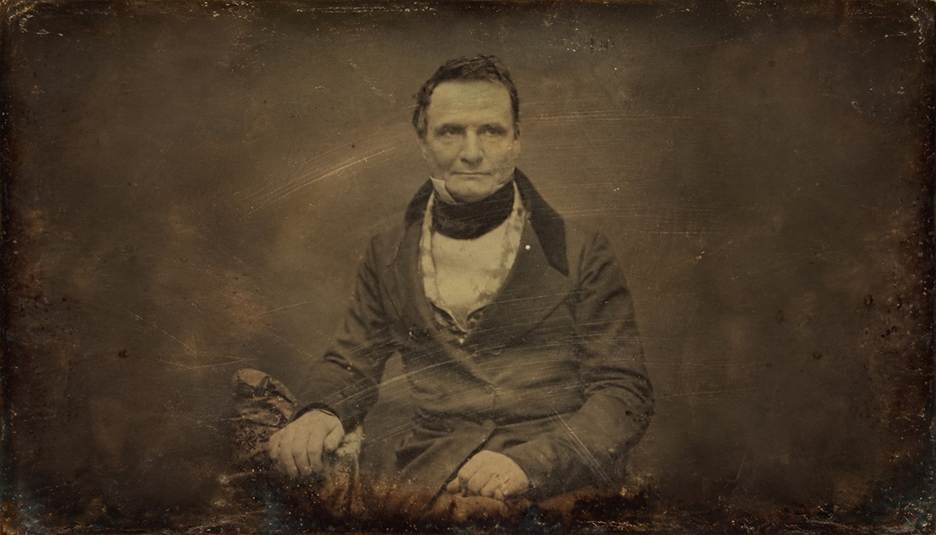
Charles Babbage was born on 26 December 1791 at Walworth, Surrey, the son of banker Benjamin Babbage and Elizabeth Teape. He entered Trinity College, Cambridge, in 1810, where he found the mathematical curriculum antiquated. With John Herschel, George Peacock and others, he founded the Analytical Society in 1812 to promote Continental mathematics and Leibnizian notation in Britain. He graduated from Peterhouse in 1814, married Georgiana Whitmore that year, was elected a Fellow of the Royal Society in 1816, and received his MA in 1817.
Babbage’s early career combined mathematics with an interest in scientific institutions and the reliability of numerical tables. He helped found the Astronomical Society of London in 1820 and became increasingly frustrated by errors introduced when human “computers” calculated and typeset mathematical tables. By 1820–21 he was already sketching the parts of a calculating machine; the often-repeated story of its conception dates from the summer of 1821, when, while checking error-ridden tables, Babbage proposed performing the calculations “by steam.”
This led to the first of three distinct calculating machines that define his career: the Difference Engine, the Analytical Engine, and the later Difference Engine No. 2.
The original Difference Engine was designed to calculate and eventually print mathematical tables automatically using the method of finite differences. Babbage constructed a small experimental machine in 1822, and in 1823 the British government provided an initial £1,500 to build a full-scale version. Working with the precision engineer Joseph Clement, Babbage embarked on a project whose mechanical demands pushed contemporary engineering practice. In 1832 Clement completed the substantial working section now preserved by the Science Museum. It contains about 2,000 parts and represents approximately one-seventh of the proposed full machine. It successfully performed a subset of the calculations that the completed Engine was designed to perform, demonstrating the viability of the underlying mechanism.
The problem was money, management and construction on a scale Babbage could not finance himself. Government support came intermittently, costs escalated, and Babbage and Clement became embroiled in a dispute over workshop arrangements, ownership of tools and payment. In March 1833 Clement dismissed the workers employed on the Engine, and construction stopped permanently. The surviving working portion therefore should not be confused with a failed machine: it was a successful partial implementation of a much larger machine that Babbage never obtained the resources to complete. The Science Museum describes it as the first successful automatic calculator.
These professional difficulties followed a much more severe personal crisis. During 1827, Babbage lost his father, two sons and his wife Georgiana. Her death on 1 September was followed by a period of poor health and travel on the Continent. Financially, his father’s death left him independently wealthy; emotionally, the cluster of deaths marked the sharpest personal loss of his life. In 1828 he became Lucasian Professor of Mathematics at Cambridge, a prestigious position he held while continuing his independent scientific and mechanical work.
The collapse of the Difference Engine project did not end Babbage’s work on calculating machinery. Instead, during 1833–34 he began conceiving something much more ambitious. By 27 November 1834, surviving drawings document detailed work on what became the Analytical Engine.
Unlike the Difference Engine, which was designed to carry out a particular class of mathematical calculations, the Analytical Engine was intended as a general-purpose programmable machine. During the 1830s Babbage developed an architecture separating the Store, where numbers and intermediate results were retained, from the Mill, where arithmetic operations were performed—functions broadly analogous to memory and a processor. Punched cards derived from the Jacquard loom controlled operations, while the design incorporated repeated sequences and conditional changes of operation. Surviving Babbage notations from 1837 show him working through multistep computational procedures. The Science Museum’s archive describes many of these notations as what would now be recognized as traces of “micro-programs.”
By 18 March 1837, Babbage’s Sketch 13 brought together variables, control barrels, punched-card machinery and printing apparatus in an integrated design. In 1840 he took the mature Plan 25 version of the Analytical Engine to Turin, where he explained it to a group of Italian mathematicians and engineers. Luigi Federico Menabrea subsequently published an account of the machine in French in 1842.
This brought Ada Lovelace back into the story.
Babbage had first met seventeen-year-old Ada Byron on 5 June 1833 through their mutual friend Mary Somerville. Twelve days later, Ada and her mother visited Babbage’s home and saw the working portion of the Difference Engine. Ada was fascinated by the machine and remained intellectually engaged with Babbage and his work. Their surviving correspondence demonstrates a relationship that was personal as well as mathematical.
I
n late 1842 Ada began translating Menabrea’s paper into English. Babbage suggested that she add notes of her own. The resulting Notes A–G, published with the translation in 1843, were considerably longer than Menabrea’s original article and became the work for which the Babbage-Lovelace partnership is principally remembered. Note G included the famous tabular procedure for calculating Bernoulli numbers on the Analytical Engine. Lovelace also grasped a broader implication of Babbage’s invention: a programmable machine might manipulate entities other than numbers if those entities could be represented symbolically.
The popular description of Lovelace as the first computer programmer requires some qualification. Babbage had devised computational procedures for the Analytical Engine years before the publication of her Notes. Yet this does not reduce Lovelace to Babbage’s secretary or popularizer. Babbage’s own later account records that she selected and developed examples herself and, during their work on the Bernoulli numbers, discovered a serious error in a calculation he had supplied. Her importance lies both in the published algorithm and in the unusually expansive interpretation she gave to what Babbage’s machine might ultimately do.
The nature of their personal relationship remains open to speculation. There is no surviving documentary evidence establishing that Babbage and Lovelace were lovers, and a physical affair should not be presented as fact. Their surviving correspondence nevertheless reveals considerable emotional and intellectual intimacy, and some biographers have interpreted their friendship as having a romantic dimension.
There is also a serious problem with arguing from the absence of incriminating correspondence: much of Lovelace’s correspondence did not survive. Following her death, letters regarded as potentially embarrassing were deliberately destroyed by her household and family; contemporary accounts refer to letters being burned and further material being destroyed by family lawyers. Consequently, the surviving correspondence cannot tell us everything about her private relationships. The unusually rich Babbage-Lovelace correspondence surrounding their 1843 collaboration survives, but much other potentially revealing material from Lovelace’s life was destroyed. A romantic relationship with Babbage therefore remains possible but unproven—not something the surviving evidence allows us either to establish or categorically exclude.
Ironically, 1843 represented the high point of their intellectual partnership. The two later remained friends, but nothing comparable to the concentrated Analytical Engine collaboration followed. Lovelace’s health deteriorated, and she died from uterine cancer on 27 November 1852, aged thirty-six. Babbage outlived her by almost nineteen years.
Meanwhile Babbage had returned to difference-engine design. Between 1846 and 1849 he developed his third major calculating machine, Difference Engine No. 2. It incorporated lessons learned during more than a decade of work on the Analytical Engine and was substantially simpler and more efficient than Difference Engine No. 1. Babbage prepared detailed drawings but, after his earlier experience with the government, never secured the financing necessary to build it. He continued refining the Analytical Engine and pursuing other inventions for the remainder of his life. The latter ranged from an early ophthalmoscope to railway-monitoring devices, signaling systems and mechanical games.
Babbage also remained an institutional critic and reformer. He helped establish the Astronomical Society, the British Association for the Advancement of Science and the Statistical Society of London. His On the Economy of Machinery and Manufactures (1832) examined industrial production and division of labor, while his earlier Reflections on the Decline of Science in England (1830) attacked what he regarded as Britain’s inadequate organization and support of science. In 1864 he published his autobiography, Passages from the Life of a Philosopher.
Babbage died at his London home on 18 October 1871, leaving behind extensive drawings, notebooks, notations and partially constructed machinery—but none of his three great machines in the complete form he had envisioned.
The decisive test came more than a century later.
Beginning in 1985, a Science Museum team led by Doron Swade set out to construct Difference Engine No. 2 from Babbage’s original nineteenth-century designs, deliberately testing whether the design itself worked. The main machine was assembled in 1991. After debugging, on 29 November 1991 it successfully completed its first full-scale calculation, generating the first 100 values of a seventh-power polynomial. It subsequently operated without error. The Science Museum archive states that construction from Babbage’s plans demonstrated the viability of his design; a printing and stereotyping apparatus was subsequently completed and attached in 2002.
The distinction among Babbage’s three machines is therefore important. Difference Engine No. 1 reached the stage of a working partial machine during his lifetime. The Analytical Engine went much further conceptually—it introduced the architecture that gives Babbage his strongest claim as a progenitor of modern computing—but remained principally on paper. Difference Engine No. 2, designed in 1846–49 but never built during his lifetime, supplied the posthumous engineering verdict. When the Science Museum made it work on 29 November 1991, the experiment demonstrated that Babbage’s nineteenth-century mechanical designs were not merely speculative drawings. The machine could actually calculate as he had intended.
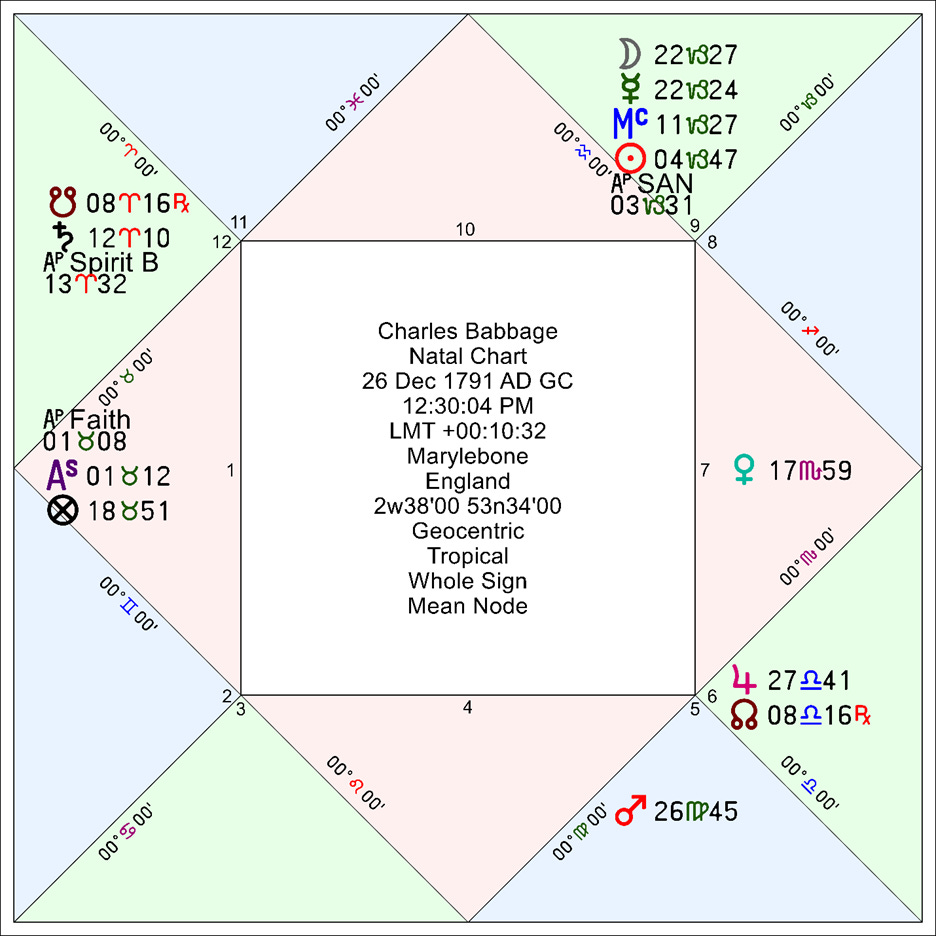
Rodden Rating X: Date w/o time.
Proposed Rectification: 12:30:04 PM, ASC 1TA12’28”. I rate this accurate to within 1 degree.
The analytical models used in the sections below are part of a larger research program developed across longer white papers and case studies, where the historical sources, rules, and testing methodology are laid out in full. These database entries show the models in practice; readers who want the theoretical foundations can start with the background papers below:
Rectification Hub (I wrote the book on it!)
Soul Hub (white paper, Victor model statistical tests, Moon’s Configuration studies)
Physiognomy Hub (white paper, examples)
Victor Model Factors favoring Mercury/Capricorn
Bound lord: Sun, Lot of Spirit, Prenatal Syzygy
Position: Same sign as MC, the first planet to reach the MC after birth by diurnal motion
Mercury in Capricorn is the victor of Babbage’s horoscope, placing methodical calculation at the center of his life’s purpose. Mercury signifies mathematics, numbers, notation, information and computation; Capricorn gives these activities structure, requiring each operation to proceed systematically from what came before it. This is an unusually close match for Babbage’s calculating engines, which mechanized precisely such ordered sequences of mathematical operations, culminating in the programmable architecture of the Analytical Engine. By whole-sign houses Mercury occupies the 9th house, directing these abilities toward higher mathematics, scientific knowledge and the formulation of general principles; by quadrant houses it occupies the 10th, bringing the same Mercury directly into career, reputation and his public contribution. The overlap is particularly descriptive: what Babbage investigated as mathematics and scientific theory in the 9th became the work for which he was publicly remembered in the 10th.
Physiognomy Model Factors favoring Scorpio
Rising sign and rising decan: Taurus
Ruler of rising sign and rising decan: Venus/Scorpio
Babbage presents a solid, upright figure with a long torso and relatively broad shoulders, giving the body a rectangular rather than rounded outline. The same geometry is more pronounced in the face. In the daguerreotype, the face is long and rectangular, with fairly straight sides, a substantial forehead, prominent nose, firm jaw and comparatively squared lower face. The features are strongly defined rather than soft, while the deep-set eyes and compressed mouth contribute to a concentrated, somewhat severe expression.
Scorpio is the principal physiognomic significator because Venus, ruler of both the rising sign and the rising decan, is placed in Scorpio. Scorpio produces the rectangular facial shape clearly visible in Babbage’s daguerreotype: length predominates without narrowing the face into an oval, while the forehead, cheeks and jaw preserve relatively straight vertical lines. Venus carries the Scorpio form to the body and face through its rulership of the Ascendant and its decan, while Scorpio modifies Venus away from softness and roundness toward sharper definition and greater intensity. The result is a useful physical confirmation of the proposed rising configuration: the rectangular Scorpio morphology is one of the most immediately recognizable features of Babbage’s face.
Moon’s Configuration
Stage One — Moon separates from Mercury (Capricorn, 9th/10th houses)
Delineation. The Moon at 22°27′ Capricorn separates from Mercury at 22°24′ Capricorn by only 3 arcminutes, making the conjunction effectively partile. The Moon signifies intuitive and instinctive cognition, while Mercury signifies rational thought, mathematics, calculation and symbolic systems. Their near-exact conjunction fuses these two modes of thought, while Capricorn imposes order, method and structure: problems are solved sequentially, with each step dependent upon the one preceding it. Both planets occupy the 9th house by whole sign and 10th by quadrant houses, joining higher mathematics and scientific knowledge with career and public reputation.
Biographical Match. Babbage’s life closely reflects this Moon–Mercury fusion. Mathematical problems were not merely abstract exercises for him; he repeatedly sought to translate mathematical reasoning into physical processes that machinery could execute. The Difference Engine mechanized sequential calculation, while the Analytical Engine extended the principle to stored numbers, arithmetic operations and programmed sequences. His preoccupation with eliminating errors from mathematical tables is especially descriptive of Moon–Mercury in Capricorn: intuitive recognition of a problem was immediately directed toward a rational, systematic and reproducible solution. With Mercury/Capricorn as victor, the Moon’s partile separation from Mercury makes this Mercurial purpose deeply embedded in Babbage’s instinctive mode of thought.
Stage Two — Moon applies to Mars (Virgo, 5th/6th houses)
Delineation. Having separated from Mercury, the Moon next applies by trine to Mars at 26°45′ Virgo, carrying the Mercury/Capricorn agenda toward another earth-sign planet concerned with execution, precision and correction. Mars supplies action, effort and technical force; Virgo directs that force toward exacting work, measurement and the identification of error. By whole-sign houses Mars occupies the 5th, where its difficulties can appear in presenting or promoting one’s creations; by quadrant houses it occupies the 6th, emphasizing sustained labor, craftsmanship and painstaking attention to detail.
Biographical Match. Babbage devoted decades to detailed mechanical drawings, calculations, notations and repeated redesigns of his engines. Mars/Virgo aptly describes the almost military precision required to translate mathematical operations into thousands of interacting mechanical parts. Its 6th-house placement emphasizes the enormous quantity of work involved, while the 5th-house placement describes a less successful side of his career: Babbage was often a poor “brand ambassador” for his own inventions. His conflicts with Joseph Clement and government officials demonstrate how the ability to design and refine machinery did not necessarily extend to managing the people and institutions required to build it. The Moon therefore carries Mercury’s mathematical conception directly toward Mars/Virgo’s relentless technical execution.
New Moon Consideration
The horoscope is post-New Moon: the Sun, Mercury and Moon are all in Capricorn, with the Sun at 4°37′ and Moon at 22°27′. Yet the Moon is 17°50′ from the Sun, beyond the approximately 15° solar bond, so I would not judge it damaged. Babbage superficially resembles the debilitated New Moon type—a lifelong tinkerer obsessively returning to mathematical tables and calculating machines, with relatively little practical success during his lifetime—but the eventual results argue against that judgment. His repeated redesigns did not wander into increasingly unworkable schemes; they produced progressively developed and technically viable machines. Difference Engine No. 2 could be constructed from his nineteenth-century plans long after his death and operated successfully. Babbage therefore shows the concentrated, forward-driving quality of a young waxing Moon without the stronger New Moon debility seen in figures such as Salinger or Gall: his failure to realize the machines during his lifetime resulted more from inadequate funding and institutional difficulties than from an inability to bring his ideas to workable form.
Influence of Sect
Babbage’s horoscope is diurnal, a condition that weakens rather than supports the Moon’s Configuration. Saturn and Jupiter are the in-sect planets, yet neither provides an obvious benefic counterweight, while Mars and Venus are out-of-sect and therefore more troublesome. Saturn/Aries in the 12th, ruling the 10th by whole signs, describes the government as a powerful but unreliable institutional patron operating behind Babbage’s career: government funding enabled his early work but was repeatedly interrupted and ultimately withdrawn by Robert Peel. Peel’s decision to terminate support as Saturn transited the Midheaven provides unusually direct confirmation of the delineation. Saturn being in-sect does not necessarily make the government helpful; rather, it gives Saturn greater capacity and reach, allowing the 12th-house institution acting as a concealed or indirect enemy to exercise decisive authority over his 10th-house career. Jupiter/Libra in the 6th, also in-sect, may describe the assistance of skilled collaborators and professional associates required to turn Babbage’s ideas into working machinery, though its benefits proved insufficient to overcome the other configurations. Mars/Virgo out-of-sect in the 5th/6th makes labor, workmanship and relations with those executing his designs more contentious, most clearly demonstrated by the breakdown with Joseph Clement that stopped construction of Difference Engine No. 1. Venus/Scorpio out-of-sect similarly complicates relationships, most notably the intense and unconventional association with Ada Lovelace, whose intellectual intimacy with the much older Babbage has also generated speculation about whether their relationship extended beyond friendship.
Early/Late Bloomer Assessment
Babbage was born after the New Moon and therefore falls on the early-bloomer side of the model. His longevity was approximately 80 years, placing the midpoint of his life at about age 40, or 1831. The biography fits the early-bloomer classification reasonably well. By the midpoint of his life, Babbage had already established most of the intellectual themes that would define him: the Analytical Society, election to the Royal Society, work on mathematical tables, conception of the Difference Engine, government sponsorship, and substantial progress toward mechanical calculation. The crucial idea of mechanizing mathematics therefore belongs decisively to the first half of his life. The Analytical Engine, Lovelace collaboration and Difference Engine No. 2 came later, but these were developments and extensions of an intellectual program already firmly established before age 40. Babbage is therefore best classified as an early bloomer whose central vocation appeared early and was elaborated for the remainder of his life, rather than a late bloomer whose defining purpose emerged only after the midpoint.
Complete biographical chronology, rectification and time lord studies available in Excel format as a paid subscriber benefit. File is behind the paywall.