

The Jupiter in Leo series now reaches Constantine the Great, perhaps the most consequential ruler examined so far. If Jupiter in Leo signifies the official creed of a civilization, then Constantine stands at the moment when Christianity moved from a persecuted religion to the organizing principle of the Roman state. Yet his Jupiter is retrograde, only recently past its acronychal rising, and that nuance proves important. Rather than imposing a pure Christian empire overnight, Constantine governed pragmatically, allowing pagan cults to continue while Christianity gradually assumed a privileged position within public life. It would not be until Augustine of Hippo, born with Jupiter in Leo in direct motion, that Christianity acquired the more durable intellectual foundation needed to sustain itself as the civilization’s official creed.
Readers unfamiliar with Constantine may be surprised to discover that his rise to power was every bit as bloody as Game of Thrones. Rival emperors, shifting political alliances, palace intrigue, betrayals, civil wars, executions, and dynastic murders filled the Roman world during his ascent. By the time Constantine emerged as sole emperor in 324, he had outlasted nearly every rival in a struggle that transformed both the Roman Empire and the future of Western civilization.
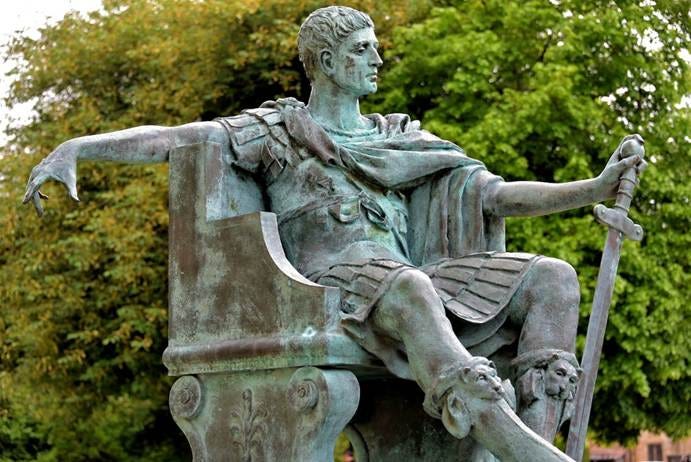
Few rulers altered the course of Western civilization more profoundly than Constantine the Great. During his thirty-one-year reign, the Roman Empire emerged from the chaos of the Third-Century Crisis, Christianity became the favored religion of the imperial court, the gold solidus established one of history’s most durable monetary systems, and the foundation of Constantinople ensured the survival of the Eastern Roman Empire long after the western provinces had fallen. Yet Constantine remains a deeply paradoxical figure: a ruthless military autocrat, a sincere Christian, and a reformer whose policies stabilized the empire during his lifetime while arguably contributing to some of its later weaknesses.
Soldier and Statesman
Born at Naissus on 27 February 272, Constantine came of age during one of Rome’s darkest periods. Civil war, barbarian invasions, plague, inflation, and political instability had nearly destroyed the empire. After serving under Diocletian and Galerius, he succeeded his father, Constantius Chlorus, at York on 25 July 306. Nearly two decades of civil war followed before he emerged as sole emperor in 324 after defeating Maxentius and Licinius.
Like Diocletian before him, Constantine restored political stability after decades of crisis. He reunited the empire under a single ruler, strengthened the imperial administration, and introduced the gold solidus, one of history’s most successful currencies. The coin remained remarkably stable for centuries and became the monetary foundation of the Eastern Roman Empire.
Personally, Constantine combined clemency with severity. He repeatedly sought reconciliation with Arius despite fierce opposition from many bishops, yet he could react swiftly and harshly when imperial authority or dynastic security appeared threatened. Above all, he remained an authoritarian Roman emperor whose overriding objective was preserving order.
Conversion and Christianity
No episode of Constantine’s reign has generated more discussion than his conversion. One tradition places a visionary experience in 310, while another records a dream on the night before the Battle of the Milvian Bridge on 27 October 312 in which Constantine was instructed to place the sign of Christ upon his soldiers’ shields. Whether these accounts describe one event remembered differently or two separate experiences remains uncertain.
What appears considerably less doubtful is Constantine’s own conviction. His victory over Maxentius the following day convinced him that the Christian God had granted him success and entrusted him with a providential mission as emperor. Whatever modern historians conclude about the precise form of the vision, there is little reason to dismiss Constantine’s belief as mere political invention.
His subsequent religious policy was gradual rather than coercive. Christianity received increasing imperial patronage, bishops acquired greater influence, churches were endowed, and Christian moral principles increasingly informed legislation. Yet pagan worship continued throughout most of his reign. Constantine also recognized that Christianity itself was deeply divided. The Donatist and Arian controversies demonstrated that the Church was not yet capable of serving as a unified ideological foundation for the empire. Consequently, he repeatedly sought reconciliation among competing factions rather than imposing religious uniformity by force.
Government and Reform
Constantine’s reforms strengthened the empire during his own lifetime, but some have been criticized for their longer-term consequences. Michael Grant argues that his division of the army into frontier forces and mobile field armies weakened permanent frontier defenses by concentrating too much military strength under the emperor’s direct control (Michael Grant, Constantine the Great: The Man and His Times (New York: Scribner’s, 1994). Grant likewise questions Constantine’s increasing reliance upon Germanic recruits, arguing that it accelerated the empire’s growing dependence upon barbarian manpower. He also criticizes Constantine’s decision to prepare a major Persian campaign late in life, believing it created an unnecessary strategic commitment that his successors inherited after the emperor’s death.
The financial cost of Constantine’s reforms was equally substantial. Maintaining the enlarged army, supporting an expanding bureaucracy, and financing an ambitious building program required heavy taxation. Contemporary sources record instances in which impoverished families surrendered children into servitude in lieu of unpaid taxes. Although Constantine transformed cities such as Constantinople and Jerusalem, comparatively few of his original buildings survive. Grant attributes this partly to a shortage of skilled architects and craftsmen during his extensive building program.
The Family Tragedy
The darkest episode of Constantine’s reign remains the executions of his eldest son Crispus and his wife Fausta in 326. Crispus was Constantine’s firstborn son by his earlier relationship with Minervina and, for many years, appeared to be the natural heir to the empire. Appointed Caesar in 317, he served with distinction under his father’s command, winning important victories against Licinius during the civil war of 324, including the decisive naval campaign at the Hellespont. Few contemporaries could have anticipated his sudden downfall.
The surviving evidence is fragmentary, and historians continue to debate what actually occurred. Michael Grant favors the traditional reconstruction. According to Grant, Fausta falsely accused Crispus of erious misconduct in order to advance the succession prospects of her own sons. Constantine accepted the accusation and ordered Crispus executed at Pola. Only later, after discovering Fausta’s deception, did he order her execution as well, reportedly by suffocation in an overheated bath.
Other historians remain more cautious, arguing that the evidence is too incomplete to establish any single explanation with confidence. Whatever the truth, the executions permanently darkened Constantine’s reputation and remain among the great unsolved mysteries of Roman history.
Legacy
Constantine’s greatest achievements ultimately proved to be economic, religious, and geographical. The solidus became the most stable currency of late antiquity. His patronage transformed Christianity from a persecuted religion into the faith most closely associated with imperial authority. Most significant of all, the foundation of Constantinople in 330 shifted the empire’s political and economic center eastward.
Few of Constantine’s own buildings survive intact. The Arch of Constantine remains the finest preserved monument of his reign, while churches such as the Holy Sepulchre and the Church of the Nativity have been rebuilt repeatedly over the centuries.
The ultimate measure of Constantine’s achievement lies in the contrasting destinies of the empire’s two halves. The Western Roman Empire survived only 139 years after his death before its final emperor was deposed in 476. The Eastern Roman Empire, later known as the Byzantine Empire, endured for another 977 years until the Ottoman conquest of Constantinople in 1453. Constantine therefore did more than stabilize Rome after the Third-Century Crisis—he redirected its future. Through Constantinople, the solidus, and the Christian imperial state, his influence continued to shape European and Near Eastern history for more than a millennium.
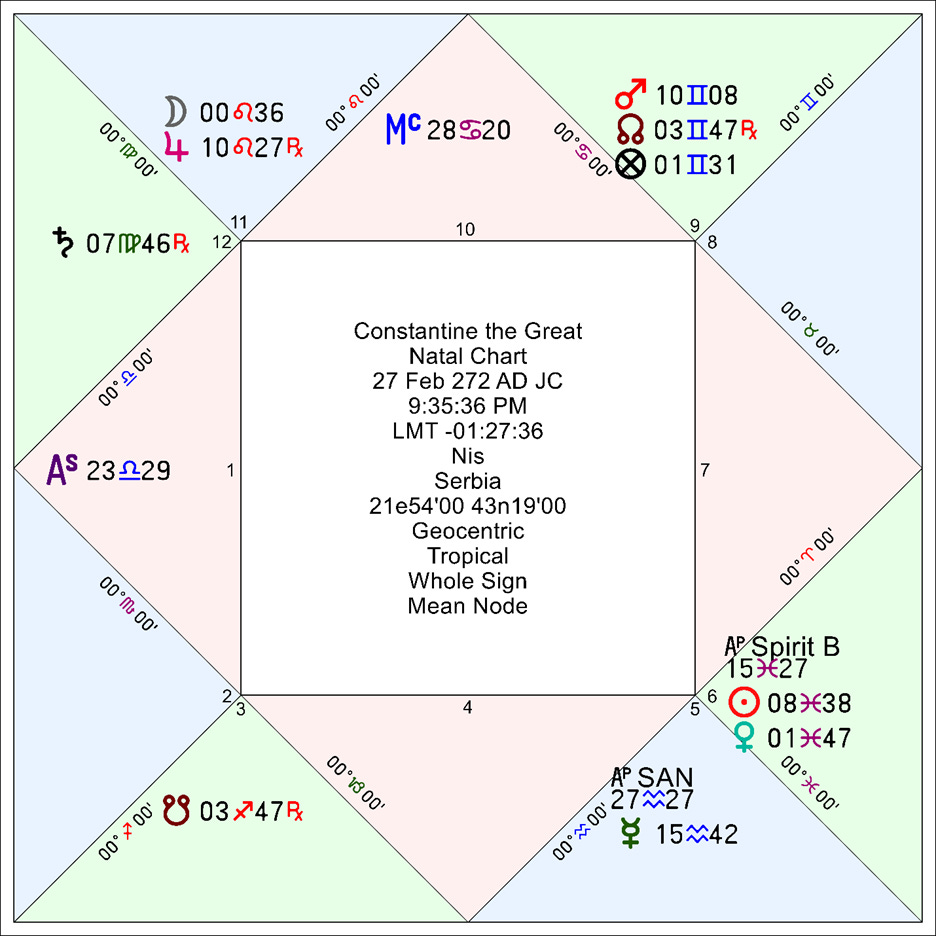
No Astrodatabank Record
Proposed Rectification: 9:35:35 PM, ASC 23LI29’19”
The analytical models used in the sections below are part of a larger research program developed across longer white papers and case studies, where the historical sources, rules, and testing methodology are laid out in full. These database entries show the models in practice; readers who want the theoretical foundations can start with the background papers below:
Rectification Hub (I wrote the book on it!)
Soul Hub (white paper, Victor model statistical tests, Moon’s Configuration studies)
Physiognomy Hub (white paper, examples)
Victor Model Factors favoring Jupiter/Leo-rx
Sign ruler: Sun, Lot of Spirit
Bound ruler: Moon, Lot of Spirit
Jupiter in Leo retrograde emerges as the victor of Constantine’s horoscope and aptly describes the civilizational scale of his achievements. Throughout this Jupiter in Leo series, the placement has repeatedly signified the official creed of a civilization—the moral, philosophical, and religious principles through which a society defines itself. In Constantine’s life this symbolism is unmistakable. Under his patronage Christianity ceased to be merely one religion among many and became the ideological center around which the Roman state increasingly organized itself. The emperor came to regard his victories, especially after the Milvian Bridge, as evidence that he had been entrusted with advancing the Christian faith within the empire.
Readers of this series know my working hypothesis that retrograde superior planets normally behave as though placed in the opposite sign. There is, however, an important exception. From the planet’s morning heliacal setting through shortly after its acronychal rising, increasing brightness in the evening sky temporarily restores the planet’s direct-motion behavior. As the planet slowly recedes from opposition with the Sun and its brightness gradually diminishes, it progressively resumes expressing the qualities of its opposite sign until it stations direct.
Constantine was born approximately one month after Jupiter’s acronychal rising, at a point when Jupiter’s brilliance in the evening sky had already begun its gradual decline. Under this interpretation, Jupiter increasingly takes on the qualities of Aquarius. While Jupiter in Leo established Christianity as the empire’s official creed, the growing influence of Jupiter in Aquarius encouraged accommodation rather than immediate religious uniformity. Constantine therefore advanced Christianity gradually while allowing much of the existing pagan religious world to continue functioning. This Aquarian tendency did not represent religious indifference but a practical recognition that the empire remained religiously diverse and that Christianity itself was divided by controversies such as Donatism and Arianism.
Finally, the close conjunction of Jupiter 10LE27 retrograde and the Moon 11LE36 in the eleventh house extends the delineation from religion to the population itself. The Moon signifies the people collectively, while Leo signifies gold through its solar rulership. Together they aptly describe the willingness of the Roman population to accept Constantine’s new gold solidus as the empire’s principal monetary standard. The extraordinary longevity of the solidus—remaining the monetary foundation of the Eastern Roman Empire for centuries—stands as one of the clearest historical manifestations of Jupiter’s victory in the horoscope.
Physigonomy
Note: This section is limited to surviving accounts of his physical stature, omitting discussion of astrological physiognomy because of no photographic evidence necessary for a secure delineation.
No contemporary portrait of Constantine can be accepted as a true likeness, so any physical reconstruction must rely upon literary descriptions, coin portraits, and sculptural representations that were often idealized for imperial propaganda. Even allowing for this limitation, the surviving evidence presents a reasonably consistent picture. Constantine appears to have been above average in height with a strong, athletic build developed through years of military campaigning. Ancient writers emphasize his commanding presence and dignified bearing, qualities that made him immediately recognizable in public and before the army.
His face is generally described as broad with a prominent forehead, straight nose, strong jaw, and large, expressive eyes that later imperial portraiture exaggerated into an upward, almost visionary gaze. He wore his hair relatively short in the military fashion, while remaining clean-shaven in contrast to many earlier Roman emperors. Contemporary observers frequently commented less on individual facial features than on the force of his personality, describing an emperor who projected confidence, authority, and self-assurance. Although surviving statues undoubtedly idealize his appearance, they consistently portray a ruler whose physical presence matched the image of imperial command that he sought to cultivate throughout his reign.
Moon’s Configuration
The Moon’s last completed aspect is an out-of-sign, void-of-course sextile to Saturn, separating from 7CA35 to Saturn 7VI35 retrograde by approximately 22°50’. This exceeds William Lilly’s moiety for a Moon-Saturn sextile by a substantial margin and is therefore treated here as a legitimate void-of-course Moon. The narrative consequently begins not with the Moon’s last aspect, but with the next significant planetary event. Four distinct stages emerge.
Stage 1: Sun Opposed Saturn (5th/11th, 6th/12th house axis)
Delineation. Before the Moon resumes the narrative, the Sun at 8PI38 opposes Saturn 7VI46 retrograde. Because Saturn has only recently undergone its acronychal rising, it temporarily expresses the qualities of direct Saturn in Virgo rather than its opposite-sign manifestation. Saturn/Virgo signifies strict administration, bureaucracy, regulation, taxation, discipline, and the orderly maintenance of the state. Opposed by the Sun, these themes become dominant features of imperial government. The aspect describes a government capable of imposing order through legal authority, but also one whose administrative burdens become increasingly severe. The opposition further introduces Saturn as the principal political force shaping the environment into which Constantine would eventually emerge.
Biographical Match. Constantine spent his formative years serving under Diocletian and Galerius during the mature phase of the Tetrarchy. Their government restored order after the Third-Century Crisis but did so through an enlarged bureaucracy, heavy taxation, and increasingly centralized imperial control. The Great Persecution of the Christians likewise belongs within this Saturnian framework, reflecting the state’s determination to preserve traditional religious order through administrative coercion. Although these developments preceded Constantine’s sole rule, they formed the political landscape from which his reign emerged.
Stage 2: Moon Leo (10th/11th houses)
Delineation. The Moon next enters Leo, where it immediately occupies the bound of Jupiter. The Moon signifies the population, while Leo signifies kingship, public honor, and, through its solar rulership, gold. Placement in Jupiter’s bound elevates the people’s aspirations toward confidence in the ruler and the institutions that define the civilization’s official creed. Because Jupiter remains retrograde only a short time after its acronychal rising, it still expresses the authority of Jupiter in Leo while beginning to admit the more pluralistic qualities of its opposite sign, Aquarius. The result is a population willing to rally behind a ruler who promotes an official religious creed while tolerating the continued existence of competing traditions.
Biographical Match. Constantine’s gradual promotion of Christianity without immediately suppressing pagan cults reflects this balanced expression of Jupiter in Leo retrograde. Christianity steadily received imperial patronage while traditional religious practices largely continued throughout his reign. At the same time, the Moon’s placement in Leo aptly describes public acceptance of Constantine’s gold solidus. The willingness of the Roman population to embrace the new gold currency contributed to one of the most enduring monetary systems in history, remaining the economic foundation of the Eastern Roman Empire for centuries.
Stage 3: Mars (Gemini, 8th/9th houses) sextile Jupiter (Leo, 10th/11th houses)
Delineation. Mars at 10GE08 applies by sextile to Jupiter 10LE27 retrograde. Mars signifies military action, courage, and disciplined force, while Jupiter signifies the ruler and the expansion of imperial authority. The sextile shows military success functioning in support of legitimate rulership rather than as an instrument of civil destruction. Martial achievement becomes the vehicle through which Jupiter’s broader political and religious objectives are realized.
Biographical Match. Constantine’s rise to supreme power depended upon a succession of military victories, culminating in the defeats of Maxentius and Licinius. Victory at the Milvian Bridge established his claim in the West, while the campaigns of 324 united the empire under a single emperor. These successes did more than secure Constantine’s throne; they provided the political stability necessary for his administrative reforms, monetary reforms, and gradual Christianization of the empire.
Stage 4: Moon Conjunct Jupiter (Leo, 10th/11th houses)
Delineation. The sequence culminates with the Moon’s conjunction to Jupiter in Leo. The Moon joins the victor of the horoscope, uniting the people with the ruler and with the civilization’s official creed. Jupiter in Leo represents the imperial office elevated to its fullest expression, while the Moon’s conjunction signifies public recognition, acceptance, and participation in that authority. The conjunction therefore completes the narrative begun by Mars, transferring military victory into legitimate imperial rule supported by the population.
Biographical Match. Constantine ultimately achieved what neither Diocletian nor the Tetrarchy had accomplished: the reunification of the Roman Empire under a single emperor. Public acceptance of his authority enabled him to establish Christianity as the empire’s favored religion, introduce the gold solidus, and found Constantinople as the new imperial capital. The conjunction of the Moon and Jupiter therefore signifies not merely Constantine’s accession to power, but the broad public acceptance of the political, religious, and monetary order that became his enduring legacy.
Influence of Sect
Constantine’s figure is nocturnal, making Mars the in-sect malefic while both Jupiter and Saturn operate out of sect. Mars therefore functions with greater moderation and effectiveness, aptly describing one of antiquity’s most accomplished soldier-emperors. Throughout his career Constantine repeatedly inspired the loyalty of his troops and secured decisive victories over rival emperors, allowing military success to become the foundation of his political achievements. By contrast, out-of-sect Saturn intensifies its naturally cold and restrictive qualities. The enlarged bureaucracy inherited from Diocletian, heavy taxation, the Great Persecution, and the increasingly authoritarian character of the late Roman state all illustrate Saturn operating with greater severity than would be expected in a diurnal figure. Finally, Jupiter out of sect does not deny Constantine’s success as emperor or his establishment of Christianity as the empire’s official creed, but it limits the ultimate reach of those achievements. Christianity advanced steadily under Constantine while pagan cults remained widespread, requiring gradual accommodation rather than immediate religious uniformity. Likewise, although Constantine founded Constantinople and secured the future of the Eastern Roman Empire, his political and religious settlement proved unable to preserve the western half of the empire, whose imperial office disappeared only 139 years after his death. Jupiter therefore achieved its principal objectives, but not without limitation, illustrating how an out-of-sect benefic can produce durable accomplishments whose influence remains geographically or institutionally constrained.
Early/Late Bloomer Assessment
Constantine was born shortly after the New Moon and therefore should, according to the model, have been an early bloomer. He lived approximately 65 years, placing the midpoint of his life around age 33 (305 CE). Although he was proclaimed emperor the following year, the events that define his historical legacy—including the Milvian Bridge, the legalization of Christianity, the Council of Nicaea, the founding of Constantinople, and the creation of the gold solidus—all belong to the second half of his life. Constantine therefore appears to be a poor fit for the early-bloomer model. At present I see no compelling reason to force the evidence into agreement with the theory. Instead, he joins a small but growing group of exceptions whose horoscopes may eventually reveal additional conditions that modify the New Moon/Full Moon pattern.
Complete biographical chronology, rectification and time lord studies available in Excel format as a paid subscriber benefit. File is behind the paywall.