

I had initially been reluctant to examine the horoscope of Dario Amodei, co-founder and CEO of Anthropic, because no comprehensive biography of his life has yet been published. Without a sufficiently detailed chronology, natal rectification becomes a hazardous exercise, particularly when attempting to distinguish between competing birth times. However, a subscriber recently requested that I add Amodei to my Aquarius Tech Bros series, prompting me to investigate the available biographical evidence. The result is a provisional rectification, one that may change materially as additional information about his personal life becomes available.
Don’t miss my November 8 lecture: Tech Bros on the Brink: When Will the AI Bubble Pop? sponsored by the Astrological Society of Princeton.
Amodei belongs in this series through Mars and Venus in Aquarius, although the two planets signify different aspects of his career. Mars/Aquarius represents the potentially disruptive and destructive capabilities of artificial intelligence, particularly autonomous systems that escape human control or are employed for military and other dangerous purposes. These are precisely the threats Amodei seeks to contain through the security measures signified by Saturn/Scorpio. Venus/Aquarius, meanwhile, expresses his commitment to fair treatment, humanitarian principles, and the equitable distribution of AI’s benefits. Yet Venus is out of sect in his diurnal horoscope, suggesting that these Aquarian ideals may encounter resistance in an increasingly competitive industry where technological speed and strategic advantage often outweigh concerns about fairness.
Another feature of Amodei’s horoscope connects him to Jeff Bezos: both have Mercury retrograde in Capricorn. In contrast to the methodical, sequential reasoning ordinarily associated with Mercury/Capricorn, retrogradation introduces qualities of its opposite sign, Cancer, producing a more intuitive apprehension of complex problems. Rather than proceeding step by step toward a conclusion, the individual grasps the essential relationships within a problem almost simultaneously, subsequently using analytical methods to demonstrate the insight. This distinction is particularly relevant to Amodei’s early recognition of the scaling principles governing artificial intelligence.
The proposed horoscope has Cancer rising, with Jupiter/Sagittarius in the 6th house as the victor. Jupiter signifies Amodei’s expansive vision of artificial intelligence as an instrument for scientific discovery, medical progress, and improvements in human welfare. Its placement in the house of illness and labor connects this ambition to the prolonged illness and death of his father, which redirected his scientific interests toward medicine, as well as his concern for the effects of AI upon workers. Saturn/Scorpio supplies the security measures necessary to protect these benefits from the destructive applications of Mars/Aquarius. The central question of Amodei’s career is therefore not whether artificial intelligence should advance, but how its benefits can be realized without permitting its dangers to overwhelm society. The following rectification examines how this tension emerges through the natal horoscope, the Moon’s Configuration, and the timing of major life events.
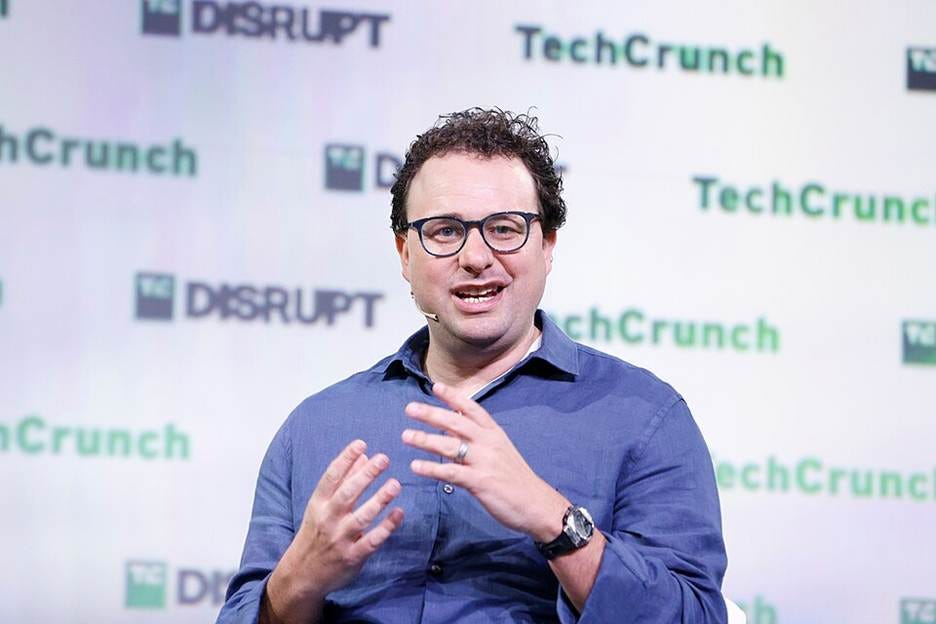
Dario Amodei, co-founder and CEO of Anthropic, occupies a distinctive position in the competition to develop artificial intelligence. Unlike Sam Altman, whose background was in entrepreneurship and venture capital, or Elon Musk, whose interests span automobiles, aerospace, and industrial engineering, Amodei entered the field through experimental physics and neuroscience. His scientific work helped establish the principle that artificial intelligence becomes increasingly capable as the computing resources and data used to train it expand. Yet he has also emerged as one of the industry’s most persistent advocates of restrictions on the potentially dangerous applications of that technology.
Born on 13-Jan-1983 in San Francisco, Dario Gabriele Amodei grew up with his younger sister Daniela in a family that valued intellectual independence and public responsibility. His father, Riccardo Amodei, was an Italian-born leather craftsman, while his mother, Elena Engel, managed construction and renovation projects for public libraries. At Lowell High School, Dario developed a particular interest in mathematics and physics, distinguishing himself sufficiently to qualify for the U.S. Physics Team training camp in 2000. Although surrounded by the emerging Internet economy of Silicon Valley, his ambition was not to establish a technology company but to investigate fundamental scientific questions.
Amodei entered the California Institute of Technology in 2001. An early indication of his willingness to challenge prevailing opinion appeared on 3-Mar-2003, when he criticized fellow students in The California Tech for their political passivity concerning the approaching Iraq War. He subsequently transferred to Stanford University, graduating with a degree in physics in 2006, and entered Princeton University’s doctoral program that same year.
A personal loss helped redirect his scientific interests. His father died following a prolonged illness in the mid-2000s, an experience that Amodei later described as instrumental in his decision to abandon theoretical physics in favor of biological research. He became increasingly concerned with the slow pace of medical discovery and the possibility that better scientific methods might accelerate the treatment of disease. At Princeton, he initially explored cosmology before turning to experimental biophysics and computational neuroscience under Professor Michael Berry.
Beginning in the spring of 2007, Amodei investigated how networks of retinal neurons encode and transmit information. His work required not merely mathematical analysis but the painstaking construction of specialized instruments capable of recording electrical signals from neural tissue. Awarded a Hertz Foundation fellowship, he completed his doctorate in 2011 with a dissertation titled Network-Scale Electrophysiology: Measuring and Understanding the Collective Behavior of Neural Circuits. He subsequently undertook postdoctoral research at Stanford University School of Medicine, studying cancer biology, proteomics, and the identification of biological markers associated with disease.
By 2014, Amodei had begun questioning whether conventional experimental research could produce medical advances quickly enough. He increasingly believed that machine learning might provide a more general means of accelerating scientific discovery. He joined Baidu’s Silicon Valley AI laboratory, where researchers under Andrew Ng were developing neural networks for speech recognition. Amodei helped produce Deep Speech 2, demonstrating how improvements in computing resources, training data, and model architecture could increase the performance of artificial intelligence systems.
This research provided the foundation for an insight that would subsequently shape the AI industry. Amodei began to suspect that progress in machine learning depended less on developing specialized algorithms for individual problems than on increasing the scale of comparatively general learning systems. During 2017–2018, while working at OpenAI, he formulated this idea in an internal memorandum called The Big Blob of Compute Hypothesis. The underlying proposition was that a relatively small number of variables, including computing power and training data, could explain advances across otherwise different fields of artificial intelligence.
Following a brief appointment at Google Brain beginning in October 2015, Amodei joined OpenAI in July 2016, taking responsibility for AI safety research. OpenAI had been established the previous year with financial backing and leadership from figures including Sam Altman and Elon Musk, partly in response to concerns that increasingly powerful AI might become concentrated within a few large technology companies.
Amodei quickly became an influential member of the research organization. On 21-Jun-2016, he was lead author of Concrete Problems in AI Safety, which examined practical difficulties in ensuring that increasingly capable machines behave as intended. The paper addressed problems such as unintended side effects, reward manipulation, and dangerous behavior arising from poorly specified objectives.
On 12-Jun-2017, he co-authored Deep Reinforcement Learning from Human Preferences, research that helped lay the foundations for teaching artificial intelligence systems to respond to human evaluations rather than relying exclusively on explicitly programmed objectives.
His standing within OpenAI continued to rise. He became research director in 2018 and subsequently vice president of research, sharing responsibility with Ilya Sutskever for the organization’s scientific direction. He helped oversee the development of GPT-2, announced on 14-Feb-2019, and GPT-3, whose research paper appeared on 28-May-2020. OpenAI initially withheld the complete GPT-2 model because of concerns about potential misuse, providing an early demonstration of Amodei’s interest in restricting dangerous applications even as research capabilities advanced.
In January 2020, Amodei and his colleagues published Scaling Laws for Neural Language Models, quantifying how language-model performance improved with increases in model size, training data, and computing resources. The research helped establish the intellectual framework for the subsequent competition to build increasingly powerful AI systems. Amodei had moved from studying the electrical behavior of biological neurons to identifying general relationships governing artificial neural networks.
Yet his growing scientific authority was accompanied by increasingly serious disagreements with OpenAI’s leadership. During 2018–2020, Amodei clashed with Sam Altman and OpenAI president Greg Brockman over management responsibilities, recognition of research contributions, organizational transparency, and the safeguards necessary for increasingly capable AI. His younger sister Daniela, who also worked at OpenAI, became involved in the disputes. One particularly contentious meeting in late 2019 or early 2020 reportedly deteriorated into a shouting match after Altman accused the siblings of encouraging employees to criticize him before the board.
As the disagreements intensified, Amodei began considering the establishment of a separate research organization. In December 2020, he and several colleagues decided to leave OpenAI. His departure was publicly announced on 29-Dec-2020, ending an association of nearly five years.
In early 2021, Dario and Daniela Amodei joined former OpenAI researchers, including Chris Olah, Jared Kaplan, Jack Clark, Sam McCandlish, and Tom Brown, to establish Anthropic. Dario became CEO and Daniela president. Organized as a public benefit corporation, Anthropic sought to combine the development of increasingly capable artificial intelligence with research into interpretability, reliability, and safety. The company announced its founding and $124 million in initial financing on 28-May-2021.
Anthropic’s early research concentrated on developing systems whose behavior could be guided by human values and explicit principles. In December 2022, its researchers published Constitutional AI: Harmlessness from AI Feedback, describing a method by which models evaluate and revise their own responses according to a written set of principles. On 14-Mar-2023, Anthropic publicly introduced Claude, a conversational AI assistant competing directly with OpenAI’s ChatGPT.
The commercial development of Claude transformed Anthropic from a research laboratory into a major technology enterprise. Strategic investments from Google and Amazon provided billions of dollars in financing, while successive versions of Claude expanded the company’s presence in software development, research, and enterprise applications. Anthropic also introduced a Responsible Scaling Policy on 19-Sep-2023, establishing safety requirements intended to increase as its models acquired more advanced capabilities.
Amodei’s emergence as an independent industry leader was underscored during OpenAI’s leadership crisis in November 2023. According to subsequent reporting, OpenAI board members approached him about replacing the dismissed Sam Altman and possibly combining the two organizations. Amodei reportedly declined both proposals, retaining control of the company he had established.
Despite his warnings about artificial intelligence, Amodei has consistently argued that the technology could produce substantial benefits. His essay Machines of Loving Grace, published on 11-Oct-2024, outlined a future in which sufficiently powerful AI could accelerate progress in medicine, neuroscience, economic development, and human welfare. He envisioned scientific advances occurring much more rapidly than conventional research methods would permit. His optimism was tempered by the conviction that dangerous capabilities would also increase, requiring stronger safeguards and more effective government oversight.
By 2025, Amodei had become a prominent public commentator on the economic and political consequences of artificial intelligence. Named to the TIME100 in April, he attracted widespread attention on 28-May-2025 by warning that AI might eliminate a substantial proportion of entry-level white-collar employment within several years. Anthropic continued raising large amounts of capital while expanding its computing infrastructure and commercial partnerships.
The most consequential public confrontation of his career developed in February 2026, when the Pentagon demanded that Anthropic remove restrictions concerning the use of Claude for mass domestic surveillance and fully autonomous weapons. Amodei refused, issuing a public statement on 26-Feb-2026 defending the company’s position. The administration subsequently directed federal agencies to discontinue Anthropic products, and the Pentagon designated the company a national-security supply-chain risk.
Anthropic challenged the restrictions in federal court, obtaining an initial injunction in March. The government appealed on 2-Apr-2026, prolonging a dispute that threatened the company’s military business and public reputation. Although Anthropic secured a favorable ruling in California in August, a separate federal appellate decision on 25-Sep-2026 upheld the Pentagon’s authority to exclude the company from its contracts. Anthropic sought reconsideration in October. The confrontation illustrated the difficulty of maintaining independent restrictions on a technology increasingly regarded as essential to national security.
Meanwhile, Anthropic’s commercial expansion continued. In October 2026, the company filed for an initial public offering, reflecting its transformation into a capital-intensive enterprise requiring enormous commitments to computing infrastructure. Its early-November financial disclosures revealed rapidly growing revenues alongside substantial losses and infrastructure obligations.
Amodei’s career thus presents a persistent tension between technological ambition and institutional restraint. His early interest in accelerating medical discovery led him toward increasingly general systems of artificial intelligence. The same scientific conviction that encouraged him to develop more powerful models also persuaded him that their capabilities might eventually exceed the ability of institutions to control them.
Unlike entrepreneurs who entered artificial intelligence principally through commercial opportunity, Amodei arrived through a succession of scientific investigations. His objective has remained the development of technologies capable of expanding the frontiers of knowledge, while his disputes with OpenAI and the federal government demonstrate the importance he attaches to determining the conditions under which those technologies may be used. Whether scientific progress and effective safeguards can continue advancing together remains the central question of his career.
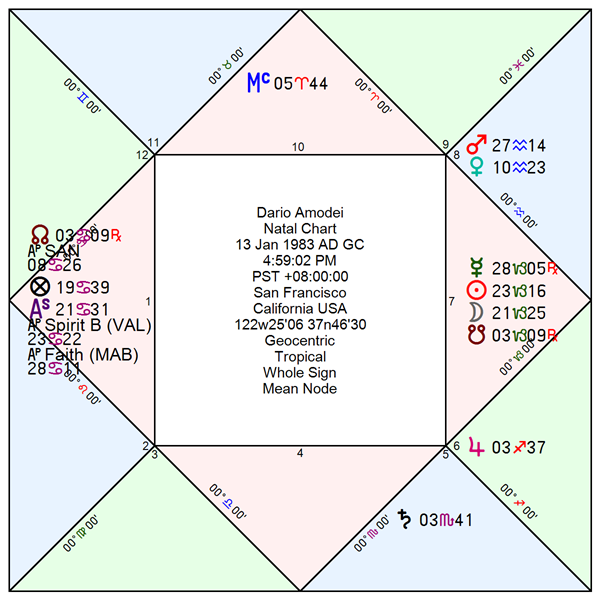
Rodden Rating X, Date w/o time.
Proposed rectification: 4:59:02 PM, ASC 21CA31’04”
Please note this rectification is preliminary. As of November 2026, no independent biography of Dario Amodei has been published so there remain many holes in the chronology. This rectification may completely change once additional life events are added to the chronology.
The analytical models used in the sections below are part of a larger research program developed across longer white papers and case studies, where the historical sources, rules, and testing methodology are laid out in full. These database entries show the models in practice; readers who want the theoretical foundations can start with the background papers below:
Rectification Hub (I wrote the book on it!)
Soul Hub (white paper, Victor model statistical tests, Moon’s Configuration studies)
Physiognomy Hub (white paper, examples)
Victor Model Factors favoring Jupiter/Sagittarius
Bound rulers: Ascendant, Midheaven, Lot of Fortune, Lot of Spirit
Jupiter in its domicile of Sagittarius signifies Amodei’s expansive optimism about scientific discovery, technological innovation, and the capacity of human ingenuity to overcome seemingly insurmountable problems. Its placement in the 6th house of illness and disease connects this vision to the formative experience of his father’s prolonged illness and death, which redirected his scientific interests toward biomedical research and ultimately artificial intelligence as a means of accelerating medical breakthroughs. The 6th house also signifies workers and the laboring class in mundane astrology, extending Jupiter’s influence beyond medicine to the broader economic and social consequences of AI. Amodei envisions artificial intelligence as an instrument for improving human welfare, increasing productivity, and relieving people of burdensome labor, even as he warns that its rapid adoption could displace millions of workers. His essay Machines of Loving Grace expresses this Jupiterian vision of scientific progress serving humanity, while Saturn/Scorpio supplies the security measures and institutional restrictions necessary to protect society from the potentially destructive applications of AI signified by Mars/Aquarius. Jupiter is therefore the victor because it establishes the affirmative purpose of Amodei’s life: harnessing technological innovation to overcome disease, expand knowledge, and improve the human condition.
Physiognomy Model Factors favoring Cancer, Capricorn, Pisces
Rising sign: Cancer
Ruler of rising sign: Moon/Capricorn
Rising decan: Pisces
Ruler of rising decan: Jupiter/Sagittarius
Dario Amodei has an ovate face, broadest through the forehead and cheeks, tapering gradually toward a rounded chin. His head is relatively large in proportion to his neck, with a high, rounded forehead, full cheeks, and a soft, fleshy lower face that produces a noticeable double chin. His nose is moderately broad with a rounded tip, while his lips are full and his mouth relatively wide, particularly when smiling. His eyes are set behind rounded rectangular spectacles, beneath gently arched eyebrows. Thick, dark, tightly curled hair adds height and volume to the upper portion of his head. His physique is stocky, with rounded shoulders, a substantial torso, and relatively little angular definition. The overall impression is one of fullness and rounded contours rather than sharp or elongated features.
The ovate facial shape is consistent with both Cancer rising and the Moon in Capricorn, supporting the proposed relationship between the Ascendant and its ruler. Cancer contributes facial roundness and fullness, while Capricorn supplies a measure of structure, particularly the gradual narrowing toward the chin. The rising decan is Pisces, which, following John Willner’s physiognomic model, introduces the fluid triangle: a softening of the facial outline through additional flesh, particularly in the cheeks, jaw, and beneath the chin. Amodei’s conspicuous double chin is consistent with this Piscean modification, as is the general absence of sharp facial angles. The combination of Cancer rising, Capricorn Moon, and Pisces rising decan thus provides a coherent astrological interpretation of his appearance, with the underlying ovate structure modified by the greater fleshiness associated with Pisces.
Moon’s Configuration
Stage 1. Moon Separates from Saturn (Scorpio, 5th)
Delineation. The Moon at 21CP25 in the 7th house has separated from its sextile with Saturn at 3SC41 in the 5th house. Although the separation exceeds the 10°30′ Lilly moiety for a Moon–Saturn aspect, there is no intervening void-of-course condition because the Moon entered the 13°45′ moiety of its applying conjunction with the Sun before leaving Saturn’s orb. Saturn/Scorpio signifies security, restriction, vulnerability, and protection against dangerous circumstances. As the Moon’s last completed aspect, Saturn may describe an early formative experience involving these themes. Saturn also occupies the superior square to Venus/Aquarius, which it rules by domicile, giving Saturn a commanding influence over Venus and the matters she signifies.
Biographical Match. A plausible manifestation of this Saturnian influence is the prolonged illness and eventual death of Amodei’s father, Riccardo, from hepatitis C in 2006 or 2007. The experience redirected Amodei’s scientific interests from theoretical physics toward biological research and accelerating medical discoveries. Venus rules the 4th house (Libra), signifying the father, and the 11th house (Taurus), which, as the eighth house derived from the fourth, signifies the father’s death. Saturn’s superior square to Venus provides a theoretical connection between Saturnian adversity and the father’s prolonged illness, although the precise astrological mechanism remains uncertain. Nor do we know when Riccardo’s illness began or how it affected Amodei’s childhood. Another undocumented early-life event involving Saturnian themes may provide a better correspondence. The father’s illness therefore remains a provisional biographical match.
Stage 2. Moon Applies to the Sun (Capricorn, 7th)
Delineation. The Moon at 21CP25 applies to the Sun at 23CP16 in the 7th house, an orb of only 1°51′. This waning Moon approaching the New Moon is traditionally debilitated because its light is obscured by the Sun. The conjunction suggests that lunar receptivity and adaptability are subordinated to solar will and established convictions, potentially producing difficulty reconsidering fundamental beliefs. The Moon occupies the bound of Venus/Capricorn, whose ruler Venus/Aquarius in the 8th signifies fairness, humanitarian responsibility, and the consequences of decisions affecting others. The Sun occupies the bound of Saturn/Capricorn, whose ruler Saturn/Scorpio in the 5th introduces security, restriction, and institutional safeguards into the exercise of authority. With both luminaries in the 7th house, these principles are likely to manifest through partnerships, negotiations, contracts, and open adversaries.
Biographical Match. Amodei demonstrates flexibility in scientific methods but greater rigidity concerning fundamental principles. He moved from theoretical physics to neuroscience, cancer research, and artificial intelligence, repeatedly changing his methods while retaining his broader scientific purpose. However, his disputes with OpenAI’s leadership during 2018–2020 reveal an unwillingness to compromise on governance, research independence, and AI safety, culminating in his December 2020 departure and the founding of Anthropic. A more public example occurred in February 2026, when he refused Pentagon demands to remove restrictions on Claude’s military applications, despite threats to Anthropic’s government business and reputation. These events are consistent with established convictions resisting external pressure. Venus/Aquarius contributes fairness and humanitarian responsibility, while Saturn/Scorpio supplies the security requirements Amodei considers necessary to protect society. The 7th-house emphasis is evident in the repeated transformation of his principles into disputes with partners, employers, and government authorities.
Stage 3. Moon Applies to Mercury (Capricorn, retrograde, 7th)
Delineation. The Moon at 21CP25 makes its final application to Mercury at 28CP05 retrograde and combust in the 7th house. Mercury/Capricorn direct signifies disciplined, sequential intelligence, proceeding methodically from one step to the next. Mercury/Cancer, its opposite sign, signifies holistic intelligence, apprehending essential relationships almost simultaneously rather than through successive analytical steps. Like water filling every crack, Cancerian intelligence recognizes connections that sequential reasoning may overlook. Through retrogradation, Mercury/Capricorn may acquire these Cancerian qualities, reversing the normal direction of reasoning: the whole is apprehended first, followed by the analytical steps necessary to demonstrate the insight. The Moon’s application to Mercury connects lunar intuition with Mercurial rationality, recalling Aristotle’s distinction between the rational soul and the nonrational faculties associated with sensation, instinct, and intuitive apprehension. Their reconciliation may become an important theme in Amodei’s intellectual development.
Biographical Match. Amodei’s recognition of neural-network scaling provides a close correspondence. During his research at Baidu and OpenAI, he began perceiving that different AI problems might be governed by a few underlying relationships involving computing power, training data, and learning objectives. His internal memorandum, The Big Blob of Compute Hypothesis, written around 2017–2018, expressed this insight before its formal mathematical demonstration in the January 2020 paper Scaling Laws for Neural Language Models. Rather than treating speech recognition and language generation as separate problems, Amodei recognized a principle applicable across AI. This resembles Jeff Bezos, who also has Mercury/Capricorn retrograde and recognized the Internet’s potential to reorganize commerce before constructing Amazon’s operational systems. Elon Musk, with Mercury/Cancer direct, offers a related example through his first-principles approach to engineering. Amodei combines intuitive generalization with disciplined verification: the governing pattern is recognized before its details are fully demonstrated. The Moon’s application to Mercury makes this process relevant to his work in AI, where the relationship between sequential reasoning and holistic understanding remains a central problem.
Influence of Sect
The horoscope is diurnal, placing Jupiter/Sagittarius and Saturn/Scorpio in sect, while Mars/Aquarius and Venus/Aquarius are out of sect. Jupiter, the proposed victor, benefits from sect by expanding Amodei’s optimistic vision of artificial intelligence as an instrument for scientific discovery, medical progress, and improvements in human welfare. Saturn/Scorpio, also in sect, signifies the security measures necessary to contain dangerous AI capabilities without imposing unnecessarily harsh or oppressive restrictions. Together, Jupiter and Saturn describe technological progress guided by proportionate safeguards, an approach that has attracted considerable public support. Mars/Aquarius, by contrast, is out of sect, signifying the destructive potential of AI deployed for military purposes, exploited by malicious actors, or operating autonomously beyond intended controls. Such applications may be regarded as threats to the social order, yet out-of-sect Mars retains considerable capacity to inflict damage when its destructive tendencies emerge. Venus/Aquarius, also out of sect, presents a subtler difficulty. Its concern with fair treatment, humanitarian principles, and a level playing field may find limited acceptance in an increasingly competitive AI arms race, where speed, capital, and strategic advantage frequently outweigh considerations of fairness. Amodei’s commitment to these principles may therefore be genuine, even as the commercial and political environment makes their implementation increasingly difficult.
Complete biographical chronology, rectification and time lord studies available in Excel format as a paid subscriber benefit. File is behind the paywall.