

The current series on Aquarian technology figures has concentrated on the people who built the modern technological world. Douglas Adams belongs here for a different reason. He imagined much of its culture before it existed. The Hitchhiker’s Guide to the Galaxy presented readers with portable electronic information, intelligent computers, robots, instantaneous translation, and a universe in which technology is simultaneously indispensable, ridiculous, and quite capable of destroying you. Adams insisted that he was writing satire rather than predictive science fiction, but the resemblance between his fictional Guide and the networked information devices that followed became difficult to ignore.
The influence on the generation that followed him was considerable. Silicon Valley borrowed Adams’s language directly: Yahoo named its translation service Babel Fish, computer scientists borrowed Deep Thought, and Google’s DeepMind name paid homage to Adams’s fictional computer. But the most conspicuous disciple is Elon Musk, who encountered Hitchhiker’s during an adolescent existential crisis and has repeatedly described Adams as an important philosophical influence. Musk took seriously the book’s central joke about “42”: answers are relatively easy; the difficult task is discovering the right question. When SpaceX launched the Falcon Heavy in 2018, Musk sent his own Tesla Roadster into space carrying a copy of The Hitchhiker’s Guide, with “DON’T PANIC!” displayed on the dashboard.
There may be a deeper affinity. Accounts of the early years at Tesla and SpaceX describe environments of extraordinary speed, pressure, improvisation, technical ambition, and sudden changes of direction. Read against Hitchhiker’s, there is something familiar about the combination: brilliant technology being assembled at breakneck speed while everything around it seems perpetually on the verge of going wrong. Adams turned that atmosphere into comedy decades earlier—the machine works, the machine fails, somebody has misunderstood the instructions, the deadline was yesterday, and meanwhile the planet may be destroyed.
The horoscope explains much of this surprisingly well. Mercury/Aries is the victor, elevated in the 10th house and moving at the speed one would expect from Mercury in a fire sign. Yet Adams was famously slow at actually completing his writing. His ideas came quickly; controlling, editing, and finishing them was another matter. The same horoscope that describes the rapid conceptual leaps behind his comedy also contains a severe braking mechanism that eventually contributed to prolonged writer’s block. And the technological theme does not stop with Mercury: a chain of bound rulers leads directly into Aquarius, while another configuration introduces the destructive machines, hostile robots, and planetary catastrophes that populate his stories.
There is even a question of whether the traditional planets tell the whole story. Adams’s comedy depends upon a particular maneuver: establish a perfectly logical sequence, then suddenly shift the frame so radically that the result becomes absurd. His horoscope offers a traditional explanation for the trickster behind that technique—but it also contains Uranus almost exactly on the Ascendant, squared by Mercury. For once, an outer planet may contribute something that the traditional model does not quite say in the same way.
Douglas Adams therefore provides a useful bridge in the Aquarian series. He was not primarily a technologist, although late in life he became deeply involved with computers and digital media. He was the comic imagination of the technological world before that world fully arrived—and one of the writers whose ideas helped shape the people who subsequently built it.
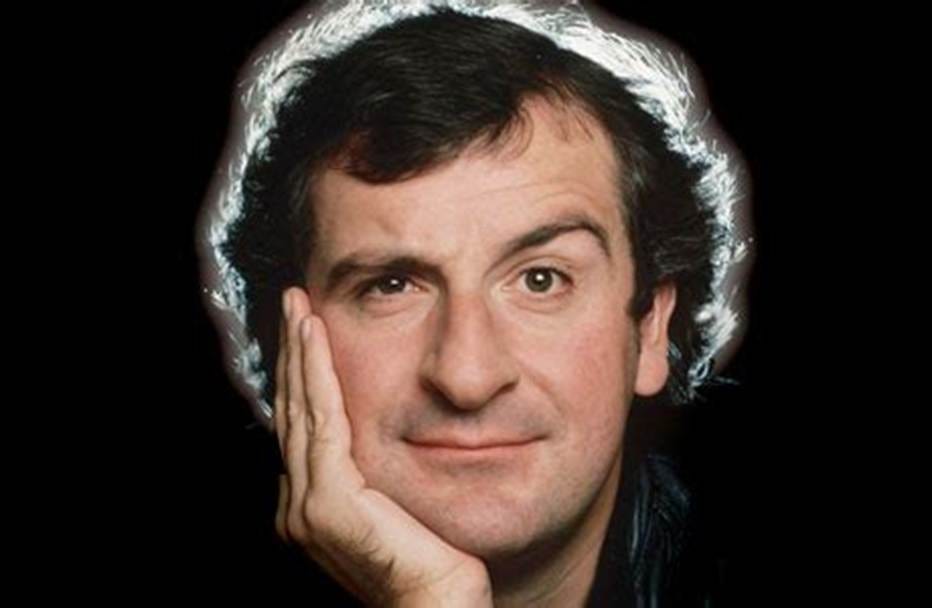
Douglas Noel Adams was an English writer, humorist, dramatist, and early advocate of digital media, best known as the creator of The Hitchhiker’s Guide to the Galaxy. Born in Cambridge on 11 March 1952, he attended Brentwood School in Essex before entering St John’s College, Cambridge, in 1971 to study English. Adams went to Cambridge with ambitions to write comedy and was elected to the Footlights in February 1972, although he often found himself at odds with its established circle. He formed the alternative revue group Adams-Smith-Adams and graduated in 1974, determined to make his living as a writer.
The first years after Cambridge were difficult. Adams sold occasional sketches and gained minor writing and performing credits with Monty Python, but writing did not initially provide a dependable income. He worked variously as a hospital porter, barn builder, and in other temporary jobs while trying to establish himself in radio and television. His fortunes changed when the BBC accepted the idea that became The Hitchhiker’s Guide to the Galaxy. The first episode was broadcast on BBC Radio 4 on 8 March 1978, beginning the work with which Adams would remain identified for the rest of his life.
At roughly the same time, Adams became closely involved with Doctor Who. He wrote The Pirate Planet, became script editor for the program, and contributed substantially to City of Death. His proposed serial Shada was left unfinished after BBC industrial action interrupted production. These projects allowed Adams to combine science fiction with the verbal comedy, absurdity, and philosophical speculation that also characterized Hitchhiker’s.
The Hitchhiker’s Guide to the Galaxy rapidly expanded beyond its original radio format. Adams adapted it as a novel in 1979, followed by The Restaurant at the End of the Universe in 1980 and Life, the Universe and Everything in 1982. The BBC television adaptation appeared in 1981, while records, stage productions, and eventually a computer game extended the series into other media. What had begun as a radio comedy became the organizing work of Adams’s career, repeatedly rewritten and reimagined for new forms.
Adams also developed work outside the Hitchhiker’s series. With John Lloyd he wrote The Meaning of Liff (1983), a comic dictionary assigning definitions to British place names. Dirk Gently’s Holistic Detective Agency followed in 1987, introducing a detective whose investigations operated according to the interconnectedness of apparently unrelated events; a sequel, The Long Dark Tea-Time of the Soul, followed. His fifth Hitchhiker’s novel, Mostly Harmless, was published in 1992 and was the last novel he completed during his lifetime.
A second important strand of Adams’s work developed from his concern with endangered species. A 1985 trip to Madagascar in search of the aye-aye led eventually to collaboration with zoologist Mark Carwardine. The two traveled in search of threatened animals, including the kakapo, Komodo dragon, northern white rhinoceros, and Yangtze river dolphin. Their journeys became the 1989 BBC radio series Last Chance to See and the 1990 book of the same name. Adams continued to support conservation organizations thereafter, and the project gave environmental advocacy a permanent place alongside science fiction and technology in his public work.
Adams was also an early enthusiast for personal computers and networked information. He bought his first computer in 1982 and later became closely associated with Apple technology. During the 1990s his interests increasingly shifted toward interactive media and the emerging Internet. As a founder-director and “Chief Fantasist” of The Digital Village, he helped develop the computer adventure Starship Titanic and pursued the idea of transforming the fictional Hitchhiker’s Guide into an actual collaborative information system.
That idea became H2G2, launched on 28 April 1999. Conceived as an “Earth edition” of the fictional Guide, the site allowed its users to contribute to an expanding body of information that could be continually revised by the community. The project anticipated important features of the collaborative web that followed. The BBC assumed responsibility for H2G2 in January 2001.
Adams married barrister Jane Belson on 25 November 1991 after a long and sometimes interrupted relationship. Their daughter, Polly Jane Rocket Adams, was born in 1994. During the final years of his life the family moved to Santa Barbara, California, while Adams continued work on digital projects, a long-delayed Hitchhiker’s Guide film, and material that was developing into a third Dirk Gently novel.
Douglas Adams died suddenly from a heart attack in Santa Barbara on 11 May 2001, aged forty-nine. His unfinished writing was collected posthumously in The Salmon of Doubt (2002), while the Hitchhiker’s film project finally reached the screen in 2005. His career had begun in radio and television comedy, but ultimately ranged across novels, science fiction, conservation, computers, and networked media. H2G2 brought several of these interests together near the end of his life: the imaginary electronic guide conceived for a 1970s radio comedy had become an attempt to construct a real, collaborative guide written and continually updated by its users.
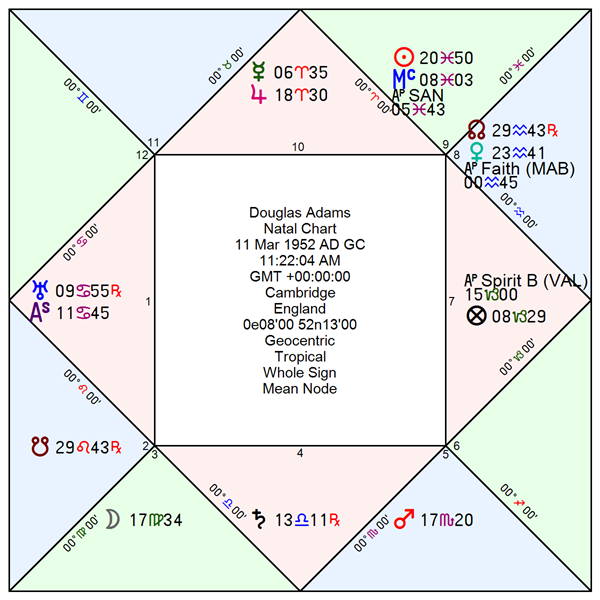
Rodden Rating A, from memory, 11:10 AM, ASC 9CA17
Proposed Trial Rectification, 11:22:04 AM, ASC 11CA45’21”
Permission: I grant the unlimited use of this rectified horoscope by the public. Credit ‘Regulus Astrology LLC’ and include an accompanying link to this webpage.
The analytical models used in the sections below are part of a larger research program developed across longer white papers and case studies, where the historical sources, rules, and testing methodology are laid out in full. These database entries show the models in practice; readers who want the theoretical foundations can start with the background papers below:
Rectification Hub (I wrote the book on it!)
Soul Hub (white paper, Victor model statistical tests, Moon’s Configuration studies)
Physiognomy Hub (white paper, examples)
Victor Model Factors favoring Mercury/Aries
Sign ruler: Moon
Position: 10th house, just under 5 degrees from a square aspect to the Ascendant
Mercury at 6°35′ Aries is the victor of the horoscope and is placed in the 10th house by both whole-sign and quadrant houses, making writing and communication central to Adams’s public life and reputation. Mercury in a fire sign operates quickly, but in Adams this describes the speed of thought rather than the speed of composition: ideas and associations came rapidly, while turning them into finished prose could be painfully slow. Mercury is in the bound of Venus/Aries, with its bound ruler Venus/Aquarius in the 8th whole-sign house and 9th quadrant house. Venus gives form, rhythm, and entertainment value to Mercury’s ideas—consistent with Adams’s obsessive attention to how a sentence sounded—while Aquarius introduces the science-fiction and technology themes that run from The Hitchhiker’s Guide through his later fascination with computers, interactive media, and H2G2. Yet Venus itself occupies the bound of Mars/Aquarius, whose bound lord Mars at 17°20′ Scorpio makes a superior square to Venus. Technology in Adams’s fictional world therefore repeatedly turns destructive: hostile or malfunctioning machines, robots and technological systems threaten the people they were supposedly designed to serve, culminating in the destruction of Earth itself to make way for a hyperspace bypass. Mercury meanwhile applies to the opposition of Saturn retrograde at 13°11′ Libra in the 4th house under both house systems. Saturn initially functions constructively as Adams’s ruthless internal editor: Mercury/Aries generates rapidly while Saturn eliminates, compresses, and demands another revision, producing the tightly constructed and rhythmically precise prose for which he became known. Later the same configuration becomes inhibiting. The internal editor increasingly overwhelms the writer, repeated revision prevents completion, and the Mercury-Saturn opposition manifests as the severe writer’s block of his later career. Finally, the 12th-part of Mercury falls in Gemini, one of Mercury’s own signs, revealing the underlying trickster quality of his comedy: wordplay, inversion, analogy, changes of scale, double meanings, and the collision of two perfectly logical propositions that ordinarily have no business occupying the same frame. The visible Mercury/Aries makes the rapid conceptual leap; the underlying Mercury/Gemini turns that leap into a joke.
Have we left anything out? Perhaps the sheer unexpectedness of Adams’s comedy. Uranus at 9°55′ Cancer is retrograde and almost exactly conjunct the Cancer Ascendant at 9°17′, while Mercury applies to its square. If Uranus is admitted into an otherwise traditional delineation, it supplies something more specific than comedy itself: the sudden disruption that makes the Mercurial construction funny. Mercury establishes a logical sequence and Uranus abruptly changes the frame—the ordinary becomes cosmic, the familiar becomes absurd, and yet the logic remains intact. Arthur Dent begins by trying to prevent the destruction of his house and shortly afterward discovers that Earth itself is about to be destroyed for essentially the same reason. Mercury supplies the logic, Gemini the trick, and Uranus the unexpected rupture.
Physiognomy Model Factors favoring Libra, Scorpio
Rising sign: Cancer
Ruler of rising sign: Moon/Virgo
Planets aspecting the Ascendant degree: Saturn/Libra-retro (within 2 degrees)
Rising decan: Scorpio
Ruler of rising decan: Mars/Scorpio
Planets in sign of rising decan: Mars/Scorpio

Adams was exceptionally tall, standing about 6′5″ (1.96 m), with a large, substantial frame that became heavier and fleshier with age. The half-body photograph shows the breadth and softness of the torso particularly well. The face itself, however, is more strongly rectangular than round: long and broad through the forehead and cheekbones, with relatively straight sides before narrowing somewhat toward the chin. The later photographs make the structure clearer as the face loses some of its youthful softness. His eyes are deep-set and penetrating beneath heavy brows, becoming more striking with age, while the nose is large, prominent, and slightly hooked or beak-shaped. Together, the rectangular facial structure, strong nose, and increasingly piercing quality of the eyes give the mature face considerably more sharpness than would be expected from the fleshy body alone.
Following John Willner’s physiognomic model, Scorpio is the primary significator and Cancer the secondary, and the photographs show the distinction unusually well. Scorpio supplies the rectangular facial shape, which is the most important diagnostic feature here; the penetrating eyes and large, hawk-like nose provide additional Scorpio testimony. Cancer describes the body rather than the basic architecture of the face: the broad, fleshy, somewhat soft physique is particularly apparent in the half-body photograph. Adams’s exceptional height requires an additional factor, and Saturn is capable of adding height; here Saturn at 13°11′ Libra squares the Cancer Ascendant at 9°17′ within two degrees, strongly modifying the Cancerian body type toward greater vertical extension. Thus the physical testimony separates cleanly: Scorpio dominates the shape and character of the face, Cancer supplies the fleshy body, and Saturn accounts for the unusual height.
Moon’s Configuration
Stage One — Moon Separates from Mars (Scorpio, 5th)
Delineation. The Moon at 17°34′ Virgo separates by only 0°14′ from Mars at 17°20′ Scorpio, an exceptionally close separating sextile. Mars is strongly placed in its own sign and occupies the 5th house under both whole-sign and quadrant houses. Mars therefore supplies the Moon with themes of conflict, danger, destruction, and crisis, while its 5th-house position directs these qualities toward creativity, amusement, and entertainment. Destruction becomes material for play.
Biographical Match. Destruction is one of the principal engines of Adams’s fictional universe. Earth is demolished, planets and civilizations are threatened, machines and robots become dangerous or hostile, and Arthur Dent is propelled through the narrative by one catastrophe after another. The 5th-house placement is particularly apt because Adams converts this Martial material into comedy and entertainment. His protagonists generally do not seek conflict or conquest; instead, they find themselves caught in dangerous circumstances from which they must escape or somehow survive.
Stage Two — Moon Applies to the Sun (Pisces, 9th/10th)
Delineation. After separating from Mars, the Moon applies to the opposition of the Sun at 20°50′ Pisces, located in the 10th whole-sign house or 9th quadrant house. The Sun occupies the bound of Mars/Pisces, causing Mars to reappear as the bound ruler of the planet toward which the Moon is moving. The configuration therefore begins with Mars/Scorpio and terminates with a Sun governed by Mars/Pisces. Whereas Mars/Scorpio signifies destruction, danger, and crisis, Mars/Pisces emphasizes sacrifice, surrender, victimization, and endurance rather than conquest.
Biographical Match. Arthur Dent provides a particularly clear expression of this movement. He is not a conventional hero who masters his circumstances: he loses his house, his planet, and nearly every stable feature of his former existence, then survives by adapting to forces vastly larger than himself. More broadly, Adams repeatedly undermines the solar assumption of human centrality. Earth and humanity occupy no privileged position in his universe and can be swept aside by impersonal cosmic systems with scarcely a second thought. The movement from Mars/Scorpio to a Sun governed by Mars/Pisces thus transforms destruction into stories about ordinary individuals subjected to loss, displacement, and circumstances they cannot control.
Stage Three — Full Moon Debility
Delineation. Adams was born approaching the Full Moon, with the Moon in Virgo applying to the Sun in Pisces. In this model, the Full Moon condition produces difficulty pivoting once a direction has been established. The Virgo-Pisces opposition also creates tension between discrimination and imaginative proliferation: Virgo seeks to sort, organize, and give usable form to material, while Pisces can open onto a much less bounded imaginative field. The problem is therefore not necessarily a lack of ideas, but difficulty selecting among possibilities and redirecting an imaginative process once it has gathered momentum.
Biographical Match. Adams repeatedly described precisely this problem in his writing. He could follow an idea until he had “written myself into corners,” at times seeing enormous possibilities for where a story might go while being unable to determine what should happen next. This rounds out the earlier delineation of Mercury/Aries as victor without duplicating it. Mercury/Aries explains the rapid generation of ideas and associations; the Full Moon helps explain why this abundance did not necessarily produce fluent composition. Once an imaginative line had been established, changing direction could become difficult, while the volume of possible images and connections complicated the task of imposing a coherent plot. Mercury’s application to Saturn then supplied the severe editorial response—cutting, compressing, and repeatedly revising the material already generated. The Full Moon therefore identifies an intermediate problem in Adams’s writing process: not an inability to imagine, but difficulty harnessing an unusually fertile imagination into a single direction and carrying it through to completion.
Influence of Sect
Sect. The figure is diurnal, placing Jupiter and Saturn in sect while Venus and Mars are out of sect. Jupiter at 20°26′ Aries has received relatively little attention in the delineation, but its position in the same sign as Mercury is important. Mercury/Aries, as victor, describes the writer and the rapid generation of ideas; Jupiter/Aries in sect, positioned later in the sign, expands the scope of what Mercury initiates. Adams did not remain simply a successful book author. The Hitchhiker’s Guide to the Galaxy grew from radio into novels, records, stage productions, television, computer games, film development, and eventually H2G2, while Adams himself moved into environmental broadcasting and digital media. Jupiter thus enlarges the essentially Mercurial vocation into a much broader media enterprise. Saturn is also in sect, moderating its harsher qualities. As already seen in Saturn’s opposition to Mercury, it supplied the discipline of relentless self-editing, compression, and revision before becoming increasingly evident as writer’s block. Because Saturn is the in-sect malefic, however, its restrictive quality was more manageable and productive than it might otherwise have been; in a nocturnal figure, the same prominent Mercury-Saturn opposition could be expected to leave a substantially stronger imprint of Saturnine heaviness and melancholy upon the temperament.
Venus and Mars operate less comfortably. Venus/Aquarius out of sect fits an aesthetic orientation toward science fiction, technology, and unconventional subject matter that initially appealed to a distinct segment of the public rather than representing mainstream literary culture; Hitchhiker’s began as a cult phenomenon before expanding far beyond that audience. More consequential is Mars/Scorpio out of sect in the 5th house, where Mars is powerful by sign but its harshness is increased by being contrary to sect. As seen in the Moon’s Configuration, this Mars supplies much of the destructive content converted into entertainment: hostile machines, threatened planets, catastrophe, violence, and ultimately the destruction of Earth itself become material for comedy. Mars may also have had a final biographical manifestation. Based on the proposed rectification, the dexter square of Mars directed to the Ascendant on 4-Feb-2001, approximately three months before Adams died suddenly from a heart attack following exercise at a gym on 11-May-2001.
Early/Late Bloomer Thesis
Adams lived 49 years, placing the midpoint of his life at approximately age 25, in 1976. Born during the waxing half of the lunation cycle, he should qualify as an early bloomer, with his defining life work established before this midpoint. There is some supporting evidence: he entered Cambridge intending to pursue comedy writing, joined the Footlights in 1972, and obtained minor Monty Python credits in 1974.
The more important evidence, however, falls on the wrong side of the midpoint. Adams struggled professionally after Cambridge, and the BBC did not approve the Hitchhiker’s Guide pilot until 1-Mar-1977. The series was commissioned on 31-Aug-1977 and first broadcast on 8-Mar-1978, when the work that defined his career finally emerged. The model therefore fails, or at best produces a borderline result. This is consistent with an important limitation already observed in testing the Early/Late Bloomer model: births close to either the New Moon or Full Moon frequently violate the expected pattern. Near these two boundaries, the distinction between early and late development appears to become less reliable; Adams, born very close to the Full Moon, provides another example.
Complete biographical chronology, rectification and time lord studies available in Excel format as a paid subscriber benefit. File is behind the paywall.