

Few twentieth-century explorers embodied the spirit of adventure more completely than Edmund Hillary. Remembered primarily as one of the first two climbers to reach the summit of Mount Everest, Hillary’s life also included Antarctic exploration, wartime service, diplomacy, and decades of humanitarian work among the Sherpa people of Nepal. Yet the horoscope suggests that these achievements were not simply the result of courage or ambition alone. Instead, they emerged from a recurring pattern in which danger, endurance, influential mentors, and an almost irresistible desire to push beyond known limits repeatedly combined to shape the course of his life.
The proposed rectification places Sagittarius on the Ascendant, immediately directing attention toward themes of exploration, long-distance travel, and the search for distant horizons. Yet the horoscope does not describe an adventurer protected from danger. Several of the most important configurations connect exploration with circumstances of hardship, injury, isolation, and mortal risk. The same chart that produced the first overland arrival at the South Pole since Scott and one of history’s most celebrated mountaineering careers also reveals a man repeatedly drawn toward environments where survival itself was uncertain.
Particularly striking is the concentration of planetary symbolism linking Hillary’s life to mountains, glaciers, snow, and ice. Equally notable is the recurring role played by influential individuals who opened doors to new opportunities at critical moments in his career. From a New Zealand beekeeper to an international explorer and humanitarian, Hillary’s life unfolded through a sequence of encounters and challenges that correspond remarkably well to the horoscope. As we shall see, the chart not only describes the achievements for which he became famous, but also the qualities of strength, perseverance, and purpose that enabled him to pursue them.
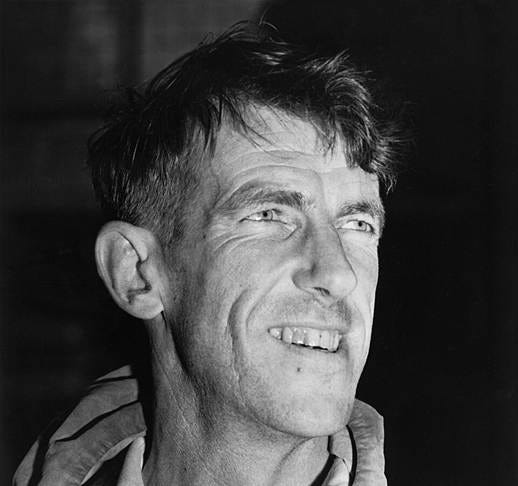
Sir Edmund Hillary (1919–2008) was a New Zealand mountaineer, explorer, philanthropist, and diplomat. Best known as one of the first two climbers to reach the summit of Mount Everest, Hillary’s life extended far beyond a single mountaineering achievement. Over a career spanning more than five decades, he helped pioneer Himalayan climbing from the Nepal side of Everest, participated in major Antarctic expeditions, served as a diplomat, and devoted much of his later life to improving living conditions among the Sherpa communities of Nepal.
Born on 20 July 1919 in Auckland, New Zealand, Hillary grew up in the small farming community of Tuakau. A shy and physically awkward child, he developed a love of books and adventure stories before discovering mountaineering as a teenager during a school trip to Mount Ruapehu. After service as a navigator in the Royal New Zealand Air Force during the Second World War, including a severe burn injury sustained in a motor launch accident in the Solomon Islands, Hillary returned to civilian life and worked as a beekeeper while pursuing increasingly ambitious climbing objectives in New Zealand’s Southern Alps.
During the early 1950s Hillary emerged as one of New Zealand’s leading mountaineers. Participation in the 1951 New Zealand Himalayan Expedition brought him to the attention of British expedition leader Eric Shipton, who invited Hillary to join the 1951 Everest Reconnaissance Expedition. Additional experience on the 1952 British Cho Oyu Expedition further established his reputation as a climber capable of performing under extreme conditions at high altitude. These accomplishments secured Hillary a place on the 1953 British Everest Expedition led by John Hunt.
On 29 May 1953, Hillary and Tenzing Norgay reached the summit of Mount Everest, becoming the first confirmed climbers to stand atop the world’s highest mountain. The achievement was announced internationally on the day of Queen Elizabeth II’s coronation and instantly transformed Hillary from an obscure New Zealand beekeeper into a global celebrity. Knighted shortly afterward, he spent the remainder of the decade engaged in exploration and scientific endeavors, most notably as leader of the New Zealand Ross Sea Party during the Commonwealth Trans-Antarctic Expedition. In January 1958, Hillary became the first person since Robert Falcon Scott’s expedition of 1912 to reach the South Pole overland.
Despite these accomplishments, Hillary repeatedly stated that his work in Nepal ultimately meant more to him than Everest itself. In 1960 he founded the Himalayan Trust, an organization dedicated to improving educational, medical, and transportation infrastructure in the Khumbu region. Over subsequent decades the Trust helped construct schools, hospitals, bridges, airstrips, and water systems that transformed daily life for thousands of Sherpa families. Among its most important achievements were the establishment of Khumjung School, the construction of Lukla Airstrip, and the opening of Khunde Hospital. Hillary’s long association with Nepal earned him extraordinary respect among local communities and established a legacy that extended far beyond mountaineering.
Hillary also remained active in public life. He led the 1960–61 Silver Hut Expedition, participated in further Himalayan exploration, and continued extensive travel throughout Asia and Antarctica. From 1985 to 1989 he served as New Zealand High Commissioner to India and Ambassador to Nepal and Bangladesh. Following the deaths of his wife Louise and daughter Belinda in a 1975 plane crash near Kathmandu, Hillary endured personal tragedy while maintaining his commitment to Nepalese development projects. He later married June Mulgrew, a longtime family friend and supporter of the Himalayan Trust.
By the end of his life, Hillary occupied a unique place in modern history. Unlike many explorers whose reputations rest upon a single feat, his public standing came to reflect a combination of exploration, leadership, service, and humanitarian achievement. When he died in Auckland on 11 January 2008 at the age of eighty-eight, tributes arrived from around the world. Today he is remembered not only as a conqueror of mountains and polar landscapes, but as a builder of schools, hospitals, and institutions whose impact continues to be felt throughout the Himalaya.
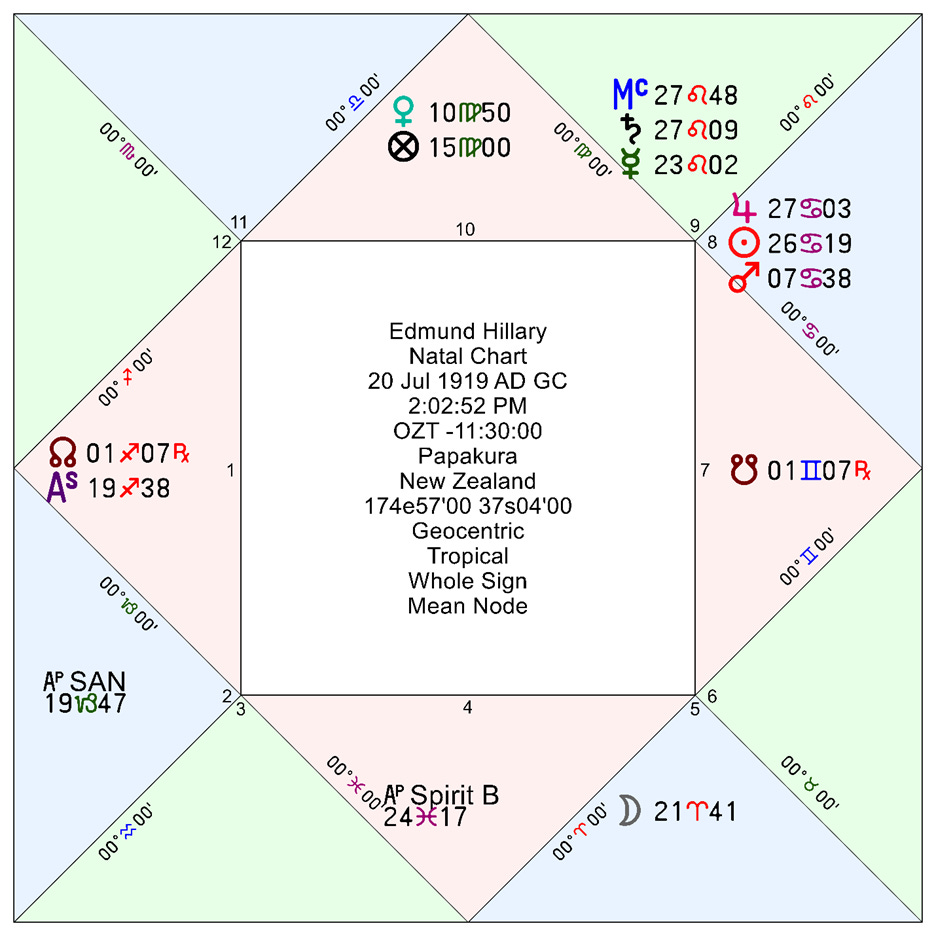
Rodden Rating DD, Conflicting/unverified. 4:00 PM, ASC 16CP11
Noel Tyl rectified to 12:52 PM, ASC 00SA15 (featured in Solar Arcs, 2001, Chapter 7). Tyl and I agree on Sagittarius rising based on physiognomy but differ on directions which timed the Everest climb. Tyl directs the Mars/Pluto conjunction (Pluto not shown above) to the MC for the Everest climb. My proposed rectification links the Sun and Jupiter to his mountaineering achievements, not Mars. By Ascendant profection, the Sun-Jupiter conjunction is tagged in fall 1950 when he met European climbers during climbs in the Swiss Alps which influenced later Himalayan opportunities. These 1950/1951 events were also timed by directing Sun and Jupiter to the MC by converse primary directions. As for Everest in 1953, the chronology details preparatory expeditions made before Everest which are as important as the Everest climb itself. Solar arc directions timed key events during 1951 and 1952 expeditions. Finally primary directions of the MC to Jupiter and Sun tag the time period immediately following the Everest climb when he received worldwide fame. Apart from this 1950-1953 block of time, the proposed rectification also directs both Sun and Jupiter to the Descendant for the Silver Hut Expedition in 1960-1961. This was his last major expedition after which his physicians advised him never to climb above 16,000 feet again. Directions to the DSC degree time closure and endings.
Proposed rectification: 2:02:52 PM, AC 19SA38’51”
The analytical models used in the sections below are part of a larger research program developed across longer white papers and case studies, where the historical sources, rules, and testing methodology are laid out in full. These database entries show the models in practice; readers who want the theoretical foundations can start with the background papers below:
Rectification Hub (I wrote the book on it!)
Soul Hub (white paper, Victor model statistical tests, Moon’s Configuration studies)
Physiognomy Hub (white paper, examples)
Victor Model Factors favoring Jupiter/Cancer
Sign ruler: Ascendant, Lot of Spirit
Notes: On a blind reading I would assign Mars/Cancer as the victor because Mars rules the Moon by sign, and the Moon, MC, and Lot of Spirit by bound. This is one of the few horoscopes where no significators are placed in the bound of the victor planet (Jupiter). The rectification may be wrong, or we may need recourse to the 12th parts to find evidence of Jupiter ruling the bounds of key significators. While applying statistical tests to the victor, I did in fact test the 12th parts which showed some, but not consistent evidence, of their influence on the empirical victor. For Hillary, the 12th part of the Ascendant is 25CA36, bound of Jupiter, and conjunct natal Sun-Jupiter. The 12th part of the Sun is 15TA48, bound of Jupiter, which provides another testimony for Jupiter.
Jupiter/Cancer in the 8th house serves as victor of Hillary’s horoscope by directing his life toward exploration of the world’s most remote and dangerous frontiers. As ruler of the Sagittarius Ascendant, Jupiter signifies long-distance travel, adventure, discovery, and the urge to push beyond known boundaries. Placement in the 8th house, the traditional place of death, danger, and extreme circumstances, repeatedly brought Hillary into environments where survival itself was uncertain. Whether confronting avalanches on Everest, crevasses in Antarctica, severe burns during wartime service, or the ever-present risks of high-altitude mountaineering, Hillary’s greatest achievements emerged through encounters with mortality rather than avoidance of it.
The placement gains additional nuance from Jupiter’s position in the bound of Saturn/Cancer. Saturn introduces themes of cold, hardship, endurance, isolation, and ice, all of which became central motifs in Hillary’s life. His two greatest public accomplishments—the first ascent of Everest and the Commonwealth Trans-Antarctic Expedition—involved frozen landscapes where survival depended upon discipline, preparation, and persistence in the face of lethal conditions. The ruler of the bound, Saturn/Leo, adds an important layer to the delineation. While Saturn/Leo primarily signifies the strong-willed, command-and-control influence of Hillary’s father, it also describes exceptional physical toughness and the capacity to impose one’s will upon difficult circumstances. In this sense, Saturn/Leo operates as the archetype of the “strong man,” combining endurance with physical resilience. Hillary’s unusual strength, stamina, and tolerance for hardship allowed him to withstand the harsh conditions signified by Saturn/Cancer. Rather than being overwhelmed by the cold, isolation, and danger of the world’s highest mountains and polar regions, he possessed the physical fortitude necessary to master them, transforming some of the planet’s most hostile environments into the stage upon which his greatest achievements were realized.
Jupiter’s condition is complicated by its combustion with the Sun. In traditional astrology, a combust planet loses some degree of independence because its significations are overwhelmed by the solar principle. Rather than acting through deliberation, consultation, or careful consideration of alternatives, the planet becomes absorbed into a singular purpose. For Hillary, this suggests that the exploratory impulse of Jupiter/Cancer could become so powerful that it eclipsed competing considerations. Once committed to an objective, he often displayed remarkable certainty of purpose and an unwillingness to be deterred by caution, discomfort, or the advice of others. The same quality that helped carry him to the summit of Everest and across Antarctica could also manifest as an almost single-minded determination to press onward despite considerable risk.
The biographical record contains several examples of this tendency. During the Commonwealth Trans-Antarctic Expedition, Hillary exceeded the expectations of the Ross Sea Committee and continued toward the South Pole after completing his assigned depot-laying duties, creating tensions with Vivian Fuchs and British expedition officials. Similar themes appear throughout his mountaineering career, where repeated exposure to objective dangers such as avalanches, crevasses, storms, and extreme altitude did little to diminish his appetite for exploration. Combustion therefore suggests that Jupiter’s desire to discover, explore, and push beyond known limits operated at such intensity that alternative viewpoints could become secondary to the overriding imperative of the quest itself. In this sense, the Sun’s rays do not extinguish Jupiter so much as amplify its purpose until the pursuit of exploration becomes the dominant organizing principle of life.
Physiognomy Model Factors favoring Sagittarius, Aries
Rising sign: Sagittarius
Ruler of rising sign: Jupiter/Cancer
Rising decan: Aries
Ruler of rising decan: Mars/Cancer
Planet in sign of rising decan: Moon/Aries
Notable configuration: Mars/Cancer and Moon/Aries mutual reception by sign
Standing 6 ft 5 in tall, Edmund Hillary possessed the physical presence one would expect of a man who spent much of his life in mountains, glaciers, and polar environments. Contemporary descriptions and photographs consistently portray him as lean, athletic, and exceptionally long-limbed rather than heavily built. The attached photographs show a face that is noticeably elongated, with a long jawline, prominent nose, high cheekbones, and a narrow overall structure. Even in middle age, when many men acquire greater facial fullness, Hillary retained an angular appearance marked by hollowing beneath the cheekbones and a rugged outdoor complexion shaped by years of exposure to sun, wind, altitude, and cold. The combination of unusual height, long limbs, and an elongated face gave him a striking appearance that was immediately recognizable among twentieth-century explorers.
The primary physiognomic significator is Sagittarius rising, reinforced by the North Node in Sagittarius. In John Willner’s facial shape model, Sagittarius is associated with elongation of the face, and this characteristic is among Hillary’s most obvious physical traits. The face is distinctly longer than it is wide, while the overall body type reflects the tall stature and extended proportions traditionally associated with the sign. Secondary influence may be seen from the Aries rising decan and its ruler Mars/Cancer, which is linked to the decan through mutual reception with Moon/Aries. Although Sagittarius dominates the physiognomy, several photographs reveal a subtle Aries contribution through the slightly pointed chin, lean facial structure, and mild hollowing beneath the cheekbones. Rather than producing the full bony-ovate “arrowhead” shape associated with Aries, the decan appears to sharpen the lower portion of the face while preserving the unmistakable Sagittarian elongation that remains the defining feature of Hillary’s appearance.
Moon’s Configuration
Stage 1: Moon/Aries Ingress
Delineation: Moon in Aries initiates a life characterized by action, courage, self-reliance, and a willingness to confront challenges directly. The placement favors individuals who learn through experience rather than theory and who are often drawn toward situations requiring physical initiative and personal risk. The configuration is strengthened by a mutual reception between Moon/Aries and Mars/Cancer. Mars receives the Moon into Aries while the Moon receives Mars into Cancer, creating a powerful exchange between the two planets. This relationship ties together themes of courage, physical endurance, danger, and survival that become recurring motifs throughout life.
Biographical Match: Hillary’s life was defined by direct engagement with difficult environments. From his early mountaineering exploits in New Zealand’s Southern Alps to Everest, Antarctica, and numerous Himalayan expeditions, he repeatedly chose action over caution. Unlike many explorers who emerged from military, aristocratic, or academic traditions, Hillary developed his skills through practical experience and perseverance. The mutual reception between Moon and Mars established a lifelong relationship between adventure and danger, a pattern that would become increasingly visible in subsequent phases of the configuration.
Stage 2: Moon Square Mars (Cancer, 8th)
Delineation: The square to Mars introduces conflict, injury, hardship, and repeated confrontations with physical danger. Mars in Cancer often manifests through accidents involving liquids, burns, scalding, or situations in which survival depends upon endurance under adverse conditions. Because Mars occupies the 8th house, encounters with danger frequently occur in circumstances where death or serious injury is a realistic possibility. The aspect does not necessarily indicate defeat; rather, it signifies a life repeatedly tested by hazardous conditions.
Biographical Match: The clearest manifestation occurred in 1945 when Hillary suffered severe burns during a motor launch explosion while serving with the Royal New Zealand Air Force in the Solomon Islands. The combination of fire, injury, and prolonged immersion in seawater closely reflects the symbolism of Mars/Cancer. The aspect continued to operate throughout his mountaineering career as Hillary repeatedly exposed himself to avalanches, crevasses, storms, extreme altitude, and polar conditions. Yet the theme of the aspect is not merely danger but survival, as Hillary consistently emerged from these encounters to pursue even greater challenges.
Stage 3: Void-of-Course Moon and Birth Moment
Delineation: Following the square to Mars, the Moon becomes void-of-course, creating a period of transition between one chapter of life and the next. Rather than signifying inactivity, the void-of-course condition often indicates a suspension of direction in which previous identities have been left behind while future roles have not yet fully emerged. Such periods frequently involve recovery, reflection, and preparation for a new path.
Biographical Match: After the Solomon Islands burn injury, Hillary entered a transitional phase in which his wartime identity came to an end but his future as a Himalayan explorer had not yet taken shape. Returning to New Zealand, he recovered from his injuries, resumed civilian life, and worked as a beekeeper. Although he continued climbing in the Southern Alps, the achievements that would later define his reputation remained unrealized. The period represents an interval between major life chapters, neither military service nor international exploration, but a necessary bridge connecting the two.
Stage 4: Moon Trine Mercury (Leo, 9th/10th)
Delineation: The trine to Mercury introduces practical intelligence, adaptability, planning, and productive routine. Mercury in Leo combines organizational skill with confidence, optimism, and the ability to communicate ideas effectively. As a 9th-house significator cadent from the 10th, Mercury often describes what occurs between periods of public accomplishment, including study, preparation, travel, and sabbatical-like intervals removed from professional ambition.
Biographical Match: Hillary repeatedly returned from major expeditions to work as a beekeeper, a profession he shared with his father. Beekeeping provided both financial support and seasonal flexibility, allowing him to alternate between ordinary work and extraordinary adventures. The pattern repeated throughout much of his adult life: expedition, return home, beekeeping, preparation, and departure for the next challenge. Mercury also describes Hillary’s practical problem-solving abilities and fundamentally optimistic outlook, qualities that made him an effective expedition member, leader, and later humanitarian.
Stage 5: Moon Square Sun (Cancer,8th)
Delineation: The square to the Sun brings encounters with prominent, influential, or authoritative individuals. Such figures often serve as patrons, sponsors, commanders, or gatekeepers who provide opportunities for advancement while simultaneously creating tension through hierarchy or differing priorities. Because the Sun occupies the 8th house, these individuals are frequently connected to dangerous undertakings, ambitious ventures, or transformative life experiences.
Biographical Match: Hillary’s career advanced through a series of relationships with influential men who recognized his abilities and opened doors to larger opportunities. Eric Shipton invited him to join the 1951 Everest Reconnaissance Expedition. John Hunt selected him for the 1953 Everest Expedition. Vivian Fuchs brought him into the Commonwealth Trans-Antarctic Expedition. These relationships proved essential to Hillary’s success, yet they were not always free of tension. The disagreement with Fuchs over the South Pole illustrates how the square often combined opportunity with conflict.
Stage 6: Moon Square Jupiter (Cancer, 8th)
Delineation: The square to Jupiter expands horizons and creates a powerful desire for exploration, discovery, and achievement. Jupiter in Cancer, ruling the Sagittarius Ascendant and exalted in sign, encourages long-distance travel, encounters with foreign lands, and a continual search for what lies beyond established boundaries. Placement in the 8th house ties exploration to risk, danger, and transformative experiences.
Biographical Match: Hillary’s life became a continuous quest to explore remote and challenging environments. Everest, Antarctica, the Himalayas, and later humanitarian work throughout Nepal all reflect Jupiter’s expansive impulse. The aspect repeatedly placed him in circumstances where exploration and danger were inseparable, requiring him to accept significant risks in pursuit of discovery. Through Jupiter, the adventurous promise of the Sagittarius Ascendant achieved its fullest expression.
Stage 7: Moon Trine Saturn (Leo, 9th10th)
Delineation: The final trine to Saturn provides discipline, endurance, perseverance, and the capacity to withstand hardship over long periods of time. Saturn in Leo closely connected to the Midheaven transforms these qualities into public reputation and lasting achievement. Success comes not through brilliance or luck alone but through sustained effort, reliability, and exceptional stamina.
Biographical Match: Hillary’s public reputation rested less upon a single dramatic accomplishment than upon decades of demonstrated endurance. Fellow climbers consistently described him as strong, dependable, and capable of continuing under conditions that exhausted others. These qualities proved essential on Everest, during the Commonwealth Trans-Antarctic Expedition, and throughout his humanitarian work in Nepal. Saturn near the Midheaven ensured that the public would remember him not only as an explorer, but as a figure whose strength, persistence, and reliability became central components of his legacy.
Influence of Sect
The figure is diurnal, placing Jupiter and Saturn in sect while Mars and Venus operate out of sect. Saturn in sect moderates the harsher implications of Saturn/Leo, transforming what might otherwise manifest as excessive control or authoritarianism into discipline, endurance, and reliability. These qualities became central to Hillary’s public reputation as an explorer capable of persevering under extreme conditions. Jupiter in sect is particularly important because it aligns Hillary’s exploratory ambitions with the prevailing values of his era. As ruler of the Sagittarius Ascendant, exalted in Cancer, and operating in sect, Jupiter expanded both the physical scope of his travels and the audience willing to support them. Society viewed exploration, mountaineering, and polar adventure as noble pursuits, allowing Hillary’s aspirations to attract widespread institutional and public backing. Mars out of sect appears most clearly in the severe burn injury sustained during military service and in the recurrent physical dangers that accompanied his expeditions. Venus out of sect is less obvious biographically; rather than manifesting through scandal or excess, the placement may have been moderated by Virgo’s practical nature, directing attention toward useful service and humanitarian work rather than personal pleasure or luxury.
Early/Late Bloomer thesis
Born shortly after a Full Moon, Hillary would be expected under the early/late bloomer model to achieve his most important accomplishments after the midpoint of life. He lived approximately 88 years, placing the midpoint near age 44 in 1964. At first glance the biography appears to contradict the model, as Hillary reached the summit of Everest at age 33 and the South Pole at age 38, securing international fame well before midlife. Yet the second half of life witnessed the expansion of the Himalayan Trust, the construction of schools, hospitals, bridges, and airstrips throughout Nepal, diplomatic service in India and Nepal, and the emergence of Hillary as a global humanitarian figure. If Everest is regarded as the defining achievement, Hillary leans toward the early-bloomer category. If his humanitarian legacy is given greater weight—as Hillary himself often argued—the second half of life becomes at least as important as the first. On balance, the horoscope presents a mixed case that leans slightly toward early bloomer, despite the post-Full Moon birth.
AI Notice: ChatGPT contributed to this article.
Complete biographical chronology, rectification and time lord studies available in Excel format as a paid subscriber benefit. Files are behind the paywall.