

Last week the North Node moved into Aquarius, and with that ingress I have begun shifting the Wednesday natal-database posts toward Aquarian subjects: technology, networks, collective organization, and competing visions of the future. Tomorrow I will turn to one of the more obvious contemporary examples, Sam Altman. Today, as a warm-up and historical precursor to the modern tech-bro utopia, I want to begin with Edward Bellamy, whose 1888 novel Looking Backward: 2000–1887 imagined what might happen if industrial development eventually made the existing relationship between labor, capital, and private ownership obsolete.
The connection to Altman is not merely thematic. In Keach Hagey’s biography The Optimist, Bellamy appears as an earlier figure in the intellectual history of universal income that formed part of the background to Altman’s thinking. Altman would eventually put substantial money behind a large basic-income experiment as he considered how technological disruption might affect employment and the distribution of wealth. Bellamy confronted a related problem nearly 140 years earlier, although his solution was considerably more radical. Rather than supplement private capitalism with a guaranteed income, Bellamy imagined private ownership of productive capital itself disappearing as corporations consolidated until the nation became the single great economic organization.
Looking Backward was not a marginal political fantasy. It became one of the publishing phenomena of the nineteenth century, selling more than one million copies. Contemporary sales comparisons are necessarily approximate, but it is commonly ranked behind only Harriet Beecher Stowe’s Uncle Tom’s Cabin and Lew Wallace’s Ben-Hur among nineteenth-century American novels. Uncle Tom’s Cabin sold about 300,000 American copies in its first year; Ben-Hur, initially a slower seller, had reached roughly 400,000 copies by 1889 and continued selling heavily thereafter; Looking Backward passed one million copies within a few years. However the figures are measured, Bellamy’s novel reached a mass audience rather than a small circle of political reformers.
The plot begins in Boston in 1887. Julian West is a wealthy young man living amid strikes, class conflict, and growing antagonism between labor and capital. Troubled by insomnia, he sleeps in a specially constructed underground chamber where he can be placed into a hypnotic trance. His house burns, the chamber is forgotten, and Julian awakens in the year 2000. Dr. Leete introduces him to a transformed United States in which the competitive capitalism of the nineteenth century has disappeared. Corporations and trusts progressively consolidated until the nation itself became the great economic organization; production and distribution are nationally administered, citizens share in the resulting economic abundance, and the old conflict between capital and labor has largely vanished. Much of the novel consists of Julian questioning Leete about how this seemingly impossible society works and gradually discovering that institutions he had regarded as permanent features of civilization belonged only to his own historical period.
The reaction to Looking Backward was itself part of the story. Nationalist clubs formed to promote Bellamy’s ideas, while the novel opened what Michael Robertson, in The Last Utopians, describes as the floodgates of a new wave of utopian writing. More than 150 fictional responses to Bellamy appeared, some defending his vision, others attacking or revising it. William Morris answered Bellamy with News from Nowhere, and the broader utopian current extended through writers and reformers including Morris, Edward Carpenter, and Charlotte Perkins Gilman. Robertson uses those four figures—Bellamy, Morris, Carpenter, and Gilman—to reconstruct a period extending from the late 1880s into the early twentieth century when imagining a radically different society became an important literary and political undertaking.
The outbreak of World War I provides a reasonable endpoint to this roughly twenty-five-year period, although it would be too simple to say that the war suddenly killed utopian literature. Robertson notes that utopian writing continued afterward, but that its once-large readership diminished drastically following the war. The twentieth-century imagination increasingly moved in the opposite direction: instead of describing better societies to come, speculative writers increasingly asked how technology, centralized authority, and social planning might go badly wrong. Bellamy’s confident future eventually gave way to the worlds of Huxley and Orwell.
That history makes Bellamy a useful backdrop for tomorrow’s Sam Altman post. The technologies have changed, but some of the questions have not. What happens when technological productivity becomes great enough to weaken the traditional relationship between employment and economic security? Who owns the resulting abundance? How should it be distributed? Bellamy answered by eliminating private ownership of productive capital and folding the corporations themselves into the nation. Modern proposals such as universal basic income stop far short of Bellamy’s solution, but they arise from a recognizable version of the same problem.
For this post, however, I want to approach Looking Backward from a different direction. Rather than merely asking whether Bellamy predicted the future, I will treat his horoscope almost as a playwright might introduce the dramatis personae at the beginning of a script. Mars in Cancer becomes the defensive laboring class of 1887; the Moon becomes Julian West, disappearing into an 8th-house sleep and emerging more than a century later; Mercury in Pisces becomes Dr. Leete, explaining the new economic order; Jupiter describes the universal provision toward which that order aspires; Venus appears through the two Ediths; the Sun becomes the single national center; and Saturn in Aries describes the corporations whose boundaries progressively disappear as they consolidate into one national organization.
The result offers a different test of natal astrology. Instead of asking only whether Bellamy’s horoscope describes Bellamy, we can ask whether it also describes the imaginative world for which Bellamy became known. At the center of both stands Saturn in Aries, ruler of an Aquarius Ascendant: a man who spent much of his mature life writing, publishing, and preaching about how existing economic structures might dissolve into a new collective order.
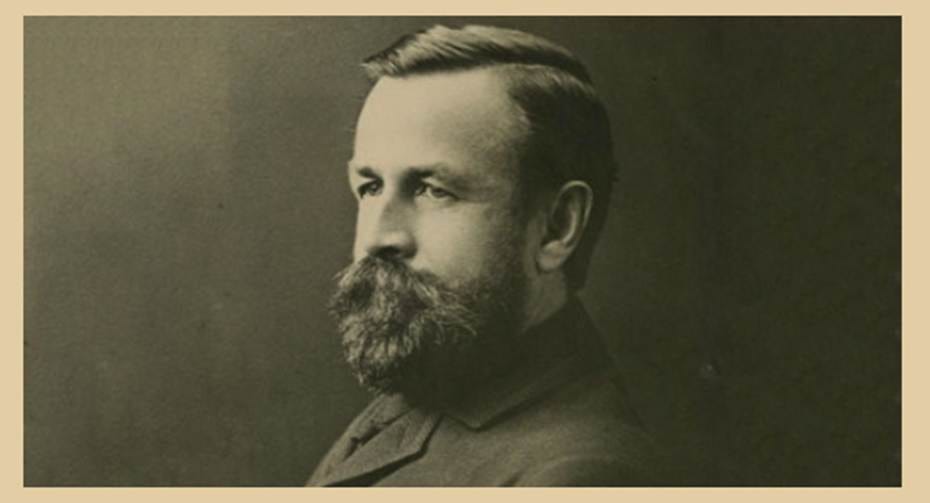
Edward Bellamy was born on March 26, 1850, in Chicopee Falls, Massachusetts, into a family with deep roots in New England Protestantism. His father, Rufus King Bellamy, was a Baptist minister, while his mother, Maria Louisa Putnam Bellamy, came from a family connected to the region’s religious and civic life. Bellamy grew up in an industrial town where the proximity of factory workers and prosperous mill owners exposed him early to differences of class and economic circumstance.
Religion occupied him intensely during adolescence. In 1864 he underwent a period of religious conversion and was baptized at the Baptist Church in Chicopee Falls on April 13. His mature outlook moved away from conventional Christianity, but the ethical concerns of his religious upbringing remained visible in his later emphasis on social brotherhood and the subordination of individual economic competition to collective welfare.
At about seventeen Bellamy sought admission to West Point but failed the physical examination. He instead attended Union College in Schenectady, New York, before traveling to Germany, where he lived in Dresden with his cousin William Packer and learned German. Returning to Massachusetts in 1869, he studied law, passed the Massachusetts bar examination in 1871, and opened an office in Chicopee Falls. After handling a case involving an eviction, Bellamy decided that the profession did not suit him and turned toward journalism.
Bellamy’s first published article, “Woman Suffrage,” appeared in The Golden Age in 1871. He subsequently obtained editorial work at the New York Evening Post before returning to western Massachusetts in 1872 to join the Springfield Union as an editorial writer and literary editor. During the 1870s he increasingly wrote fiction, developing interests in psychology, altered states of consciousness, memory, technology, and speculative situations that would later provide some of the literary machinery for his better-known work.
Poor health repeatedly interrupted his career. Bellamy left the Springfield Union in December 1877, with fainting spells and pulmonary problems contributing to his departure, and traveled with his brother Frederick to the Hawaiian Islands in an effort to recover. These physical limitations were not temporary: tuberculosis increasingly constrained his activities and ultimately caused his death at forty-eight.
His literary career nevertheless continued. Six to One: A Nantucket Idyll appeared anonymously in 1878, while Dr. Heidenhoff’s Process, concerned with the technological removal of painful memories, was published in book form in 1880. The Duke of Stockbridge, a historical novel centered on the social tensions surrounding Shays’ Rebellion, appeared serially, and Miss Ludington’s Sister followed in 1884. These works show Bellamy experimenting with historical, psychological, and speculative fiction before turning those techniques toward economic society.
In 1880 Bellamy and his brother Charles also established the Penny News in Springfield, which developed into the Springfield Daily News. Bellamy relinquished his active interest in the newspaper in 1881 and concentrated increasingly on literature. On May 31, 1882, he married Emma Augusta Sanderson. Their son Paul was born on December 26, 1884, followed by their daughter Marion in 1886.
During 1886 and 1887 Bellamy began sustained work on the book that changed his life. Looking Backward: 2000–1887 placed its protagonist, Julian West, into a hypnotically induced sleep in late nineteenth-century Boston and awakened him in the year 2000. Competitive capitalism had disappeared, production and distribution had been organized nationally, and citizens participated in an economic system intended to distribute the benefits of industrial development more evenly. Bellamy used speculative fiction to present an alternative political economy.
Published on January 21, 1888, Looking Backward rapidly moved beyond the normal boundaries of a successful novel. Readers organized clubs around its ideas, drawing Bellamy into a political movement built around his work. The Boston Nationalist Club became the organizational center of what came to be called Nationalism, a term Bellamy preferred to socialism, and by the end of 1888 he had become the club’s first vice president.
Bellamy became increasingly public during 1889 and 1890. He contributed to The Nationalist, addressed large audiences at Boston’s Tremont Temple, and attempted to translate the social system depicted in Looking Backward into a reform program. His Nationalism called for public control of major industries and utilities and the gradual replacement of competitive capitalism by coordinated national economic organization. Nationalist clubs spread across the country, although the movement never developed into a durable independent political party.
In January 1891 Bellamy entered politics more directly by launching The New Nation as an organ of the movement. Nationalism was meanwhile becoming entangled with the Farmers’ Alliance, labor and monetary reformers, and the emerging People’s Party. Bellamy supported much of this coalition’s economic program while trying to preserve Nationalism as a distinct movement.
At Omaha on July 4, 1892, the People’s Party adopted a platform containing several proposals compatible with Bellamy’s program and nominated James B. Weaver for president. Bellamy himself was placed on the Massachusetts People’s Party ticket as a presidential elector at large pledged to Weaver. The episode marked his clearest direct participation in electoral politics but also showed how his independent Nationalist movement was being absorbed into the broader Populist coalition.
Weaver received about 8.5 percent of the national popular vote in November 1892 and carried several western states, but the People’s Party remained weak in Massachusetts. The Panic of 1893 then worsened the financial difficulties of The New Nation as Bellamy’s health deteriorated. The paper ceased publication with its February 3, 1894 issue, effectively ending the most intensive phase of his political activity.
Bellamy withdrew substantially from political organization and returned to writing. As former Nationalists dispersed into Populism and other reform movements, he worked on Equality, intended to answer objections to Looking Backward and provide a more systematic explanation of his proposed society. William Jennings Bryan’s “Cross of Gold” speech on July 9, 1896 reflected the growing influence of monetary and anti-corporate reform within national politics, although Bellamy’s program was never reducible to the free-silver issue.
Equality appeared in 1897, but Bellamy was by then seriously ill with tuberculosis. His condition deteriorated during his final year, and he spent much of the period confined to his home in Chicopee Falls. Edward Bellamy died there on May 22, 1898, at the age of forty-eight.
Bellamy’s political organization did not survive him as an independent force, but many of its concerns continued through Populism and into the Progressive Era: public ownership of utilities, concentrated corporate power, economic inequality, labor conditions, and the relationship between industrial organization and democratic government. His historical identity nevertheless rests primarily on Looking Backward, the book that transformed a writer of speculative fiction into a social critic and provided reformers with an imagined alternative to the economic arrangements of the Gilded Age.
For readers who want to explore Looking Backward itself, there are good free versions online:
Read: Project Gutenberg — Looking Backward: 2000–1887 — complete public-domain text, with online reading and free EPUB/Kindle downloads.
Listen: LibriVox — Looking Backward: 2000–1887 — complete free audiobook, read by Anna Simon; running time about 7 hours 45 minutes.
No Astrodatabank Record
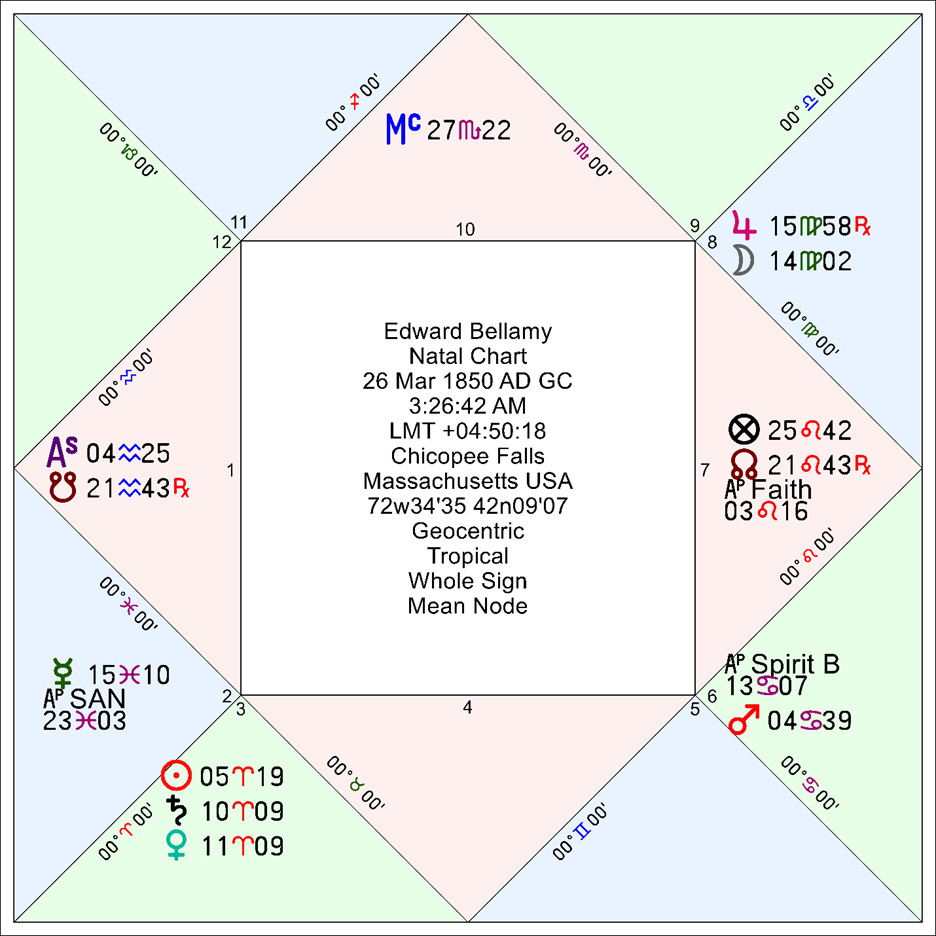
Proposed Rectification 3:26:42 AM, ASC 4AQ25’08”
The analytical models used in the sections below are part of a larger research program developed across longer white papers and case studies, where the historical sources, rules, and testing methodology are laid out in full. These database entries show the models in practice; readers who want the theoretical foundations can start with the background papers below:
Rectification Hub (I wrote the book on it!)
Soul Hub (white paper, Victor model statistical tests, Moon’s Configuration studies)
Physiognomy Hub (white paper, examples)
Model Assessments
Victor — Saturn/Aries. Saturn is the strongest candidate for Victor: it rules the Aquarius Ascendant and rising decan, while its Firdaria periods contain several important developmental events and, most decisively, the completion and publication of Looking Backward during Mars/Saturn. Saturn is contrary to sect and in fall in Aries, describing Bellamy’s preoccupation with social structure alongside difficulty maintaining institutional boundaries—a theme developed more fully below through both the novel and the fate of his Nationalist movement.
Physiognomy — Aquarius/Aries. Bellamy provides a reasonable match to the proposed rectification. Aquarius rising and the Aquarius rising decan correspond with the large rectangular forehead, elongated head, and relatively straight temporal lines, while Aries provides a secondary bony-ovate influence visible in the narrowing from the upper face toward the chin.
Sect. The horoscope is nocturnal: Venus and Mars are of sect, while Jupiter and Saturn are contrary to sect. Mars therefore has greater capacity to turn conflict toward constructive ends, while Venus preserves love and private attachment despite its detriment in Aries. Jupiter, contrary to sect and in detriment in Virgo, struggles to translate universal provision into practical administration, while Saturn—contrary to sect and fallen in Aries—is the more problematic planet, seeking social order while repeatedly dissolving the boundaries it would normally maintain.
Early/Late Bloomer — weak result. Born after a New Moon but shortly before the Full, with the Moon nevertheless more than 15° beyond the Sun’s bond, Bellamy should be an early bloomer. He lived 48 years, placing the midpoint of his life at approximately age 24, in 1874. Although important intellectual and vocational development occurred early, Looking Backward did not appear until 1888, when he was 37. On the defining-work criterion, the model fails or produces at best a weak result.
AND NOW FOR SOMETHING COMPLETELY DIFFERENT
Dramatis Personae: Looking Backward in the Horoscope
Rather than treating the Moon’s Configuration as a sequence of abstract delineations and then looking for corresponding events in Bellamy’s biography, Looking Backward permits a different approach. The principal planets can be treated almost as a dramatis personae, with each assuming the role of a character, social class, institution, or governing principle within the novel. The planetary relationships then reproduce much of the movement of the story itself. What begins with Mars and the labor problem of 1887 passes through the Moon to Mercury and Jupiter, before returning through Mars to the Aries stellium of Sun, Saturn, and Venus. At the center of the entire construction is Saturn in Aries, ruler of the Aquarius Ascendant and the strongest candidate for Victor.
Mars in Cancer in the 6th — the laboring class. The story begins with Mars. In the world Julian West leaves behind in 1887, the central social problem is the antagonism between labor and capital. The 6th house supplies the working class, while Mars supplies conflict, strikes, agitation, and the division of society into opposing camps. Yet this is Mars in Cancer and in its own bound. Its aggression is therefore substantially defensive: labor fights to protect its wages, employment, family security, and existing position against the power of capital. The workers are not initially Bellamy’s revolutionary architects of a new civilization. They are defending their portion of the old one.
Mars, however, cannot resolve the conflict it represents. Cancer sends us to its ruler, the Moon at 14°02′ Virgo in the 8th house. This moves the narrative away from the immediate struggle between workers and employers and toward the peculiar mechanism by which Bellamy escapes the problem altogether. The nineteenth-century conflict cannot be solved within the nineteenth century. Julian West must effectively die to it. He descends into his underground sleeping chamber, enters a death-like suspended state, disappears from society, and awakens more than a century later.
There is an older technical meaning of the 8th house that makes the symbolism more specific than a general association with death. Deborah Houlding (The Houses: Temples of the Sky, p. 27), drawing attention to terminology preserved by the fourth-century astrologer Firmicus Maternus, notes that the Greek name for the 8th was Epicataphora—“falling down into the Underworld.” Its opposite house, the 2nd, was Anaphora—“rising up from the Underworld.” Both houses were understood as portals connected with the underworld, but in opposite directions: the 8th describes the descent or portal of entry, while the 2nd describes emergence or release. Julian’s journey follows that symbolism almost literally. He goes physically downward into a chamber beneath his house, disappears from the living world of 1887, and remains there in a state resembling death until he is recovered in the year 2000.
The Moon in Virgo in the 8th — Julian West. If Mars is the collective protagonist of the social problem, the Moon can be identified more personally with Julian, the experiencing consciousness through which the reader travels. The Moon has just separated from Mars by sextile, at 9°23′, barely within Lilly’s 9°30′ Moon–Mars moiety. Julian therefore still carries the Mars problem with him: he comes directly out of a society convulsed by labor disputes, and strikes have intruded into his private life by delaying construction of the house in which he expects to live after marrying Edith Bartlett. Yet the extreme width of the separating aspect is itself a delineation match to the plot. More than a century separates the world Julian leaves behind from the utopian society in which he awakens; just as the Moon has moved almost completely beyond its connection with Mars, Julian awakens at the furthest edge of his connection with the labor conflict of 1887. The aspect has not quite disappeared, however, because the old social order remains the point of comparison through which Julian—and the reader—must understand everything he encounters in the year 2000.
The Moon next applies by opposition to Mercury at 15°10′ Pisces in the 2nd, only 1°08′ away. Here the ancient house symbolism completes the movement. Julian has descended through the 8th-house Epicataphora, but the Moon now carries him immediately toward the 2nd-house Anaphora, “rising up from the Underworld.” And what awaits him there is Mercury: Dr. Leete, the man who effectively receives Julian after his emergence and explains the material and economic conditions of his new world.
Mercury in Pisces in the 2nd — Dr. Leete. Dr. Leete is fundamentally Mercurial. His principal function is to talk. Julian asks questions; Leete explains. Through conversations, comparisons, examples, and arguments, he teaches Julian—and therefore the reader—how the society of 2000 works. Mercury’s placement in the 2nd makes wealth, property, money, and economic organization the principal subjects of those explanations. The house therefore operates on both levels of its traditional symbolism: it is the place of material resources, but also the place of emergence from the underworld. Julian rises out of his 8th-house burial only to discover that the first great problem requiring explanation is 2nd-house material life—how this new civilization organizes wealth and provides for its citizens.
Pisces is important because Leete repeatedly dissolves distinctions that Julian regards as self-evident. Employer and employee, capitalist and worker, private and public, rich and poor are no longer the organizing categories of society. Mercury in Pisces can paint with a broad brush, sometimes at the expense of distinctions, and that is precisely what Bellamy requires of Leete. His task is to explain why the divisions upon which Julian’s nineteenth-century understanding depends no longer apply.
Mercury also rules both the 5th and 8th houses. The 8th supplies the strange mechanism by which Julian reaches the future, while the 5th supplies the fictional and ultimately romantic vehicle through which Bellamy presents his argument. Mercury therefore governs both Julian’s passage into the new world and much of the literary machinery used to explain it.
The Moon then continues to Jupiter at 15°58′ Virgo retrograde in the 8th, an application of only 1°56′. Mercury and Jupiter themselves oppose one another within just 0°48′, making the Moon–Mercury–Jupiter complex far tighter than the Moon’s separating relationship with Mars.
Jupiter in Virgo retrograde in the 8th — the economic promise of the new society. Jupiter need not be reduced to a single character. It represents what Julian discovers through Leete: a society in which the wealth produced by the whole is made available to the whole. Jupiter rules the 2nd house of wealth and the 11th house of wages or income from profession. Its subject matter therefore fits Bellamy’s economic system directly.
The uncertainty surrounding Jupiter’s solar phase may actually help here. If Jupiter is behaving more straightforwardly as Jupiter in Virgo, it describes Bellamy’s concern with the administrative details necessary to operate a national economy: occupations must be organized, production coordinated, goods distributed, and the practical machinery explained. But if the retrograde Jupiter is beginning to behave more like Jupiter in Pisces, another side of Bellamy appears—Christian brotherhood, generosity, forgiveness of economic distinctions, and the conviction that everyone should participate in society’s abundance. Pisces does not itself signify equality; Aquarius does that more naturally. Jupiter/Pisces instead supplies the principle of universal provision: nobody should be excluded from the common wealth.
Mercury and Jupiter are also in mutual reception by domicile. Mercury occupies Jupiter’s Pisces while Jupiter occupies Mercury’s Virgo. Both are poorly dignified in those signs, yet each receives the other. This is an unusually apt picture of Bellamy’s utopia. Mercury/Pisces supplies the broad conception in which economic distinctions dissolve; Jupiter/Virgo has to explain how that conception can be administered in practice. The visionary and the administrator require one another. Dr. Leete continually moves between the two modes.
This Moon–Mercury–Jupiter configuration is therefore what rules Mars and what Mars aspires toward. Mars represents labor defending itself because the old system gives it no security. Following Mars’s ruler leads instead to a world in which the original reason for labor conflict has disappeared. The worker no longer has to fight defensively for a share of economic security because membership in society itself provides that security. The Moon carries Julian from the Mars world into the Mercury–Jupiter world and thereby shows the reader the solution toward which the labor problem is moving.
But Mars has another function. It does not merely answer to the Moon. Mars rules the Sun, Saturn, and Venus in Aries. We can therefore pivot back from Bellamy’s utopian solution to the institutions and private relationships transformed by the labor problem.
Saturn in Aries — corporations, trusts, and consolidation. Saturn represents structure, hierarchy, concentration, institutions, and boundaries. Bellamy’s historical argument is not that the rise of large corporations should be reversed. The trusts are part of the process by which competitive capitalism destroys itself. Businesses consolidate into progressively larger organizations until private competition becomes increasingly unnecessary. Eventually the process reaches its logical conclusion and the nation absorbs the corporations into a single economic organization.
Saturn’s fall in Aries becomes highly descriptive. Saturn attempts to structure and consolidate, but it cannot maintain boundaries. One corporation absorbs another; separate economic units disappear; consolidation proceeds until the boundaries separating corporations themselves have been eliminated. Bellamy’s solution is therefore not a well-regulated collection of independent Saturnian institutions. It is the dissolution of their boundaries through consolidation.
The Sun in Aries — the nation as the final center. Once the process of consolidation has run its course, the Sun provides the single center around which the system can be organized. The nation becomes the ultimate corporation and employer. The Sun’s natural tendency toward centralization suits a system in which numerous competing centers of economic power have been replaced by one national center. Mars therefore takes the original labor conflict and, through its rulership of the Sun, ultimately produces a centralized response.
Venus in Aries — private happiness and material life caught within the conflict. Venus brings the economic argument down to the personal level. Julian’s intended marriage to Edith Bartlett is disrupted by the same labor conflict represented by Mars: strikes delay construction of their house and therefore interfere directly with the establishment of their married life. Venus is also separating from Saturn, providing an image of Venusian happiness damaged by the Saturnian conditions of the old order. Julian’s first Venus cannot be recovered; Edith Bartlett belongs to the world he has lost.
But Venus reappears as Edith Leete. The duplication of the name makes the symbolism particularly useful. The old Venus and the new Venus are connected, yet the second exists within an entirely different economic structure. Julian’s relationship with Edith Leete restores the private affection that had been severed when he disappeared from 1887. Bellamy therefore does not abolish Venusian private life when he abolishes much of private economic ownership. Love, attraction, domestic happiness, and personal attachment survive the restructuring of society.
This brings the planetary cast back to Mars. Mars in the 6th is simultaneously the problem and the engine driving the transformation. Labor conflict pressures the economic structure represented by Saturn; Saturnian corporations consolidate; the process culminates in the solar national center; and Venusian private life has to be reconstructed within the resulting order. Yet Mars itself answers to the Moon, which carries the story toward Mercury and Jupiter. The entire plot can therefore be understood as a circuit: the labor problem generates institutional transformation, while the ruler of labor points toward the economic and moral alternative that makes the conflict unnecessary.
Complete biographical chronology, rectification and time lord studies available in Excel format as a paid subscriber benefit. File is behind the paywall.