

Elon Musk is perhaps the most literal expression yet of the Aquarius technology series. With Mars at 20°54′ Aquarius ruling the Midheaven, here is a technology entrepreneur whose defining ambition is to go to Mars. The symbolism is almost suspiciously neat. Yet Mars/Aquarius describes more than SpaceX: rockets, electric vehicles, advanced engineering, automation, robotics, and a willingness to challenge established technological systems recur throughout the career. The argument developed in this study is that Mars is not simply one important planet in Musk’s horoscope. It is the Victor, the planet that most clearly describes the vocation around which the rest of the chart organizes itself.
Musk also provides an appropriate successor to Douglas Adams, the previous entry in this series. The connection is direct: Musk has described Adams as his favorite philosopher, and The Hitchhiker’s Guide to the Galaxy helped shape his thinking about humanity, technology, and becoming a multiplanetary species. When Falcon Heavy carried Musk’s Tesla Roadster into space in 2018, the dashboard displayed DON’T PANIC, while a copy of The Hitchhiker’s Guide and a towel accompanied the car. The Guardian The connection also works at the level of atmosphere. The madcap world of Adams—grand schemes, improbable machines, looming catastrophe, absurd improvisation, and people somehow carrying on through the chaos—can sometimes sound remarkably like the early cultures of Tesla and SpaceX.
One episode captures this particularly well. During Tesla’s 2018 struggle to increase Model 3 production, the company needed another assembly line but did not have time to construct a conventional factory building. The solution was to erect a 137,250-square-foot tent-like structure in the Fremont parking lot and install an assembly line inside it, using equipment and materials already available. Musk said the line had been constructed in only weeks; during the final production push, roughly 20 percent of the week’s 5,031 Model 3s came through it. It is difficult to imagine a better real-world approximation of the Hitchhiker’s sensibility: the conventional solution is impossible, the deadline is approaching, so build the factory in a giant tent and keep going.
There is also an important astrological problem to resolve before proceeding. The Astro-Databank B-rated birth time of 7:30 AM places Musk very close to sunrise, making sect unusually sensitive to rectification. In the preliminary research published yesterday, the diurnal and nocturnal Firdaria sequences were tested systematically against a chronology now containing more than 210 dated events. Although the diurnal sequence produced several strong correspondences, particularly under Mercury and Saturn, the nocturnal sequence provided the more coherent overall biography: Jupiter/Taurus for the creation of wealth, Mars/Aquarius for the formative SpaceX period, the Nodes for breakthrough and consolidation, and the Sun for Musk’s subsequent rise to sustained personal prominence.
For the present study, therefore, the birth time has been moved 35 minutes earlier, from 7:30 AM to 6:55 AM, producing a nocturnal figure. This remains a trial rectification, not a settled conclusion. There is evidence against it—not least the physiognomy problem discussed later—and further testing may require another adjustment. But the nocturnal Firdaria sequence, the strength of Mars/Aquarius as Victor, and the additional rectification tests examined below provide enough support to make 6:55 AM the working hypothesis for the moment.
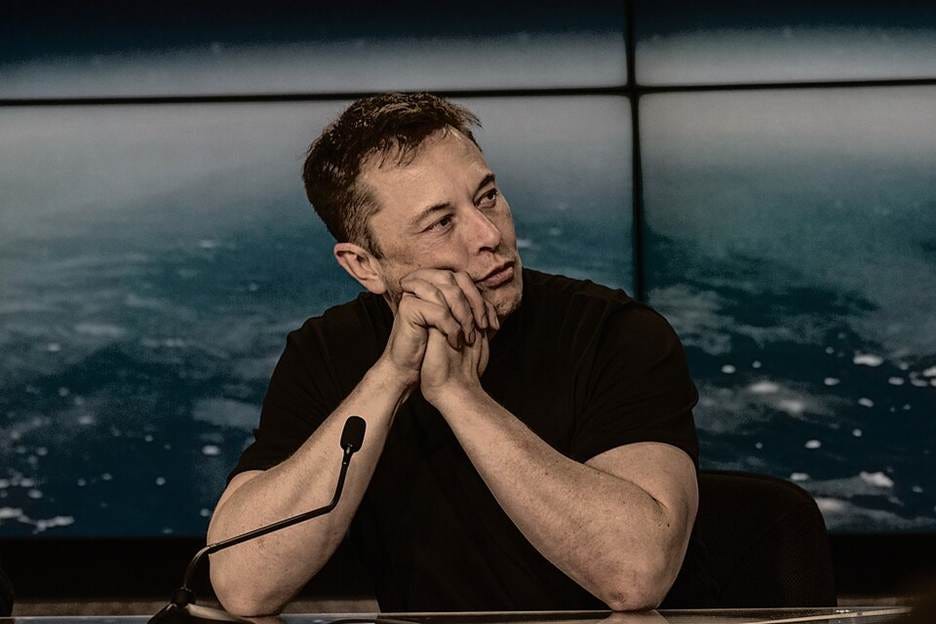
Elon Reeve Musk was born on 28 June 1971 in Pretoria, South Africa, the eldest of three children of Maye Haldeman Musk, a model and dietitian, and Errol Musk, an engineer. His younger siblings are Kimbal and Tosca Musk. His parents divorced during his childhood, after which Musk eventually chose to live primarily with his father. An intensely bookish child, he developed an early interest in science fiction, physics, computers, and space travel. At about twelve, after teaching himself programming, he created the video game Blastar and sold its source code for approximately $500.
Musk left South Africa for Canada as a teenager, obtaining Canadian citizenship through his mother. After attending Queen’s University in Ontario, he transferred to the University of Pennsylvania, where he studied physics and economics. Summers and internships exposed him to both energy-storage technology and software development. In 1995 he moved to California intending to pursue graduate work at Stanford, but abandoned the program almost immediately as the commercial Internet began to expand.
With his brother Kimbal, Musk founded Zip2, initially developing online maps and business directories before shifting toward software and Internet services for newspaper publishers. Venture financing brought professional management and relationships with major media companies, including Knight-Ridder, Hearst and The New York Times. In 1999 Compaq acquired Zip2 for approximately $307 million in cash, leaving Musk with roughly $22 million and providing the first substantial pool of capital for his subsequent ventures.
Musk immediately committed much of that money to X.com, an attempt to build a broad Internet financial-services company. X.com merged with Confinity in 2000, bringing Musk together with Peter Thiel, Max Levchin and the group that developed PayPal. The combination was contentious. Disagreements over technology, management and strategy culminated in Musk’s removal as CEO while he was traveling in September 2000, although he retained a large equity position. The company subsequently adopted the PayPal name, completed a successful IPO in February 2002 and was acquired by eBay later that year for approximately $1.5 billion, producing another, much larger liquidity event for Musk.
By then Musk’s attention had begun shifting from Internet businesses toward physical engineering. After exploring the possibility of purchasing rockets in Russia for a proposed Mars experiment, he concluded that launch vehicles could instead be built more cheaply in the United States. He founded Space Exploration Technologies Corporation—SpaceX—in 2002, with the longer-term objective of reducing launch costs sufficiently to make human settlement of Mars possible. The first three Falcon 1 launches failed. On the fourth attempt, in September 2008, Falcon 1 became the first privately developed liquid-fueled launch vehicle to reach orbit; in December, NASA awarded SpaceX a major contract to transport cargo to the International Space Station.
At the same time, Musk became involved with Tesla Motors, which had been founded by Martin Eberhard and Marc Tarpenning. Musk led Tesla’s Series A financing in 2004, joined its board as chairman and became deeply involved in development of the Roadster. The project proved far more difficult and expensive than anticipated. Production delays, escalating costs and management conflict coincided with the 2008 financial crisis and SpaceX’s repeated launch failures, bringing both companies under severe financial pressure. Musk became Tesla’s CEO in October 2008 and committed much of his remaining liquid wealth to keeping his companies operating.
The following decade transformed both companies. SpaceX successfully launched Falcon 9 in 2010; Dragon became the first privately developed spacecraft to reach the International Space Station in 2012; reusable Falcon boosters subsequently changed the economics of orbital launch; and in 2020 Crew Dragon carried NASA astronauts from American soil to orbit. Tesla introduced the Model S in 2012, followed by the Model X and Model 3, while building battery factories and expanding production internationally. Musk’s industrial interests also widened to include SolarCity, Neuralink and The Boring Company.
These successes also turned Musk himself into a mass-media figure. Tesla product introductions became highly watched public events, while SpaceX launches supplied increasingly dramatic spectacles—the synchronized recovery of rocket boosters, the Falcon Heavy launch of Musk’s own Tesla Roadster into space, and eventually crewed missions. His communication increasingly bypassed conventional corporate public relations, particularly through Twitter, where product announcements, arguments, jokes and market-moving statements were delivered directly to tens of millions of followers.
That relationship with social media eventually became another business. After accumulating a large position in Twitter, Musk offered to purchase the company in 2022, attempted to withdraw from the transaction, and ultimately completed the $44 billion acquisition on 27 October 2022. He subsequently renamed the service X, substantially reduced its workforce and altered its approach to content moderation and verification. The acquisition brought together several longstanding Musk themes: consumer technology, direct communication, hostility toward institutional constraints, and the resurrection of the “X” identity first used for his Internet bank more than two decades earlier.
Musk simultaneously continued expanding his technological interests. xAI was established in 2023, placing artificial intelligence alongside electric vehicles, rockets, satellite communications, tunneling and brain-machine interfaces in his collection of ventures. His companies increasingly overlapped: Tesla pursued autonomous driving and robotics; SpaceX’s Starlink created a global communications network; and xAI developed large-scale artificial-intelligence systems. By 2026, SpaceX had also absorbed xAI, further consolidating several of these projects.
During the 2024 presidential campaign, Musk became increasingly involved in American politics and emerged as a prominent supporter of Donald Trump. Following Trump’s election, Musk participated in the administration’s Department of Government Efficiency (DOGE) initiative as a special government employee before leaving that role in May 2025. The episode extended Musk’s public role beyond technology and business into government itself, while also producing new conflicts over federal spending, regulation and the relationship between private enterprise and state power.
Across three decades, the scale of Musk’s activities changed repeatedly, but a consistent pattern remained. Proceeds from one enterprise were repeatedly placed at risk in the next: Zip2 financed X.com; the PayPal fortune helped finance SpaceX and Tesla; success in rockets and automobiles provided the platform for later ventures in communications, artificial intelligence and robotics. The progression from Internet entrepreneur to industrialist also moved Musk increasingly into public view. A career that began with software written by two brothers in a small Silicon Valley office eventually placed him at the center of several of the most capital-intensive technological projects of the early twenty-first century.
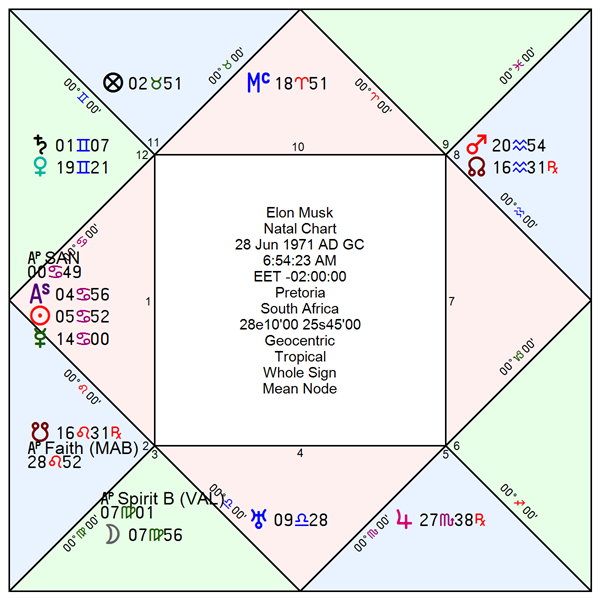
Rodden Rating B, Bio/autobiography, 7:30 AM, ASC 13CA30
Proposed Rectification: 6:54:22 AM, ASC 4CA56’23”
Special Note: please consult this post which identified the chart sect as nocturnal.
Alternate Rectification: 7:49:20 AM, ASC 18CA18’23”
Permission: I grant the unlimited use of this rectified horoscope by the public. Credit ‘Regulus Astrology LLC’ and include an accompanying link to this webpage.
The analytical models used in the sections below are part of a larger research program developed across longer white papers and case studies, where the historical sources, rules, and testing methodology are laid out in full. These database entries show the models in practice; readers who want the theoretical foundations can start with the background papers below:
Rectification Hub (I wrote the book on it!)
Soul Hub (white paper, Victor model statistical tests, Moon’s Configuration studies)
Physiognomy Hub (white paper, examples)
Victor Model Factors favoring Mars/Aquarius
Sign ruler: MC
Bound ruler: Sun, Ascendant, Prenatal Syzygy
Mars/Aquarius as Victor. Mars at 20°54′ Aquarius is placed in the 8th house, in its own bound, and rules both the Midheaven and the 5th house. Its rulership of the 5th provides one expression through entertainment, particularly Musk’s early fascination with computer games, a medium often built around combat, competition, weapons, and other martial themes. But Mars’s rulership of the Midheaven makes its vocational significance much more consequential. Mars/Aquarius describes rockets, advanced engineering, technological disruption, and most literally Musk’s overriding ambition to reach and eventually colonize Mars; Firdaria testing likewise found the nocturnal Mars major period closely aligned with the formative SpaceX years, from the development and repeated failures of Falcon 1 through its successful orbit, the NASA contract, and the first successful Falcon 9 launch. Its 8th-house placement adds the element of extreme risk: Mars describes where Musk is willing to risk everything, or, in the older analogy of the 8th house as the opening to the gates of hell, how he would go down fighting. Yet this is a nocturnal horoscope, placing Mars in sect and thereby moderating its excessive heat. The distinction is important: Musk repeatedly works with technologies capable of violent failure—rockets explode and Tesla vehicles sometimes burn—but the overwhelming majority do not. Mars is therefore not simply destructive; disciplined by sect and strengthened by its own bound, Mars/Aquarius converts controlled danger, engineering risk, and relentless competition into the central vocational signature of the horoscope.
Physiognomy Model Factors favoring Cancer
Rising sign and decan: Cancer
Ruler of rising sign and decan: Moon/Virgo
Planets in rising sign: Sun/Cancer and Mercury/Cancer
Physiognomy. Musk’s face combines two distinct characteristics. The overall structure is rectangular, with relatively straight sides and a firm, sharply defined jawline forming the lower boundary of the face. Superimposed on that angular framework, however, are distinctly softer features: smooth, almost silky-looking skin, fullness through the cheeks, and a rounded quality extending upward from the chin through the cheeks and bridge of the nose. This produces something of the traditional “man in the moon” appearance associated with Cancer. His body has likewise shown a tendency toward greater softness and weight gain at heavier weights, reinforcing the Cancer component rather than the leaner, more finely articulated appearance expected from Virgo.
Astrological Match. The physiognomy presents a genuine problem for the proposed rectification and should be stated as such. Cancer rising, with the Sun also in Cancer in the rising sign, accounts well for the lunar softness, rounded central facial features, skin quality, and tendency toward fullness; however, it does not account for the clearly rectangular underlying shape of the face. In Willner’s model, that rectangular structure points toward a fixed sign as the primary physiognomy significator. Yet the rectification places the first decan of Cancer on the Ascendant, leaving Cancer and the Moon’s sign, Virgo, as the relevant significators—and Musk shows little of the characteristic Virgo facial structure. A fixed-sign explanation becomes available only with a later birth time: the second decan of Cancer would introduce Scorpio, whose ruler Mars is in fixed Aquarius, while the third decan would introduce Pisces, whose ruler Jupiter is in fixed Scorpio. The evidence is therefore mixed: the Cancer imprint is readily visible, but the rectangular facial framework requires a fixed-sign influence that the proposed first-decan rectification does not provide. Either Willner’s physiognomy model fails in this instance, or the proposed rectification is incorrect. This should remain an explicit piece of contrary evidence rather than being forced to support the preferred birth time.
Moon’s Configuration (Complete – all aspects)
Stage I — Moon Virgo Ingress
Delineation. The Moon’s entry into Virgo establishes the underlying condition of the configuration. Virgo separates, measures, tests, corrects, and attends to details, giving the Moon a practical and analytical orientation. More important, the Moon is received by Mercury/Cancer, while Mercury is itself received by the Moon, creating a mutual reception between the two planets. Mercury supplies conception, calculation, and the ability to imagine products whose usefulness may not yet be obvious; Moon/Virgo supplies the detailed attention necessary to translate those concepts into functioning systems.
Biographical Match. Musk’s career repeatedly combines product conception with unusually detailed involvement in engineering and production. He does not operate solely as a financier or corporate executive: accounts of Tesla and SpaceX repeatedly show him engaging directly with technical specifications, manufacturing problems, costs, and design decisions. The Moon–Mercury mutual reception provides a useful signature for this combination of imaginative product conception and detailed technical execution.
Stage II — Moon Square Saturn (Gemini, 11th/12th)
Delineation. The Moon’s first aspect after entering Virgo is a square to Saturn/Gemini, located in the 11th quadrant house and 12th whole-sign house. Saturn/Gemini imposes limits upon ideas and communication, demanding factual demonstration, precision, and control before a concept can be accepted. The square introduces obstruction early in the sequence: ideas encounter skepticism, restrictions, or circumstances requiring them to prove their viability. The 11th/12th-house overlap connects this problem both with organizations and groups and with adversity, exclusion, and hidden or institutional obstacles.
Biographical Match. The earliest manifestation is Musk’s difficult relationship with his father, particularly relevant because Saturn also becomes the major Firdaria ruler during his teenage years. The pattern subsequently becomes vocational. Musk repeatedly advances proposals regarded as impractical or excessively ambitious—Internet banking, commercially viable electric cars, reusable rockets, and settlement of Mars—and encounters technical, financial, organizational, or regulatory resistance. Saturn does not prevent the idea; it forces the idea to survive testing.
Stage III — Moon Sextile Sun (Cancer, 1st)
Delineation. After the Saturn square, the Moon makes a constructive sextile to the Sun/Cancer, positioned close to the Ascendant. The Sun signifies visibility, authority, leadership, and the capacity to place the individual personally at the center of events. Of particular importance, the Sun occupies the bound of Mars, while Mars rules the Midheaven. The solar contact therefore does not stand apart from the vocational structure of the horoscope: solar prominence ultimately carries a Mars/MC signature.
Biographical Match. Musk did not remain the relatively anonymous engineer or founder behind his companies. He increasingly became their public representative, personally presenting products, explaining engineering objectives, promoting missions, and defending controversial decisions. This development becomes especially pronounced during the major Sun Firdaria period, when Musk’s public visibility expands far beyond the technology and financial communities. The Moon–Sun contact therefore describes not simply personal identity, but the eventual fusion of Musk the individual with Musk’s vocational projects.
Stage IV — Birth: Moon at 7°56′ Virgo
Delineation. The birth occurs after the Moon has separated from Saturn and the Sun but before its subsequent applications. This division is important. Saturn and the Sun describe conditions already established before birth, while the remaining aspects describe the direction in which the lunar configuration develops after birth. The natal Moon retains the Virgo emphasis on discrimination, calculation, correction, and practical execution while beginning its movement toward Mercury, its dispositor.
Biographical Match. Musk enters life with the Saturnian and solar components already embedded in the configuration: constraint followed by the drive toward visibility and leadership. The prospective portion of the sequence then turns toward Mercury, Venus, Mars, and Jupiter—a progression that closely resembles the later movement of the biography from ideas and commercial technology, through networks and finance, into engineering and finally large-scale expansion.
Stage V — Moon Applies to sextile of Mercury (Cancer, 1st)
Delineation. The Moon next applies by sextile to Mercury/Cancer in the 1st house. Because Mercury rules Virgo and the Moon rules Cancer, this is a mutual reception: each planet occupies the domicile of the other. Mercury/Cancer conceives products through an intuitive understanding of what people may want, including products for which no established market yet exists; Moon/Virgo subjects those ideas to calculation, refinement, and practical implementation. The combination joins imagination with detailed execution.
Biographical Match. This is visible from the beginning of Musk’s entrepreneurial career. Zip2 sought to bring maps, directories, and local information onto the emerging Internet; X.com attempted to persuade consumers to conduct financial transactions online before Internet banking was commonplace. The same pattern later reappears in Tesla, SpaceX, Starlink, and other ventures: Musk conceives a product or service before its market has fully formed and then becomes intensely involved with the technical details required to make it work. The Moon–Mercury mutual reception is therefore one of the principal signatures for the unusual combination of conceptual imagination and computational or engineering detail found throughout the biography.
Stage VI — Moon Sextile Venus (Gemini, 12th)
Delineation. The Moon subsequently applies by sextile to Venus/Gemini in the 12th house. Venus introduces exchange, attraction, relationships, and the ability to connect people, while Gemini emphasizes communication and networks. Because Venus/Gemini is ruled by Mercury, this phase remains dependent upon the preceding Mercury configuration rather than opening an unrelated sequence. Mercury creates and organizes information; Venus distributes it through networks and makes the exchange attractive to others.
Biographical Match. Zip2 and X.com/PayPal provide the early expression. Both used Internet technology to connect people with information, businesses, or money. The symbolism becomes still more literal much later with Musk’s purchase of Twitter and its transformation into X, where communication, social networks, commercial ambitions, and Musk’s own public persona converge. The 12th-house position also allows the same communications environment to become a source of difficulty: statements made through social media have repeatedly generated controversy, litigation, and regulatory disputes.
Stage VII — Venus (Gemini, 12th) applies to trine of Mars (Aquarius, 8th)
Delineation. This stage differs technically from the others because it is Venus, rather than the Moon, that applies to Mars. Nevertheless, it continues the chain established by the lunar configuration. Venus is disposed by Mercury and now carries the Mercury–Venus sequence into a trine with Mars/Aquarius, the proposed Victor of the horoscope, ruler of the Midheaven, and occupant of its own bound in the 8th house. The sequence therefore moves from ideas and commercial networks toward engineering, risk, competition, rockets, and the central vocation.
Biographical Match. The correspondence with Musk’s career is unusually clear. Zip2 and X.com/PayPal generate the capital that Musk subsequently redirects into SpaceX and Tesla. The transition is not merely chronological: wealth created through the Mercury/Venus businesses becomes the financial resource placed at risk in the Mars/Aquarius enterprises. Musk eventually committed so much of his PayPal fortune to SpaceX and Tesla that the failures of 2008 threatened his remaining liquidity. Venus therefore hands the proceeds of commerce to Mars in the 8th—the proposed Victor—where capital is risked in pursuit of the vocation that ultimately defines him.
Stage VIII — Moon Sextile Jupiter (Scorpio, retrograde, 5th)
Delineation. The final lunar application is a sextile to Jupiter at 27°38′ Scorpio, retrograde, in the 5th house. Under the retrograde model used here, Jupiter/Scorpio functions in its flipped-sign position of Jupiter/Taurus. Jupiter therefore signifies expansion, wealth, capitalization, physical scale, abundance, and reproduction, while its 5th-house position emphasizes children as well as creative enterprises. As the final application of the Moon, Jupiter describes expansion following the establishment of the Mars-centered vocation.
Biographical Match. Once SpaceX and Tesla survive their formative crises, the scale of Musk’s life increases dramatically. Tesla develops from a small Roadster manufacturer into a global automobile and energy company; SpaceX moves from Falcon 1 to Falcon 9, Falcon Heavy, Dragon, Starlink, and Starship; factories, launch facilities, satellite constellations, capital requirements, and Musk’s personal wealth all expand accordingly. The 5th-house placement is also unusually literal in Musk’s large number of children. The Moon’s final application therefore completes the sequence with Jupiterian multiplication: more capital, larger enterprises, greater physical scale, and more children.
Taken as a whole, the Moon’s Configuration describes a coherent progression: Saturnian obstruction → solar visibility → Mercury/Virgo conception and execution → Venus/Gemini networks and commerce → Mars/Aquarius engineering and risk → Jupiter/Taurus expansion and multiplication. Of particular importance for the rectification, the sequence independently reinforces the result obtained through Firdaria: Mars/Aquarius occupies the decisive vocational turning point, while Jupiter describes the large-scale expansion that follows once the Mars enterprise succeeds.
Influence of Sect
The proposed rectification produces a nocturnal figure, placing Venus and Mars in sect while Jupiter and Saturn are out of sect. This is particularly important for Mars/Aquarius, the proposed Victor. Mars is naturally hot and dry, but in a night chart its excessive heat is moderated, allowing its competitive, forceful, risk-taking qualities to operate more constructively: Musk builds rockets and high-performance vehicles in fields where explosions, fires, and catastrophic failure are inherent risks, yet most of these machines work as intended. Venus/Gemini is likewise in sect, supporting its more productive expressions through commerce, networks, communication, and social media. By contrast, Jupiter/Scorpio-retrograde and Saturn/Gemini are out of sect, making their benefits or restrictions less reliable. Jupiter can expand beyond prudent limits—capital commitments, corporate scale, personal wealth, and children all multiply—while Saturn can impose unusually severe problems involving control, regulation, procedures, employees, and institutional constraints. Sect therefore reinforces the central argument of the rectification: Mars may appear the most dangerous planet in the horoscope, but its in-sect condition helps make it one of the most functional, while the apparently more constructive Jupiter and restrictive Saturn operate with less moderation.
Complete biographical chronology, rectification and time lord studies available in Excel format as a paid subscriber benefit. File is behind the paywall.