

After his forced emigration from Nazi Germany in 1934 and relocation to the USA, Erich Fromm published his breakout book Escape from Freedom in 1941. It distinguishes between negative and positive forms of freedom. Negative freedom is “freedom from” and positive freedom is “freedom to.” His central thesis is that western capitalist economies have supplied negative freedom in abundance but little in the way of positive freedom. The resulting void of positive freedom leaves the populace at risk of indoctrination under authoritarian political regimes.
The study and teaching of crowd psychology are signified by Mercury and Jupiter in Cancer respectively and Fromm completes a quartet of philosophers on this topic as I launch the natal database section of the House of Wisdom Substack. While Fromm does not have Jupiter in Cancer in his natal horoscope, the Midheaven degree 17CA31 is in the bound of Mercury in Cancer for which crowd psychology is one signification. While I have read Escape from Freedom, I have yet to read a full-length biography for Fromm so my rectification, a slight advance of the birthtime, should be considered provisional.
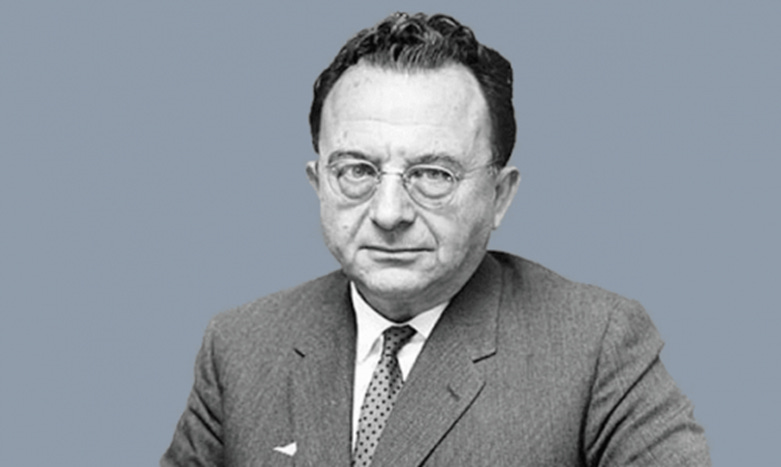
Erich Fromm (1900–1980) was a German-American psychoanalyst, philosopher, social critic, and public intellectual whose writings helped shape modern discussions of freedom, alienation, love, and the psychological foundations of political life. Born on March 23, 1900, in Frankfurt am Main, Germany, he was the only child of Naphtali Fromm and Rosa Krause, members of an Orthodox Jewish family. Raised in a household steeped in religious tradition and Talmudic scholarship, Fromm was exposed from an early age to questions of ethics, community, and human responsibility that would remain central to his work throughout his life.
The upheavals of the early twentieth century profoundly influenced his intellectual development. As an adolescent, he witnessed the social dislocation and nationalist fervor surrounding World War I, experiences that left him deeply skeptical of mass political movements and eager to understand why seemingly civilized societies could descend into violence and irrationality. He initially studied law at the University of Frankfurt before turning to sociology, philosophy, and psychology. In 1922 he completed a doctorate in sociology at the University of Heidelberg under Alfred Weber, brother of the renowned sociologist Max Weber. During this period, Fromm developed a lasting interest in the relationship between individual psychology and broader social structures.
Following his doctoral studies, Fromm trained as a psychoanalyst at the Berlin Psychoanalytic Institute under Hanns Sachs, one of Sigmund Freud’s closest associates. Although he embraced psychoanalysis as a powerful tool for understanding human motivation, he gradually became dissatisfied with Freud’s emphasis on biological drives and instinctual conflict. Fromm increasingly argued that personality could not be understood apart from the social, economic, and cultural environments in which people lived. This conviction would eventually place him among the leading figures of the neo-Freudian movement.
In the late 1920s and early 1930s, Fromm became associated with the Institute for Social Research, later known as the Frankfurt School. Working alongside thinkers such as Max Horkheimer, Theodor W. Adorno, and Herbert Marcuse, he participated in an ambitious effort to combine sociology, philosophy, economics, and psychology into a unified critique of modern society. Fromm’s contributions focused on the psychological mechanisms that linked individuals to social and political systems. His research explored how insecurity, loneliness, and dependence could make people susceptible to authoritarian ideologies, themes that would become increasingly urgent with the rise of National Socialism in Germany.
As the Nazi regime consolidated power, Fromm’s Jewish background and intellectual commitments made continued life in Germany impossible. He emigrated to the United States in 1934, joining many other European intellectuals who fled fascism. Settling first in New York, he taught and lectured at Columbia University, the New School for Social Research, Bennington College, and other institutions. During these years he refined the ideas that would bring him international recognition.
His most influential work, Escape from Freedom (1941), examined the paradox that modern individuals, though formally liberated from traditional authorities, often experience freedom as a burden rather than a blessing. According to Fromm, many people seek relief from uncertainty by submitting themselves to authoritarian leaders, rigid ideologies, or conformist social structures. Written during the era of fascism and world war, the book remains one of the most important psychological analyses of authoritarianism and political mass movements.
Fromm continued to develop these themes in a series of widely read books, including Man for Himself (1947), Psychoanalysis and Religion (1950), The Sane Society (1955), and The Art of Loving (1956). The latter became an international bestseller and introduced millions of readers to his argument that love is not merely an emotion but an active practice requiring discipline, knowledge, responsibility, and care. Throughout his work, Fromm rejected both radical individualism and collectivist conformity, advocating instead a humanistic vision in which personal fulfillment arises through productive activity, authentic relationships, and participation in healthy communities.
Beginning in the 1950s, Fromm developed a particularly strong connection to Mexico. He joined the faculty of the National Autonomous University of Mexico (UNAM), helped establish a psychoanalytic training institute, and conducted extensive cross-cultural research. Many of his most mature works were written during this period. Mexico provided both a professional base and a degree of intellectual independence from the academic and psychoanalytic establishments of the United States and Europe.
Politically, Fromm identified with democratic socialism and humanist traditions rather than revolutionary Marxism. He criticized both Western consumer capitalism and Soviet-style communism, arguing that each could produce forms of alienation that diminished human freedom and creativity. During the Cold War he became active in anti-nuclear and peace movements, supported international disarmament efforts, and spoke frequently on the moral responsibilities of modern societies. His writings found an especially receptive audience among students, religious reformers, psychologists, and social activists during the 1960s and 1970s.
By the end of his career, Fromm had established himself as one of the twentieth century’s most widely read interpreters of the human condition. His work bridged psychology, sociology, philosophy, religion, and political theory, seeking to explain how individuals might preserve their humanity within increasingly bureaucratic, technological, and impersonal social systems. Though some of his theories have been debated or revised, his analyses of loneliness, conformity, consumer culture, and the attraction of authoritarian politics continue to resonate in contemporary discussions of modern life.
Erich Fromm died on March 18, 1980, in Locarno, Switzerland, just five days before his eightieth birthday. His legacy remains influential in humanistic psychology, psychoanalysis, critical theory, religious studies, and political thought. More than any single doctrine, he left behind a sustained argument that psychological health and ethical responsibility are inseparable, and that a humane society depends upon cultivating both individual freedom and genuine human solidarity.
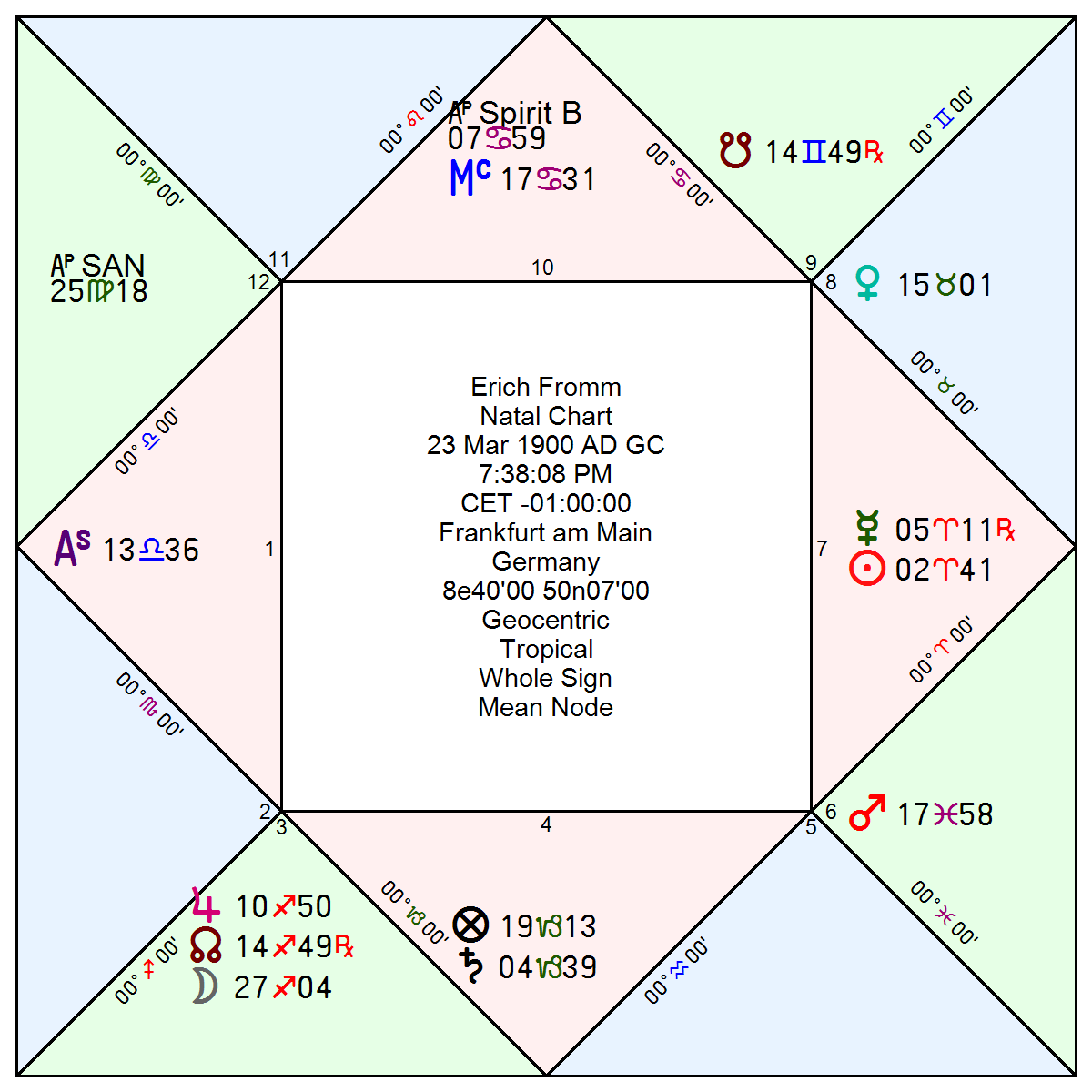
ADB Rodden Rating AA, Quoted BC/BR, 7:30 PM, ASC 12LI09
Proposed rectification: 7:38:07 PM, ASC 13LI36’44”
The analytical models used in the sections below are part of a larger research program developed across longer white papers and case studies, where the historical sources, rules, and testing methodology are laid out in full. These database entries show the models in practice; readers who want the theoretical foundations can start with the background papers below:
Rectification Hub (I wrote the book on it!)
Soul Hub (white paper, Victor model statistical tests, Moon’s Configuration studies)
Physiognomy Hub (white paper, examples)
Victor Model Factors favoring Jupiter/Sagittarius
Sign ruler: Moon
Bound ruler: Midheaven and Sun
Amplified by conjunction with North Node
Morning rising solar phase
Jupiter in Sagittarius in the 3rd house serves as victor of the horoscope and provides the organizing principle behind Fromm’s life’s work. The 3rd house governs communication, writing, teaching, publication, and the circulation of ideas, while Jupiter in its own domicile seeks enlargement of knowledge, intellectual freedom, and the search for universal principles. Fromm built his career through books, essays, lectures, and public engagement rather than through political office or institutional authority. The victor’s placement in the 3rd house is therefore remarkably literal: his enduring achievements came through the written and spoken word.
The conjunction of Jupiter with the North Node strengthens Jupiter’s capacity to express its significations. Throughout his career, Fromm repeatedly returned to questions of freedom, human development, and the conditions necessary for psychological flourishing. His major works—including Escape from Freedom (1941), The Sane Society (1955), and The Art of Loving (1956)—all examine the problem of how individuals might achieve meaningful autonomy within modern society. Jupiter in Sagittarius signifies freedom in its broadest sense, not merely freedom from external restraint but freedom directed toward the cultivation of wisdom, responsibility, and human potential.
The placement of Jupiter in the 3rd house is also consistent with Fromm’s role as an interpreter and communicator of ideas. Unlike many academic psychologists, he wrote for a general audience and sought to bridge psychology, philosophy, religion, and social criticism. His work continually moved between the personal and the collective, explaining how social institutions shape individual character and how individual choices contribute to the health or sickness of society. Jupiter’s combination of breadth, synthesis, and moral concern is visible throughout this effort to connect psychological insight with larger questions of ethics and culture.
Physiognomy Model Factors favoring Aquarius, Capricorn
Rising sign: Libra
Ruler of rising sign: Venus/Taurus
Rising decan: Aquarius
Ruler of rising decan: Saturn/Capricorn
Fromm’s physical appearance was distinctive and immediately recognizable. He appears to have been of below-average height, with several biographical sources and photographs suggesting a compact, stocky build rather than a tall or imposing frame. In portraits from middle age onward, he presents a broad forehead, rounded cheeks, a substantial nose, and a relatively short neck, giving the head a strong visual dominance over the body. His eyes were large and expressive, often conveying curiosity or concern rather than aggression. Deep horizontal furrows across the forehead became a prominent feature in later life, reinforcing the impression of a man engaged in constant reflection. His hair, dark in youth and later graying, was typically combed back from the forehead, while his round spectacles became an enduring part of his public image. The overall impression is not one of physical force or charisma in the conventional sense, but rather of intellectual intensity, attentiveness, and accessibility. Even in formal photographs, Fromm projects the demeanor of a teacher or counselor rather than that of an academic authority seeking distance from his audience.
From the standpoint of astrological physiognomy, Fromm presents an intriguing blend of Aquarius and Capricorn forms. The most obvious feature is the rectangular framework of the face, particularly visible when tracing the contour from the broad forehead downward through the temples and jaw. This rectangular structure corresponds closely to John Willner’s Aquarius type, conveying solidity, abstraction, and intellectual orientation. Superimposed upon this framework, however, is a softer ovate contour associated with Capricorn. The cheeks and lower face curve inward rather than maintaining a strictly geometric outline, producing the impression that the Capricorn oval has been laid over the Aquarius rectangle. The result is a face that combines the architectural quality of Aquarius with the more organic form of Capricorn. His ears are also unusually prominent and visible in both frontal and profile photographs, a feature that Willner associated with Capricorn. In that system, exposed ears echo the large ears of the goat from which the Capricorn glyph was originally derived. Taken together, the rectangular cranial structure, softened oval facial contour, and conspicuous ears produce a physiognomic blend that mirrors the interaction of Aquarius and Capricorn symbolism, with neither sign entirely dominating the visual presentation.
Moon’s Configuration
Phase I: Moon Separating from Mars (Pisces, 6th House)
Delineation. Mars in Pisces occupies the 6th house, a place associated with labor, servitude, illness, and conditions of dependency. In a mundane sense, the 6th house describes the laboring classes, while Mars signifies conflict, struggle, and compulsion. The Moon’s separation from Mars describes a movement away from conditions of constraint and subordination. Mars is ruled by Jupiter through its placement in Pisces, but more importantly Jupiter in Sagittarius overcomes Mars by superior square from the 3rd house. In Hellenistic astrology, the overcoming planet supplies the outcome or resolution of the condition represented by the overcome planet. The symbolism therefore describes a movement from Mars-signified servitude, coercion, and dependency toward Jupiter-signified freedom, understanding, and self-direction.
Biographical Match. This symbolism resonates strongly with Fromm’s lifelong concern for the psychological consequences of social dependence. His writings repeatedly examined how individuals surrender autonomy to political authorities, economic systems, and social conventions. Whether discussing fascism, bureaucratic capitalism, or rigid forms of psychoanalytic orthodoxy, Fromm consistently focused on conditions that reduce human beings to passive participants in systems they no longer control. The Moon’s departure from Mars mirrors his intellectual effort to move beyond coercion, conformity, and servitude toward a more expansive conception of human freedom.
Phase II: Void-of-Course Moon
Delineation. After separating from Mars, the Moon becomes briefly void of course before changing signs. This interval represents a transitional state in which the old condition has been left behind, but the new condition has not yet fully emerged. The Moon’s position near the end of Sagittarius suggests that the promise of Jupiterian freedom has been glimpsed but not yet secured. The native may recognize deficiencies in an inherited worldview long before a satisfactory alternative can be constructed.
Biographical Match. Fromm’s intellectual development followed precisely such a pattern. Although trained within orthodox Freudian psychoanalysis, he gradually became dissatisfied with its emphasis on instinctual drives and biological determinism. Yet he did not immediately abandon the Freudian framework. Instead, he spent many years revising, expanding, and reinterpreting psychoanalysis before developing the mature humanistic perspective for which he became famous. The void-of-course period reflects this prolonged interval between rejecting one system and establishing another.
Phase III: Moon Applying to the Sun (Aries, 7th House)
Delineation. After entering Capricorn, the Moon applies to a square of the Sun in Aries in the 7th house. Although out of sign, the aspect remains within moiety and therefore retains operative power. The Sun signifies individual identity, self-determination, and conscious direction. Its placement in the bound of Jupiter colors the solar principle with themes of freedom, growth, and moral development. The square indicates that the path toward this solar-Jupiterian condition is neither automatic nor effortless. It must be achieved through struggle, discipline, and conscious effort.
Biographical Match. This symbolism closely parallels Fromm’s distinction between negative and positive freedom. The individual may escape external authority, yet this alone does not produce fulfillment. Genuine freedom requires the difficult task of constructing an independent self capable of meaningful action and responsibility. Throughout his career, Fromm argued that many people retreat from this challenge and seek refuge in conformity, ideology, or authoritarian movements. His mature philosophy sought to guide individuals beyond mere liberation from constraints toward the creation of a productive and self-directed life. The out-of-sign application suggests that this destination lies beyond the assumptions of the original Sagittarian framework, requiring a transition into a new mode of understanding before the promise of freedom can be fully realized.
Influence of Sect
The nocturnal sect of the horoscope degrades the Moon’s configuration because it increases the influence of Mars as the in-sect malefic while reducing the influence of Jupiter as the out-of-sect benefic. This arrangement allowed Fromm to identify and analyze a wide range of Mars-signified conditions—authoritarianism, conformity, alienation, psychological dependence, and social coercion—with remarkable clarity. Yet the remedies he proposed were often more difficult to realize than the problems he diagnosed. His ideal of positive freedom required a level of self-awareness, responsibility, and moral development that many individuals and societies struggled to attain. The same sect condition may also be reflected in Saturn’s out-of-sect placement, for the social institutions Fromm hoped would support human flourishing often proved resistant to reform or vulnerable to the very authoritarian tendencies he criticized. Venus, by contrast, benefits from being in sect and finds expression in Fromm’s recurring emphasis on love, compassion, and authentic human relationships as essential components of psychological health. The result is a horoscope that vividly portrays the obstacles to human freedom while offering a more limited, though still compelling, vision of the conditions necessary to achieve it.
Early/Late Bloomer Thesis
Fromm’s longevity was 79 years, 11 months, and 24 days, placing the midpoint of his life at approximately age 40. He was granted United States citizenship on May 25, 1940, at age 40 years, 2 months, and 1 day, almost exactly at this midpoint. The following year he published Escape from Freedom (1941), the book that established his reputation and launched the phase of life for which he is chiefly remembered. Most of his major works, including Man for Himself (1947), The Sane Society (1955), and The Art of Loving (1956), were likewise produced after the midpoint of life. This pattern is consistent with the early/late bloomer thesis, which proposes that preventional nativities—those born after the Full Moon during the Moon’s waning phase—tend to manifest the most significant and enduring portions of their horoscope during the second half of life.
AI Notice: ChatGPT contributed to this article.
Complete biographical chronology, rectification and time lord studies available in Excel format as a paid subscriber benefit. They are behind the paywall.
