

G. William Miller occupies an unusual place in the history of the Federal Reserve—a transitional figure between the troubled tenure of Arthur Burns and the decisive regime of Paul Volcker. If Burns represents the accommodation of inflation and Volcker its suppression, Miller sits uneasily in between, presiding over a brief interlude in which the institutional framework of the Fed was reshaped even as its policy direction remained uncertain. His tenure is often dismissed as ineffective, and not without reason. Yet to reduce Miller to a failed chairman is to miss the deeper story: he was not brought in to impose discipline, but to manage a system that was already beginning to break down.
This distinction becomes clearer when viewed through the lens of his horoscope. The Moon in Virgo separating from Venus in Pisces and applying to Saturn in Scorpio describes a life path that moves from cooperation into conflict before achieving structured success. In Miller’s case, the early reliance on negotiation and accommodation—visible in both his personal life and his corporate career—gave way to the pressures of institutional struggle, most notably in the Textron proxy fight that brought him into Royal Little’s orbit. From there, the Moon’s trine to Jupiter in Capricorn, the victor of the chart, describes his ascent within Textron: ambition realized through structure, not vision. But the sequence does not end there. The Moon’s eventual opposition to the Sun forms a Full Moon condition, introducing tension that cannot be easily resolved—a signature that becomes most visible during his time at the Federal Reserve.
Placed in this context, Miller’s role in the Fed series comes into sharper focus. Carter did not select him as a monetary technician, but as a manager and mediator, an outsider who could restore credibility without provoking further instability. His contributions reflect that mandate. During his tenure, the Fed helped usher through the International Banking Act of 1978 and the Humphrey-Hawkins Full Employment Act, both of which reshaped the relationship between the central bank and the broader financial system. These were not minor achievements. They defined the institutional boundaries within which the Fed would operate for decades, formalizing oversight, expanding jurisdiction, and codifying the dual mandate.
Yet the same qualities that made Miller effective in institutional settings limited him in crisis. The chart’s emphasis on accommodation—reinforced by Venus in Pisces and a Jupiter in Capricorn that distorts rather than clarifies—points toward a leader inclined to balance competing demands rather than resolve them decisively. Faced with rising inflation, he hesitated where his successor would act. The result is a legacy defined by contrast: architect of institutional reform, but an ineffective steward of monetary policy. In this sense, Miller is not an anomaly in the series, but a necessary bridge—linking the failures of Burns to the corrective force of Volcker, and revealing, in the process, the limits of management when discipline is required.
Subscribe for complete access to model discussion for the victor, physiognomy, Moon’s Configuration, influence of sect, and the early/late bloomer thesis.
Complete biographical chronology, rectification and time lord studies available in Excel format as a paid subscriber benefit.
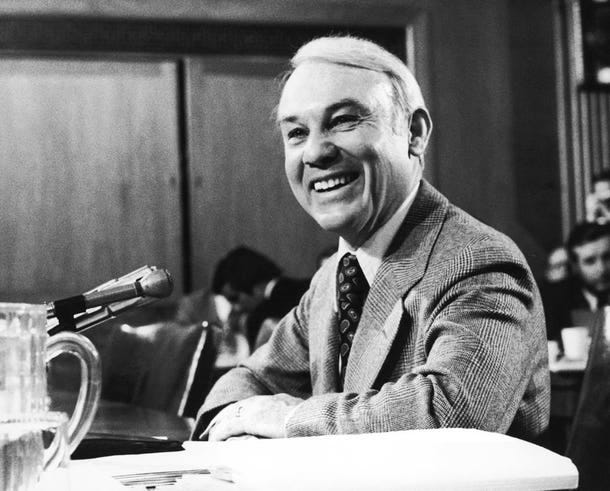
G. William Miller did not come out of central banking or academic economics, but from the older American path of regional ambition, wartime service, elite legal training, and corporate ascent. Born on March 9, 1925, in Sapulpa, Oklahoma, and raised largely in Borger, Texas, he grew up in a family that embodied upward mobility in the oil-boom Southwest. After service in the Coast Guard during World War II, including time in the Pacific and postwar Shanghai, Miller returned to the United States determined to pursue higher education. At UC Berkeley Law School, he rose to the top of his class and became editor of the California Law Review, already showing the combination of discipline and ambition that would define his career.
His entry into corporate America came through Cravath, Swaine & Moore, but it was a specific transaction that redirected his path. Cravath was retained by Textron during its proxy fight to acquire American Woolen, and Miller worked on that effort. The successful campaign brought him into close contact with Textron’s founder, Royal Little, who recognized in the young lawyer not merely technical ability but managerial ambition. Miller made clear that he did not intend to remain a career attorney, and Little moved quickly to recruit him. Shortly after Textron’s successful bid for American Woolen, Miller left Cravath to join the company in 1956, beginning a rapid ascent through its executive ranks.
His rise at Textron was striking: vice president within a year, president by 1960, and eventually chief executive officer in 1968 and chairman in 1974. He operated within the dominant corporate model of the era—the conglomerate—helping manage a sprawling portfolio of unrelated businesses assembled through acquisitions. Yet he was not simply a hard-driving empire builder. He articulated a more tempered philosophy of management, warning against maximizing profits at the expense of “human and spiritual values” and emphasizing the need to build institutions that accommodated different kinds of people. By the mid-1970s, he had become less a dealmaker than a coordinator of complexity, presiding over a mature conglomerate rather than constructing one from scratch.
Miller’s entry into public life began in 1970, when he became a Class B director of the Federal Reserve Bank of Boston, linking his corporate career to the Federal Reserve System. This role, typical for business leaders, exposed him to monetary policy at a high level without requiring technical expertise. It also made him visible to policymakers at a moment when confidence in the Federal Reserve was weakening. By the late 1970s, inflation was rising sharply in the aftermath of the 1973 oil crisis, and President Jimmy Carter was determined to replace Arthur Burns with a figure untainted by the politics of the Nixon era. Carter’s choice of Miller reflected both necessity and temperament: he wanted an outsider, not a doctrinaire economist, and believed that a capable corporate executive could bring managerial discipline to the central bank. Miller, with his reputation for pragmatism and independence, appeared to be a safe, non-ideological choice.
Sworn in as Fed Chair in March 1978, Miller brought precisely those administrative and consensus-building skills to the institution. During his brief tenure, he played a role in shepherding important legislative changes, including the International Banking Act of 1978, which extended Federal Reserve oversight to foreign banks operating in the United States, and the Humphrey-Hawkins Full Employment Act, which formalized the Fed’s dual mandate and established regular Congressional reporting. These were not trivial achievements. They helped define the institutional framework within which the Federal Reserve still operates today, shifting the relationship between Congress and the Fed toward accountability through transparency rather than direct control.
Yet Miller’s reputation as Fed Chair has been shaped far more by what he did not do. Faced with accelerating inflation, he proved reluctant to impose the kind of aggressive monetary tightening that the situation ultimately required. His instinct was to balance competing objectives—growth, employment, and price stability—rather than to force a decisive break with inflationary expectations. In a period that demanded discipline and clarity, his consensus-oriented style came across as indecisive, and his lack of deep monetary expertise became increasingly apparent. Within eighteen months, Carter moved him out of the Federal Reserve, replacing him with Paul Volcker, whose approach would be markedly more forceful.
In August 1979, Miller became Secretary of the Treasury, where his role shifted from monetary policy to financial and industrial stabilization. It was during this period that Congress passed the Depository Institutions Deregulation and Monetary Control Act (1980), which began the phased removal of interest rate ceilings and extended Federal Reserve reserve requirements across the banking system. Although much of this legislation reflected broader structural forces, Miller was part of the administration effort that carried it through. He is best remembered, however, for overseeing the Chrysler rescue, one of the first major federal interventions to stabilize a large industrial firm, which set a precedent for later government involvement in corporate crises.
Miller left office in January 1981 with the end of the Carter administration. His legacy is therefore a study in contrast. As a central banker, he is often judged harshly, remembered for failing to confront inflation at a critical moment. But this judgment obscures a more durable contribution. Through his involvement in the International Banking Act and Humphrey–Hawkins—and indirectly in the deregulatory framework of 1980—Miller helped shape the institutional architecture of modern American finance. He was not the man to impose discipline on the system, but he was one of the men who helped define how the system would be governed.
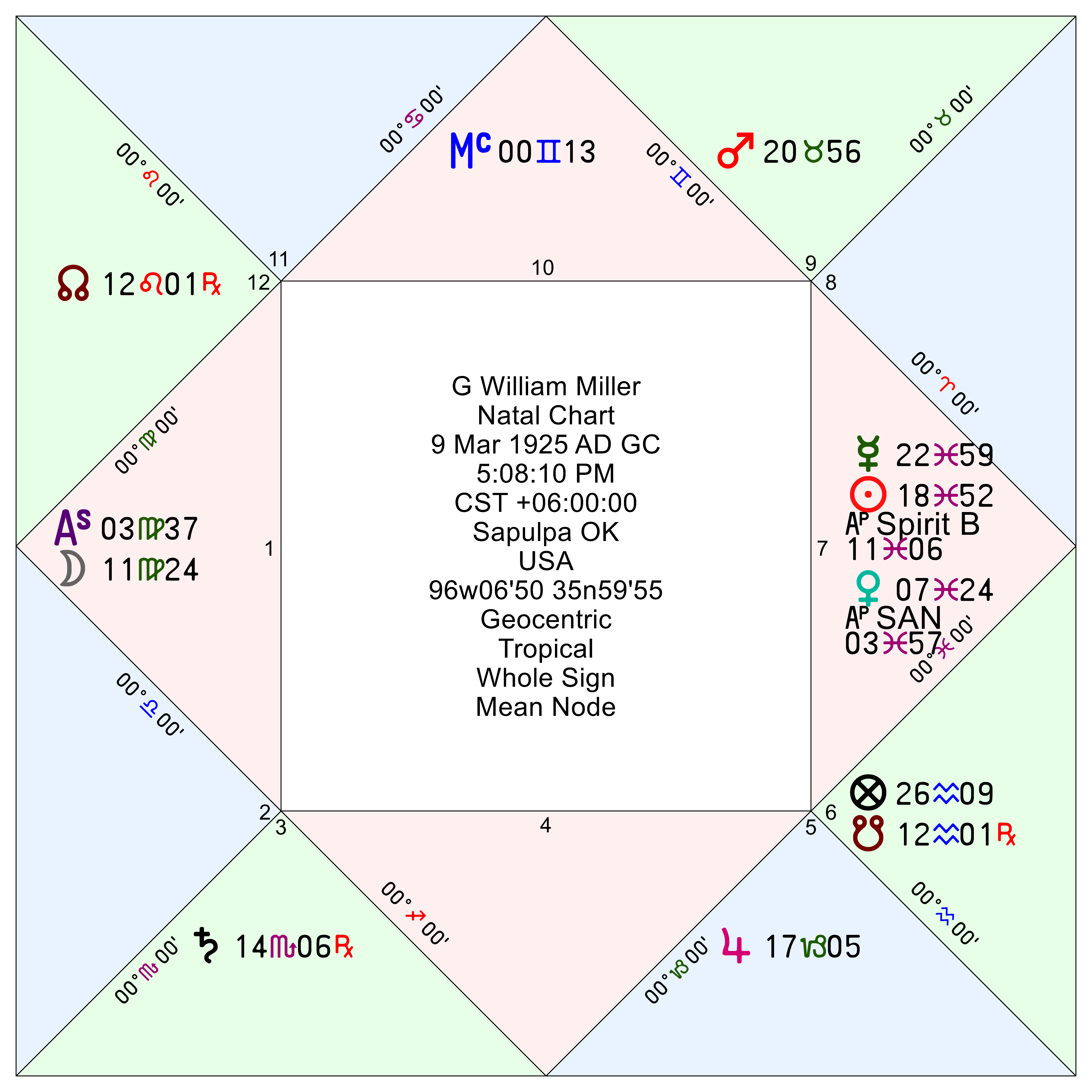
No Astrodatabank Record
Proposed rectification: 5:08:10 PM, ASC 3VI37’32”
This rectification needs more work though confident with early mutable degrees on the angles.
The analytical models used in the sections below are part of a larger research program developed across longer white papers and case studies, where the historical sources, rules, and testing methodology are laid out in full. These database entries show the models in practice; readers who want the theoretical foundations can start with the background papers below:
Rectification Hub (I wrote the book on it!)
Soul Hub (white paper, Victor model statistical tests, Moon’s Configuration studies)
Physiognomy Hub (white paper, examples)
Victor Model Factors favoring Jupiter/Capricorn as Victor
Sign ruler: Sun, Lot of Spirit, Prenatal Syzygy
Jupiter rules Venus-Sun-Mercury Pisces stelia in the 7th house
Major Jupiter Fidaria beginning 9-Mar-1976 increases Miller’s prominence with Democrat Pary politics; Jupiter-Mars timed Fed Chair; Jupiter-Sun timed Treasury Secretary.
Notable testimonies for Mercury:
Sign ruler: MC, ASC, Moon
Bound ruler: MC, ASC, Sun
While Mercury rules the bounds of three of the seven key significators for victor analysis (and Jupiter rules no bound) Mercury is received by Jupiter who ultimately takes over the victor role for Miller. Jupiter at 17° Capricorn as victor of the horoscope describes a career shaped by ambition under constraint, where the promise of growth is present but consistently redirected or diminished. Recent work has emphasized Jupiter in Capricorn as a morally compromised placement in an ethical sense, yet in Miller’s case the manifestation is better understood as distortion rather than outright corruption. The condition of Jupiter is filtered through its bound ruler, Venus at 7° Pisces in the 7th house, shifting its expression toward negotiation, accommodation, and settlement with others. This produces a leadership style inclined toward agreement rather than imposition. At Textron, the combination proved effective: a conglomerate assembled through Jupiter/Capricorn ambition—disciplined, acquisitive, and structurally coherent—was held together by the softer, cohesive influence of Venus in Pisces, supported by the broader Pisces cluster that provided institutional flexibility. In monetary policy, however, the same configuration worked against him. As an interest rate signature, Jupiter in Capricorn distorts the natural market-clearing rate—most notably by keeping rates too low in the face of rising inflation, as seen during his tenure at the Federal Reserve. The Venus/Pisces influence encourages forgiveness and accommodation—qualities that later found a more suitable outlet in the Chrysler bailout—but at the Fed translated into hesitation where discipline was required. Jupiter still brings trouble, but not through vice so much as through misplaced leniency in a system demanding restraint, yielding outcomes that are organized and well-intentioned yet ultimately lacking the force needed to sustain genuine economic expansion.
Physiognomy Model Factors favoring Capricorn
Rising sign and rising decan: Virgo
Ruler of rising sign and ruler of rising decan: Mercury/Pisces
G. William Miller presents a compact, composed physical type: medium height, solidly built without heaviness, and carrying himself with a restrained, almost administrative poise rather than physical dominance. In the photographs, his face is notably broad yet gently tapered, forming a clear ovate structure—full through the cheeks, narrowing toward the chin, with a smooth, unbroken contour. The forehead is rounded rather than angular, the jawline firm but not square, and the overall impression is one of contained symmetry rather than sharp definition. Most striking are the ears, which are visible even in frontal profile, subtly projecting from the head—an important detail in physiognomic terms. The expression reinforces this: calm, agreeable, slightly reserved, with a tendency toward a polite smile rather than intensity.
Overlaying this with John Willner’s framework, the head shape aligns closely with a Capricorn ovate, which in this system carries not only the oval contour but also the signature ear prominence, echoing the goat imagery embedded in the Capricorn glyph. While the chart suggests a Virgo rising with the first decan pointing to Mercury in Pisces as the physiognomy significator, the actual facial structure is better captured at the level of rulership. As with the victor analysis, Mercury yields to Jupiter, which governs the Pisces stellium and thereby reasserts itself as the primary significator. Jupiter, however, operates here through its placement in Capricorn, producing a physiognomy that is tempered, controlled, and structurally coherent rather than expansive. The result is a face that reflects Jupiterian breadth under Saturnian constraint—a moderated fullness, disciplined into symmetry and proportion. This combination avoids both the softness of Pisces and the sharpness of Virgo, instead presenting a balanced, managerial physiognomy, consistent with a figure whose public role was to coordinate rather than dominate.
Moon’s Configuration
Phase I – Moon separating from Venus (Pisces, 7th house)
The Moon in Virgo separating from Venus in Pisces describes a life that begins under the influence of grace, accommodation, and relational ease. Venus in Pisces is exalted and forgiving, inclined toward cooperation, generosity, and the smoothing over of conflict. When the Moon separates from such a planet, it carries forward a style shaped by agreement rather than imposition, and by the benefits that come through others rather than through solitary effort. This is not a confrontational beginning; it is one rooted in alliances, social integration, and the willingness to meet others halfway.
This phase finds a clear biographical match in Miller’s early adult life. His meeting and marriage to his wife, Ariadna Rogojarsky, during his Coast Guard service in Shanghai reflects the literal expression of Venus in the 7th. More broadly, his entry into elite professional circles—first through law school at Berkeley and then through Cravath—was facilitated not by force of personality but by adaptability, intelligence, and the ability to work within established systems. Even his initial contact with Textron came not through direct ambition toward corporate leadership, but through participation in a legal team—an inherently Venusian environment of negotiation and representation.
Phase II – Moon applying to Saturn (Scorpio, 3rd house, Retrograde)
As the Moon applies to Saturn, the tone shifts markedly. Saturn in Scorpio introduces constraint, pressure, and prolonged engagement within contested environments. In Scorpio, Saturn operates through intensity, strategy, and hidden struggle; in the 3rd house, this manifests through documents, negotiations, and the mechanics of communication itself. The retrograde condition deepens this further, indicating processes that are non-linear, drawn out, and internally complex, often requiring repeated engagement rather than clean resolution.
This phase corresponds closely to Miller’s early professional work as an attorney during Textron’s proxy fight for control of American Woolen. This was not a simple legal matter, but a protracted corporate struggle involving strategy, persuasion, and sustained pressure over time. Here, Saturn is not merely “law” in abstraction—it is the experience of conflict within institutional systems, where outcomes are uncertain and must be worked through incrementally. Miller is not yet the victor in this phase; rather, he is shaped by the discipline and demands of the struggle itself. This Saturnian period forms the crucible through which his later ascent becomes possible.
Phase III – Moon applying to Jupiter (Capricorn, 5th house)
Following Saturn, the Moon forms a trine to Jupiter in Capricorn, marking a release from pressure into structured advancement and institutional success. Jupiter here operates not in its full expansive dignity, but in Capricorn, where growth is disciplined, incremental, and tied to organizational hierarchy. The trine indicates that the experience of Saturn is not wasted; rather, it is integrated and redirected into opportunity.
This phase aligns with Miller’s rapid rise within Textron after the American Woolen proxy fight. Having demonstrated competence within a difficult and contested environment, he was recruited by Royal Little and advanced quickly through the company’s ranks—vice president, president, and eventually chief executive. The success is real, but it bears the mark of Jupiter in Capricorn: ambition realized through structure, growth achieved within limits, and advancement tied to the management of complex systems rather than visionary expansion. The Saturnian trial leads directly into Jupiterian reward, but in a moderated form.
Phase IV – Opposition to the Sun (Pisces, 7th house, Full Moon Condition)
The sequence culminates in the Moon’s opposition to the Sun in Pisces, forming a Full Moon configuration. This is a condition of tension and visibility, where opposing principles must be held simultaneously but are not easily reconciled. The Virgo–Pisces axis highlights the conflict between practical discernment and compassionate accommodation, between analytical clarity and the desire to preserve harmony.
In Miller’s life, this manifests most clearly during his tenure as Chairman of the Federal Reserve. Faced with rising inflation, he was unable to fully resolve the competing demands of economic growth and price stability. His instinct—shaped earlier by Venus and reinforced through Jupiter—was toward accommodation and balance, but the moment required decisive discipline. The Full Moon condition exposes this limitation: the inability to integrate opposing forces leads to outcomes that are visible, consequential, and ultimately judged as insufficient. His reluctance to impose aggressive interest rate increases reflects this unresolved tension.
Phase V – Creating the Loop
The configuration forms a coherent loop: from Venus (agreement) to Saturn (conflict), to Jupiter (structured success), and finally to the Sun (exposure and tension). The early reliance on cooperation gives way to the necessity of enduring conflict, which in turn enables advancement within institutional hierarchies. Yet the same qualities that facilitated ascent—moderation, accommodation, and system management—reassert themselves at the highest level, where they become limitations rather than strengths.
This loop explains the central paradox of Miller’s career. He succeeds through navigating systems and relationships, but when placed in a position requiring decisive control over those systems, he reverts to the earlier pattern of accommodation. The cycle does not fully resolve; instead, it repeats in different forms, linking his corporate success to his later difficulties in public office.
Phase VI – Assessing the Full Moon Birth
The Full Moon condition deserves explicit emphasis. Traditionally, such a configuration can indicate overextension, divided judgment, or difficulty maintaining internal coherence, particularly when opposing principles demand simultaneous expression. In Miller’s case, this is not a matter of personal instability, but of structural tension within decision-making. His career shows repeated evidence of balancing competing forces rather than decisively subordinating one to the other.
This does not negate his accomplishments. Indeed, it helps explain both his effectiveness in institutional settings—where balance and negotiation are valued—and his shortcomings in crisis conditions, where clarity and unilateral action are required. The Full Moon does not prevent success, but it shapes the manner in which success is achieved and the limits within which it can be sustained.
Influence of Sect
The figure is diurnal, placing Jupiter and Saturn in sect and Venus and Mars out of sect, and this distinction helps clarify both the strengths and limitations already observed in Miller’s chart. Jupiter, as victor, benefits from being in sect, which stabilizes its expression even in Capricorn, allowing it to operate through institutional channels with a measure of coherence and legitimacy. Saturn likewise gains footing from sect, softening what would otherwise be a more corrosive influence and instead directing its pressure into structured environments—legal, corporate, and administrative—where constraint becomes a productive force rather than a purely obstructive one. By contrast, Venus in Pisces, though dignified, is out of sect, and its tendency toward accommodation and forgiveness becomes less reliably placed, showing up at times where softness is ill-timed or misapplied. Mars in Taurus in the 9th, also out of sect, is muted and indirect, its capacity for decisive action blunted and rerouted into prolonged disputes rather than clean assertion. Taken together, sect reinforces the chart’s central pattern: the planets responsible for structure and authority are supported and therefore operative, while those inclined toward ease or decisive action are less well integrated, contributing to a leadership style that is organized and institutionally effective, yet hesitant when force or clarity is required.
Early/Late Bloomer Model
Miller was born shortly after a New Moon, but the Moon’s position places him effectively in a Full Moon phase, within orb of opposition to the Sun—a condition the Hellenistic astrologers describe as under the Sun’s bond, a form of lunar debility. He was born on March 9, 1925 and died on March 17, 2006, giving a longevity of about 81 years, with a midpoint at roughly age 40–41 (1965–1966). By that point, he had already achieved notable success—top of his class at Berkeley, a move from Cravath into Textron, and a rapid rise to president by 1960. Yet the defining phases of his life—CEO in 1968, chairman in 1974, Federal Reserve Chair in 1978, and Treasury Secretary shortly thereafter—all fall after the midpoint.
Miller therefore does not fit the model cleanly. While he shows early promise, the major career milestones fall after the midpoint, aligning more closely with natives born after a Full Moon. This runs counter to the expectation for a post–New Moon birth and highlights a recurring exception in the model: when the Moon is within 15 degrees of opposition to the Sun—under the Sun’s bond in Hellenistic terms—the pattern often breaks down. In these cases, development is not absent early on, but the weight of the life shifts later, producing outcomes that resemble Full Moon nativities rather than confirming the theoretical phase at birth.