

Before Jeff Bezos or Elon Musk imagined millions of people living and working in space, Gerard K. O’Neill had already designed the places where they might live.
Tomorrow’s post turns to Bezos. Today’s concerns the Princeton physicist whose ideas provide an important part of the intellectual architecture behind Bezos’s long-term vision for Blue Origin. Bezos has repeatedly invoked O’Neill’s argument that a growing technological civilization need not remain confined to the limited resources and surface area of Earth. The alternative was not primarily to abandon Earth for Mars, but to move increasing amounts of industry—and eventually human population—into enormous artificial habitats constructed in space. For O’Neill, the purpose was partly environmental: Earth could remain a place to live rather than becoming the industrial center of an indefinitely expanding civilization.
O’Neill arrived at this vision by an unusual route. Before becoming identified with space colonies, he was a Princeton particle physicist whose work on storage rings and colliding particle beams helped open the path toward the great particle colliders that followed. Then, during the Apollo era, he asked a deceptively simple question: is the surface of a planet really the best place for an expanding technological civilization? The answer redirected the remainder of his career. By the mid-1970s, O’Neill cylinders, lunar mining, electromagnetic mass drivers, solar-power satellites and permanent settlements in space had moved from a Princeton classroom exercise onto the front page of The New York Times and eventually 60 Minutes.
There is an astrological reason O’Neill belongs immediately before Bezos in this series. The horoscope places unusual emphasis on the tension between expansion and limitation—between a vision that continually enlarges the available field and the physical, institutional and financial structures required to make that expansion possible. Aquarius is prominent, as one might expect in the horoscope of a technological futurist, but it does not by itself explain the scale or purpose of O’Neill’s thinking. Another planet appears to supply the larger organizing principle: not simply invention, but abundance, growth and the extension of opportunity across society.
That distinction will become important when we turn to Bezos. O’Neill supplied much of the philosophy; Bezos has spent billions of dollars attempting to build part of the infrastructure. The two men approach the same problem from different historical positions and, as we will see, through different astrological configurations. O’Neill imagined a civilization freed from terrestrial limits. Bezos inherited that vision in a world where private capital and reusable rockets made portions of it less hypothetical. Today’s horoscope examines the visionary; tomorrow’s examines the industrialist trying to build the road to his vision.
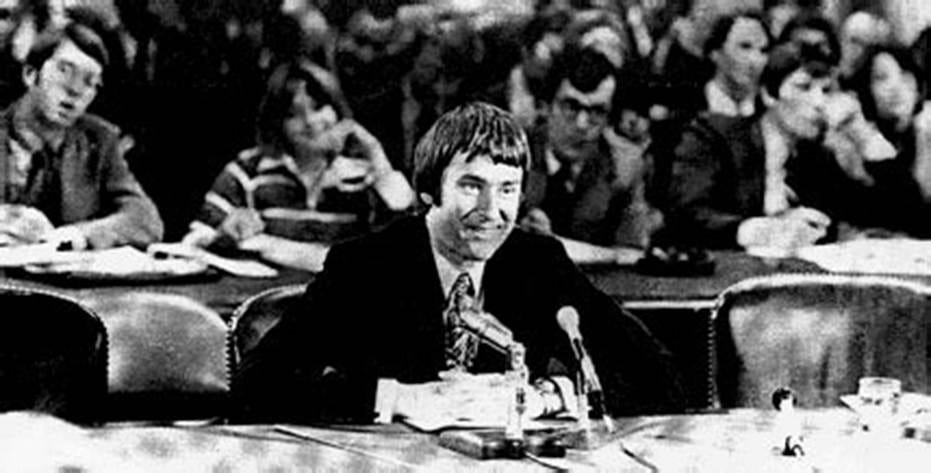
Gerard Kitchen O’Neill (1927–1992) was an American physicist, inventor, professor, entrepreneur, and advocate for the permanent human settlement of space. His career moved through three distinct phases: experimental particle physics, the design of large-scale space habitats, and attempts to commercialize new transportation and communications technologies. His ideas about moving heavy industry and eventually millions of people beyond Earth later became an important intellectual influence on the commercial space movement.
O’Neill was born in Brooklyn, New York, on February 6, 1927. At seventeen he enlisted in the U.S. Navy and served as a radar technician during the Second World War. After leaving the Navy, he studied physics at Swarthmore College, graduating with high honors in 1950, and continued to Cornell University, where he received his Ph.D. in physics in 1954. That year he joined the physics faculty at Princeton University, where he would spend most of his academic career.
O’Neill first established his reputation in high-energy particle physics. In 1956 he proposed the storage-ring technique, in which beams of particles could be accumulated and made to collide head-on, making far more of their energy available for investigating fundamental particles than conventional fixed-target experiments. O’Neill subsequently worked with Burton Richter and other researchers at Stanford to turn the idea into functioning hardware. The first beam was successfully stored in 1962, followed by electron-electron scattering experiments that culminated in the first mature colliding-beam physics experiment by 1965. Richter later recalled that what they learned during the project opened a new field of particle-physics research.
It was work at the forefront of a field that would soon produce Nobel-winning discoveries. Richter carried colliding-beam physics forward at Stanford, where the SPEAR storage ring produced the J/ψ discovery for which he shared the 1976 Nobel Prize in Physics with Samuel Ting. Storage-ring colliders subsequently became fundamental instruments of high-energy physics. O’Neill, however, had begun redirecting his attention toward a very different problem, and his pioneering role in particle accelerators became overshadowed by his later reputation as an advocate for space colonization. Freeman Dyson would later write that O’Neill had effectively taught the world how to build this new generation of high-energy physics machines before moving on to other things.
In 1965 O’Neill became a full professor at Princeton. Two years later he was a finalist for NASA’s sixth group of scientist-astronauts but was not selected. His career nevertheless began moving toward space through an unexpected route: undergraduate teaching. In 1969, while teaching physics at Princeton during the Apollo era, O’Neill began asking his students to analyze whether the surface of a planet was really the best place for an expanding technological civilization. The question initiated the research that would occupy much of the remainder of his life.
O’Neill spent the next several years working through the engineering implications. Instead of concentrating on settlements on the Moon or Mars, he proposed constructing enormous rotating habitats in free space. Rotation would provide artificial gravity, mirrors would provide sunlight, and enclosed landscapes could support agriculture, industry, vegetation, and large human populations. Raw materials could be obtained from the Moon and later from asteroids, avoiding the enormous expense of lifting most construction material from Earth.
His ideas initially struggled to find a publisher. That changed in 1974 when Physics Today accepted his paper “The Colonization of Space.” On May 10, O’Neill convened a conference at Princeton to discuss space settlement with scientists and engineers. Three days later, Walter Sullivan reported the proposal on the front page of The New York Times. The publicity transformed O’Neill from a Princeton physicist pursuing an unusual sideline into a nationally known advocate for space colonization. Coverage in magazines and broadcast media followed.
O’Neill’s proposal was not simply to put people in space. It was an argument about resources, energy, population, and the environmental limits of Earth. Large orbital settlements could be powered by solar energy, while resource-intensive industries could eventually be moved away from the terrestrial environment. Space offered access to quantities of energy and material vastly greater than those available within a closed terrestrial economy. SSI would later describe abundant clean energy, including energy for developing countries, as one of the principal reasons for pursuing space-based industry.
During 1975 and 1976 O’Neill moved increasingly into public advocacy. He organized further Princeton conferences on space manufacturing, testified before congressional committees, participated in NASA studies, and attracted a growing network of scientists, engineers, environmentalists, futurists, and space enthusiasts. The L5 Society, founded in 1975 by Keith and Carolyn Henson, developed into an activist organization devoted to advancing many of O’Neill’s ideas.
O’Neill simultaneously worked on the engineering required to make his proposals plausible. One of his most important inventions was the mass driver, an electromagnetic launcher intended to accelerate material without chemical rockets. A mass driver located on the Moon, where gravity is much weaker and there is no atmosphere, could theoretically propel lunar material into space for construction. O’Neill built his first mass-driver prototype in 1976, turning another element of his space-settlement proposal into working hardware.
The movement reached its public high-water mark in 1977. O’Neill published The High Frontier: Human Colonies in Space, which presented the case for orbital settlements to a general audience and received the Phi Beta Kappa science-book award. The same year he established the nonprofit Space Studies Institute (SSI) to pursue research into mass drivers, lunar resources, space manufacturing, solar-power satellites, and related technologies outside the conventional government space program.
National attention also brought political resistance. In October 1977, CBS’s 60 Minutes broadcast a segment on space colonies. Senator William Proxmire, an influential critic of government spending, publicly attacked the proposal as a fantasy undeserving of federal money. The episode symbolized the larger problem confronting O’Neill’s program: enthusiasm for post-Apollo space settlement was colliding with tighter federal budgets and a NASA increasingly committed to the Space Shuttle rather than the construction of large orbital communities.
O’Neill responded by shifting emphasis from government programs toward privately financed research. SSI began operations in Princeton in early 1978 and sponsored work on improved mass drivers, processing lunar materials, solar-power satellites, asteroid resources, and methods by which an extraterrestrial industrial base might gradually reproduce much of its own machinery. O’Neill wanted small, privately supported groups to demonstrate technologies independently of government and at substantially lower cost.
His optimism about technology extended well beyond space. In 2081: A Hopeful View of the Human Future (1981), O’Neill considered how technological change might transform energy, transportation, communications, and human settlement over the following century. He increasingly moved from academic physics toward entrepreneurship, attempting to convert inventions into commercial systems.
The most important of these ventures was Geostar Corporation, founded in 1983. O’Neill envisioned a satellite system capable of determining the location of aircraft, vehicles, and individuals while also providing digital communications. The concept anticipated features that later became commonplace through satellite navigation and mobile communications. Geostar raised private capital, sought regulatory approval, and pursued the development of its Radio Determination Satellite Service. The Smithsonian describes the company as a pioneer in satellite-based tracking and locating services whose work contributed to the subsequent development of the field.
In 1985 O’Neill retired from Princeton as professor emeritus and President Ronald Reagan appointed him to the National Commission on Space, bringing him back into national space-policy discussions. That same year he was diagnosed with leukemia. His illness reduced his involvement with Geostar and coincided with growing conflict inside the company, including a proxy dispute and subsequent litigation.
Despite his illness, O’Neill continued developing new technologies. In 1986 he founded O’Neill Communications, which developed LAWN, a radio-based local-area networking system. Near the end of his life he pursued another project called Magnetic Flight, a high-speed ground-transportation system using magnetic propulsion, through VSE International. His commercial projects encountered financial, managerial, and technical difficulties, and Geostar ultimately filed for bankruptcy in 1991. Yet the succession of ventures showed the same pattern that had characterized his particle-physics and space work: identify a technological limitation, propose a different physical architecture, and attempt to demonstrate it experimentally.
O’Neill died of leukemia on April 27, 1992, at the age of sixty-five, after a seven-year illness. He continued working until shortly before his death. One month before he died, he told the Space Studies Institute that its mission would remain unfinished until people were living and working in space.
O’Neill did not live to see large orbital settlements constructed. His more immediate technological work, however, contributed to particle accelerators and anticipated developments in satellite positioning, wireless networking, electromagnetic launch systems, and privately financed space research. His larger legacy was an alternative conception of humanity’s future in space: rather than settling primarily on other planetary surfaces, civilization could construct its own environments from extraterrestrial materials and expand beyond the physical limits of Earth. Decades later, that idea would find a new audience among the entrepreneurs building the commercial space industry.
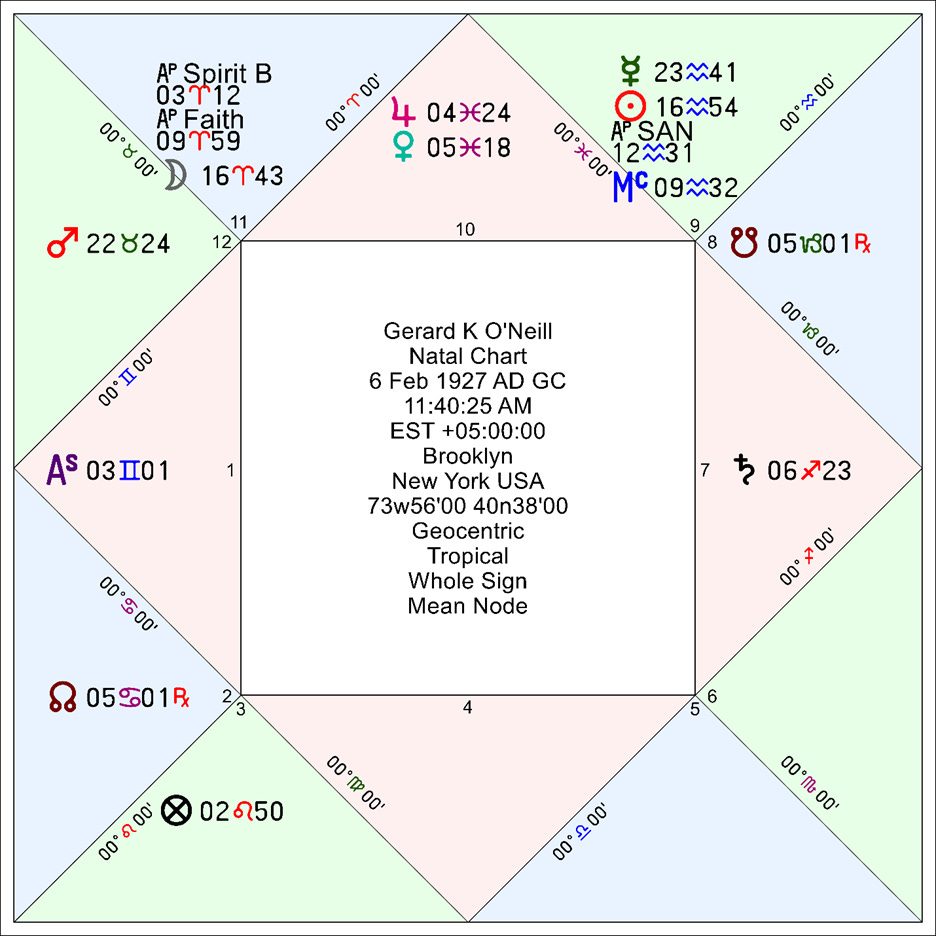
No Astrodatabank Record
Proposed Rectification: 11:40:25 AM, ASC 3GE01’47”.
I rate this rectification accurate to within 1 degree
The analytical models used in the sections below are part of a larger research program developed across longer white papers and case studies, where the historical sources, rules, and testing methodology are laid out in full. These database entries show the models in practice; readers who want the theoretical foundations can start with the background papers below:
Rectification Hub (I wrote the book on it!)
Soul Hub (white paper, Victor model statistical tests, Moon’s Configuration studies)
Physiognomy Hub (white paper, examples)
Victor Model Factors favoring Jupiter/Pisces
Bound rulership: Sun, Lot of Fortune, Lot of Spirit
Position: 10th whole sign from Ascendant
Jupiter’s central theme is expansion beyond existing limits, while Pisces gives that expansion a universal and humanitarian objective. O’Neill’s vision was not merely technological: space offered a means of overcoming terrestrial limits on population, resources and energy while reducing environmental pressure on Earth. Jupiter is placed in the 10th house by whole-sign houses, connecting these themes directly with career, reputation and public accomplishment, and in the 11th house by quadrant houses, emphasizing the groups and organizations through which his vision was advanced. The latter is particularly descriptive of the communities that formed around his ideas—the Princeton space-manufacturing conferences, the L5 Society, the Space Studies Institute, and eventually the broader constituency for permanent human settlement beyond Earth. Jupiter also describes the scale of O’Neill’s thinking: not individual spaceflight but entire populations, not isolated spacecraft but self-sustaining civilizations, and not merely exploration but an effectively unlimited expansion of the human sphere. His career repeatedly returned to this Jupiter/Pisces premise that apparent scarcity could be overcome by enlarging the field in which humanity operates.
Physiognomy Model Factors favoring Gemini, Aquarius
Rising sign and rising decan: Gemini
Ruler of rising sign and rising decan: Mercury/Aquarius
O’Neill presents a somewhat difficult physiognomic case, although several features are consistent across photographs taken at different ages. His face is moderately long and relatively narrow, with a firm jaw tapering toward the chin, prominent straight eyebrows, a substantial nose, and closely arranged features. His build appears lean to medium rather than heavy, reinforcing the generally elongated rather than broad impression. Another feature is particularly consistent: the hair is cut almost horizontally across the front, creating a pronounced straight upper boundary. Although relatively little of the forehead is exposed, the horizontal hairline and straighter sides leave a small but clearly visible rectangular shape.
Astrologically, Gemini is both the rising sign and rising decan, with Mercury/Aquarius as the principal physiognomy significator. Using Robert Willner’s physiognomy model, Gemini produces an elongated face, while Aquarius produces a square face or rectangular forehead—the latter sometimes resembling the straight edge of a bulldozer blade. O’Neill therefore fits the model better than might initially appear: the moderately long face corresponds to Gemini, while the smaller rectangular forehead, made especially noticeable by his consistently horizontal haircut, corresponds to Mercury/Aquarius. The match is nevertheless less obvious than in stronger examples of either type, making O’Neill a relatively difficult physiognomic case. This is consistent with findings from other rectifications in which Gemini Ascendants have tended to produce some of the least reliable physiognomic results; here, however, the elongated face and rectangular forehead provide separate physical correspondences to the two principal significators.
Moon’s Configuration
Stage One — Moon separates from Saturn/Sagittarius
Delineation. The Moon at 16°43′ Aries in the 11th house separates from the trine of Saturn at 6°23′ Sagittarius in the 7th. By William Lilly’s aspect moieties, the allowable Moon–Saturn distance is 10°30′; at 10°20′, the separating trine remains operative by only ten minutes of arc. It is therefore a marginal configuration: Saturn provides a prior direction or structure, but the Moon is already at the outer edge of its influence. This suggests an almost-wandering period, during which the life has direction but lacks the clear destination normally provided by a more strongly separating aspect. Saturn/Sagittarius nevertheless establishes the underlying problem that O’Neill will eventually attempt to solve: material restrictions and physical boundaries set against expansion into a much larger domain.
Biographical Match. O’Neill’s early career shows precisely this combination of achievement and incomplete direction. He served as a Navy radar technician, trained as a physicist, joined Princeton, invented the storage-ring technique, and helped establish colliding-beam physics—a line of research that would become fundamental to modern particle accelerators. Yet this highly successful scientific career did not become his defining life work. His 1967 failure to enter NASA’s astronaut corps was followed in 1969 by the question that redirected his career: whether an expanding technological civilization needed to remain confined to planetary surfaces. The Moon therefore does not emerge from a true void, but from the very edge of Saturn’s influence, producing something close to a period of wandering before O’Neill identifies the subject that will make him publicly recognizable.
Stage Two — Moon applies to Sun/Aquarius
Delineation. The Moon next applies to the Sun at 16°54′ Aquarius, placed in the 10th house by quadrant division and 9th by whole signs. The Sun promises visibility, reputation and celebrity, while Aquarius directs that recognition toward science, technology and ideas concerning the organization of the future. More importantly, the Sun lies in the bound of Jupiter, and Jupiter/Pisces is the victor of the horoscope. The Moon therefore moves from a marginal separation from Saturn toward a solar expression governed by the victor: O’Neill’s life becomes publicly identified with Jupiter/Pisces themes of expansion, abundance and a vision intended to benefit humanity. Saturn/Sagittarius, by superior square to Jupiter, ultimately possesses the stronger position and imposes limits on the Jupiterian program; nevertheless, the Moon’s application to the Sun allows O’Neill to eke out celebrity status for that vision before Saturnian political, financial and practical restrictions prevail.
Biographical Match. The application is realized most clearly in O’Neill’s transformation during the 1970s from Princeton physicist into the public face of space development. His 1969 investigations led to the 1974 Princeton conference, Walter Sullivan’s 13-May-1974 front-page New York Times article, widespread national media coverage, congressional testimony, the growing L5 movement, and finally The High Frontier in 1977. His appearance on 60 Minutes at the movement’s high-water mark made the solar promise particularly literal: O’Neill had become a nationally visible spokesman for a technological vision of human expansion. Yet the success proved difficult to sustain. Senator William Proxmire’s attack, declining federal support, and the retreat of NASA from large-scale space-settlement plans demonstrated Saturn’s superior position over Jupiter. O’Neill never realized the civilization he envisioned, but the Moon’s application to a Sun/Aquarius governed by the Jupiter bound was sufficient to make both O’Neill and his vision of permanent human settlement in space publicly known.
Influence of Sect
The horoscope is diurnal, placing Jupiter and Saturn in sect while Venus and Mars are out of sect. Jupiter/Pisces in sect, as victor of the horoscope, supports O’Neill’s ability to expand the scope of his vision from a technical proposal for orbital habitats into a broader program addressing energy, resources, population, environmental preservation, and the future organization of human society. Saturn/Sagittarius in sect takes some of the sharp edge off Saturn, even though Saturn overcomes Jupiter by superior square and ultimately restricts the Jupiterian vision. O’Neill’s failure to become a NASA astronaut, for example, was a genuine limitation but not one severe enough to drive him away from space development; instead, he found another route into the field and continued working in it for the remainder of his life. The out-of-sect malefic Mars/Taurus operates more harshly, amplifying concerns about the destruction and exhaustion of terrestrial resources—one of the pressures behind O’Neill’s argument for moving population and industry beyond Earth. Venus/Pisces out of sect may be visible in the less convincing aesthetic side of the project: the idealized illustrations of luxurious orbital landscapes, abundant greenery, attractive homes, and comfortable lifestyles helped popularize the colonies, but their fanciful quality may also have limited their acceptance by making the program appear more utopian than practical.
Early/Late Bloomer Assessment
O’Neill was born after a New Moon, placing him in the early-bloomer category under this model. His longevity was 65 years, giving a life midpoint at approximately 33 years of age, in 1959. The biographical fit is reasonably strong: well before the midpoint he had completed his doctorate, joined the Princeton faculty, and in 1956 proposed the storage-ring technique that established his importance in high-energy physics. By the time he reached the midpoint, he was already engaged in the experimental development of colliding-beam technology that would become foundational to modern particle physics. His later fame as the advocate of space colonization came after the midpoint, but it represented a redirection of an already established scientific career rather than a late emergence into accomplishment. On balance, O’Neill fits the early-bloomer model well: his principal intellectual and professional capacities were evident early, while the second half of life enlarged and redirected them toward space development and technological entrepreneurship.
Complete biographical chronology, rectification and time lord studies available in Excel format as a paid subscriber benefit. File is behind the paywall.