

The Jupiter in Leo series continues with the third of three major Romantic composers: Anton Bruckner, Richard Wagner, and Gustav Mahler. Bruckner’s Jupiter in Leo supported the grandeur, confidence, and doctrinal scale of a musical vision ultimately governed by Mercury in Libra as victor. Wagner’s Jupiter in Leo was itself the victor, directing myth, drama, and music toward the construction of a new cultural order. Mahler also has Jupiter in Leo as victor, but his version of the configuration turns the symphony into a philosophical meditation on life, death, suffering, nature, and the search for transcendence.
The comparison between Wagner and Mahler is especially instructive because both were born with Jupiter in Leo as the ruling planet of the horoscope, yet their lives and legacies developed very differently. Wagner’s work achieved enormous cultural reach during his lifetime, and his public identity became inseparable from the mythology he created around German art and civilization. Mahler, by contrast, was celebrated principally as a conductor while alive. The wider recognition of his compositions came later, as succeeding generations of conductors and orchestras revealed the full scale of his achievement.
Sect helps explain this divergence. Wagner was born in a diurnal figure, making Jupiter the in-sect benefic. His Jupiter in Leo therefore operated with unusual breadth, carrying his artistic and ideological program far beyond the opera house and into the wider culture. His Mars, however, was the out-of-sect malefic. It repeatedly troubled the practical foundations of his life through debt, unstable income, damaged alliances, political conflict, exile, and dependence upon patrons.
Mahler’s nocturnal figure reverses this relationship. His Mars in Capricorn is the in-sect malefic, giving conflict a disciplined, strategic, and constructive form. Mahler did not merely rebel against the established musical hierarchy; he reorganized it. His exacting rehearsals, demands for orchestral precision, resistance to inherited performance habits, and reform of operatic production made him an effective disruptor of musical institutions. Mars remained severe and uncompromising, but its severity served structure, execution, and artistic reform.
Mahler’s Jupiter in Leo, although still the victor, is the out-of-sect benefic. It supplied the scale, moral seriousness, and philosophical ambition of his music, but with less immediate scope for public success than Wagner’s in-sect Jupiter. Mahler imagined musical worlds vast enough to contain the personal and the universal, the grotesque and the sublime, yet much of the recognition due to those works arrived only after his death. Jupiter gave him the vision; sect qualified the speed and reach of its realization.
The nocturnal chart also places Venus in the favored sect. Retrograde and closely joined to the South Node in Leo, Venus appears to redirect much of its operation toward Aquarius. This moderates Mars without weakening it. Mahler’s discipline was not exercised merely for personal domination, but to bind singers, musicians, and orchestral sections into a unified artistic body in service of the score. Mars supplied the pressure and organization; Venus gave that pressure a collective purpose.
The result is a useful demonstration of why the victor cannot be interpreted in isolation. Wagner and Mahler share Jupiter in Leo as victor, but sect changes the distribution of power within each horoscope. Wagner’s Jupiter expanded his public reach while Mars destabilized his life. Mahler’s Mars became the engine of institutional achievement, while Jupiter’s promise unfolded more slowly and attained its greatest scope through his posthumous reputation. Mahler’s horoscope therefore shows not simply what Jupiter in Leo signifies, but how its expression is conditioned by the entire planetary order of the nativity.
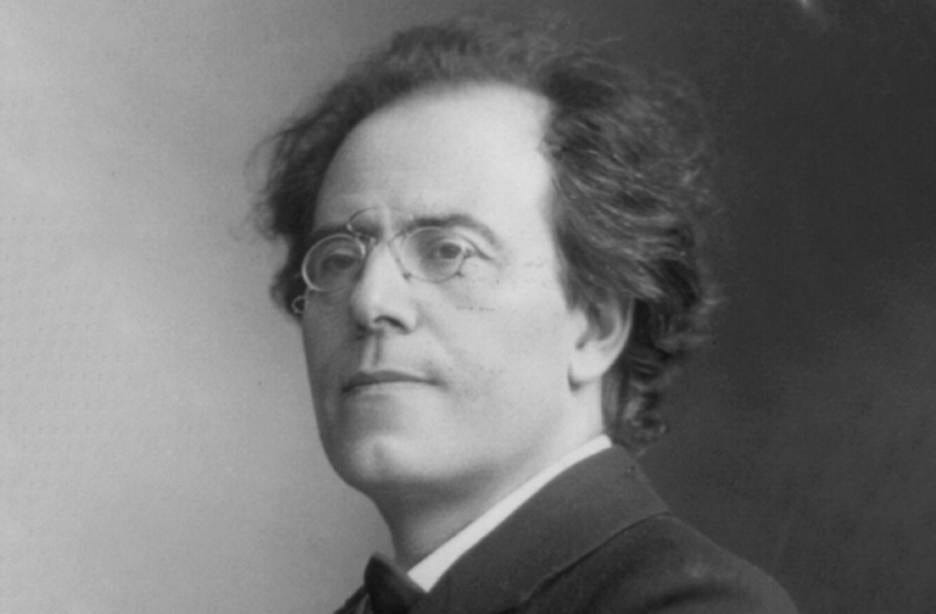
Few composers have fused autobiography and music as completely as Gustav Mahler (1860–1911). His symphonies transformed the orchestra into a vehicle for philosophical reflection, exploring themes of life, death, nature, love, faith, and transcendence on an unprecedented scale. Although celebrated today as one of the greatest symphonists in Western music, Mahler spent most of his career known primarily as the leading conductor of his generation rather than as a composer.
Mahler was born on July 7, 1860, in Kaliště, Bohemia, then part of the Austrian Empire, and grew up in nearby Iglau (today Jihlava in the Czech Republic). The second of fourteen children, he experienced tragedy from an early age as several siblings died in childhood. These repeated encounters with mortality profoundly shaped his emotional world and later found expression in works that continually return to questions of suffering, innocence, and the possibility of redemption. His childhood was equally influenced by military bands, folk music, synagogue chant, Catholic liturgy, and the sounds of everyday provincial life, all of which became woven into his mature musical language.
Displaying exceptional musical talent, Mahler entered the Vienna Conservatory as a teenager before embarking on a conducting career that advanced rapidly through opera houses in Central Europe. Appointments in Kassel, Prague, Leipzig, Budapest, and Hamburg steadily enhanced his reputation, culminating in his appointment in 1897 as director of the Vienna Court Opera. There he imposed exacting artistic standards that transformed the institution into one of Europe’s finest opera companies. His relentless perfectionism earned both admiration and resentment, but few disputed his extraordinary command of the repertoire.
Because high public office in imperial Vienna effectively required membership in the state church, Mahler converted from Judaism to Roman Catholicism shortly before assuming the Vienna directorship. While the conversion was largely pragmatic, questions of spirituality remained central throughout his life. His music rarely expresses conventional religious certainty; instead it presents an ongoing search for meaning through struggle, resignation, and ultimately transcendence.
Mahler composed almost exclusively during his summer vacations, retreating to isolated composing huts where he could escape the demands of conducting. Across nine completed symphonies, the unfinished Tenth Symphony, and song cycles such as Lieder eines fahrenden Gesellen, Des Knaben Wunderhorn, Kindertotenlieder, and Das Lied von der Erde, he expanded the emotional and structural possibilities of the symphonic tradition. His works juxtapose the sublime with the grotesque, rustic dances with funeral marches, military fanfares with birdsong, creating musical worlds that embrace both the ordinary and the cosmic.
His personal life brought moments of both great happiness and profound sorrow. In 1902 he married Alma Mahler, an intelligent and gifted musician nearly twenty years his junior. Their marriage produced two daughters but was marked by emotional strain, Mahler’s demanding personality, and Alma’s frustration that her own creative ambitions were largely subordinated to his career. The death of their eldest daughter, Maria, from scarlet fever in 1907 devastated the family and permanently altered Mahler’s outlook.
That same year proved catastrophic in other ways. Mahler was forced from the Vienna Court Opera amid growing political tensions and anti-Semitic hostility, while physicians diagnosed the heart condition that would eventually claim his life. Accepting an invitation from the Metropolitan Opera, he moved to New York, later dividing his conducting duties between the Metropolitan Opera and the New York Philharmonic. Despite declining health, these final years witnessed an extraordinary burst of creative inspiration that produced Das Lied von der Erde, the Ninth Symphony, and substantial portions of the unfinished Tenth Symphony.
Mahler died in Vienna on May 18, 1911, at the age of fifty. His music remained controversial for decades after his death, admired by a devoted minority but often dismissed as excessively emotional, overlong, or philosophically ambitious. Beginning in the mid-twentieth century, however, a remarkable revival established him as one of the central figures of the symphonic tradition. Today his works occupy a permanent place in the international concert repertoire, admired for their emotional depth, architectural scope, and uncompromising exploration of the human condition.
The Mahler Revival
The modern Mahler renaissance owes as much to a remarkable succession of conductors as it does to the enduring power of the music itself. Although a small circle of admirers—including Bruno Walter and Otto Klemperer, both of whom worked directly with Mahler—kept the symphonies alive after the composer’s death, his works remained outside the standard orchestral repertoire for much of the first half of the twentieth century. Their advocacy preserved an authentic performing tradition, but Mahler’s music did not achieve widespread popularity until after the Second World War, when improvements in orchestral playing, recording technology, and changing musical tastes allowed audiences to appreciate the scale and emotional complexity of his symphonies.
No conductor did more to elevate Mahler into the center of the orchestral canon than Leonard Bernstein. Beginning in the 1960s, Bernstein championed Mahler with a conviction unmatched by any previous interpreter, recording complete cycles of the symphonies with both the New York Philharmonic and later the Vienna Philharmonic. Bernstein approached the scores as deeply personal spiritual journeys, emphasizing their emotional intensity, existential struggle, and ultimate search for transcendence. His performances introduced millions of listeners to Mahler and are widely credited with transforming the composer from a respected specialist into one of the pillars of the modern orchestral repertoire.
Subsequent generations have produced a wealth of distinguished Mahler interpreters, each illuminating different facets of the music. Bernard Haitink became renowned for structural clarity and restraint, allowing the architecture of the symphonies to emerge with exceptional transparency. Claudio Abbado brought lyricism, warmth, and extraordinary orchestral refinement, while Pierre Boulez revealed an unexpected modernity through analytical precision and objective balance. More recently, conductors such as Riccardo Chailly, Mariss Jansons, Michael Tilson Thomas, and Simon Rattle have continued to expand Mahler’s recorded legacy. Together these artists demonstrate the remarkable interpretive breadth of Mahler’s music, whose emotional, philosophical, and orchestral richness continues to reward fresh perspectives more than a century after its composition.
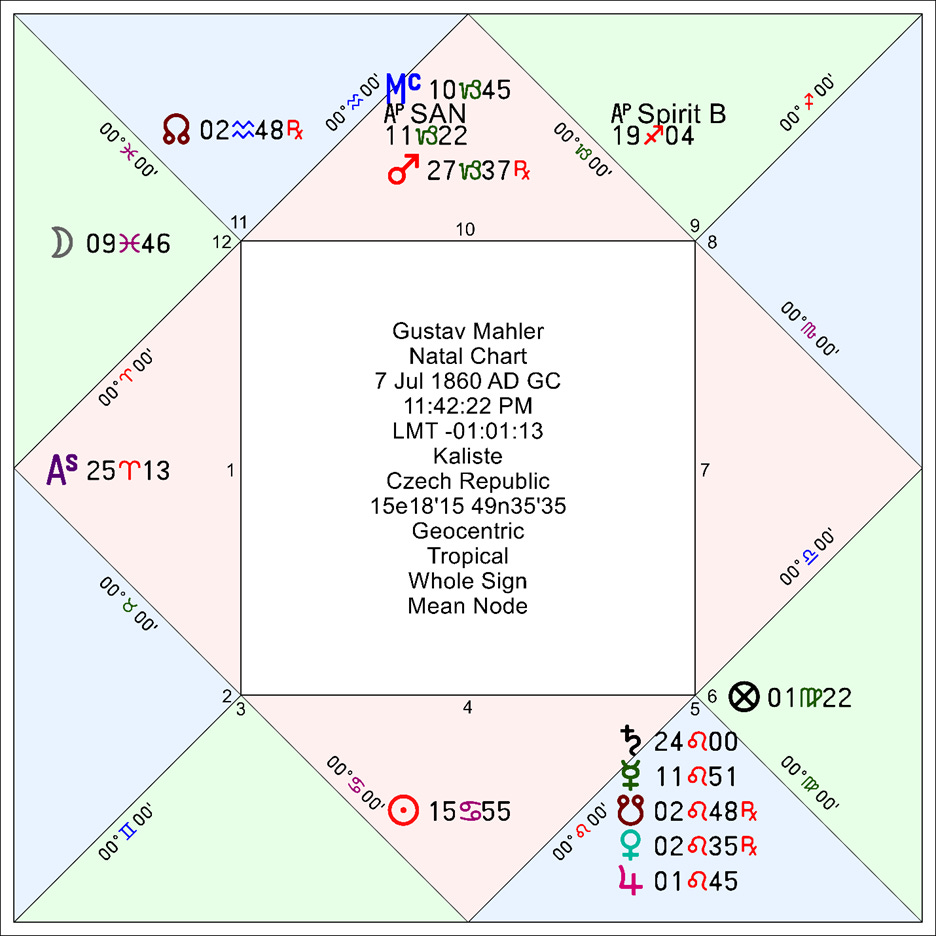
Rodden Rating C, original source not known, 10:15 PM, ASC 9PI40
Proposed rectification: 11:42:22 PM, ASC 25AR13’45”
The analytical models used in the sections below are part of a larger research program developed across longer white papers and case studies, where the historical sources, rules, and testing methodology are laid out in full. These database entries show the models in practice; readers who want the theoretical foundations can start with the background papers below:
Rectification Hub (I wrote the book on it!)
Soul Hub (white paper, Victor model statistical tests, Moon’s Configuration studies)
Physiognomy Hub (white paper, examples)
Victor Model Factors favoring Jupiter/Leo
Sign rulership: Moon, Lot of Spirit
Bound rulership: Midheaven, Prenatal Syzygy
Jupiter in Leo is the victor of Mahler’s horoscope, making questions of belief, morality, and humanity’s highest ideals the organizing principle of his life and work. His symphonies are far more than orchestral compositions; they are philosophical journeys that wrestle with suffering, death, nature, faith, love, and the possibility of transcendence. Jupiter imparts breadth of vision and a relentless search for universal truth, while Leo seeks to elevate the human spirit through works of lasting cultural significance. This combination helps explain the extraordinary scale of Mahler’s musical architecture, where deeply personal experiences are transformed into meditations on the human condition itself. Even his most intimate moments are presented as universal dramas, inviting listeners to contemplate the moral and spiritual questions that define civilization. In Mahler’s hands, the symphony became a vehicle for exploring humanity’s highest aspirations, expressing not only emotion but an enduring vision of what it means to live, suffer, and ultimately seek meaning.
Physiognomy Model Factors favoring Leo
Rising sign: Aries
Ruler of rising sign: Mars/Capricorn-rx
Rising decan: Sagittarius
Ruler of rising decan: Jupiter/Leo
Mahler was of medium-to-tall height with a lean yet well-proportioned frame that conveyed energy and authority rather than physical mass. His posture was erect and self-possessed, giving him a commanding presence despite his relatively slender build. His face was broad and distinctly rectangular, with a high forehead, pronounced cheekbones, and a firm, well-defined jaw. His eyes were large, thoughtful, and penetrating behind his characteristic pince-nez glasses, conveying both intellectual intensity and emotional sensitivity. His expression was typically serious and introspective, softened by moments of warmth and quiet humanity. Perhaps his most distinctive feature was his thick, wavy hair, which radiated outward from his head in all directions, creating an unmistakable halo-like appearance that contemporaries frequently remarked upon. The overall impression is one of intellectual gravity combined with artistic vitality, a man whose physical bearing projected both contemplation and quiet authority.
Mahler’s physiognomy corresponds closely with Leo as the significator of appearance, the sign occupied by Jupiter, the victor of the horoscope. In John Willner’s physiognomic model, Leo produces the rectangular facial type, a characteristic readily visible in Mahler’s broad forehead, square jaw, and well-proportioned facial structure. Jupiter’s rulership of the third (rising) decan of Aries, associated with Sagittarius, further enlarges the frame and contributes dignity, breadth, and an elevated bearing. Most striking of all is Mahler’s luxuriant hair, which radiates outward from the head like the rays of the Sun, one of the classical signatures of Leonine physiognomy. The combination of Jupiter and Leo produces neither an aggressive nor theatrical presence, but rather one of natural nobility, intellectual confidence, and moral seriousness. His appearance conveys the same qualities found in his music: expansive vision, elevated purpose, and a lifelong search for truths that transcend the merely personal.
Moon’s Configuration
Stage I — Moon in Aquarius Opposed Saturn in Leo (Out-of-Sign Separation)
Delineation. The Moon has recently separated from an opposition to Saturn in Leo, but the aspect is both out of sign and beyond the 10°30′ moiety, meaning Saturn is no longer actively influencing the Moon, though its psychological imprint remains powerful. Saturn in Leo signifies authority enacted through display, dominance, and public performance. When opposed by the Moon, this creates an early emotional environment shaped by fear, exposure, and moral pressure. Because the Moon has already left Aquarius, Saturn’s domicile, the influence lacks continuity and coherence; authority is encountered as traumatic rather than structuring. The result is not discipline, but an unresolved internalization of power experienced as overwhelming and externally imposed.
Biographical Match. Mahler’s early childhood reflects this pattern with painful clarity. His father, Bernhard Mahler, repeatedly subjected his wife to verbal and physical abuse in public, episodes the young Gustav witnessed helplessly. This was Saturn in Leo enacted as spectacle: domination performed before an audience. Because Saturn also rules the 10th house, the maternal figure becomes implicated in this Saturnian drama—not as agent, but as victim—linking authority, humiliation, and maternal suffering in the child’s psyche. These events, concentrated in the 1860s and early 1870s, left Mahler with a profound sensitivity to cruelty and injustice, imprinting authority as something morally disturbing rather than protective.
Stage II — Moon Enters Pisces (Change of Condition)
Delineation. When the Moon enters Pisces, the psychological condition shifts decisively. Aquarius’s rational distance gives way to emotional permeability and imaginative absorption. The Moon can now see the Sun by trine, though it has not yet begun to apply, signaling the potential for coherence without its realization. Experience becomes fluid rather than structured; suffering is absorbed rather than resisted. This is a condition of receptivity rather than agency, in which emotional life deepens but lacks form.
Biographical Match. This stage corresponds to Mahler’s adolescence and early conservatory years, roughly from the mid-1870s into the early 1880s. During this time he is intensely sensitive, intellectually precocious, and inwardly driven, yet still without a stable vocational identity. He absorbs musical traditions, emotional atmospheres, and personal loss with extraordinary depth, but remains unformed. His gifts are evident, yet his direction is not. This is the period of inward accumulation before articulation.
Stage III — Void-of-Course Phase (After 4°30′ Pisces)
Delineation. Once the Moon passes approximately 4°30′ Pisces, its separation from Saturn exceeds the allowable orb, rendering it genuinely void-of-course with respect to Saturn. The prior structure has dissolved, and no new organizing principle has yet emerged. The psyche is active but unmoored; experience accumulates without synthesis. This is a liminal interval characterized by openness, vulnerability, and indeterminacy rather than resolution.
Biographical Match. This phase corresponds to Mahler’s prolonged professional wandering from roughly 1880 to 1897. He moves restlessly between conducting posts—Bad Hall, Laibach, Olmütz, Kassel, Prague, Leipzig, Hamburg—rarely settling, often leaving under strain. Despite growing mastery, his career lacks consolidation. These years are emotionally and artistically fertile but structurally unstable, as Mahler gathers the experiential material that will later crystallize into his mature voice.
Stage IV — Moon Applies to the Sun in Cancer (Bound of Mercury)
Delineation. The Moon’s application to the Sun at 15° Cancer marks the resolution of the sequence. The Sun signifies identity, coherence, and authority, but its placement in the bound of Mercury means that authority is expressed through interpretation, articulation, and mediation rather than command. The trine allows emotional material to integrate harmoniously into consciousness, while the Mercurial bound ensures that meaning is constructed through language, structure, and intellect. Authority here is not imposed; it is communicated.
Biographical Match. This stage corresponds to Mahler’s emergence as a mature artistic figure, beginning with his appointment to the Vienna Court Opera in 1897 and extending through his greatest creative period. His authority manifests not as dominance but as interpretive mastery. He leads through explanation, rehearsal, and conceptual rigor, shaping orchestral and emotional experience through insight rather than force. His music becomes a vehicle for meaning, capable of holding suffering without collapsing into it.
Interpretive Summary
Mahler’s Moon configuration traces a psychological journey from traumatic authority, through emotional dissolution, toward a hard-won synthesis of meaning. The early Saturnian wound does not mature into obedience but into sensitivity; the Piscean interval allows experience to accumulate without form; and the eventual solar integration produces authority grounded in interpretation rather than domination. His greatness lies not in command, but in translation—turning suffering into structure and experience into meaning.
Influence of Sect
Because Mahler was born in a nocturnal figure, the Moon is the luminary of sect and therefore the planet most capable of expressing its nature constructively. This lends extraordinary depth to his emotional life and explains why his music communicates with such psychological immediacy. Rather than seeking authority through political or institutional power, Mahler’s lasting influence arose through emotional identification with the listener. His symphonies transform intensely personal experiences into universal reflections on life, death, suffering, and transcendence, a fitting expression of the Moon’s privileged status in a night chart.
The nocturnal sect also fundamentally alters the operation of the other principal planets. Mars, as the in-sect malefic, channels its difficult nature into disciplined action rather than indiscriminate conflict. Placed in Capricorn, Mars manifests as organizational rigor, relentless self-discipline, and the determination to reform established institutions. Mahler became one of history’s great musical reformers, revolutionizing rehearsal practices, orchestral precision, and operatic production through uncompromising standards that frequently brought him into conflict with conservative musicians, administrators, and critics. His Mars did not merely oppose the existing hierarchy—it sought to replace complacency with excellence, making disruption the necessary instrument of artistic progress.
Venus, the in-sect benefic, tempers Mars by directing its discipline toward cooperation rather than domination. Although placed in Leo, Venus is both retrograde and closely conjunct the South Node, conditions which appear to redirect much of its expression toward Aquarius. Instead of seeking personal admiration or artistic self-display, Mahler consistently subordinated individual personalities to the needs of the collective musical enterprise. As a conductor he demanded that singers, instrumentalists, and even star performers sacrifice personal preferences in service of the score, forging orchestras and opera companies into unified artistic bodies. Venus thus softened Mars without weakening it, ensuring that Mahler’s relentless perfectionism was exercised not for personal conquest but for the creation of a higher artistic ideal. The resulting combination produced a leader whose authority rested less on charisma than on his ability to organize individuals into a coherent and disciplined whole.
By contrast, Jupiter, despite being the victor of the horoscope, belongs to the opposite sect and therefore operates with somewhat less freedom than it otherwise would. Jupiter in Leo still endowed Mahler with an expansive artistic vision and an enduring concern for humanity’s highest moral and spiritual questions, but its out-of-sect condition reduced the ease with which those gifts achieved immediate public realization. During his lifetime Mahler was revered primarily as a conductor, while the full stature of his symphonic achievement emerged only after his death through the advocacy of later generations. Thus, Jupiter retained its philosophical grandeur while its promise unfolded more gradually than its essential dignity alone might suggest.
Saturn, the planet from which the Moon separates, is also out of sect, intensifying its harsher qualities and placing Saturnian experiences at the very beginning of Mahler’s emotional narrative. The repeated deaths of siblings during childhood, his difficult relationship with authority, persistent anti-Semitic hostility, and an early acquaintance with grief and mortality all formed the psychological foundation upon which his later life was built. Because Saturn lies behind the Moon’s motion, these experiences became enduring memories rather than future objectives, continually informing Mahler’s emotional outlook and artistic imagination. Yet the Moon, as the in-sect luminary, possessed the resilience to carry these Saturnian burdens throughout life without being defined by them. Instead, Mahler transformed suffering, loss, and isolation into the emotional substance of his music, allowing Saturn’s hardships to become the foundation of one of the most profound artistic legacies in the history of Western music.
Early/Late Bloomer Thesis
Born shortly after a Full Moon, Mahler conforms closely to the late-bloomer pattern. His lifespan (7 July 1860 – 18 May 1911) yields a midpoint of approximately 12 December 1885, when he was twenty-five years old and still establishing himself through a succession of conducting appointments. Although his exceptional abilities were already evident, neither his artistic identity nor his lasting historical significance had yet fully emerged.
The decisive chapters of Mahler’s life all unfolded after this midpoint. His appointment as director of the Vienna Court Opera in 1897 established him as the foremost conductor of his generation, while his greatest symphonies and song cycles—including the Fifth through Ninth Symphonies and Das Lied von der Erde—were composed during the final decade of his life. Even the hardships that defined his mature years—the death of his daughter, his diagnosis with heart disease, and his departure from Vienna—became the emotional catalyst for some of his most profound music. The trajectory of his life therefore strongly supports the late-bloomer model: the deepest themes of the horoscope, both triumphant and tragic, manifested only after prolonged artistic development, emotional maturation, and decades of disciplined labor.
Complete biographical chronology, rectification and time lord studies available in Excel format as a paid subscriber benefit. File is behind the paywall.