

The recent series on Jupiter in Leo has concentrated heavily on state-supported religion, national creeds, and the political expression of Jupiter/Leo. With the North Node now in Aquarius, I wanted to take a break. Aquarius brings us into a different set of subjects: science, technology, futurism, social organization, and attempts to imagine what lies ahead. H. G. Wells is a useful place to begin.
Wells was not merely a writer of speculative fiction. A surprising number of technologies and political developments that appeared in his books later became realities. He wrote about aerial warfare before airplanes had transformed the battlefield, imagined atomic bombs decades before Hiroshima, anticipated mechanized warfare and space travel, and repeatedly considered the possibility that technological development would outrun the political institutions responsible for controlling it. This prophetic dimension is immediately visible in his horoscope: the Moon in Aquarius is conjunct the Ascendant just over two degrees, a traditional testimony for prophecy and an unusually literal signature for a man whose reputation became inseparable from visions of the future.
There is a further refinement. Both the Moon and the Ascendant fall in the bound of Mars in Aquarius, directing much of that prophetic faculty toward Mars subjects—war, weapons, destruction, conflict, and the military consequences of technology. Wells repeatedly returned to precisely these themes. The War in the Air anticipated the transformation of warfare by aviation; The World Set Free imagined atomic weapons; and The Shape of Things to Come, published as Europe moved toward another general war, projected contemporary political and military trends into a future dominated by global conflict and reconstruction. Aquarius supplies the futurism and technological imagination; its Mars bound gives much of that vision a distinctly martial subject matter.
There are other pieces of the horoscope that deserve attention. Mercury in Virgo emerges as the Victor, fitting a career built from writing, science, analysis, journalism, education, and the organization of information. His Moon’s Configuration tells a very different part of the story: the Moon separates from Venus in Scorpio, becomes void of course as it changes signs, and only much later reaches a remote trine with Mars in Cancer. That Venus–Mars sequence offers a useful test against Wells’s complicated sexual biography, while the unusually wide application to Mars raises a technical question we have encountered elsewhere in the natal database: can an application well beyond conventional moiety still operate if its manifestation is substantially delayed?
Finally, the horoscope gives us an opportunity to test several timing methods against an unusually dense chronology. Wells became famous early, consistent with his birth after a New Moon, while Firdaria gives Mercury a particularly strong vocational showing. Taken together, Wells gives us something more useful than a horoscope that simply “looks like” its native: prophecy, vocation, sexuality, career timing, and physiognomy can all be tested against a life documented in considerable detail.
Herbert George Wells was born on 21 September 1866 in Bromley, Kent, the youngest child of Joseph and Sarah Wells. His father was a shopkeeper and professional cricketer whose career ended after he fractured his thigh, worsening the family’s already precarious finances. Wells’s mother periodically worked as a housekeeper at Uppark, a country estate in Sussex, where the young Wells had access to a substantial library. His appetite for reading had begun earlier, during a long convalescence after breaking his leg as a child. When the family shop failed to support them, Wells followed his older brothers into the drapery trade, spending much of 1880–1883 in apprenticeships whose class hierarchy and humiliations later supplied material for Kipps.
In 1883 Wells escaped the drapery trade and returned to Midhurst Grammar School, initially as a pupil-teacher. His ability in science won him a scholarship to the Normal School of Science in South Kensington, where he studied biology under T. H. Huxley, one of the principal defenders of Darwinian evolution. Wells initially performed well, but his attention increasingly wandered toward politics, journalism and writing. His examination results deteriorated, and he left the school in 1887 without completing its course. He subsequently supported himself by teaching while continuing his scientific studies, eventually receiving his University of London B.Sc.
These years were also marked by recurrent physical illness. Wells suffered haemorrhages and feared tuberculosis, and for a time believed that his life might be short. The combination of precarious health and financial necessity helped push him away from teaching and toward full-time writing. In 1891 he married his cousin Isabel Mary Wells, but the marriage soon deteriorated. Wells became involved with Amy Catherine Robbins, one of his students, left Isabel, and married Amy—whom he called Jane—in 1895. They would have two sons, George Philip, born in 1901, and Frank Richard, born in 1903.
The mid-1890s brought the concentrated burst of writing on which much of Wells’s later reputation would rest. The Time Machine appeared in book form in 1895, followed by The Island of Doctor Moreau (1896), The Invisible Man (1897), and The War of the Worlds (1898). These books helped define what Wells called the “scientific romance,” using speculative science less as prediction for its own sake than as a means of examining class, evolution, human nature and the possible future of civilization.
The Time Machine projected Victorian class divisions into the distant future, dividing humanity into the apparently carefree Eloi and the subterranean Morlocks. The Island of Doctor Moreau turned evolutionary theory toward the problem of whether civilization represented genuine human progress or merely a fragile restraint upon animal nature. Wells accepted Darwinian evolution but rejected any easy assumption that evolution necessarily meant improvement. The novel also raised questions about the expanding authority of experimental science and the moral limits of scientific investigation.
The Invisible Man similarly treated scientific power as morally ambiguous, while The War of the Worlds placed technologically superior Martians against an almost helpless humanity. The latter appeared amid widespread public speculation about life on Mars generated by Giovanni Schiaparelli’s observations and Percival Lowell’s writings. Wells inverted the assumptions of imperial Britain: London and southern England suddenly experience the terror, displacement and destruction that European powers had inflicted elsewhere. The Martians’ ultimate defeat by terrestrial microorganisms further undermined confidence in technological superiority.
Wells did not confine himself to science fiction. Love and Mr. Lewisham (1900), Kipps (1905), and The History of Mr. Polly (1910) drew more directly on class, education and the constrained lives of the lower-middle classes he knew firsthand. At the same time, books including Anticipations (1901), Mankind in the Making (1903), and A Modern Utopia (1905) increasingly turned his attention toward social organization and humanity’s future.
Politics consequently became inseparable from Wells’s writing. He joined the Fabian Society in 1903 but never fit comfortably within its leadership. Although a socialist, he rejected Marxist class struggle and favored planned social reform led by educated and technically competent people. His attempt to transform the Fabians brought him into conflict with George Bernard Shaw and other established members. The quarrel eventually supplied material for The New Machiavelli (1911), a political novel that also drew freely upon Wells’s private life.
That private life was complicated. Although Wells remained married to Jane until her death, the marriage accommodated a succession of affairs. His partners included Amber Reeves, novelist Elizabeth von Arnim, journalist and novelist Rebecca West, Moura Budberg, Constance Coolidge and, later, Martha Gellhorn. Wells incorporated aspects of his wives and lovers into his fiction and cultivated a reputation for sexual unconventionality. His relationship with Rebecca West began when she was a young journalist; their son Anthony West was born in 1914 and later wrote about his parents’ difficult relationship in H. G. Wells: Aspects of a Life.
The First World War shifted Wells’s attention increasingly toward international politics. At the request of Charles Masterman he joined British writers and editors engaged in presenting the Allied case to neutral and Allied countries. From May to July 1918 he directed propaganda literature against Germany at Crewe House. Yet Wells’s larger concern was what political structure might prevent another such war. He advocated a “League of Free Nations” and became involved in the movement that developed around the League of Nations.
Wells’s speculative fiction continued to anticipate technologies that later acquired an uncanny resemblance to his inventions. The First Men in the Moon (1901) imagined space travel; The War in the Air (1908) explored the military consequences of aviation; and The World Set Free (1914) imagined weapons based on the release of atomic energy. Yet prediction was usually subordinate to his larger concern: how technological change would alter political institutions and whether human social organization could keep pace with scientific power.
After the war Wells increasingly attempted to address humanity as a whole rather than merely the British reading public. The Outline of History (1920) presented world history on a broad scale and became commercially successful. The Open Conspiracy (1928) proposed an international movement of scientifically and politically informed people capable of reorganizing world affairs, while The Science of Life, written with Julian Huxley and Wells’s son George Philip, extended his efforts at popular scientific synthesis.
His socialism nevertheless remained distinctly non-Marxist. During a 1920 visit to Soviet Russia, Wells stayed with Maxim Gorky and met Lenin. He sympathized with some aims of the Russian Revolution but disliked Marxist doctrine and remained suspicious of Soviet methods. The trip also introduced him to Moura Budberg, Gorky’s secretary and former mistress, who became one of the most important women of Wells’s later life. They resumed their relationship years later, and Budberg became a regular presence in his life during the 1930s.
By then Wells was an international public figure as much as a novelist. In 1934 he met both Franklin D. Roosevelt and Joseph Stalin, looking to each for evidence that the economic and political crisis of the 1930s might produce a more rationally organized society. Neither encounter satisfied him. His conversation with Stalin exposed the gulf between Wells’s technocratic and evolutionary socialism and Stalin’s Marxist conception of class conflict. Wells increasingly concluded that Western socialism could not simply accommodate itself to Soviet communism. The Holy Terror (1939) subsequently examined modern dictatorship through a fictional figure shaped partly by Stalin, Mussolini and Hitler.
Wells’s reputation as a prophet was meanwhile taking on a life independent of his books. On 30 October 1938, Orson Welles’s Mercury Theatre broadcast an adaptation of The War of the Worlds, presenting portions of the story in the form of simulated news reports. The broadcast became one of the most famous episodes in American radio history. Wells himself initially disliked what had been done with his story, although when the two men finally met at a San Antonio radio station in 1940, the older Wells had softened toward his namesake.
From 1934 until his death Wells served as international president of PEN. He remained in London through the Second World War rather than leave during the Blitz. But the confidence that science, education and international organization might ultimately overcome nationalism and war steadily weakened. His final book, Mind at the End of Its Tether (1945), offered a bleak assessment of humanity’s prospects, far removed from the more confident schemes for world reconstruction that had occupied him earlier in the century. Wells died in London on 13 August 1946, aged seventy-nine.
His posthumous reputation has rested disproportionately on the scientific romances written during a relatively short period early in his career. The War of the Worlds, The Time Machine, The Invisible Man, and The Island of Doctor Moreau have repeatedly returned through film, radio and television, while many of the political and realistic novels to which Wells devoted much of his later career have receded from general readership. That imbalance was already apparent to Arthur C. Clarke, who argued that the continuing power of Wells’s best science fiction lay not simply in its ideas but in literary qualities Wells himself sometimes tried to minimize.
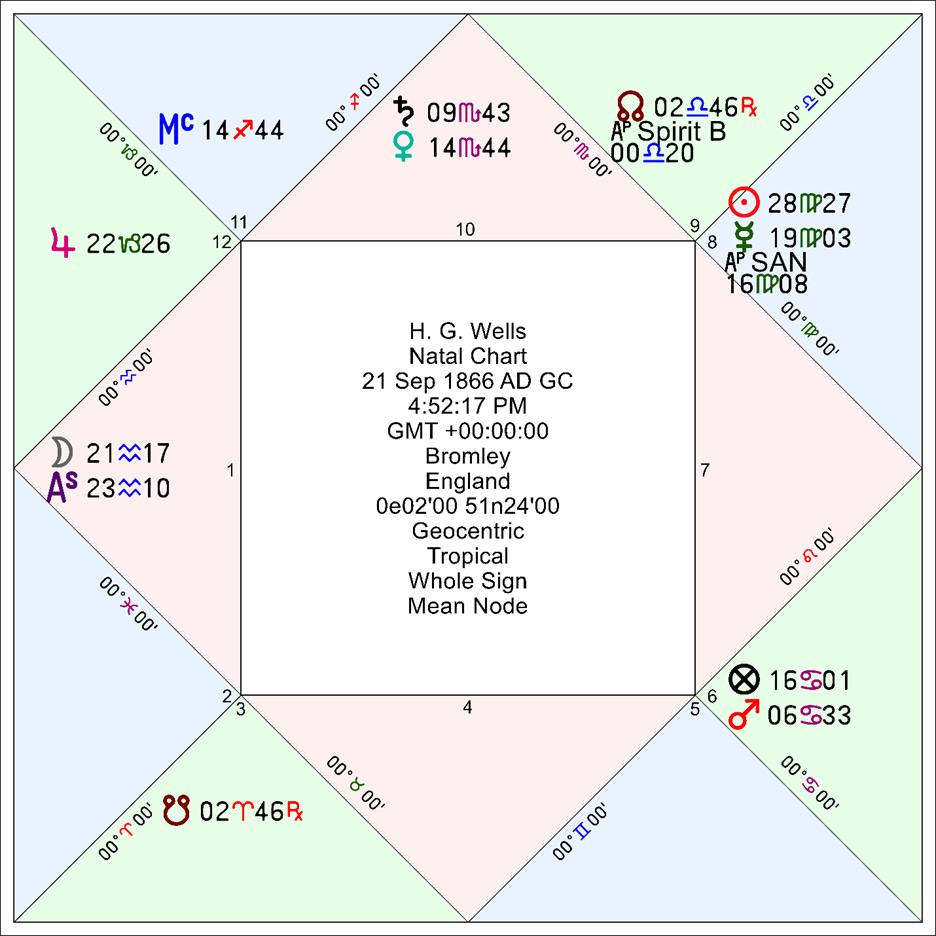
Rodden Rating AA, Quoted BC/BR, 4:30 PM, ASC 12AQ58
Proposed Rectification 4:52:17 PM, ASC 23AQ10’38”
The analytical models used in the sections below are part of a larger research program developed across longer white papers and case studies, where the historical sources, rules, and testing methodology are laid out in full. These database entries show the models in practice; readers who want the theoretical foundations can start with the background papers below:
Rectification Hub (I wrote the book on it!)
Soul Hub (white paper, Victor model statistical tests, Moon’s Configuration studies)
Physiognomy Hub (white paper, examples)
Victor Model Factors favoring Mercury/Virgo
Sign ruler: Sun, Prenatal Syzygy
Bound ruler: Lot of Fortune
Mercury in Virgo is the Victor of Wells’s horoscope, describing a vocation built around writing, teaching, journalism, scientific explanation, public argument, and the transmission of ideas. Virgo gives Mercury an analytical and systematic cast particularly appropriate to Wells: the scientifically trained novelist who turned evolutionary theory and technological speculation into fiction, but also the synthesizer who attempted to organize enormous bodies of knowledge in The Outline of History, The Science of Life, and eventually World Brain. The Firdaria supports the identification. Mercury’s major period, 1884–1897, carries Wells from his scientific education under T. H. Huxley through teaching, student journalism, criticism, and professional writing, culminating in the sequence that established his career: The Time Machine, The Island of Doctor Moreau, and The Invisible Man. Later Mercury minor periods repeatedly reactivate writing, publication, journalism, and intellectual communication. Jupiter certainly enlarges the scale of Wells’s ambitions—world history, international politics, social planning—but Mercury/Virgo supplies the vocational engine: the writer and analyst who made ideas his profession.
Physiognomy Model Factors favoring Scorpio, Aquarius, and the Moon
Rising Sign: Aquarius
Ruler of Rising Sign: Saturn/Scorpio
Planets in Rising Sign: Moon/Aquarius
Rising Decan: Libra
Ruler of Rising Decan: Venus/Scorpio
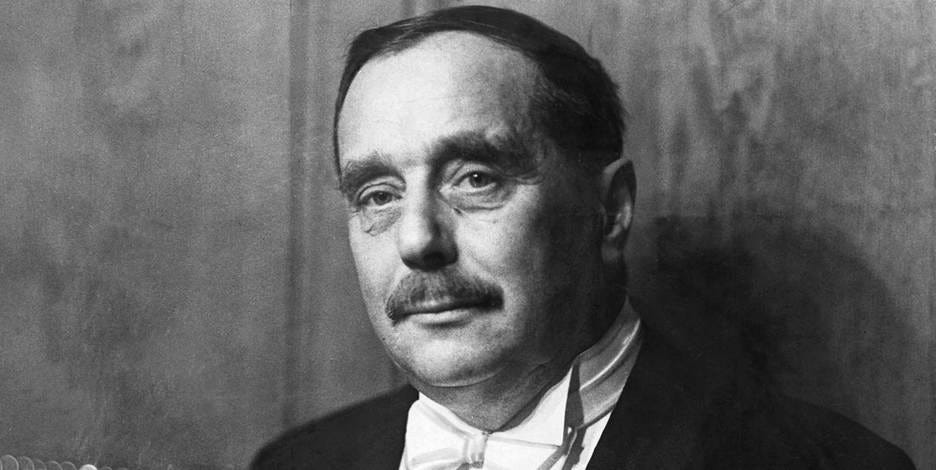
In the photographs from his middle years, Wells appears compact rather than imposing, standing about 5 ft 5½ in. (1.66 m) tall. His early-1900s build was relatively trim, before the heavier body and fuller face familiar from later photographs. The head is moderately broad, with a high, wide forehead whose sides descend with relatively little taper, giving the upper face an almost rectangular outline. The lower face is softer: rounded cheeks, a short-to-moderate jaw, and a chin that does not project strongly. His nose is straight and substantial, while the heavy horizontal moustache becomes one of the most conspicuous features of the face. The eyes are comparatively large and open, with a soft, attentive expression; even in the younger portrait, the contrast between the broad, firm forehead and the gentler contours around the eyes and cheeks is noticeable.
Astrologically, Aquarius rising contributes the rectangular forehead, which in Wells is unusually easy to see: broad, flat and nearly straight across, rather like the blade of a bulldozer. Both the ruler of the rising sign, Saturn, and the ruler of the rising decan, Venus, are placed in Scorpio, adding the pronounced moustache—a classic Scorpio physiognomic significator, with its two projecting sides mimicking the pincers of the scorpion. But the Moon conjunct the Ascendant just over two degrees modifies what might otherwise be a harder Saturnian face. Its influence is unmistakable in the subtly ovate shape of the face, the softness of the flesh, and especially the eyes, which have an unusually sentient, inward-looking quality. This provides a physical counterpart to the traditional delineation of the Moon closely conjunct the rising degree as a testimony for prophecy: in Wells, whose career was so closely associated with imagining the future, there are at least hints of that quality in the eyes.
Moon’s Configuration
Stage 1 — Moon separates from Venus
Delineation. The Moon at 21°17′ Aquarius separates from the square of Venus at 14°44′ Scorpio, with Venus placed in the 9th house by quadrant houses and the 10th by whole signs. Venus signifies women, sexual relationships, attraction, pleasure, sociability and artistic production. In Scorpio these matters become more intense, private and complicated, while the square introduces friction into the Moon’s separation from Venus. The 9th/10th placement extends Venus into publishing, intellectual life, foreign travel, career and public reputation. Because the Moon is separating, these Venusian matters belong particularly to antecedent conditions and to experiences characterized by departure, rupture or the ending of attachments.
Biographical Match. Wells’s biography strongly supports Venus as the planet from which the Moon separates. His life was marked by numerous sexual relationships and by repeated separation from women: his marriage to Isabel broke down after his involvement with Amy Catherine Robbins; his marriage to Jane accommodated affairs; Amber Reeves bore his daughter Anna-Jane; and his long relationship with Rebecca West produced their son Anthony before itself ending. Other relationships included Elizabeth von Arnim, Moura Budberg, Constance Coolidge and Martha Gellhorn. Venus also reaches beyond sexuality into Wells’s professional life: women repeatedly entered his literary and intellectual circles, while his novels drew freely upon his relationships. The repeated pattern is therefore not simply Venusian attraction but attachment followed by separation, closely matching a Moon already moving away from Venus.
Stage 2 — Moon void of course and changes signs to Pisces
Delineation. After separating from Venus, the Moon makes no further applying aspect within the relevant planetary moiety before leaving Aquarius. It is therefore void of course and subsequently changes signs into Pisces. This interrupts the sequence between Venus and Mars: the Moon cannot simply carry the Venusian narrative directly into the next planet. A void-of-course interval can signify discontinuity, lack of resolution, wandering or circumstances that fail to develop along an expected course. The sign change reinforces the transition. The Moon leaves fixed-air Aquarius and enters mutable-water Pisces, exchanging a more cerebral, fixed and detached environment for one that is more fluid, permeable and difficult to contain.
Biographical Match. Wells repeatedly resisted settled structures in both his private and professional life. His first profession, science, did not develop as expected; teaching was interrupted by illness; his first marriage failed; and even after literary success established him professionally, his interests repeatedly shifted among fiction, science, journalism, socialism, history, futurism and schemes for international political organization. His private life shows an even clearer resistance to fixed boundaries: marriage did not contain his sexual relationships, and individual affairs frequently overlapped with other commitments. The void-of-course Moon therefore provides an intermediate condition of discontinuity and redirection. Wells repeatedly left one established framework without immediately settling into another, a pattern compatible with the Moon having to leave Aquarius and enter a new sign before the final planetary contact can occur.
Stage 3 — Moon applies remotely to Mars
Delineation. After entering Pisces, the Moon eventually applies by trine to Mars at 6°33′ Cancer, placed in the 5th house by quadrant houses and the 6th by whole signs. The application is unusually remote: 16°16′, considerably beyond William Lilly’s 9°30′ moiety for a Moon–Mars aspect. On a strict application of Lilly’s rule, the aspect could therefore be discarded and the Moon declared simply void of course. The alternative adopted here is to retain Mars as a remote application, with the excessive distance indicating delayed manifestation. Mars in the 5th points toward sexuality, lovers, children, pleasure and creative activity; in the 6th it adds work, illness and physical strain. Mars is in fall in Cancer and is the out-of-sect malefic in this diurnal horoscope, making its eventual activation potentially disruptive. Moon–Venus–Mars combinations frequently produce a strongly sexual, “Romeo” temperament, although here the long interval before Mars suggests that the consequences of that temperament become clearer with time.
Biographical Match. Wells fits the Venus–Mars sexual pattern closely, but Mars describes more than appetite. His sexual life repeatedly produced concrete consequences: the collapse of his marriage to Isabel, overlapping relationships during his marriage to Jane, Anna-Jane by Amber Reeves, Anthony West by Rebecca West, jealousy and conflict surrounding his affairs, and the 1923 episode in which Hedwig Gatternigg attempted suicide in his study. The alternative 6th-house placement is also supported by Wells’s recurrent physical problems, including haemorrhages in youth and his later diabetes. Most importantly for admitting such a wide application, Mars does appear to become more conspicuous as the biography develops rather than dominating the beginning of life. Mars Firdaria periods repeatedly activate combinations of sexual entanglement, children, conflict, illness and creative work. This makes Wells useful for the broader natal-database hypothesis: an application lying well outside conventional moiety may still preserve the narrative sequence, but the excessive distance between the Moon and its applying planet is expressed as a lengthy delay before that planet’s themes reach full manifestation.
Influence of Sect
The figure is diurnal, which degrades the Moon’s Configuration because both planets directly involved in the sequence are out of sect: Venus is the nocturnal benefic, while Mars is the nocturnal malefic and therefore the more troublesome malefic in a day chart. This helps explain why the Moon–Venus–Mars sequence produces less stable pleasure than its basic symbolism might promise: Venus brings women, attraction and literary creativity, but repeatedly with separation and complications, while Mars carries the sequence toward sexual consequences, conflict, illness and physical strain.
By contrast, Saturn at 9°43′ Scorpio in the 9th/10th and Jupiter at 22°26′ Capricorn in the 12th are both in sect, and their Firdaria periods suggest that they provide some of the more constructive scaffolding around Wells’s career. Saturn’s 1906–1917 major period coincides with sustained productivity but also the increasingly serious organization of his thought around socialism, war and political reconstruction; Jupiter’s 1917–1929 major period contains his League of Nations work, The Outline of History, the Lenin meeting, international reporting and the expansion of his role from novelist into world historian and public intellectual. Thus sect produces an interesting division in the horoscope: the out-of-sect Venus and Mars make the Moon’s personal narrative more unstable and costly, while the in-sect Saturn and Jupiter are better placed to support the institutional, intellectual and international dimensions of the career.
Early/Late Bloomer Thesis
Wells fits the early-bloomer thesis well. Born after a New Moon, he should reach important developmental and vocational milestones before the midpoint of life, and his biography strongly conforms to that expectation. Wells lived about 80 years (21 September 1866–13 August 1946), placing his midpoint at about age 40, in 1906—more precisely, around 2 September 1906. Long before that midpoint, his vocation had already emerged: scientific study and student journalism occupied the 1880s, The Time Machine established him as a professional writer in 1895 at age twenty-eight, and The Island of Doctor Moreau (1896), The Invisible Man (1897), and The War of the Worlds (1898) followed before he was thirty-two. By the 1906 midpoint he had already completed the concentrated group of scientific romances on which much of his enduring reputation rests and had expanded into social and political writing with Anticipations, Mankind in the Making, and A Modern Utopia. The second half of life remained highly productive—most notably The Outline of History and his emergence as an international political commentator—but it represents an expansion and redirection of an already established career rather than its late maturation. On this measure, Wells is a good match for the rule: post-New Moon birth, early development, with the defining professional breakthrough occurring roughly eleven years before the longevity midpoint.
Complete biographical chronology, rectification and time lord studies available in Excel format as a paid subscriber benefit. File is behind the paywall.