

Hillary Clinton’s unknown birth time became a subject of considerable controversy within the astrological community during her 2016 presidential campaign against Donald Trump. Some astrologers went so far as to attribute their incorrect predictions of a Clinton victory to uncertainty surrounding her birth time. The competing proposals included 8:00 AM and 8:00 PM, along with numerous other times that produced substantially different horoscopes. The debate became particularly heated in the closing weeks of the campaign, with astrologers disagreeing not only about which birth time was correct but also about whether reliable election predictions could be made without it. This was a controversy in which I did not participate. I had already rectified Clinton’s horoscope to 10:53:13 PM, publishing the result in the first edition of A Rectification Manual on 17-Dec-2007, nearly nine years before the 2016 election.
Fast forward to March 2023, when Clinton’s birth certificate was finally obtained and made available through Astro-Databank. One might have expected this discovery to settle the controversy. Instead, another debate emerged over whether the handwritten birth time read 6:45 PM or 10:45 PM. Alois Treindl of Astro-Databank acknowledged that the handwriting was ambiguous but adopted 6:45 PM, producing a Gemini Ascendant. The alternative reading of 10:45 PM produces a Leo Ascendant, remarkably close to my original rectification. In fact, the birth time I published in 2007, 10:53:13 PM, is only 8 minutes and 13 seconds later than the possible 10:45 PM birth certificate time. The discovery therefore provided an interesting retrospective test of a rectification completed sixteen years earlier.
What I found comical about these debates was the almost complete absence of attention to one of the most fundamental distinctions between the competing horoscopes: whether Clinton’s Moon occupied late Pisces or early Aries. This difference separates not only the 8:00 AM and 8:00 PM proposals but also the more recent 6:45 PM and 10:45 PM interpretations. In my judgment, there is little question that Clinton’s Moon belongs in early Aries. A Moon in Pisces is simply not credible when tested against her temperament and life affairs. Her assertiveness, political independence, willingness to confront established authority, and lifelong advocacy for women’s advancement are consistent with Moon/Aries in the ninth house. The rectification is anchored by the solar arc direction of Moon–MC corresponding to her commencement address at Wellesley College on 31-May-1969, when she challenged the preceding speaker, Senator Edward Brooke, and publicly articulated the political convictions that would characterize her subsequent career. The ninth house, associated with higher education and philosophy, makes this a particularly precise delineation match.
The proposed victor of Clinton’s horoscope is Jupiter/Sagittarius in the fifth house, a planet whose domicile dignity helps explain the central themes of her political vocation. The fifth house traditionally signifies children, reflected in Clinton’s early work with the Children’s Defense Fund, educational reform, and advocacy for children’s health care. Less commonly appreciated is the fifth house’s association with legates and ambassadors, a direct correspondence with her subsequent service as United States secretary of state. Jupiter’s importance is independently supported by Zodiacal Releasing from the Lot of Spirit in Capricorn. Jupiter/Sagittarius occupies the tenth sign from the Lot of Fortune in Pisces (LOF10), and three important L2 Sagittarius periods coincide with defining transitions in Clinton’s political career: Bill Clinton’s announcement of his presidential candidacy in 1991, during an L1 Gemini/L2 Sagittarius Fortune-spirit transition; Hillary’s launch of her independent Senate campaign in 2000, during an L1 Gemini/L2 Sagittarius Loosing of the Bond; and her assumption of office as secretary of state in January 2009, during L1 Cancer/L2 Sagittarius. These correlations provide an additional basis for identifying Jupiter as the victor. Paid subscribers have access to the accompanying research workbook, including Clinton’s expanded chronology and the Firdaria and Zodiacal Releasing worksheets used to evaluate the rectification.
The timing of this article is also astrologically appropriate. As I write in November 2026, the Sun and Mercury are passing through Scorpio, while Mars occupies Leo, revisiting three of the principal planetary signs in Clinton’s natal horoscope. The Sun in Scorpio is again in mutual reception by domicile with Mars in Leo, the same relationship that connects Clinton’s pursuit of public prominence with the political opponents who have repeatedly challenged her and her husband. Mercury has recently stationed direct in Scorpio, in contrast to its retrograde condition in her natal figure. These planetary repetitions provide an appropriate occasion to revisit a controversy that began long before the 2016 election. Nearly nineteen years after the publication of my original rectification, and more than three years after the discovery of Clinton’s birth certificate, it is time to set the record straight.

Hillary Diane Rodham Clinton was born on October 26, 1947, in Chicago, Illinois, and grew up in Park Ridge, a Chicago suburb. Her father, Hugh Rodham, operated a textile business, while her mother, Dorothy Howell Rodham, was a homemaker. Raised in a politically conservative Republican household, Clinton initially shared her father’s political sympathies, supporting Barry Goldwater’s presidential campaign in 1964. Her political views gradually shifted during the civil rights movement and the Vietnam War, and by the late 1960s she had aligned herself with the Democratic Party.
Clinton attended Wellesley College, graduating in 1969 with a degree in political science. As president of the student government, she attracted national attention for her commencement address, which challenged some of the assumptions expressed by an earlier speaker, Senator Edward Brooke. She subsequently entered Yale Law School, where she developed an interest in children’s legal rights and met fellow law student Bill Clinton. After graduating in 1973, she worked for the Children’s Defense Fund before joining the staff of the House Judiciary Committee investigating President Richard Nixon during the Watergate scandal in 1974.
Rather than pursue a legal career in Washington, Clinton moved to Arkansas, where Bill Clinton was beginning his political career. The couple married on October 11, 1975. She taught law at the University of Arkansas and subsequently joined the Rose Law Firm in Little Rock, becoming a partner in 1979. She also served on the board of the Legal Services Corporation, eventually becoming its chairwoman. Their daughter, Chelsea, was born on February 27, 1980.
Bill Clinton was elected governor of Arkansas in 1978, defeated for reelection in 1980, and returned to office following his victory in November 1982. Throughout his governorship, Hillary combined her responsibilities as Arkansas’s First Lady with an active legal career and involvement in educational reform. In 1983, she chaired the Arkansas Education Standards Committee, helping develop recommendations for improving the state’s public schools. She also served on several corporate boards, including Walmart, and became a prominent figure in Democratic Party circles.
Her husband’s election as President of the United States in November 1992 transformed Clinton into a national political figure. As First Lady, she assumed a more direct policymaking role than many of her predecessors. In January 1993, President Clinton appointed her to lead the administration’s Task Force on National Health Care Reform. The resulting proposal encountered opposition from Republicans, insurers, business interests, and some Democrats, ultimately collapsing in September 1994 without congressional approval.
The failure of health care reform coincided with growing scrutiny of the Clintons’ Arkansas business dealings. Investigations into their Whitewater real-estate investment became a recurring political controversy. In March 1994, reports also emerged concerning Hillary Clinton’s commodities trading during 1978–1979, when she earned nearly $100,000 in cattle futures profits. Although the trading episode generated questions about the circumstances of those gains, no criminal charges resulted from it.
Clinton subsequently redirected much of her public work toward children’s welfare, education, and women’s rights. At the United Nations Fourth World Conference on Women in Beijing in September 1995, she delivered a widely reported speech arguing that women’s rights should be understood as fundamental human rights. Her 1996 book, It Takes a Village, further developed her argument that children’s development depended upon families, communities, and public institutions working together.
The Clinton presidency was again engulfed in controversy in 1998 when President Clinton’s relationship with White House intern Monica Lewinsky became public. Hillary initially defended her husband against allegations that she attributed to his political opponents. The subsequent disclosure of the relationship placed their marriage under public scrutiny, culminating in President Clinton’s impeachment by the House of Representatives in December 1998 and acquittal by the Senate in February 1999. Hillary remained married to Bill Clinton and continued to pursue her own political career.
On November 6, 1998, New York Senator Daniel Patrick Moynihan announced that he would not seek reelection in 2000, creating an opportunity for Clinton to enter elective politics. She established residency in New York and announced her Senate candidacy in 1999. On November 7, 2000, she defeated Republican Rick Lazio, becoming the first former First Lady elected to the United States Senate and the first woman elected statewide in New York.
Serving in the Senate from January 2001 until January 2009, Clinton developed a legislative record spanning national security, health care, economic development, and military affairs. Following the September 11, 2001 terrorist attacks, she became involved in securing federal assistance for New York’s recovery. In October 2002, she voted to authorize the use of military force against Iraq, a decision that later became a significant liability in her presidential ambitions. She won reelection to the Senate in November 2006.
Clinton announced her first presidential campaign in January 2007 and entered the 2008 Democratic primaries as a leading contender. Her principal opponent, Senator Barack Obama, ultimately secured the nomination after a prolonged contest involving close primary results and disputes over delegate allocations. Clinton conceded in June 2008 and endorsed Obama, subsequently campaigning for his election. After winning the presidency, Obama nominated his former rival to serve as Secretary of State.
Sworn in on January 21, 2009, Clinton became the 67th Secretary of State, serving until February 1, 2013. She traveled extensively, emphasizing diplomatic engagement, international partnerships, women’s rights, and what she termed smart power, the combination of military strength with diplomacy and other instruments of influence. Her tenure encompassed the withdrawal of American forces from Iraq, growing tensions over Iran’s nuclear program, the American military presence in Afghanistan, and the Obama administration’s attempt to shift strategic attention toward Asia.
The Arab Spring, beginning in Tunisia in December 2010, presented a major foreign policy challenge. Popular uprisings spread across North Africa and the Middle East, reaching Libya in February 2011. Clinton supported international intervention against Muammar Gaddafi’s government, which culminated in NATO military operations and Gaddafi’s overthrow later that year. The consequences of intervention, including Libya’s subsequent political fragmentation, became a subject of sustained debate.
On September 11–12, 2012, militants attacked American diplomatic and intelligence facilities in Benghazi, Libya, killing Ambassador Christopher Stevens and three other Americans. As Secretary of State, Clinton faced criticism over security arrangements and the administration’s public explanations of the attacks. Multiple congressional investigations followed, including a lengthy House Select Committee inquiry that continued after she left office. The episode remained an important political controversy during her subsequent presidential campaign.
Following her departure from the State Department in February 2013, Clinton returned to private life, public speaking, writing, and the activities of the Clinton Foundation. Her memoir Hard Choices, published in June 2014, reviewed her experiences as Secretary of State. Speculation about another presidential campaign intensified, and on April 12, 2015, she formally announced her candidacy for the Democratic presidential nomination.
Clinton secured the Democratic nomination in June 2016 and formally accepted it at the party’s July convention, becoming the first woman nominated for president by a major American political party. Her campaign against Republican nominee Donald Trump was dominated by disputes over immigration, trade, national security, personal character, and the handling of emails during her State Department tenure. The FBI investigated her use of a private email server, with Director James Comey announcing in July 2016 that the agency would not recommend criminal charges while criticizing her handling of classified information.
On November 8, 2016, Clinton received approximately 2.9 million more popular votes than Trump but lost the Electoral College, 304 to 227 in the official tally. The result ended her second presidential campaign and left her as the first female major-party presidential nominee to win the national popular vote without securing the presidency.
Following the election, Clinton published What Happened in September 2017, offering her account of the campaign and its defeat. She remained active in Democratic politics, supporting candidates, speaking on public affairs, and criticizing several policies of the Trump administration. During the 2020 presidential election, she endorsed Joe Biden and participated in virtual campaign and fundraising events.
In 2023, Clinton joined Columbia University’s School of International and Public Affairs as a professor of practice and helped establish its Institute of Global Politics. She continued writing and lecturing on international affairs, democratic institutions, and women’s political participation. Her later publications included Something Lost, Something Gained: Reflections on Life, Love, and Liberty (2024) and collaborative work concerning national security decision-making.
On January 4, 2025, President Joe Biden awarded Clinton the Presidential Medal of Freedom in recognition of her career in public service. She has remained involved in academic and political discussions, drawing upon her experience as First Lady, senator, presidential candidate, and Secretary of State.
Clinton’s career is distinguished by the unusual progression from political spouse to an independent holder of national office, Cabinet secretary, and presidential nominee. Her public life has encompassed legal advocacy, legislative service, international diplomacy, electoral competition, and repeated controversies involving both her own decisions and those of her husband. Few figures in recent American political history have occupied so many different positions within the country’s governing institutions while remaining under sustained public scrutiny across several decades.
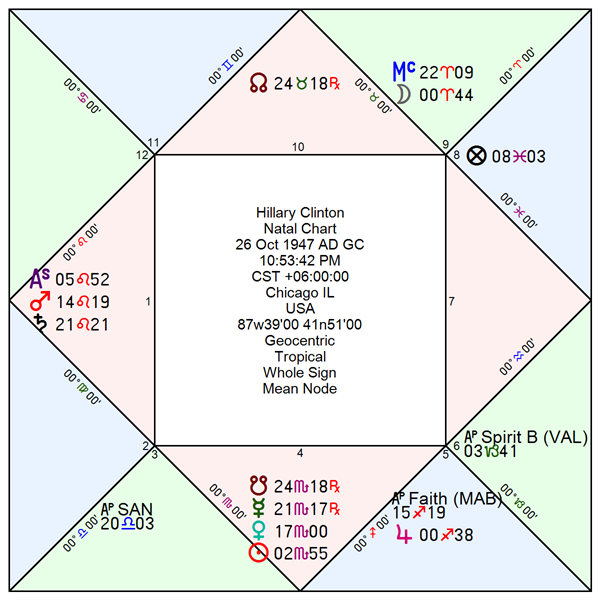
Rodden Rating AA, BC/BR in hand, 6:45 PM, ASC 11GE03
2007 Proposed Rectification: 10:53:13 PM, ASC 5LE46’52”
2026 Revised Rectification: 10:53:42 PM, ASC 5LE52’32”
Permission: I grant the unlimited use of this rectified horoscope by the public. Credit ‘Regulus Astrology LLC’ and include an accompanying link to this webpage.
The analytical models used in the sections below are part of a larger research program developed across longer white papers and case studies, where the historical sources, rules, and testing methodology are laid out in full. These database entries show the models in practice; readers who want the theoretical foundations can start with the background papers below:
Rectification Hub (I wrote the book on it!)
Soul Hub (white paper, Victor model statistical tests, Moon’s Configuration studies)
Physiognomy Hub (white paper, examples)
Big Three (Sun sign = Scorpio, Moon sign = Aries, Rising sign = Leo)
Victor Model Factors favoring Jupiter/Sagittarius
Sign ruler: Lot of Fortune
Bound ruler: Moon, Ascendant, Prenatal Syzygy
10th sign from Lot of Fortune
Jupiter/Sagittarius is identified as victor of Hillary Clinton’s horoscope, occupying its own domicile in the 5th house. Although Jupiter is out-of-sect in this nocturnal figure, its essential dignity provides considerable strength, allowing its significations to emerge prominently throughout her life. The 5th house governs children, an enduring theme in Clinton’s career through her advocacy for children’s rights, education, and family welfare. Less commonly recognized is the 5th house’s traditional association with legates and ambassadors, an especially appropriate correspondence for Clinton’s tenure as Secretary of State, when she represented the United States in diplomatic relations across the world. Jupiter’s association with law, government, political influence, and the expansion of social institutions further reinforces its claim as victor. Its out-of-sect condition, however, suggests that these Jupiterian ambitions would not unfold without conflict, as illustrated by the repeated political controversies accompanying her advancement to positions of national and international prominence.
Physiognomy Model Factors favoring Leo
Rising sign and decan: Leo
Ruler of rising sign and decan: Sun/Scorpio
Planets in rising sign and decan: Mars/Leo, Saturn/Leo
Note Mars/Leo is in mutual reception with Sun/Scorpio
Hillary Clinton has a broad, well-defined face with a prominent lower jaw, full cheeks, and a relatively high forehead. The overall facial outline approaches a rectangle, with the breadth of the jaw balancing the width of the upper face. Her nose is moderately narrow and straight, while the mouth is relatively small, with well-defined lips. Her eyes are widely spaced beneath gently arched eyebrows. Her neck and shoulders are substantial, contributing to a sturdy upper-body appearance. Across the decades, changes in weight and hairstyle have altered her appearance, but the underlying rectangular facial structure has remained recognizable.
Leo is the principal astrological significator of Clinton’s physiognomy, consistent with the rectified Leo Ascendant. The prominent lower jaw and rectangular facial outline correspond to John Willner’s model, which associates Leo with a broad, rectangular face characteristic of the fixed signs. Equally revealing is Clinton’s hair, which offers a particularly instructive case study in Leo hairstyles. From longer, flowing styles to the carefully shaped bobs of her later political career, her hair has repeatedly emphasized volume, breadth, and the suggestion of a lion’s mane. Even when cut relatively short, the rounded silhouette preserves something of the Leonine appearance. An additional correspondence occurred at the Metropolitan Museum of Art’s April 2001 gala celebrating the exhibition Jacqueline Kennedy: The White House Years, where Clinton appeared in a leopard-print gown with a bronze-colored shawl. Although the print was leopard rather than lion, the conspicuous feline imagery provides another example of the visual symbolism associated with Leo.
Moon’s Configuration
Stage 1 — Moon Separating from Jupiter (Sagittarius, 5th)
Delineation. The Moon at 00AR44 in the ninth house separates from a partile trine with Jupiter at 00SA38 in the fifth house, an aspect separated by only 6′. The Moon in Aries is independent, assertive, and inclined to challenge established authority. Its placement in the ninth house, opposite the third house of the Moon’s joy, suggests a reversal of customary gender roles: a woman doing man’s work. The separating trine to Jupiter/Sagittarius, the proposed victor of the horoscope, establishes a formative influence involving law, higher education, moral philosophy, and public advocacy. Jupiter occupies its own domicile in the fifth house, traditionally associated with children as well as legates and ambassadors. These two fifth-house significations provide particularly specific indications of the native’s principal vocation.
Biographical Match. Clinton’s Moon/Aries is apparent in her commencement address at Wellesley College on 31-May-1969, when she challenged the preceding speaker, Senator Edward Brooke, and articulated her generation’s demands for political and social change. The rectification is anchored by the solar arc direction of Moon–MC corresponding to this event, a particularly precise delineation match given the Moon’s placement in the ninth house of higher education, philosophy, and intellectual conviction. The direction connects the Moon’s headstrong Aries character and ninth-house interests with the Midheaven’s signification of public recognition, marking Clinton’s emergence as an independent political voice. Her subsequent career made her a prominent advocate for women’s independence and their participation in professions and political offices traditionally dominated by men. The partile separation from Jupiter is reflected in her early legal training at Yale, work with the Children’s Defense Fund, establishment of Arkansas Advocates for Children and Families, and subsequent involvement in education reform and children’s health insurance. Jupiter’s fifth-house significations also extend to her appointment as United States secretary of state in 2009, when she assumed responsibility for American diplomacy and international representation. Thus, both children and diplomatic service emerge as distinctive expressions of Jupiter/Sagittarius.
Interlude — Moon Void of Course
Delineation. Following its separation from Jupiter, the Moon is temporarily void of course according to William Lilly’s moiety criterion. Although the Moon will subsequently trine Mars at 14LE19, the initial distance of 13°35′ exceeds the allowable 9°30′ Moon–Mars moiety. The Moon remains outside the applying orb of Mars until reaching approximately 04AR49. This interval separates the formative Jupiterian influence from the more contentious circumstances signified by Mars. The interruption suggests a period during which the native’s established principles and ambitions have not yet become fully engaged with the conflicts that will characterize the subsequent stage.
Biographical Match. The interval corresponds symbolically to the development of Clinton’s independent professional identity before the political controversies of her national career became a defining feature of her public experience. Her work as an attorney, advocate for children, and education reformer established the purposes that would persist throughout her life. Although political opposition was already present during her Arkansas years, the sustained controversies involving both Clintons became more prominent following Bill Clinton’s emergence onto the national political stage in 1992. The void-of-course interval therefore serves as a transition between the establishment of Clinton’s Jupiterian vocation and the increasingly adversarial circumstances of her later career.
Stage 2 — Moon Applying to Mars (Leo, 1st)
Delineation. After the void-of-course interval, the Moon applies to a trine with Mars at 14LE19 in the first house. Mars/Leo is interpreted primarily as a significator of the native’s enemies and political opponents rather than her own character. Its placement in the rising sign brings the activities of these adversaries directly into her personal experience. Mars also participates in mutual reception by domicile with the Sun: Mars occupies Leo, ruled by the Sun, while the Sun occupies Scorpio, ruled by Mars. Because the Sun rules the Leo Ascendant and signifies the native’s identity and public prominence, this mutual reception connects the pursuit of fame and authority with the activities of her opponents. The applying Moon–Mars trine suggests that political confrontation becomes an increasingly prominent feature of the native’s life, particularly when she seeks public recognition or greater political power.
Biographical Match. Clinton’s political career has been accompanied by repeated controversies, investigations, and adversarial campaigns directed against both herself and her husband. The Whitewater investigation, the Lewinsky scandal and subsequent impeachment proceedings, her contentious 2008 presidential primary against Barack Obama, and the controversies surrounding her private email server during the 2016 presidential campaign illustrate the recurring prominence of political conflict. Sidney Blumenthal’s The Clinton Wars (2003) captures this adversarial dimension of the Clinton presidency. The Sun–Mars mutual reception is especially revealing: periods of increasing public prominence frequently coincided with intensified opposition, as though her pursuit of political authority simultaneously activated her adversaries. The Moon’s final application to Mars thus describes a life in which the Jupiterian objectives established in the first stage were repeatedly pursued under conditions of sustained political conflict.
Influence of Sect
Hillary Clinton’s horoscope is nocturnal, placing Venus and Mars in-sect, while Jupiter and Saturn are out-of-sect. Jupiter/Sagittarius, the victor of the horoscope, is therefore diminished by sect despite its domicile dignity, limiting Clinton’s political reach in matters associated with the fifth house, particularly children, child care, and education, as well as diplomatic affairs. Her ambitions in these areas frequently exceed her ability to secure lasting political results. Saturn/Leo, ruling the seventh house of open enemies, is also out-of-sect, intensifying the difficulties posed by adversaries, particularly through litigation, investigations, and other legal challenges. Mars/Leo, by contrast, is in-sect, extending the influence of her enemies beyond direct personal confrontation into the broader social sphere, where accusations and political attacks circulate widely and acquire a collective dimension. Venus/Scorpio is likewise in-sect, although weakened by its essential detriment. This combination is especially revealing in Clinton’s marriage: Venus signifies the difficulties of being the wife of an adulterous husband, while its favorable sect status allows those very difficulties to generate public sympathy. Thus, despite Venus’s poor essential dignity, the wider recognition of her marital circumstances works to Clinton’s advantage, transforming a source of personal humiliation into public support.
Complete biographical chronology, rectification and time lord studies available in Excel format as a paid subscriber benefit. File is behind the paywall.