

Among the many horoscopes examined in the ongoing Jupiter/Cancer series, Ingmar Bergman presents an especially revealing variation on the theme. In earlier examples, Jupiter/Cancer often manifests through moral philosophy, emotional intuition, family mythology, or attempts to preserve meaningful forms of life against cultural or psychological decay. With Bergman, however, Jupiter/Cancer does not dominate the horoscope through the Victor itself. Instead, the Victor is Mercury/Leo, producing one of the twentieth century’s greatest dramatists of the inner life. Mercury/Leo turns emotional and psychological material into performance, dialogue, theatre, cinema, and public display. Yet beneath the theatrical machinery of Mercury/Leo, Jupiter/Cancer supplies many of the emotional and philosophical themes that recur throughout Bergman’s films: guilt, failed intimacy, emotional memory, religious anxiety, moral ambiguity, and the attempt to understand suffering through human relationships.
This combination helps explain why Bergman differs so sharply from most commercial film directors of the postwar era. Even at the height of international fame, Bergman’s work remained psychologically inward, emotionally confessional, and often deeply uncomfortable. Films such as The Seventh Seal, Persona, Cries and Whispers, and Scenes from a Marriage do not merely entertain; they force viewers into confrontation with fear, loneliness, silence, betrayal, and the instability of identity itself. The horoscope reveals a remarkable fusion between Mercury/Leo’s theatrical need for dramatic expression and Jupiter/Cancer’s fascination with emotional truth, memory, and moral psychology. In Bergman’s case, cinema became less a form of spectacle than a mechanism for exposing the hidden emotional structures governing human life.
The horoscope also contains one of the clearest examples in this series of how the Moon’s configuration modifies the expression of Jupiter/Cancer. The Moon ultimately applies to Jupiter, making Jupiter psychologically dominant despite Mercury/Leo holding the Victor position. Yet the path to Jupiter is difficult, involving fear, relational conflict, and emotional fragmentation before philosophical insight becomes possible. Bergman’s films repeatedly follow this pattern: descent into psychological darkness followed by attempts — sometimes successful, sometimes not — to recover emotional understanding, tenderness, or spiritual meaning. The result is a body of work that transformed intensely private fears into some of the most influential art films ever created.
Ingmar Bergman was an influential filmmaker of the twentieth century, a director who transformed cinema into a vehicle for philosophical confession, psychological exploration, and spiritual anxiety. Though celebrated primarily for film, Bergman considered himself equally a man of the theatre, directing hundreds of stage productions while writing or supervising the scripts for most of his films. His artistic world was intensely personal and often autobiographical, shaped by a strict Lutheran upbringing, recurring fears of death and abandonment, complicated romantic relationships, and a lifelong struggle with religious doubt. Through these experiences Bergman developed a cinematic language unlike any of his contemporaries, combining emotional intimacy with symbolic imagery that elevated film into a serious literary and philosophical art form.
Born on 14-Jul-1918 in Uppsala, Sweden, Bergman was the son of Erik Bergman, a stern Lutheran minister who later became chaplain to the Swedish royal court. Much of Bergman’s later work drew upon memories of his childhood household, which he described as disciplined, emotionally repressive, and saturated with religious ritual. One of the defining stories of his youth occurred during Christmas 1924 when his older brother received a magic lantern projector as a gift. The six-year-old Bergman traded away his prized tin soldiers to obtain it, later describing the experience of projected light and moving images as the beginning of his lifelong obsession with theatre and cinema. This fascination with illusion, shadows, masks, and dreams became central themes throughout his career.
Bergman entered Stockholm University in the late 1930s but devoted far more energy to student theatre than academics. By the early 1940s he was working professionally as a scriptwriter and assistant stage director. His screenplay for brought early recognition, and in 1946 he directed his first feature film, . During the following decade he emerged as one of Europe’s most original directors while simultaneously building an extraordinary theatrical reputation at Malmö City Theatre. The “Malmö years” of the 1950s proved decisive, allowing Bergman to assemble a repertory company of actors who would appear repeatedly throughout his films, including Harriet Andersson, Bibi Andersson, Gunnar Björnstrand, Max von Sydow, Erland Josephson, and later Liv Ullmann.
International fame arrived suddenly with The Seventh Seal, with its unforgettable image of a medieval knight playing chess against Death during the Black Plague, established Bergman as cinema’s leading dramatist of mortality, fear, and religious uncertainty. Wild Strawberries revealed a warmer and more reflective side of Bergman, following an aging professor forced to confront the emotional failures of his life. These films transformed Bergman into an international cultural figure and helped establish the American art house film movement, influencing directors including Woody Allen, Francis Ford Coppola, Stanley Kubrick, Martin Scorsese, and Steven Spielberg.
Although Bergman occasionally produced works of joy and tenderness, especially and portions of Wild Strawberries, his cinema is most associated with emotional crisis and psychological exposure. Films such as Winter Light (1963), Persona (1966), and Cries and Whispers (1972) explored silence, identity, sexuality, emotional cruelty, and the apparent absence of God. Bergman often described filmmaking as a method of confronting and exorcising his own fears. Persona and Cries and Whispers in particular were viewed by Bergman as artistic breakthroughs in which cinema approached what he called “wordless secrets.”
Bergman’s personal life was as turbulent as the emotional worlds he created onscreen. Married five times and involved in several major relationships, he fathered nine children, many of whom later entered film and theatre professions themselves. Bergman later admitted that his devotion to artistic work frequently came at the expense of family life. Themes of infidelity, emotional abandonment, failed marriages, and strained parent-child relationships appeared repeatedly throughout his films, most notably in Scenes from a Marriage and Autumn Sonata. His long collaboration with actress Liv Ullmann became one of the defining creative partnerships of postwar European cinema.
One of the defining crises of Bergman’s life occurred on 30-Jan-1976 when Swedish authorities arrested him during a rehearsal at the Royal Dramatic Theatre on charges of tax evasion. Though the charges were eventually dropped, the humiliation triggered a nervous breakdown and profound bitterness toward the Swedish government. Bergman closed his film studio and entered self-imposed exile, first in Paris and later in Munich, where he lived and worked for much of the next eight years. Although he eventually reconciled with Sweden and returned home, the episode permanently altered his relationship with his native country.
Bergman’s final major cinematic statement was Fanny and Alexander (1982), a richly autobiographical work synthesizing many of the themes that had defined his career: childhood imagination, theatrical illusion, authoritarian religion, ghosts, family conflict, and the redemptive power of art itself. Widely regarded as one of the greatest films ever made, it won four Academy Awards and was initially presented by Bergman as his farewell to theatrical filmmaking.
By the time of his death on 30-Jul-2007 at his home on the island of Fårö, Bergman had become recognized not merely as Sweden’s greatest filmmaker but as one of the defining artists of modern world cinema. His honors included three Academy Awards for Best Foreign Language Film, multiple Cannes awards, Golden Globes, and countless international retrospectives. In a symbolic acknowledgment of his cultural importance, Sweden’s central bank later placed Bergman’s portrait on the nation’s 200-kronor banknote. What once seemed austere or difficult came to be recognized as one of cinema’s most profound explorations of memory, suffering, faith, loneliness, and the fragile search for human connection.
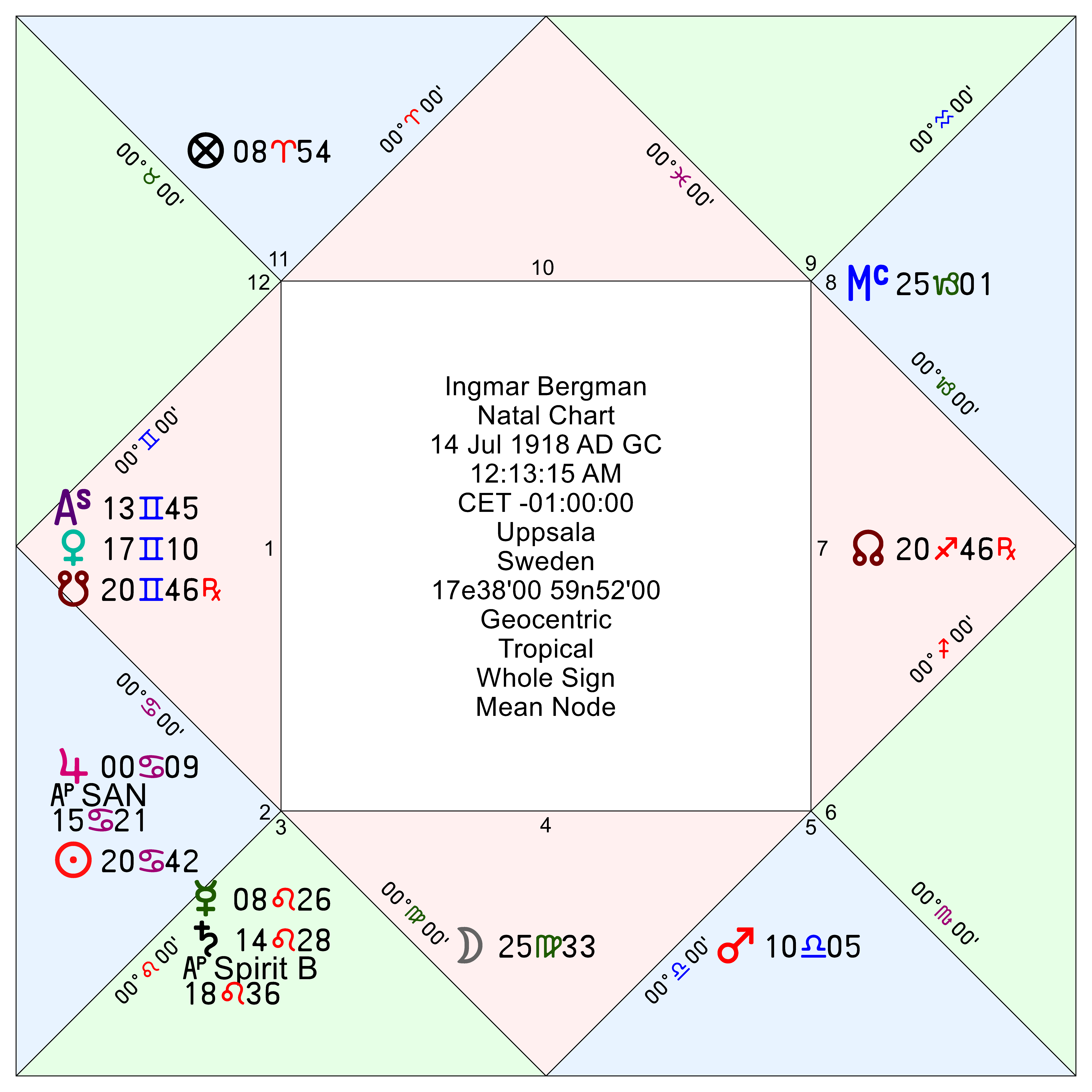
Rodden Rating B, Bio/autobiography, 12:15 AM, ASC 14GE21
Proposed Rectification 12:13:15 AM, ASC 13GE45’16”
The analytical models used in the sections below are part of a larger research program developed across longer white papers and case studies, where the historical sources, rules, and testing methodology are laid out in full. These database entries show the models in practice; readers who want the theoretical foundations can start with the background papers below:
Rectification Hub (I wrote the book on it!)
Soul Hub (white paper, Victor model statistical tests, Moon’s Configuration studies)
Physiognomy Hub (white paper, examples)
Victor Model Factors favoring Mercury/Leo
Sign ruler: Ascendant, Moon
Bound rulers: Prenatal Syzygy, Lot of Spirit
For Ingmar Bergman, Mercury/Leo as Victor of the Horoscope signifies the dramatic and highly self-conscious presentation of inner psychological life through performance, storytelling, and spectacle. In America is Born, I delineate Mercury/Leo as “blockbuster entertainment,” but in Bergman’s case this principle manifests less through commercial spectacle than through the theatrical magnification of personal fears, demons, anxieties, and religious crises into public art. Leo gives Mercury a performative and emotionally expressive quality, turning communication into staged drama before an audience. This symbolism is strengthened by Mercury’s co-presence with Saturn in Leo, which darkens the otherwise playful and extroverted qualities of Mercury/Leo into a more somber fascination with suffering, guilt, death, silence, and emotional isolation. Unlike many major film directors who primarily interpreted or supervised scripts written by others, Bergman personally wrote or co-wrote most of his screenplays, linking him more directly to Mercury as author, narrator, and dramatist. His films were therefore not simply visual productions but highly literary and confessional works in which dialogue, symbolism, dreams, and psychological monologues became the primary vehicles for artistic expression. In this sense, Mercury/Leo describes Bergman’s life purpose as the flamboyant theatrical broadcasting of the inner life itself, transforming intensely private emotional struggles into universally recognized cinema.
Physiognomy Model Factors favoring Gemini
Rising sign: Gemini
Rising sign ruler: Mercury/Leo
Planets located in the rising sign: Venus/Gemini
Rising decan: Libra
Rising decan ruler: Venus/Gemini
Planets located in the rising decan: Mars/Libra
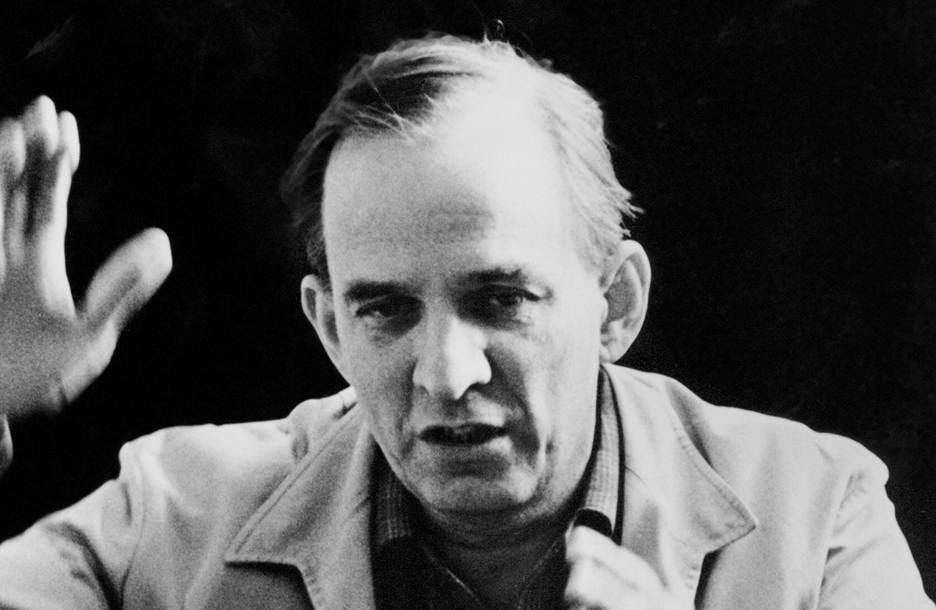
Ingmar Bergman possessed a highly recognizable physiognomy distinguished by an elongated and narrow facial structure, thin jawline, high forehead, and understated bodily presentation. Standing approximately 5 feet 10 inches (178 cm) tall, Bergman was neither physically imposing nor conventionally glamorous, especially when compared to many prominent film directors of the postwar era. His appearance projected introspection rather than charisma in the theatrical Leo sense. The face was long and vertically stretched, with a narrow chin, recessed cheeks, and a somewhat severe expression intensified by deep-set eyes and a receding hairline later in life. In photographs and interviews Bergman often appeared tense, cerebral, and emotionally inward, with gestures suggesting nervous concentration or intellectual intensity rather than social ease. Even in casual portraits there is a noticeable austerity to his appearance which matches the psychological seriousness and emotional exposure associated with his films.
Astrologically, Bergman’s physiognomy is an unusually clear match to a Gemini rising sign, especially when interpreted through the physiognomic framework of John Willner. In Willner’s model Gemini frequently produces an elongated facial structure, and Bergman is close to an ideal textbook example of the type. The rising decan is Libra, ruled by Venus, while Venus itself is placed in Gemini in the rising sign, reinforcing both the artistic dimension of the horoscope and the refined but elongated facial symmetry associated with airy signs. Gemini rising often produces alertness, nervous animation, intellectual expressiveness, and a face that appears shaped more by mental activity than by physical heaviness or sensuality. Bergman’s thin frame, narrow features, and highly cerebral visual presence fit this symbolism closely. The Libra decan softens the harsher possibilities of Gemini physiognomy by adding proportion and aesthetic sensitivity, while Venus in the rising sign contributes to the artistic refinement and visual self-awareness that became central to Bergman’s identity as both theatre and film director.
Moon’s Configuration
Phase I — Jupiter/Cancer Ingress (2nd House)
Delineation. The foundation of Bergman’s Moon configuration begins with Jupiter at 00CA09 in the 2nd house, ruling both the 7th and 10th houses. Across the broader Jupiter/Cancer series, Jupiter/Cancer repeatedly signifies moral philosophy, emotional intuition, psychological sensitivity, and the attempt to protect or preserve emotionally meaningful forms of life. In Bergman’s horoscope this principle becomes psychologically dominant because the Moon rules Jupiter and ultimately applies to Jupiter by superior square. Thus the Moon’s entire narrative arc channels experience toward Jupiterian interpretation and meaning-making.
Yet this is not a gentle or sentimental Jupiter/Cancer. Jupiter is placed in the bound of Mars, with Mars itself located in Libra. Mars/Cancer signifies the defense of emotional vulnerability, family, intimacy, and psychological security, often through indirect or emotionally manipulative forms of conflict rather than direct aggression. Because Mars is in Libra — a sign traditionally unfavorable for decisive martial force — the result is not clean confrontation but lingering emotional injury, unresolved relational tensions, guilt, repression, passive aggression, and simmering psychological wounds. Jupiter therefore develops a moral philosophy centered on the ambiguity of human relationships, especially the impossibility of clean moral resolutions within intimate life.
The 2nd house placement further modifies this symbolism. If the 8th house signifies descent into fear, loss, death, and psychological hell, then the opposing 2nd house can symbolize emergence from those states with accumulated psychological insight and interpretive understanding. Bergman’s artistic life becomes a repeated descent into Saturnian fear followed by a Jupiterian reinterpretation of suffering into philosophy, cinema, theatre, and moral inquiry. Jupiter ruling the 7th house from the 2nd is especially important because the 2nd house is the 8th house from the 7th by derived houses. Thus Jupiter directly signifies the death, termination, dissolution, or ending of relationships and marriages themselves, not merely abstract themes associated with separation. Bergman’s life repeatedly revolved around failed unions, emotional estrangement, divorce, and relational collapse. The symbolism also extends literally to the death of partners, including the loss of his wife Ingrid von Rosen to cancer in 1995. These experiences became central material for Bergman’s artistic and philosophical investigations into intimacy, suffering, guilt, and emotional isolation.
Biographical Match. Bergman’s entire cinematic career can be viewed as a prolonged exploration of the psychological consequences of fear, guilt, failed intimacy, and moral ambiguity. Many of his greatest works revolve around marriages collapsing under emotional strain, including and , where relationships become arenas for emotional excavation rather than comfort or stability. His repeated portrayals of strained marriages, emotional betrayal, and unresolved psychological wounds mirror Jupiter ruling the 7th from the 2nd house.
The Saturnian “descent into hell” component is equally visible throughout Bergman’s life and work. Fear, silence, death, anxiety, and religious dread dominate films such as The Seventh Seal. Yet Bergman’s art never remains entirely within despair. The purpose of the descent is interpretive: to emerge with insight into the moral complexity of human suffering. Even his bleakest films are ultimately attempts to understand emotional pain rather than merely display it. This reflects the Jupiterian function of transforming fear and emotional chaos into philosophical understanding.
Phase II — Moon Separating from Sun (Cancer, Bound of Jupiter, 2st House)
Delineation. The Moon at 25VI33 separates from a sextile to the Sun at 20CA42, with the Sun itself located in the bound of Jupiter and conjoined Jupiter by sign. This creates a strong transfer of light into Jupiterian themes of morality, emotional intuition, and interpretive understanding. The Sun in Cancer emphasizes childhood memory, emotional subjectivity, family conditioning, and vulnerability. Because the Moon separates from the Sun, Bergman’s later life emerges through psychological separation from paternal and religious authority. Since the Sun often signifies the father, this phase strongly suggests movement away from the emotional and theological control represented by his Lutheran upbringing. The sextile also shows cooperation between emotional suffering and conscious artistic expression. Bergman did not merely experience psychological crises privately; he transformed them into structured artistic narratives centered on faith, shame, fear, and emotional exposure.
Biographical Match. Bergman’s difficult relationship with his father became one of the central psychological foundations of his artistic life. Many films revisit authoritarian fathers, emotionally oppressive households, and religious guilt, most clearly in . His cinema repeatedly transformed private psychological anxieties into consciously dramatized artistic expression, especially concerning mortality, silence, and failed intimacy.
Phase III — Moon Changes Signs from Virgo to Libra
Delineation. After birth the Moon changes signs from Virgo into Libra before perfecting its square to Jupiter. Virgo signifies analysis, criticism, and psychological dissection, while Libra externalizes emotional conflict into relationships, mirroring, and interpersonal negotiation. Bergman therefore moves from inward psychological scrutiny toward dramatized emotional interaction between couples, families, lovers, and emotionally dependent individuals. Because Mars is also in Libra, unresolved emotional injuries become shared relational conflicts rather than isolated private suffering. The Libra emphasis also increases theatricality, visual composition, and emotionally charged dialogue, all central features of Bergman’s cinema.
Biographical Match
This transition appears clearly in Persona (1966), Scenes from a Marriage (1973), and Autumn Sonata (1978), where internal psychological suffering is externalized through emotionally intense relationships. Bergman’s genius lay in transforming private emotional wounds into carefully staged interpersonal drama.
Phase IV — Moon Applying to Jupiter (Cancer, 2nd House)
Delineation. The Moon’s final application is a superior square to Jupiter in Cancer, making the entire configuration strongly Jupiterian in conclusion. Yet the square indicates that emotional wisdom emerges only through conflict, contradiction, and suffering. Bergman’s films repeatedly ask whether compassion, emotional understanding, or moral meaning remain possible after betrayal, fear, humiliation, and despair. Because Jupiter rules the 10th house, this search for moral and psychological meaning became Bergman’s public vocation and reputation. His artistic life depended upon transforming intensely private emotional suffering into universally recognized philosophical cinema.
Biographical Match. Bergman became internationally recognized not simply as a director of darkness, but as a filmmaker attempting to understand the moral ambiguity of human suffering and failed intimacy. Even his bleakest films search for emotional truth, tenderness, or reconciliation beneath psychological damage. His repeated return to artistic collaboration and emotional confession through cinema reflects the Moon’s final movement toward Jupiterian understanding after descent into fear and relational crisis.
Influence of Sect
For Ingmar Bergman, the nocturnal sect status of the horoscope is highly revealing because it places Venus and Mars in-sect while Jupiter and Saturn become out-of-sect. Jupiter out-of-sect helps explain why Bergman’s moral and psychological investigations often stood apart from the optimistic cultural mood of the postwar era. Rather than embracing the triumphant confidence, consumerism, and emotional exuberance that characterized much of Western popular culture after World War II, Bergman repeatedly focused on guilt, emotional isolation, failed intimacy, religious doubt, and existential anxiety. His work therefore flourished primarily within the art house cinema world rather than the broader commercial film industry. Saturn out-of-sect intensified the darker dimensions of the horoscope further, increasing tendencies toward melancholy, emotional withdrawal, fear, nervous exhaustion, and recurring depression, all of which Bergman openly acknowledged throughout his life.
The more interesting question concerns the in-sect condition of Venus/Gemini in the 1st house and Mars/Libra in the 5th house, since these planets become constructive engines supporting Bergman’s artistic productivity. Venus in Gemini in the rising sign gave Bergman remarkable aesthetic intelligence, verbal dexterity, theatrical sensitivity, and the ability to transform emotional complexity into elegant artistic form. Even when his subject matter was psychologically brutal, the presentation retained refinement, wit, rhythm, compositional beauty, and intellectual sophistication. Venus in Gemini also strengthened dialogue, duality, mirroring, and psychologically layered conversation, all hallmarks of Bergman’s scripts. Mars in Libra in the 5th house is especially important because, although Mars in Libra is traditionally weakened by sign, sect considerably moderates its more destructive tendencies. Instead of crude aggression, Mars becomes redirected into artistic creation, dramatic tension, romantic conflict, and emotionally charged performance. Located in the 5th house of creativity, theatre, pleasure, and dramatic expression, Mars signifies the staging of conflict itself as art. Bergman’s cinema rarely resolves tension through physical action; instead conflict unfolds through accusation, silence, psychological pressure, emotional negotiation, seduction, betrayal, and intimate confrontation. Mars in Libra in the 5th therefore becomes highly effective for a dramatist and theatre director because conflict is aestheticized, choreographed, and transformed into performance. Sect allows Venus and Mars to cooperate productively, turning interpersonal struggle and emotional instability into the creative machinery of Bergman’s career.
Early/Late Bloomer Thesis
Because Ingmar Bergman was born shortly after a New Moon, the early-bloomer thesis would predict decisive emergence before the midpoint of life. Bergman lived 89 years and 16 days, from 14-Jul-1918 to 30-Jul-2007, placing the lifespan midpoint around 20-Jan-1963 at age 44½. The thesis fits remarkably well. Before the midpoint, Bergman had already written Torment (1944), directed Crisis (1946), completed the influential Malmö theatre period, and achieved international breakthrough with The Seventh Seal and Wild Strawberries in 1957, establishing himself as one of the world’s leading film directors well before midlife. After the midpoint he continued producing masterpieces including Persona (1966), Cries and Whispers (1972), Scenes from a Marriage (1973), and Fanny and Alexander (1982), but these works represent refinement and culmination rather than initial emergence. Bergman therefore stands as a strong confirmation of the early-bloomer thesis associated with post-New Moon births.
Complete biographical chronology, rectification and time lord studies available in Excel format as a paid subscriber benefit. Files are behind the paywall.