

J. M. Barrie belongs squarely within the Jupiter in Cancer series, a group defined not simply by success, but by the ability to preserve experience—especially childhood—through narrative, memory, and emotional continuity. In Barrie’s case, this placement reaches an unusually pure expression: the creation of Peter Pan, a myth centered on the refusal of growth and the preservation of youth against time. Like others in this series, including John Wayne, the presence of Jupiter in Cancer alone is not sufficient to explain the life. It establishes the theme, but not the mechanism. To understand how that theme unfolds in concrete terms, we must look to the Moon, ruler of Jupiter, and more specifically to the Moon’s configuration, which provides the sequence through which experience is shaped, disrupted, and ultimately expressed.
What emerges immediately is a chart where Jupiter promises expansion and preservation, but does so under conditions that are far from straightforward. The life is not one of simple nostalgia or sentiment, but of memory under pressure, where early emotional experiences are not released but instead fixed, reworked, and given enduring form. The key lies in the relationship between the Moon and the rest of the chart—particularly its connections to Venus, the Sun, and Saturn—which together outline a progression from attachment, to loss, to reconstruction. These are not abstract principles; they map directly onto the defining events of Barrie’s life and the structure of his most famous work.
The result is a figure whose creative output cannot be separated from his emotional history. Barrie does not invent Peter Pan so much as arrive at it, through a sequence of lived experiences that demand resolution. The chart suggests that this resolution is never complete in a conventional sense. Instead, it is stabilized through repetition and form, producing a body of work that holds together precisely because it never fully escapes its origin. This dynamic—how Jupiter in Cancer seeks to preserve, and how the Moon determines what is preserved and in what form—will be the central focus of what follows.
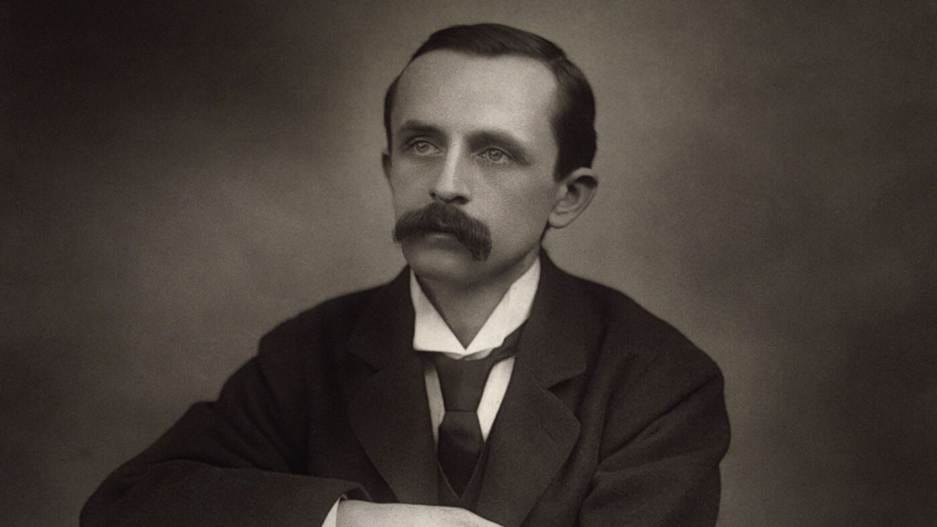
Born James Matthew Barrie, in the Lowland village of Kirriemuir, Forfarshire (now Angus), Scotland, on May 9, 1860, he was the ninth of ten children of a handloom weaver, David Barrie, and Margaret Ogilvy, whose storytelling and intense emotional influence would shape both his imagination and his inner life. A defining trauma came early: at age seven, Barrie lost his older brother David—his mother’s favorite—in a skating accident, after which Barrie sought to console his grieving mother by imitating the lost child, an experience often seen as central to his lifelong fascination with childhood, loss, and the refusal to grow up.
Educated at Dumfries Academy and later the University of Edinburgh, Barrie developed an early interest in literature and theater, reading adventure writers such as Jules Verne and James Fenimore Cooper while also writing and acting in amateur productions. After graduating with an M.A. in 1882, he worked as a journalist before moving to London in 1885, where he built a reputation contributing humorous sketches to publications like The Pall Mall Gazette. His first major success came with Auld Licht Idylls (1888), followed by the widely popular novel The Little Minister (1891), which established him as a leading literary figure and led him increasingly toward playwriting.
Barrie’s greatest and most enduring creation emerged from his relationship with the Llewelyn Davies family, particularly the five young sons of Sylvia Llewelyn Davies. Drawing on stories he told them during walks in Kensington Gardens, he developed the character of Peter Pan—the boy who would not grow up—first introduced in The Little White Bird (1902) and immortalized in the 1904 stage play Peter Pan. The tale, with its blend of fantasy and melancholy, explores themes of childhood innocence, maternal longing, and the passage of time, and remains one of the most influential works in children’s literature. The later prose version, Peter and Wendy (1911), cemented its legacy.
His personal life, however, was marked by complexity and ambiguity. His marriage to actress Mary Ansell in 1894 lasted 15 years. The marriage itself was never consummated sexually and after Mary Ansell had an affair, divorce soon followed in 1909. Biographers have long debated the nature of his emotional attachments, particularly to the Llewelyn Davies boys, whom he informally helped raise after the deaths of their parents. Tragedy continued to shadow him, as several of the boys died young, including George in World War I and Michael by drowning, events that deepened the elegiac tone often found in his later works.
Beyond Peter Pan, Barrie wrote a series of successful plays, including Quality Street (1902), The Admirable Crichton (1902), and What Every Woman Knows (1908), as well as later fantasy works such as Dear Brutus (1917) and Mary Rose (1920), which explore alternative lives, memory, and haunting loss. Honored with a baronetcy in 1913 and the Order of Merit in 1922, he became a central figure in British literary society, counted among acquaintances such as George Bernard Shaw and H. G. Wells.
Barrie died on June 3, 1937, leaving behind a body of work that continues to resonate for its delicate balance between whimsy and sorrow. At its core lies a singular preoccupation: the fragile, fleeting nature of childhood, and the enduring human desire—captured in Peter Pan himself—to escape time and remain forever young.
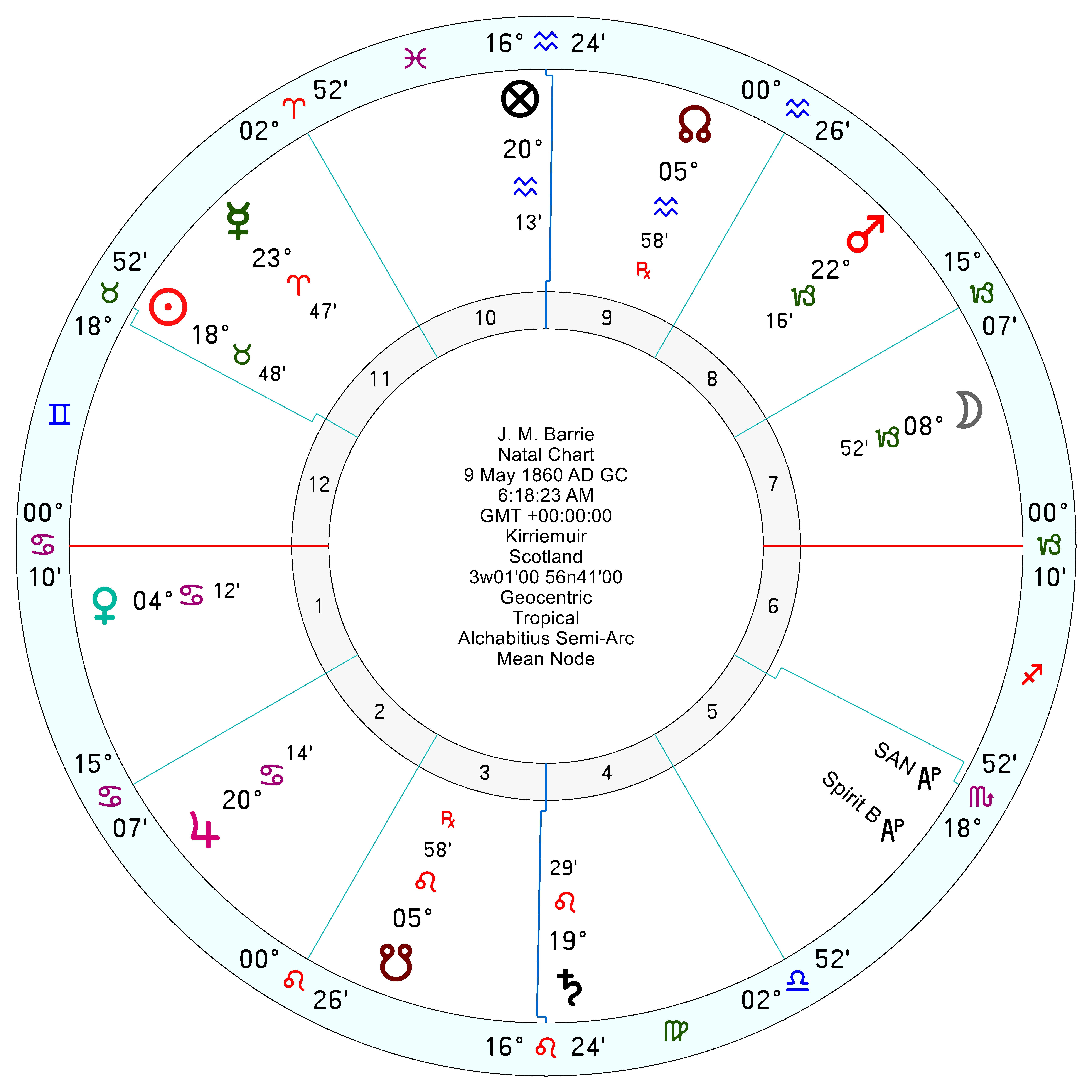
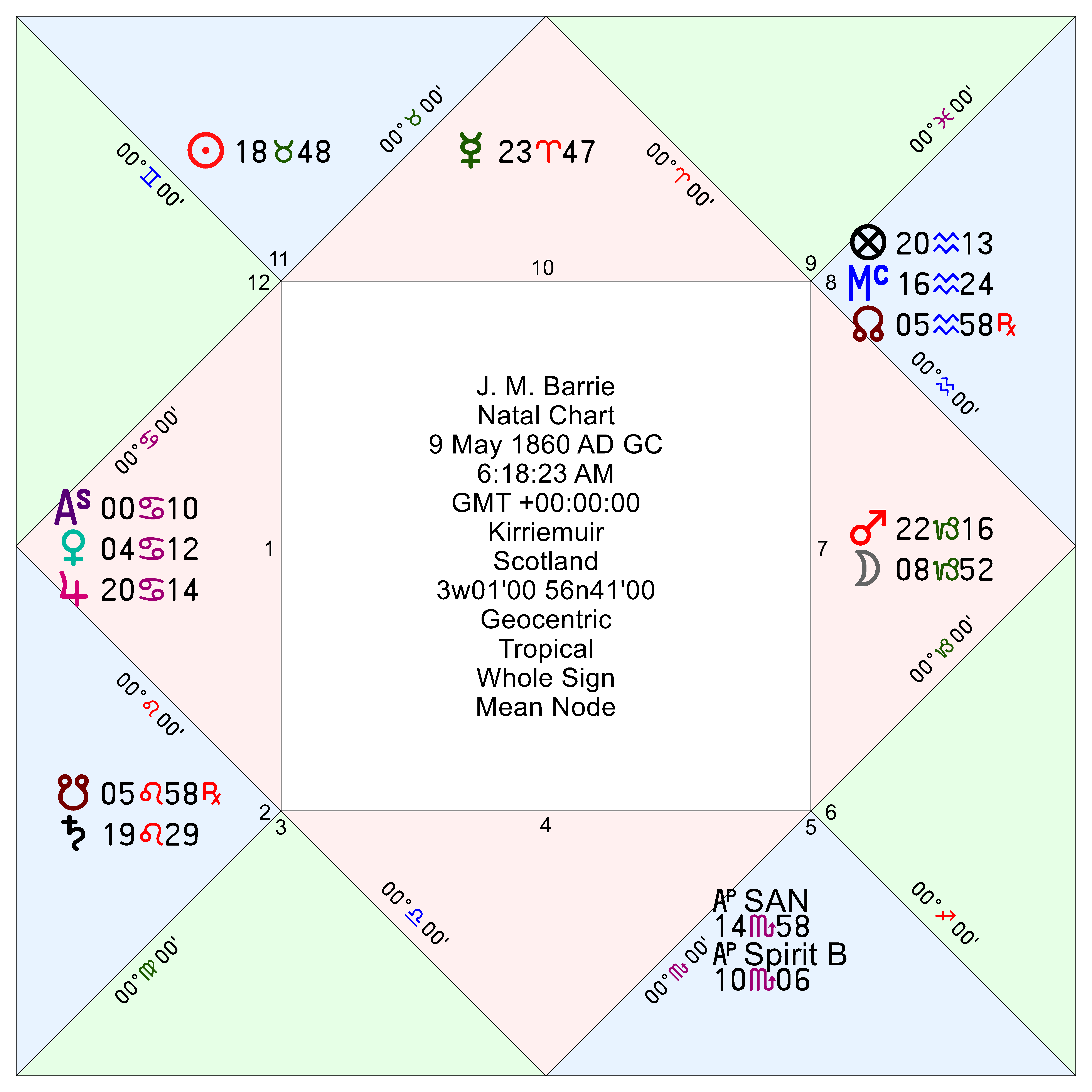
Rodden Rating AA: BC/BR in hand, 6:30 AM, ASC 2CA47
Proposed rectification: 6:18:23 AM, ASC 0CA10’03”
The analytical models used in the sections below are part of a larger research program developed across longer white papers and case studies, where the historical sources, rules, and testing methodology are laid out in full. These database entries show the models in practice; readers who want the theoretical foundations can start with the background papers below:
Rectification Hub (I wrote the book on it!)
Soul Hub (white paper, Victor model statistical tests, Moon’s Configuration studies)
Physiognomy Hub (white paper, examples)
Victor Model Factors favoring Jupiter/Cancer
Bound ruler: MC, Moon, Sun
Position: 1st house
Essential dignity: exaltation
As victor of the horoscope, Jupiter in Cancer describes the central engine of Barrie’s life as the expansion and preservation of childhood memory, rooted in family, loss, and emotional continuity. Exalted in Cancer, Jupiter does not simply signify imagination in the abstract, but rather the mythologizing of the past, transforming personal experience into enduring narrative. Its conjunction with the twin stars Castor and Pollux adds a crucial layer: a symbolism of divided existence, where one life is lost and the other persists in an altered, quasi-immortal state. This is reflected with unusual literalness in Barrie’s biography—the death of his brother and the psychological imperative to preserve that lost child—which finds its ultimate expression in Peter Pan, a figure who refuses growth and time itself. Jupiter’s rulership by the Moon ensures that this myth-making process is not detached or philosophical, but emotionally compelled, driven by lived experience rather than invention; the technical workings of that process, however, belong properly to the Moon’s configuration, where the chart’s deeper sequence of loss and reconstruction unfolds.
Physigonomy Model factors favoring Cancer, Capricorn
Rising sign + rising decan: Cancer
Ruler of rising sign + ruler of rising decan: Moon/Capricorn
Planets placed in rising sign + rising decan:
Barrie presents a small, compact physical frame, consistent with contemporary accounts of his short stature, reinforced by a narrow build and slightly drawn posture that gives him a delicate, almost fragile presence. The face is especially revealing: a smooth, rounded forehead with a polished, almost “billiard ball” quality, set above large, somewhat distant eyes that suggest an inward, reflective temperament. His thin jawline and tapered chin lack the heaviness associated with more robust constitutions, while the prominent mustache seems to add a layer of adult formality over an otherwise youthful structure. The overall impression is unmistakable—a man who never fully grew into his physical form, retaining a boyish quality well into adulthood that mirrors the well-documented traits of a high-pitched voice and an almost theatrical identification with childhood.
Astrologically, this coheres closely with Cancer rising at 00°10′, placing both the sign and decan under lunar governance, with the Moon in Capricorn ruling the Ascendant. Both Cancer and Capricorn are traditionally associated with shorter stature and compressed build, and Barrie exemplifies this clearly. The lunar signature dominates the face, particularly in the smooth cranial structure and softened contours noted above, aligning with classical descriptions of a Moon-governed physiognomy. At the same time, the Moon’s placement in Capricorn introduces a counterpoint of constraint and reserve, visible in the controlled expression and somewhat withdrawn demeanor. The result is a body that appears held in suspension between child and adult, never fully resolving into mature solidity—an embodiment of the same theme that defines his life and work, where growth is resisted and childhood persists beyond its natural limits.
Moon’s Configuration
Phase I – Moon separating from Venus (Cancer, 1st House)
Delineation: The Moon separating from Venus in Cancer in the 1st house indicates an early condition of intense emotional bonding followed by withdrawal or loss of nurturing support. Venus in Cancer is among the most maternal of placements, emphasizing protection, affection, and identity formed through closeness to a caregiver. Its placement in the 1st house suggests that this bond is not merely relational but constitutive of the self. The Moon’s separation from Venus therefore describes a break in this formative attachment, producing a lingering sense of emotional displacement. What remains is not independence, but a continued orientation toward the lost condition, often expressed through longing, imitation, or attempts to recreate the original bond.
Biographical Match: This configuration aligns closely with the central trauma of Barrie’s childhood: the death of his brother David, after which his mother—deeply attached to the lost child—became emotionally withdrawn. Barrie’s response was not to individuate, but to enter into the space left behind, reportedly dressing in his brother’s clothes and attempting to console his mother by becoming, in effect, a substitute. This is the Venusian bond fractured but not released, setting the stage for a life defined by attachment to an absent ideal, rather than engagement with present reality.
Phase II – Sun applying to Saturn (Taurus, 11th/12th to Leo, 4th House)
Delineation: The Sun in Taurus applying to a square of Saturn in Leo introduces a powerful structure of loss, constraint, and irreversible separation with the Sun ruling the IC and Saturn the MC. The Sun signifies vitality, identity, and coherence of life direction; Saturn imposes limits, often through deprivation, grief, or the intrusion of mortality. The square indicates that this is not a background condition but an active and formative tension, shaping the individual’s development through confrontation with what cannot be restored. With Saturn near the IC degree, the locus of this tension is rooted in the home, family, and foundational emotional life, suggesting that identity itself becomes organized around an early rupture.
Biographical Match: With death of siblings assigned to the 10th house (8th from the 3rd), the death of Barrie’s brother functions as one expression of this configuration, but its effects reverberate far beyond a single event. The family environment becomes defined by absence, and Barrie’s identity forms within that absence. Later in life, similar themes re-emerge in his involvement with the Llewelyn Davies family, where the deaths of both parents left the children without their original foundation. Barrie’s role in their lives reflects not resolution, but repetition of the same structural condition: identity shaped in response to loss, with no clear boundary between care and substitution. [Note: by whole sign houses death of a brother is also indicated by Mercury, ruler of the 3rd (siblings), placed in the 10th (death of siblings) with rulers of both houses in square aspect.]
Phase III – Moon applying to Sun (Taurus, 11th/12th)
Delineation: Following the Saturnian rupture, the Moon applies to a trine with the Sun in Taurus, indicating a movement toward integration and stabilization. The trine suggests that the emotional life (Moon) finds a way to align with the organizing principle of identity (Sun), not by resolving the prior loss, but by incorporating it into a coherent system. Taurus, as a fixed earth sign, emphasizes preservation, continuity, and the holding of form over time, making it especially suited to sustaining what would otherwise be lost. However, the Sun is placed in the bound of Mercury, and Mercury itself is configured by a square to Mars, introducing a distinctly malefic undercurrent into what would otherwise be a purely stabilizing process. This modifies the Sun’s role: rather than a simple integration of emotional experience, the identity is shaped through mental agitation, tension, and the intrusion of harsher or more dissonant elements. The result is a structure that holds together, but not without strain—a preserved form that carries within it the imprint of conflict, distortion, or unease.
Biographical Match: This is most clearly realized in Barrie’s creation of Peter Pan, a work that transforms personal trauma into mythic permanence, but with an unmistakable darker subtext. The child who never grows up is not simply preserved innocence, but a figure existing under tension—detached from time, yet unable to fully belong to the world of adults or children. The Mercury–Mars influence suggests that this preservation is achieved through a restless, sometimes troubling imaginative process, where themes of danger, separation, and even death coexist with whimsy. Thus, while Barrie succeeds in constructing a world that stabilizes his emotional experience, that world is not purely benign; it retains the edge of the earlier Saturnian rupture, now refracted through the Sun’s Mercurial bound and Mars-inflected expression.
Influence of Sect
The diurnal sect of the chart places Jupiter and Saturn in-sect, while Venus and Mars operate out-of-sect, producing a striking division between what is supported and stabilized in the life and what remains misaligned or incomplete. Jupiter in sect, and exalted in Cancer, functions at full strength, accounting for Barrie’s broad literary success, cultural reception, and ability to give enduring form to his imaginative world, particularly in a late Victorian and Edwardian context already attuned to themes of childhood, memory, and loss. Saturn, also in sect, does not remove difficulty, but renders it coherent and formative: the Sun–Saturn square anchors identity in early rupture, yet Saturn’s sect condition ensures that this rupture becomes structural rather than destabilizing, allowing repeated experiences of loss to be integrated into a consistent life pattern and ultimately preserved through his work. By contrast, the out-of-sect planets show where integration fails. Venus in Cancer in the 1st house retains its capacity for charm, attachment, and social grace—evident in Barrie’s cultivated social circle and carefully staged entertainments—but is limited in its ability to consummate union, contributing to a division between emotional closeness and physical intimacy. Mars in Capricorn in the 7th, though exalted, is similarly displaced, with its energies projected outward or held in tension with Venus, rather than integrated into the self. The result is a life in which creative and structural forces (Jupiter–Saturn) operate with exceptional coherence, while relational and erotic functions (Venus–Mars) remain divided, producing the well-documented contrast between Barrie’s public success and private incompletion.
Early/Late Bloomer Thesis
Assuming a lifespan from May 9, 1860 to June 3, 1937, J. M. Barrie lived approximately 77 years, yielding a midpoint at age 38–39 (circa 1898–1899). As a post–Full Moon birth, Barrie falls into the category of a late bloomer, where the expectation is that the most defining contributions emerge after midlife. The chronology supports this pattern with notable clarity. Before the midpoint, Barrie achieves genuine success—Auld Licht Idylls (1888, age 28) establishes his reputation, and The Little Minister (1891, age 31) brings widespread popularity—but these belong to a formative phase, marked by experimentation and consolidation rather than lasting cultural impact. The decisive shift occurs after the midpoint, beginning with The Little White Bird (1902, age 42), which introduces Peter Pan, followed by the 1904 stage production of Peter Pan (age 44) and the 1911 publication of Peter and Wendy (age 51), works that secure his enduring legacy. His elevation to a baronet in 1913 (age 53) further confirms that his greatest recognition and historical significance cluster in the second half of life. In this sense, Barrie exemplifies the late bloomer pattern in a refined form: early success lays the groundwork, but the work for which he is remembered—both culturally and mythically—emerges decisively after the midpoint.
Complete biographical chronology, rectification and time lord studies available in Excel format as a paid subscriber benefit. Files are behind the paywall.