

The horoscope of Janis Joplin is anchored by Venus in Aquarius as victor of the horoscope, a placement that immediately situates her within a collective, anti-traditional, and future-oriented aesthetic. Venus in Aquarius does not seek refinement or polish; it seeks truth, difference, and emotional honesty unmediated by convention. Placed in the bound of Jupiter, this Venus absorbs Jupiter’s amplifying, generous, and morally charged qualities, giving Joplin’s music its unmistakable quality of emotional excess offered as a gift. Her performances were not crafted objects so much as acts of communal release—Venusian pleasure fused with Jovian largesse. This configuration aligns uncannily with her rise during what her contemporaries explicitly named the “Age of Aquarius”: a cultural moment defined by collectivism, emotional openness, and the rejection of inherited social forms. Venus in Aquarius made her a voice of the group rather than above it, while Jupiter’s involvement ensured that her art carried the weight of meaning, belief, and emotional magnitude rather than mere entertainment.
At the same time, Joplin belongs to a broader Jupiter-in-Cancer series, inviting direct comparison with Benjamin Franklin, whose horoscope we examined earlier. Both figures share Jupiter in Cancer emerging near acronychal rising, a position that grants Jupiter heightened visibility and public efficacy. Franklin’s Jupiter rises at the moment of maximum strength, fully asserting its protective, constructive, and enduring Cancerian virtues. Joplin’s Jupiter rises roughly a week later—still bright, still operative, but already diminishing as Jupiter rapidly ascends the night sky as the retrograde cycle unfolds. The difference, however, is not merely one of planetary brightness but of Moon configuration, which determines how Jupiter’s promise is used and sustained. Franklin’s Moon in Pisces in the 2nd house applies to Venus in Capricorn, linking emotional intuition to wealth, stability, and long-term value, reinforced by Venus’s mutual reception with Saturn in Taurus. This configuration grounds Jupiter’s generosity, allowing it to crystallize into institutions, property, and durable social roots. Joplin’s Moon, by contrast, applies widely to Jupiter retrograde in Cancer in the 6th house of labor and illness. Her emotional life feeds Jupiter directly through bodily effort, exhaustion, and service rather than accumulation or stability. Where Franklin’s astrology channels Jupiter into permanence and flourishing, Joplin’s channels it into intensity and depletion. The result is stark: one life builds and endures; the other burns brilliantly, gives everything, and cannot hold.
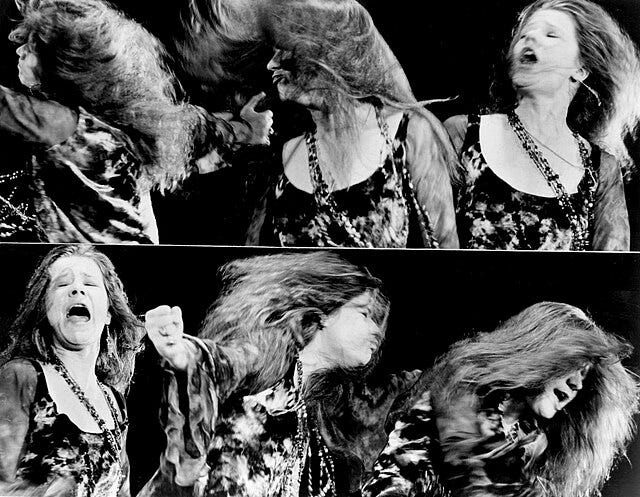
Janis Joplin was an American blues-rock singer whose voice—abrasive, pleading, and emotionally exposed—became one of the most unmistakable sounds of the 1960s counterculture. Born in Port Arthur, Texas, she grew up intellectually curious but socially marginalized, mocked for her appearance, nonconformity, and outspoken personality. Music, particularly early blues and folk, became both refuge and identity. By her late teens she had immersed herself in the work of classic blues singers—Bessie Smith, Ma Rainey, and Big Mama Thornton—absorbing not only their vocal techniques but their unapologetic emotional directness.
After drifting through the folk-blues circuits of Texas and California, Joplin found her artistic home in San Francisco, joining Big Brother and the Holding Company in 1966. Her breakout moment came at the Monterey Pop Festival in June 1967, where her performance stunned audiences and critics alike, instantly transforming her into a national figure. The band’s album Cheap Thrills captured the volatility of her stage presence—equal parts pain, defiance, and ecstatic release—and made her one of the most visible female rock singers of the era.
Joplin left Big Brother in 1968 to pursue a solo career, first with the Kozmic Blues Band and later with the Full Tilt Boogie Band, seeking greater musical control and a tighter rhythmic foundation rooted in soul and R&B. Yet commercial success did little to resolve her inner instability. She oscillated between fierce confidence onstage and acute vulnerability offstage, struggling with alcohol and heroin addiction, unstable romantic relationships, and a recurring sense of emotional exposure without shelter. Her final album, Pearl, recorded shortly before her death, revealed a striking maturation—cleaner arrangements, greater rhythmic discipline, and a voice that retained its rawness while gaining authority. Joplin died of a heroin overdose in October 1970 at age 27, leaving behind a body of work that came to symbolize both the promise and the psychic cost of radical authenticity.
“Ball and Chain,” Big Mama Thornton, and Musical Lineage
Joplin’s relationship to blues tradition is especially clear in her performances of Ball and Chain, written and originally recorded by Big Mama Thornton. Joplin treated the song not as anonymous material but as a personal inheritance: she consistently credited Thornton in interviews, spoke openly of her debt to her, and performed the song as a dramatic act of transmission rather than appropriation. The two women met, and Thornton publicly praised Joplin’s rendition, recognizing it as an extension—rather than an erasure—of her own work. This stands in sharp contrast to the earlier history of Hound Dog, also first recorded by Thornton, whose later recording by Elvis Presley became definitive in popular memory while largely severed from its originator in public attribution. Joplin’s use of “Ball and Chain” was thus unusually conscientious for its era: she framed herself as a vessel for the blues tradition, not its owner, reinforcing her self-conception as a white singer paying explicit homage to Black female forebears rather than silently absorbing their labor into rock stardom.
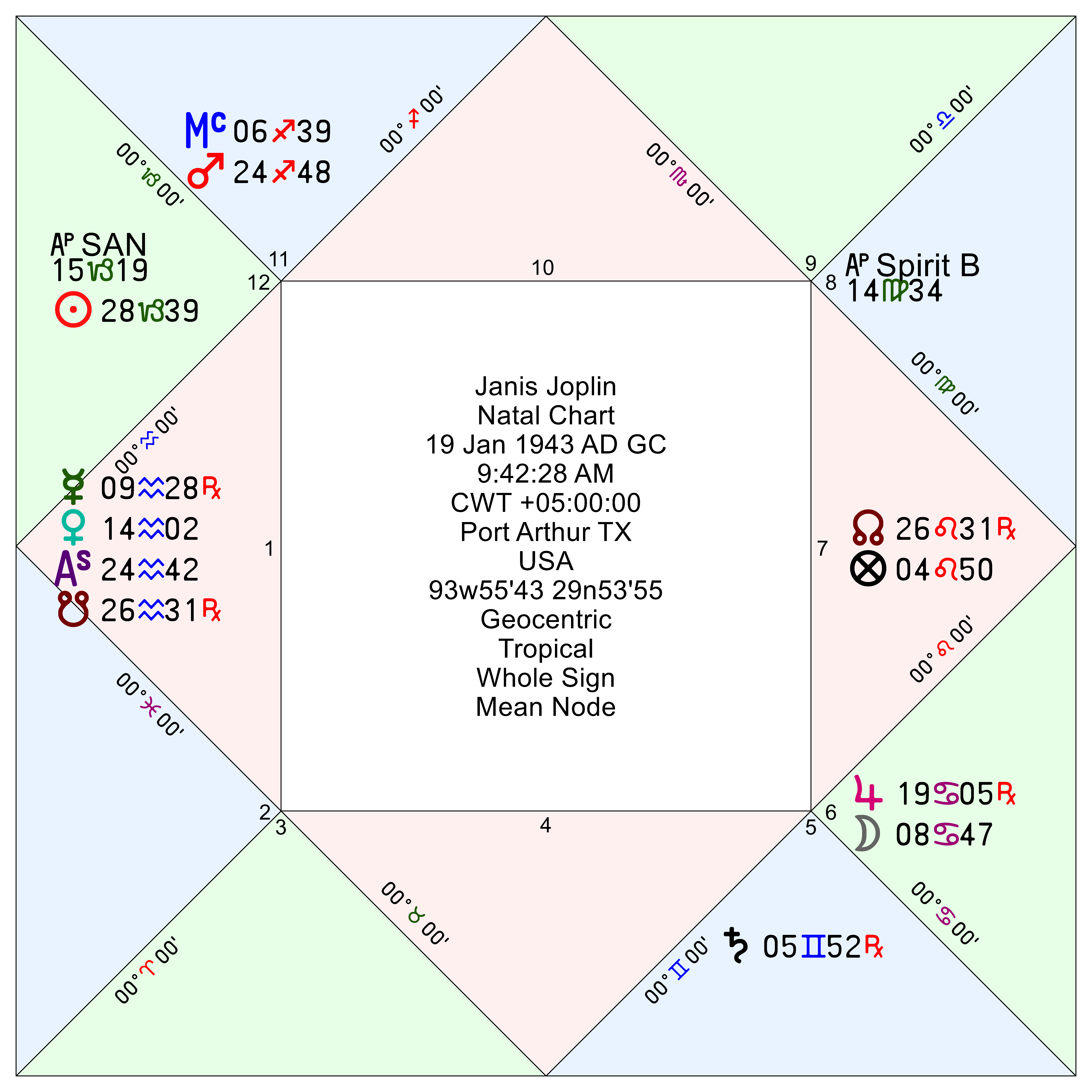
Rodden Rating AA, BC/BR in hand, 9:45 AM, ASC 25AQ52
Proposed rectification: 9:42:28 AM, ASC 24AQ42’36”
The analytical models used in the sections below are part of a larger research program developed across longer white papers and case studies, where the historical sources, rules, and testing methodology are laid out in full. These database entries show the models in practice; readers who want the theoretical foundations can start with the background papers below:
Rectification Hub (I wrote the book on it!)
Soul Hub (white paper, Victor model statistical tests, Moon’s Configuration studies)
Physiognomy Hub (white paper, examples)
Victor of the Horoscope – Venus/Aquarius
Bound rule: Moon, Lot of Spirit, Prenatal Syzygy
Position: Ascendant
Venus in Aquarius, victor of the horoscope and placed in close proximity to the Ascendant, signifies a life in which personal identity and public image become inseparable from artistic expression. Unlike Venus in signs that seek harmony, refinement, or social acceptance, Venus in Aquarius derives its strength from independence, unconventionality, and a willingness to disregard established standards of taste. Joplin’s success rested precisely on these qualities. Her voice was raw rather than polished, emotionally exposed rather than restrained, and stood in sharp contrast to prevailing expectations for female performers during the 1960s. Placement in the 1st house brought the victor directly into public view, making Venus not merely a talent but the defining feature of her persona. Audiences did not simply listen to Janis Joplin; they encountered an individual whose appearance, mannerisms, and performances embodied a rejection of convention. The result was a career built upon authenticity rather than conformity, allowing her to become one of the most recognizable figures associated with the countercultural movement. Long after the social conditions that produced that movement have faded, the image of Joplin remains intact because Venus in Aquarius transformed artistic nonconformity into a lasting public identity.
Physiognomy factors favoring Aquarius, Sagittarius
Rising sign: Aquarius
Ruler of rising sign: Saturn/Gemini-retrograde
Rising decan: Libra
Ruler of rising decan: Venus/Aquarius
Planet with partile aspect to the Ascendant degree: Mars/Sagittarius
Janis Joplin stood approximately 5 feet 6 inches tall and possessed a slender, somewhat angular build that contrasted with the glamorous image often associated with female performers of her era. Her face was broad through the forehead and cheekbones, narrowing only slightly toward the jaw, producing a distinctly rectangular appearance. The forehead is particularly prominent, while the nose is straight and substantial, giving the face a strong architectural quality rather than delicate refinement. Her smile was expansive and expressive, capable of conveying warmth, humor, and vulnerability simultaneously. Perhaps her most recognizable physical feature was her hair, worn long, loose, and often deliberately untamed, creating an impression of spontaneity and freedom. Together these features projected individuality and authenticity rather than conventional beauty, a quality that became central to her public image.
The physiognomy is best explained through a combination of Aquarius and Sagittarius signatures. Aquarius is visible in the rectangular structure of the face, especially the broad forehead, which assumes the shape of a flat horizontal plane reminiscent of a bulldozer’s blade. This signature is consistent with Aquarius as the rising sign and with Venus in Aquarius, victor of the horoscope, ruling the Libra rising decan. Sagittarius appears most clearly through the long, flowing hair that became one of Joplin’s defining visual characteristics. Mars in Sagittarius sends a partile sextile to the Ascendant degree, which also occupies Mars’ bound, providing an example of a planet in close aspect to the Ascendant contributing directly to physical appearance. The combination produces a physiognomy that is simultaneously unconventional and expansive: Aquarius supplies individuality and nonconformity, while Sagittarius contributes freedom, movement, and a refusal to be constrained by conventional standards of presentation.
Moon’s Configuration
Stage I — Moon Separating from Mars (Sagittarius, 11th House)
Delineation. The Moon’s separation from Mars describes conflicts already embedded in the life, not challenges yet to come. Mars in Sagittarius signifies ideological disputes, clashes over vision, and uncompromising positions regarding meaning and direction. Placed in the 11th house by whole sign, Mars governs bands, organizations, collaborators, and income derived from collective effort; its proximity to the Midheaven degree elevates these conflicts into public and professional visibility. Mars here does not consolidate authority but fractures cohesion, producing ruptures within group structures rather than victories through them. Because the Moon is separating, these conflicts act as formative wounds: they weaken collective bonds and compel withdrawal rather than enabling mastery or leadership within groups.
Biographical Match. This stage is most clearly reflected in Joplin’s tenure with Big Brother and the Holding Company between 1966 and early 1968. Although her performance at the Monterey Pop Festival on 17 June 1967 brought sudden national recognition, tensions within the band quickly intensified over musical direction, discipline, and control. By late 1967, producer conflicts during the recording of Cheap Thrills revealed deep structural fractures. Joplin formally left the band in December 1968, a decisive separation that ended her primary collective affiliation. These events exemplify Mars in the 11th operating through public group conflict rather than cooperative expansion.
Interlude — Void of Course and Sign Change (Gemini → Cancer)
Delineation. Before the Moon can apply to Jupiter, it passes through a void-of-course interval and changes signs, marking a necessary rupture in the narrative. The Moon’s earlier opposition to Mars occurred in Gemini, a sign associated with division, argument, and multiplicity of voices, indicating disputes conducted through words and competing claims. The void-of-course condition signifies a period in which no effective resolution is possible within that framework. The sign change into Cancer does not represent progress but necessity: the Moon must abandon the arena of debate entirely and retreat into its own domicile, shifting from negotiation to instinct, embodiment, and emotional self-preservation.
Biographical Match. This interlude corresponds to the turbulent transitional period of 1968–1969, when Joplin drifted professionally and personally following her departure from Big Brother. Her brief attempt to stabilize her career with the Kozmic Blues Band failed to resolve underlying tensions, culminating in a critically panned European tour in spring 1969. During this time, conflicts were not repaired but abandoned, and Joplin increasingly withdrew from collaborative structures altogether. The lack of resolution, coupled with escalating substance use, mirrors the Moon’s void-of-course passage: the old framework had collapsed, but no new one had yet formed.
Stage II — Moon Applying to Jupiter (Cancer, 6th House, Retrograde)
Delineation. The Moon’s application to Jupiter in Cancer is benefic yet constrained. Jupiter is exalted by sign but retrograde and placed in the 6th house, indicating growth through labor, repetition, and physical expenditure rather than honor or institutional security. Jupiter’s recent acronychal rising briefly restores its full Cancerian expression—emotional generosity, protection, and intuitive bonding with others—but this condition is unstable and quickly diminishes with Jupiter now a week after acronycal rising. Jupiter is ruled by the Moon in domicile, forming a closed circuit of emotional intuition, while the Moon’s placement in the bound of Venus, the victor of the horoscope, binds belief, labor, emotion, and music into a single operative system. Jupiter is bonified only performatively: it gives meaning through Venusian expression, but at bodily cost.
Biographical Match. This stage is exemplified by Joplin’s final period with the Full Tilt Boogie Band in 1969–1970, marked by extraordinary public connection achieved through punishing work. Her performance at Woodstock on 18 August 1969, though chaotic, cemented her role as an emotional conduit for mass audiences. Intensive touring followed, culminating in the recording sessions for Pearl between September and October 1970. These months show Jupiter functioning fully onstage—generous, emotionally binding, and expansive—while offstage her health deteriorated under the strain. Her death on 4 October 1970 underscores the configuration’s limit: Jupiter performs, but cannot sustain itself within the 6th-house conditions of exhaustion and bodily vulnerability.
Interpretive Summary
Janis Joplin’s Moon’s Configuration describes a life in which emotional authenticity is achieved not through stability, but through exhaustion. Conflicts within collective structures repeatedly force separation, leaving no durable organizational shelter. The void-of-course interval shows that these conflicts could not be resolved through negotiation or reform; withdrawal was the only available response. The subsequent application to Jupiter in Cancer allows genuine beneficence—emotional generosity, intuitive bonding with the public—but only through relentless labor and physical depletion. Bonified by the Moon placed in the bound of Venus, Joplin’s Jupiter performs magnificently through music, transforming suffering into communal meaning. Yet the configuration offers no mechanism for preservation. What it grants in significance, it exacts from the body, leaving a legacy of truth without endurance.
Influence of Sect
Viewed through the Moon’s Configuration, sect clarifies the contrast between conflict and connection in this chart. In this diurnal chart, Mars is out of sect, sharpening the separating Moon–Mars phase and intensifying conflicts within groups; disputes with bands and collaborators are volatile, emotionally charged, and leave damage rather than resolution. The Moon itself, though dignified in Cancer, is out of sect, which limits its capacity to contain these stresses without cost. By contrast, the Moon’s application to Jupiter in sect allows the second phase of the configuration to perform effectively. Jupiter’s in-sect status legitimizes its beneficence and enables a powerful connection with a wide public, even while retrograde and placed in the 6th house. That connection, however, is sustained through labor and depletion, with the emotional generosity Jupiter provides paid for through the body rather than preserved by it.
Early/Late Bloomer Test - A Failure Case
Janis Joplin was born on 19 January 1943 and died on 4 October 1970, giving her a total lifespan of just under 27 years. The midpoint of her life therefore falls in late May 1956, when she was a little over 13 years old. All of the milestones by which she is remembered occur well after this date. She joins Big Brother and the Holding Company in 1966, breaks nationally at the Monterey Pop Festival on 17 June 1967, releases Cheap Thrills in 1968, and reaches peak visibility between 1967 and 1969, including her appearance at Woodstock in August 1969. Measured against her actual lifespan, her public and vocational emergence is decisively late, not early, and the early/late bloomer thesis does not hold.
The reason for the failure likely lies in lunar proximity to the syzygy. Although Joplin is technically born after a New Moon, her Moon is only about 20 degrees from the Sun–Moon opposition, placing her close to a Full Moon axis rather than in a clean waxing phase. In prior tests, horoscopes born near the New or Full Moon consistently resist gradual developmental models, showing instead compressed and extreme life patterns. Traditional authors already recognized this instability. Firmicus Maternus cautioned that syzygy births tend toward excess and imbalance because the luminaries are locked in contention rather than orderly growth. Joplin’s life reflects this condition exactly: delayed ignition followed by rapid culmination, brilliance without moderation.
AI Notice: This post created with assistance from ChatGPT.
Complete biographical chronology, rectification and time lord studies available in Excel format as a paid subscriber benefit. Files are behind the paywall.