

Jay Gould occupies an uneasy position in American financial history. Few nineteenth-century businessmen attracted more hostility from the press or broader public, and the label of “robber baron” attached itself to Gould more firmly than perhaps any other financier of the Gilded Age. Yet the historical record is more complicated than the caricature. Modern revisionist historians such as Maury Klein have argued that Gould was not merely a speculative manipulator, but a central figure in the consolidation of the nation’s transportation and communications infrastructure during the decades following the Civil War. The horoscope reflects this tension clearly. Gould’s chart belongs to the broader Jupiter in Cancer series, but here Jupiter operates through a far darker and more politically controversial expression than many other examples.
The choice of Jupiter in Cancer as victor of the horoscope ties Gould’s career to the expansion of large commercial systems serving the broader public: railroads, freight networks, telegraphy, and transportation corridors linking agricultural and industrial regions of the country. Particularly important is Jupiter’s placement in the bound of Mercury, with Mercury itself placed in Gemini, creating a strong connection between Jupiterian expansion and Mercurial industries involving movement, communication, coordination, and exchange. Gould’s empire ultimately rested upon railroads and telegraph systems, two of the clearest Gemini significations in nineteenth-century commerce. But Jupiter is also out-of-sect, limiting the public legitimacy of these achievements. Gould built systems of continental scale while remaining politically and socially mistrusted, his enterprises often viewed less as national accomplishments than as instruments of manipulation and concentrated financial power.
The Moon’s configuration further modifies Jupiter’s expression. The Moon in Scorpio conjunct the South Node intensified public suspicion toward Gould and contributed to the near-demonic reputation he acquired in the press. Even legitimate business operations often appeared secretive or conspiratorial in the public imagination. At the same time, the Moon’s lengthy void-of-course period before perfecting its trine to Jupiter delayed the full emergence of Gould’s empire. His rise unfolded gradually through years of failed ventures, reorganizations, speculation, and strategic consolidation before reaching its mature form in the railroad and telegraph systems of the 1870s and 1880s. The result is a horoscope where Jupiter eventually achieves large-scale expansion, but only after passing through Scorpio’s atmosphere of suspicion, conflict, and prolonged uncertainty.
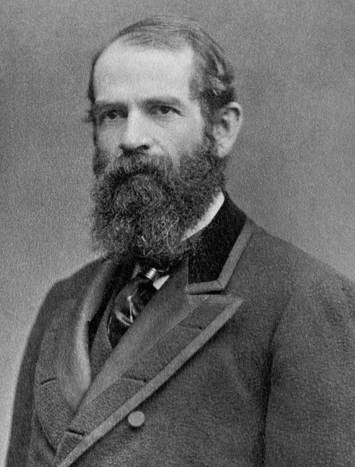
Jay Gould entered American history as the ultimate “robber baron,” a financial schemer blamed for stock manipulation, political corruption, railroad wars, and the infamous Gold Panic of 1869. Contemporary newspapers portrayed him almost as a criminal mastermind lurking behind every financial crisis of the Gilded Age, while later Progressive historians elevated him into a symbol of predatory capitalism itself. Yet modern scholarship—especially the revisionist work of biographer Maury Klein—has challenged much of this mythology, arguing that Gould was less a destroyer of American capitalism than one of its most misunderstood architects.
Born into modest circumstances in rural Roxbury, New York, Gould displayed extraordinary intelligence, discipline, and ambition from an early age. Before entering Wall Street, he worked as a surveyor and mapmaker, professions that sharpened his fascination with geography, transportation, and systems of commerce. His first major entrepreneurial venture was a tannery partnership in Pennsylvania during the 1850s, but the business deteriorated into debt, lawsuits, and bitter disputes with associates. The failure proved decisive in shaping Gould’s personality. He emerged from the experience intensely secretive, suspicious of partners, and convinced that survival in American business depended upon maintaining control rather than trusting others.
Klein argues that Gould’s rise did not come through inherited privilege or political office, but through relentless study and an unusual ability to recognize how fragmented industries could be reorganized into larger integrated systems. Railroads fascinated Gould not simply as speculative vehicles, but as living economic networks capable of transforming entire regions of the country. During the 1870s and 1880s he acquired influence over major rail systems including the Union Pacific, Missouri Pacific, Wabash, Texas & Pacific, and several southwestern lines. Gould often entered companies during periods of crisis, reorganized finances, expanded trackage, reduced competition, and attempted to stabilize freight operations during an era marked by repeated depressions and violent market instability.
At the height of his influence in the early 1880s, Gould controlled or heavily influenced roughly 15 percent of all railroad mileage in the United States, in addition to vast telegraph interests through Western Union and important urban transit holdings in New York City. His empire stretched from Wall Street to the Great Plains, linking railroads, telegraph communications, finance, and metropolitan transportation into one of the largest private business systems in America. Even many critics who despised Gould privately acknowledged the sheer scale of his organizational talent. Klein contends that this empire was not built solely through manipulation, but through Gould’s extraordinary command of logistics, capital flows, and competitive strategy during one of the most chaotic phases of American industrialization.
Far from merely looting corporations, Gould immersed himself in rate structures, freight flows, regional development, and long-range planning with obsessive intensity. Klein also stresses that many practices associated with Gould—stock watering, political bribery, speculative warfare, and legislative influence—were widespread features of nineteenth-century capitalism rather than inventions unique to him. In this interpretation, hostile journalists, political enemies, and rival financiers gradually transformed Gould into a public symbol onto which Americans projected broader anxieties about concentrated wealth, industrialization, and the expanding power of Wall Street.
Personally, Gould differed sharply from the flamboyant image created by his enemies. He was quiet, intensely private, devoted to his family, and almost indifferent to public approval. Unlike contemporaries such as Jim Fisk or Cornelius Vanderbilt, Gould preferred secrecy, calculation, and behind-the-scenes maneuvering to theatrical displays of wealth or power. When he died in 1892, he left behind not only one of the largest fortunes of the Gilded Age, but also one of the most contested reputations in American business history—a man remembered simultaneously as a financial predator, railroad strategist, and misunderstood architect of the modern corporate economy.
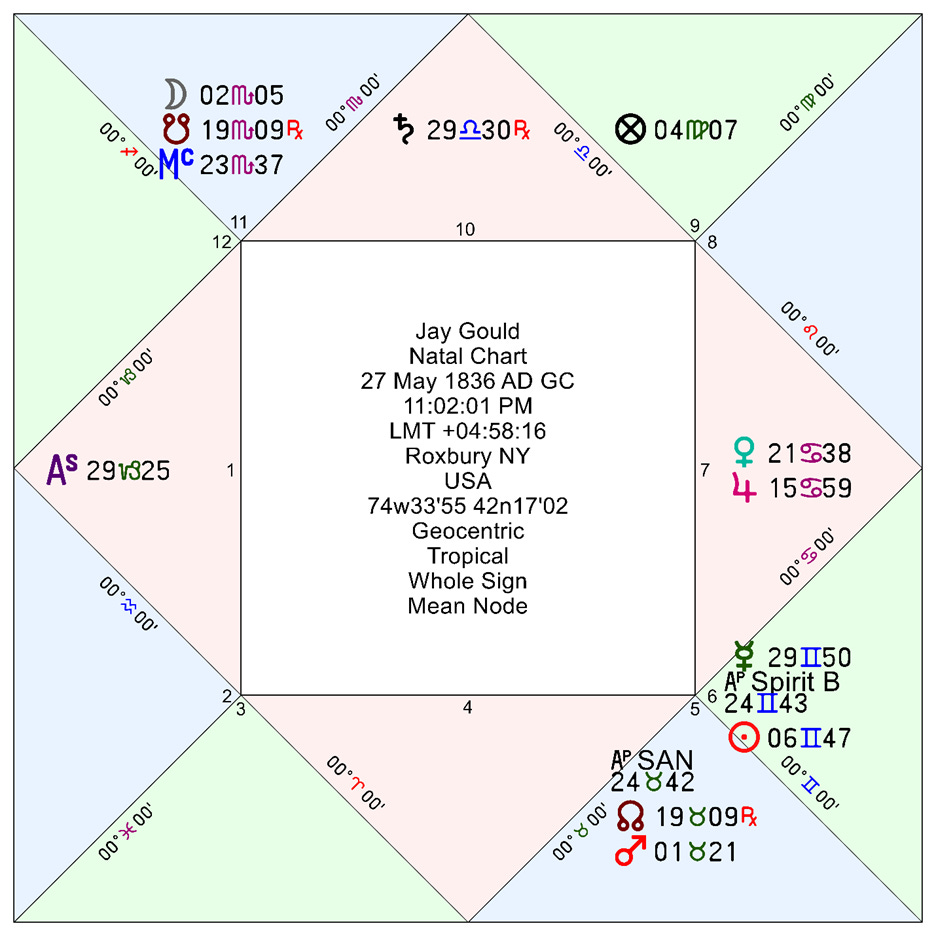
Rodden Rating C, original source not known. 5:35 AM, ASC 22GE25
Proposed Rectification: 11:02:01 PM, ASC 29CP25’21”
The analytical models used in the sections below are part of a larger research program developed across longer white papers and case studies, where the historical sources, rules, and testing methodology are laid out in full. These database entries show the models in practice; readers who want the theoretical foundations can start with the background papers below:
Rectification Hub (I wrote the book on it!)
Soul Hub (white paper, Victor model statistical tests, Moon’s Configuration studies)
Physiognomy Hub (white paper, examples)
Victor Model Factors favoring Jupiter/Cancer
Bound ruler: MC, Sun
Essential Dignity: exaltation
House position: 7th by whole sign houses
The choice of Jupiter in Cancer as victor of the horoscope fits the broad structure of Jay Gould’s life and career. Exalted Jupiter in Cancer signifies expansion through systems tied to trade, transport, and the circulation of resources. Gould’s empire rested upon the infrastructure of nineteenth-century America: railroads, telegraph networks, freight systems, and agricultural commerce moving across the continent. By the early 1880s he controlled roughly 15 percent of American railroad mileage along with major interests in Western Union and New York elevated transit. Whatever judgment one makes about Gould’s methods, his career was tied to the consolidation of the commercial networks that connected the post–Civil War economy. Jupiter in Cancer frequently operates through large public systems, and Gould’s business life followed that pattern closely.
Jupiter’s expression is modified by its ruler, the Moon in Scorpio, and especially by the Moon’s configuration. The Moon separates from Mars and applies to Jupiter, describing Gould’s movement away from the losses and conflict of the tannery business toward financial success in railroads and communications. But the Scorpio Moon also alters the public expression of Jupiter. Gould did not appear as a celebrated builder in the mold of later industrial magnates. Instead, he became associated with secrecy, manipulation, and hidden strategy, earning a reputation as one of the most feared financiers of the Gilded Age. The Moon near the South Node intensifies this darker public image. In Gould’s chart, Jupiter’s expansive power remains fully intact, but it operates through Scorpio’s preference for concealment, tactical maneuvering, and control behind the scenes.
Physiognomy Model Factors favoring Gemini
Rising sign: Capricorn
Rising sign ruler: Saturn/Libra-retro
Rising decan: Virgo
Rising decan ruler: Mercury/Gemini
Gould’s physiognomy is dominated by elongation, narrowness, and dryness. In photographs he appears slender and vertically oriented rather than broad or heavyset, with a long torso, thin limbs, narrow shoulders, and an extended facial structure. The forehead rises high and somewhat vertically, while the cheeks remain lean and compressed. His nose is long and sharp, the jaw narrow rather than square, and the eyes deeply set beneath a tense browline. Even the beard contributes to the impression of vertical extension rather than fullness. Nothing in Gould’s appearance suggests physical exuberance or overt vitality. Instead, the overall effect is wiry, restrained, calculating, and somewhat withdrawn. He lacks the expansive bodily presence often associated with railroad magnates of the period and instead resembles a scholar, surveyor, or accountant who happened to control a continental business empire.
Astrologically, the strongest physiognomic significator is Mercury in Gemini, which rules the Virgo rising decan. This combination fits Gould’s appearance closely. Gemini frequently produces elongated body types, narrow facial structures, and a nervous or tensile quality to the physique, especially when reinforced by Saturnian influences. Mercury in its own sign emphasizes quickness, intelligence, adaptability, and a certain physical sparseness rather than muscularity or bodily mass. The Virgo decan adds refinement, dryness, and precision to the presentation. Gould’s face reflects this Mercury-Gemini dominance through its lean geometry and highly alert expression. The overall physiognomy suggests intellect operating continuously beneath the surface — a man defined less by overt force than by observation, calculation, and strategic control.
Moon’s Configuration
Phase I. Moon separating from Mars (Taurus, 3rd/5th House)
Delineation. The Moon at 2° Scorpio separates from Mars at 1° Taurus, establishing an opening life narrative shaped by conflict, financial instability, and contested material resources. Mars in Taurus directs attention toward cattle, commodities, and business losses, themes reflected clearly in Gould’s disastrous tannery venture. The Moon conjunct the South Node intensifies Scorpio’s instinct for secrecy, suspicion, and strategic calculation, often inflating intuitive judgments beyond their true importance. The same symbolism magnifies public distrust, contributing to Gould’s reputation as a hidden manipulator operating behind the scenes of American finance.
Biographical Match. The tannery collapse of the late 1850s closely matches the Moon’s separation from Mars. Gould became entangled in lawsuits, disputes with partners, armed confrontations, and the suicide of financier Charles Leupp during the unraveling of the business. Yet the same configuration shows Gould’s ability to recover from commercial wreckage. Throughout later life he repeatedly entered distressed situations—failing railroads, collapsing stock positions, and unstable companies—and rebuilt them into larger and more profitable systems.
Phase II. Void-of-Course Moon (Scorpio)
Delineation. Before reaching Jupiter in Cancer, the Moon passes through a lengthy void-of-course condition in Scorpio. This suggests that Gould’s rise would occur gradually through patience, secrecy, and long-term strategic positioning rather than rapid public success. The void Moon often delays visible outcomes, while Scorpio prefers indirect influence and concealed maneuvering. Combined with the South Node, the configuration intensified the mystery surrounding Gould’s activities and encouraged others to assume hidden motives even when little evidence existed.
Biographical Match. Gould’s empire emerged through decades of gradual consolidation rather than sudden triumph. After leaving the tannery business, he spent years speculating in smaller railroad securities before gaining influence over Erie Railroad during the late 1860s. Even afterward, repeated legal battles, reorganizations, and financial crises slowed the construction of his system. The growth of Union Pacific, Missouri Pacific, Western Union, and related enterprises unfolded piece by piece over many years, matching the prolonged developmental quality of the void-of-course Moon.
Phase III. Moon applying to Jupiter (Cancer, 6th/7th House)
Delineation. The Moon ultimately perfects its trine to Jupiter in Cancer, the victor of the horoscope. Exalted Jupiter in Cancer signifies expansion through transportation, communications, trade networks, and systems tied to the broader public. In Gould’s chart, Jupiter’s power operates through the construction and consolidation of commercial infrastructure. Yet the Scorpio Moon modifies Jupiter’s expression, producing expansion through secrecy, tactical maneuvering, and control behind the scenes rather than through public admiration or popularity.
Biographical Match. By the early 1880s Gould controlled or heavily influenced roughly 15 percent of American railroad mileage alongside major telegraph and urban transit interests. His empire linked railroads, freight systems, telegraph communications, and financial capital into one of the largest commercial networks in the United States. Despite scandals surrounding Erie, Black Friday, and repeated accusations of manipulation, Gould consistently emerged from crises with larger systems and broader influence than before. The Moon’s eventual application to Jupiter describes the long process through which financial conflict and instability were transformed into a continental-scale business empire.
Influence of Sect
Sect plays an important role in explaining both Gould’s business success and the hostility surrounding his public reputation. The figure is nocturnal, placing Mars and Venus in-sect while Saturn and Jupiter are out-of-sect. Out-of-sect Saturn in Libra near the 9th/10th house signifies repeated public perceptions that the rule of law had become distorted through finance, politics, and corporate influence. Gould operated in environments filled with lawsuits, legislative favors, stock manipulation, and accusations of corruption, causing many contemporaries to view him as a symbol of institutional breakdown during the Gilded Age. Yet Saturn in Libra still retains administrative discipline and strategic intelligence, and its harsher effects are moderated by Venus in Cancer in-sect. Venus helped preserve Gould’s connection to respectable Victorian social norms through marriage, family life, philanthropy, and commercial systems tied to ordinary domestic life such as rail transport and communications. Similarly, Jupiter in Cancer out-of-sect granted large-scale business expansion while limiting public acceptance of his achievements, casting his empire as politically suspect even at moments of economic success. By contrast, Mars in Taurus in-sect repeatedly protected Gould during periods of financial destruction. The collapse of the tannery business, the Erie conflicts, Black Friday, and later market crises damaged others more severely than Gould himself. Mars in-sect gave him the endurance and tactical resilience to survive commercial disasters and rebuild larger systems from their remains.
Early/Late Bloomer Thesis
Gould lived 56 rounded years; the midpoint of his life falls at about 28 rounded years, around late August 1864.
Since Gould was born after a New Moon, the early/late bloomer thesis predicts an early bloomer. His chronology supports that fairly well. Before the midpoint, he had already left farming, worked as a surveyor and mapmaker, published his History of Delaware County, entered the tannery business, survived its collapse, moved into railroad securities, married Helen Day Miller, and begun the transition from failed leather entrepreneur to railroad speculator. By the midpoint in 1864, the foundations of the later career were already in place.
After the midpoint, however, the scale of achievement expands sharply. Gould became a director of the Erie Railroad in 1867, emerged as a central figure in the Erie War, participated in the 1869 gold corner, moved into Union Pacific after 1873, entered telegraphy in the mid-1870s, and by the early 1880s controlled or influenced a large railroad and communications empire. So the thesis works if “early bloomer” means early vocational formation and early entry into the decisive field. It does not mean his peak came early. Gould’s major empire-building belonged to the second half of life, but the pattern, skills, and commercial direction were established before the midpoint.
Complete biographical chronology, rectification and time lord studies available in Excel format as a paid subscriber benefit. Files are behind the paywall.