

The Tech Bros series returns to a configuration that should now look familiar. Jeff Bezos and Jensen Huang have strikingly similar astrological foundations: both were born diurnally, both have Moon/Sagittarius, and both have Saturn/Aquarius as victor of the horoscope. The resemblance is appropriate. Neither man is primarily distinguished by inventing a single consumer technology. Their achievement lies in building and controlling the infrastructure upon which other technologies, businesses and products depend. Huang did it with the computational architecture of NVIDIA; Bezos did it with the commercial architecture of Amazon.
There is, however, an important difference. Jensen Huang appears largely untouched by the kind of literary or philosophical precursor encountered elsewhere in the Tech Bros series. Jeff Bezos is not. Bezos was an enthusiastic reader of science fiction, with writers including Isaac Asimov, Robert Heinlein and Arthur C. Clarke among the influences associated with his interest in space. More important than any of them, however, was the physicist Gerard K. O’Neill, the subject of the previous article.
As a teenager, Bezos encountered O’Neill’s vision of moving human settlement and heavy industry beyond Earth into enormous orbital habitats. The idea caught his imagination. Bezos was already speaking at his high-school graduation about millions of people living in space, and at Princeton he became president of the university chapter of Students for the Exploration and Development of Space. Decades later, Blue Origin can be understood as an attempt to build some of the infrastructure necessary to make O’Neill’s vision possible. For readers coming directly from the O’Neill article, the connection is therefore unusually direct: yesterday’s theorist becomes today’s billionaire infrastructure builder.
That distinction also provides a useful way into Bezos’s horoscope. Huang’s Saturn/Aquarius rules Mercury/Aquarius, directing Saturn’s command-and-control qualities toward computation and computer chips. Bezos’s Saturn/Aquarius instead rules Venus/Aquarius, shifting the same impulse toward consumer products and the systems through which they are bought, sold and delivered. The books themselves were almost incidental. What mattered was constructing the machinery capable of selling the books—and eventually almost everything else.
The Moon/Sagittarius adds another dimension shared with Huang: an appetite for growth on a scale that can initially appear excessive. In Bezos’s case, however, that Moon also connects the seemingly unrelated worlds of Amazon and Blue Origin. One moves packages ever faster across terrestrial distances; the other seeks to make movement into near-Earth space routine. Behind both lies a recurring Bezos proposition: rather than accept an existing constraint, build a larger system capable of overcoming it.
That is where the horoscope becomes particularly interesting. The same planetary configuration has to account for the young quantitative financier at D. E. Shaw, the founder who drove Amazon through the dot-com boom and near-collapse, the architect of Prime and AWS, and the billionaire who eventually climbed aboard his own rocket. The individual pieces look quite different. The underlying system does not.
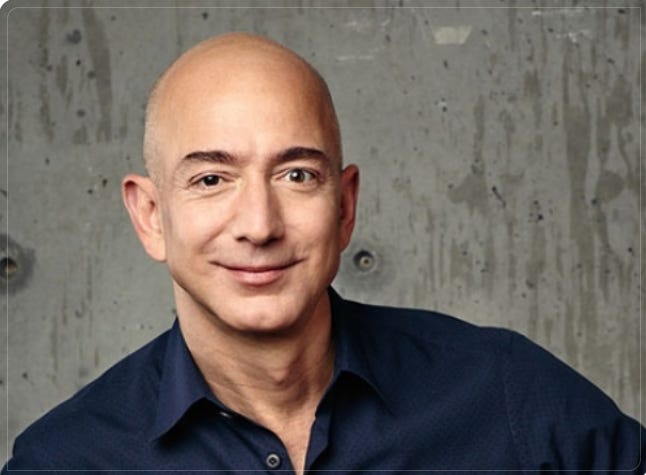
Jeffrey Preston Bezos was born Jeffrey Preston Jorgensen on January 12, 1964, in Albuquerque, New Mexico. His mother, Jacklyn Gise, was seventeen when she gave birth to him; his biological father, Ted Jorgensen, had performed in a unicycle troupe and struggled to establish himself financially. The marriage was short-lived. Jacklyn subsequently married Cuban immigrant Miguel “Mike” Bezos, who adopted the young Jeff and gave him the surname by which he would become known.
Bezos grew up principally in Houston and later Miami. Summers were often spent on the Texas ranch of his maternal grandfather, Lawrence Preston Gise, a former regional director of the Atomic Energy Commission. Bezos later credited his grandfather with teaching him self-reliance and practical problem-solving. An early interest in science and technology accompanied a durable fascination with space.
As a high-school student, Bezos spoke of humanity eventually moving much of its population and industry beyond Earth, leaving the planet itself protected. The vision was strongly influenced by Princeton physicist Gerard K. O’Neill, whose proposals for large orbital settlements offered an alternative to restricting economic and population growth on a finite Earth. O’Neill’s ideas remained with Bezos for decades and eventually supplied much of the intellectual foundation for Blue Origin.
At Princeton University, Bezos initially intended to study physics. Encountering classmates whose abilities in theoretical physics surpassed his own prompted a reassessment, and he graduated in 1986 with degrees in electrical engineering and computer science.
After Princeton, Bezos entered the emerging intersection between computing and finance. He worked first at Fitel, developing telecommunications systems for financial firms, and then at Bankers Trust. In 1990 he joined D. E. Shaw & Co., the quantitative investment firm founded by computer scientist David E. Shaw. Bezos rose rapidly, becoming one of the firm’s youngest senior vice presidents.
D. E. Shaw was also where Bezos met MacKenzie Tuttle. They married in 1993. More consequentially for his career, the firm exposed Bezos to businesses made possible by the rapidly expanding Internet. In 1994 he encountered a statistic showing that use of the World Wide Web was increasing at roughly 2,300 percent annually. Bezos later described using a “regret-minimization framework”: imagining himself at age eighty and asking whether he would regret failing to participate in the emergence of the Internet.
He decided that he would.
Bezos left D. E. Shaw in 1994 despite Shaw’s efforts to persuade him to reconsider. Jeff and MacKenzie drove west while Bezos developed the business plan along the way. On July 5, 1994, he incorporated Cadabra, Inc. in Washington State. After deciding that the name sounded too much like “cadaver,” he eventually renamed the company Amazon, invoking both the world’s great river and the scale he hoped the business would attain.
Books were chosen methodically. Bezos examined numerous categories that might be sold online and concluded that books offered an unusually large number of individual products that no physical store could stock. An Internet bookstore therefore possessed a structural advantage unavailable to conventional retailers.
Amazon.com opened to the public in July 1995. Operating initially from the Bezos home in Bellevue, Washington, the company expanded rapidly. Bezos reinvested heavily, placing growth, selection and customer acquisition ahead of near-term profits.
Amazon went public in May 1997. Bezos repeatedly warned shareholders that management would make decisions according to long-term market leadership rather than quarterly earnings. His 1997 shareholder letter made the principle explicit: Amazon would prioritize customers, growth and durable cash-generating capacity even when doing so reduced current profitability.
The late-1990s Internet boom magnified both the opportunities and risks of that strategy. Amazon moved beyond books into music, video, electronics and other categories, acquired companies, constructed fulfillment centers and raised billions of dollars. Bezos was named Time magazine’s Person of the Year in December 1999 as Amazon became one of the defining companies of the Internet boom.
Then the technology bubble collapsed.
Amazon’s shares fell sharply, losses remained substantial and analysts questioned whether the company could survive its debts and spending commitments. Bezos responded with layoffs, tighter operations and greater efficiency without abandoning the long-term strategy. Amazon recorded its first quarterly profit in the fourth quarter of 2001 and its first full-year profit in 2003. The company had survived the dot-com collapse.
Survival was followed by a different stage of development. Amazon increasingly became not merely a retailer but an infrastructure company. Amazon Prime, launched in 2005, encouraged customers to purchase more frequently by removing the repeated decision over shipping costs. It eventually became a broad membership ecosystem encompassing shopping, entertainment and other services.
Amazon Web Services pushed the infrastructure concept further. S3 and EC2, launched in 2006, allowed outside developers to rent storage and computing capacity rather than construct their own expensive infrastructure. AWS ultimately became one of Amazon’s most important businesses and a major source of operating profit.
The Kindle, introduced in 2007, demonstrated Bezos’s willingness to undermine an existing Amazon business rather than protect it. Digital books threatened the physical books on which Amazon had been built, yet Bezos instructed the Kindle organization to behave as though its job were to destroy the old business.
Amazon continued expanding through acquisitions and new businesses, including Audible, Zappos, Amazon Studios and Kiva Systems, whose mobile robots became part of Amazon’s fulfillment infrastructure. Not every experiment succeeded. The Fire Phone, introduced in 2014, was a conspicuous failure, while Echo and its Alexa voice assistant, introduced the same year, created another successful extension of Amazon’s technological ecosystem.
Bezos’s ambitions had meanwhile extended beyond Amazon. In 2000 he founded Blue Origin, initially operating the space company with unusual secrecy. Its objective returned directly to the ideas of Gerard K. O’Neill that had interested Bezos since adolescence. Bezos argued that Earth possessed finite resources while human demand for energy and economic growth could continue. Rather than suppress growth, humanity could eventually move heavy industry and expanding settlement into space while preserving Earth.
Blue Origin developed reusable rockets as a necessary step toward reducing the cost of reaching space. In November 2015, its New Shepard vehicle reached space and its booster returned to make a vertical landing. Bezos increasingly sold Amazon shares to finance the company, eventually describing Blue Origin as his most important work.
Another personal investment placed him in an entirely different institution. In 2013 Bezos purchased The Washington Post for $250 million of his own money. He invested in technology and national distribution while initially leaving editorial decisions to the newspaper’s journalists.
Amazon itself continued growing. AWS emerged publicly as a highly profitable business after Amazon
began reporting its results separately in 2015. The company acquired Whole Foods Market for $13.7 billion in 2017, giving Amazon a substantial physical grocery network. That year Bezos became the world’s richest person, and Amazon’s market capitalization touched $1 trillion in September 2018.
The growth also intensified scrutiny over warehouse conditions, Amazon’s treatment of competitors and third-party merchants, taxation and its growing control of digital commerce. Amazon’s highly publicized search for a second headquarters generated hundreds of bids from governments offering incentives; plans for a large New York headquarters were abandoned in February 2019 after political opposition.
At the same time, Bezos’s private life became public. On January 9, 2019, Jeff and MacKenzie Bezos announced that they were divorcing after twenty-five years of marriage. Reporting revealed Bezos’s relationship with television personality Lauren Sánchez. When the National Enquirer subsequently threatened to publish intimate photographs, Bezos responded publicly by accusing its owner of extortion and publishing the communications describing the threatened material himself. The divorce was finalized that July.
His philanthropy also expanded. The Bezos Day One Fund, announced in 2018, concentrated on homeless families and Montessori-inspired preschools in underserved communities. In February 2020 he announced the Bezos Earth Fund, committing $10 billion to efforts addressing climate change.
The COVID-19 pandemic transformed Amazon’s position again. Demand for online delivery surged, Amazon hired hundreds of thousands of workers and Bezos’s wealth rose dramatically. The same conditions intensified criticism over employee safety, labor relations and Amazon’s market power. In July 2020 Bezos appeared before Congress for his first antitrust testimony.
On February 2, 2021, Amazon announced that Bezos would relinquish the chief executive position and become Executive Chair. Andy Jassy, who had built AWS into one of Amazon’s principal businesses, would succeed him. The transition became effective July 5, 2021, twenty-seven years after the incorporation of Cadabra.
Fifteen days later Bezos climbed aboard a Blue Origin New Shepard capsule in West Texas with his brother Mark, Wally Funk and Oliver Daemen. On July 20, 2021, the rocket carried them above the Kármán line before returning safely to Earth. The flight transformed an ambition rooted in his youthful encounter with O’Neill’s ideas into a personal journey to space.
The post-Amazon-CEO period increasingly centered on Blue Origin, philanthropy and private investments. NASA selected Blue Origin in 2023 for a $3.4 billion contract to develop a lunar lander for the Artemis program. New Glenn successfully reached orbit on its maiden flight in January 2025; later that year Blue Origin successfully landed a New Glenn first-stage booster after an orbital mission.
Bezos announced in 2023 that he was leaving Seattle for Miami to be closer to his parents and Blue Origin’s Cape Canaveral operations. His relationship with Sánchez became another prominent part of his public life; the couple married in Venice in June 2025.
Bezos remains Amazon’s founder and Executive Chair rather than its operating chief executive. The company he created as an online bookstore became a network encompassing retail, logistics, cloud computing, advertising, entertainment, devices, grocery and communications infrastructure. Blue Origin extends the same inclination toward infrastructure onto a much larger physical scale.
Across these ventures, Bezos’s recurring achievement has been less the invention of an individual product than the construction of systems through which products and services can flow. Amazon Marketplace organizes sellers; Prime organizes consumers; fulfillment centers organize physical distribution; AWS organizes computing resources; and Blue Origin seeks to reduce the infrastructure cost of reaching space. The adolescent who encountered Gerard K. O’Neill’s vision of an industrial civilization extending beyond Earth ultimately built one system after another intended to overcome the physical limitations of the systems that preceded them.
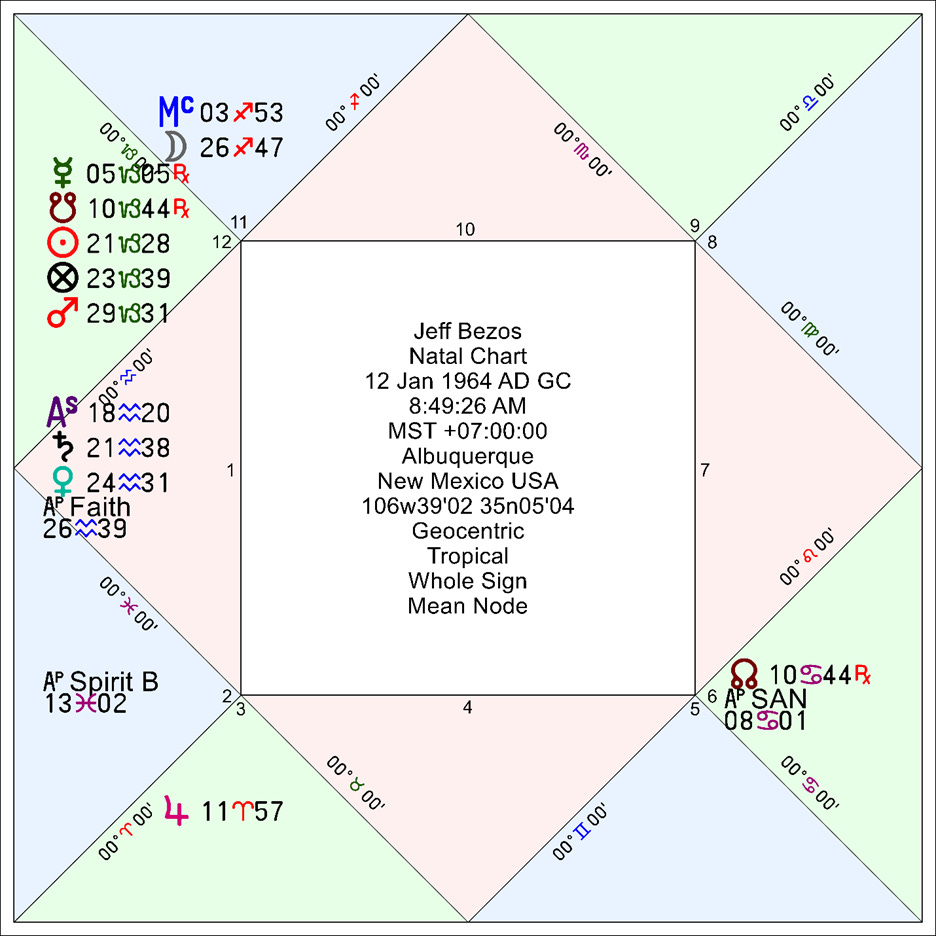
Rodden Rating X, Date w/o time
Proposed Rectification: 8:49:25 AM, MST, ASC 18AQ20’40”
Permission: I grant the unlimited use of this rectified horoscope by the public. Credit ‘Regulus Astrology LLC’ and include an accompanying link to this webpage.
The analytical models used in the sections below are part of a larger research program developed across longer white papers and case studies, where the historical sources, rules, and testing methodology are laid out in full. These database entries show the models in practice; readers who want the theoretical foundations can start with the background papers below:
Rectification Hub (I wrote the book on it!)
Soul Hub (white paper, Victor model statistical tests, Moon’s Configuration studies)
Physiognomy Hub (white paper, examples)
Victor Model Factors favoring Saturn/Aquarius
Sign rulersip: Sun, Lof of Fortune, Ascendant
Bound rulership: Lot of Fortune.
Essential dignity: in its own sign
House placement: angular in the 1st
Saturn/Aquarius is the victor of Bezos’s horoscope, placed in the rising sign and ruling both the 1st and 12th houses. The combination is particularly descriptive of a systems architect: Saturn imposes hierarchy, standardization, command and control, while Aquarius extends that control across technological networks and infrastructure. Bezos’s characteristic achievement was not simply inventing individual products, but constructing systems through which enormous quantities of goods, information and computing resources could be organized and distributed—Amazon’s fulfillment network, Prime, Marketplace and especially AWS exemplify this pattern. The comparison with Jensen Huang, whose victor is also Saturn/Aquarius, helps sharpen the distinction. In Huang’s horoscope, Saturn/Aquarius rules Mercury/Aquarius, directing Saturn’s command-and-control function toward Mercury’s domain of computation and, concretely, NVIDIA’s computer chips. In Bezos’s horoscope, Saturn instead rules Venus/Aquarius: the same systems architecture and centralized control are directed toward Venusian consumer products—books, merchandise, entertainment, groceries and devices—and toward the technological and logistical networks that place those products in the hands of customers. Huang controls the computational machinery underlying the system; Bezos controls the system through which the consumer receives the product.
Physigonomy Model Factors favoring Capricorn, Aquarius
Rising sign: Aquarius
Ruler of Rising sign: Saturn/Aquarius
Planets in rising sign: Saturn/Aquarius, Venus/Aquarius
Rising decan: Gemini
Ruler of rising decan: Mercury/Capricorn-retro
Bezos has a compact, well-conditioned build with a rectangular torso, broad through the shoulders and chest but relatively straight through the trunk. In later life increased muscular development makes the upper body considerably heavier than in earlier photographs, although the underlying frame remains taut rather than rounded. The face is a bony ovate, narrowing from the upper head toward the chin, with a prominent nose, defined jaw and notably large, projecting ears. Yet the facial surface itself is not especially gaunt or angular: there is sufficient flesh over the underlying bone structure to produce relatively smooth, even contours and skin, particularly through the cheeks and lower face.
The body strongly supports Aquarius rising, reinforced by both Saturn and Venus in Aquarius: the sign supplies the rectangular form and lean, taut underlying structure, comparable to the physique of Harry Houdini with a similar configuration, while Saturn emphasizes structure and Venus moderates its severity. The face, however, is more characteristic of Capricorn—the bony ovate form and conspicuous projecting ears, suggestive of the goat, provide a close match to Willner’s Capricorn model. Mercury/Capricorn retrograde may help explain why the Capricorn signature is present without producing an excessively dry or skeletal face. Under the retrograde/opposite-sign principle, Mercury can temporarily exhibit Mercury/Cancer qualities; Cancer’s smoother, fleshier and more fluid form would soften Capricorn’s exposed bone structure, producing the combination visible here: a fundamentally Capricorn-shaped face covered by enough flesh to give the skin and contours a smoother Cancerian finish.
Complete Moon’s Configuration - from Sagittarius through Capricorn
1. Moon/Sagittarius Ingress — Expansion. The Moon enters Sagittarius, establishing optimism, expansion and confidence in growth as the starting condition of the sequence. This is an unusually direct fit for Bezos: from his youthful enthusiasm for Gerard K. O’Neill’s vision of human expansion into space to Amazon’s early strategy, the assumption is that growth should not be restrained but accommodated by building systems capable of handling ever greater scale. The same symbolism describes the go-go Amazon years of the late 1990s, when expansion was pursued aggressively through new product categories, acquisitions, fulfillment centers and international markets, even as losses mounted.
2. Moon trine Jupiter/Aries — Expansion through movement. The Moon next trines Jupiter at 11°57′ Aries, placed in the 2nd house by quadrant houses but the 3rd by whole sign houses. Jupiter enlarges the Moon/Sagittarius impulse, while the 3rd-house placement gives expansion a distinctly local-transportation dimension. Bezos’s early encounter with Gerard K. O’Neill provides an interesting expression: although spaceflight ordinarily belongs to the 9th house of long-distance journeys, O’Neill’s vision was specifically about making near-Earth space a normal human environment—travel between Earth and orbital habitats could eventually become something closer to 3rd-house commuting than a voyage into the unknown. Amazon later literalized the same symbolism terrestrially through rapid local movement of goods, culminating in Prime and the progressive compression of delivery times from days toward hours.
3. Moon sextile Saturn/Aquarius — Systems architecture. The Moon then sextiles Saturn at 21°38′ Aquarius in the 1st house, bringing the expansive lunar impulse under the direction of the horoscope’s victor. Saturn/Aquarius signifies systems architecture, quantitative organization and command and control of technological infrastructure. Bezos’s years at D. E. Shaw fit naturally as an early manifestation: quantitative finance organized enormous flows of capital through mathematical and computerized systems. Amazon extends the same principle into commerce. Bezos’s characteristic achievement was not simply selling individual products but constructing an overarching technological and logistical architecture—Marketplace, fulfillment centers, Prime and AWS—capable of organizing transactions, inventory, computing capacity and delivery at enormous scale.
4. Moon sextile Venus/Aquarius — Consumer products. The Moon subsequently sextiles Venus at 24°31′ Aquarius, also in the 1st and also ruled by Saturn. Here Saturn/Aquarius turns its systems architecture specifically toward Venusian consumer products. Amazon begins with books but quickly expands into music, video, electronics, clothing, groceries, entertainment and eventually almost every category of consumer merchandise. The placement also helps distinguish Bezos from Jensen Huang: Huang’s Saturn/Aquarius rules Mercury/Aquarius, directing technological control toward computation and chips; Bezos’s Saturn rules Venus/Aquarius, directing the same command-and-control impulse toward consumer goods and the infrastructure through which they are purchased. Amazon’s comparatively unsuccessful early push into digital music can be included as a weaker Venusian expression—the company participated in the market but never achieved the cultural identification with music that Apple developed under Steve Jobs.
5. Birth moment and Moon Sagittarius → Capricorn — Growth becomes discipline. Bezos is born while the Moon remains in Sagittarius, but it soon enters Capricorn, producing an unusually useful transition from exuberant expansion to disciplined consolidation. Moon/Sagittarius describes Amazon’s first great cycle: rapid growth, seemingly limitless expectations, the dot-com boom and the willingness to spend heavily in pursuit of scale. After the bubble collapses, however, the company has to become more Capricornian. Layoffs, cost controls, operating discipline and attention to cash flow replace some of the earlier exuberance; Amazon achieves its first quarterly profit in late 2001 and its first full-year profit in 2003. Symbolically, the Moon has moved from how large can this become? to how can this be made durable?
6. Mars Capricorn → Aquarius — Competitors brought inside the system. As the sequence develops, Mars changes from Capricorn to Aquarius. Mars/Capricorn in the 12th can signify formidable competitors and adversaries operating outside Bezos’s immediate control; yet Mars is already ruled by Saturn, the victor, even though Capricorn is initially in aversion to Aquarius. When Mars enters Aquarius it joins Saturn’s sign directly, making the relationship more explicit: competition itself comes inside Bezos’s system of control. Amazon repeatedly confronts rivals through aggressive pricing, scale and prolonged willingness to accept thin margins; some are acquired, others weakened, and still others become sellers dependent upon Amazon Marketplace and its fulfillment infrastructure. Mars remains competitive and destructive, but under Saturn/Aquarius its capacity to tear down existing commercial structures becomes incorporated into Amazon’s larger architecture.
7. Moon conjunct Mercury/Capricorn retrograde — Employees, customers and method. The Moon then applies to Mercury/Capricorn retrograde, bringing together the Moon as ruler of the 6th house of employees with Mercury’s management of information, analysis and communication. Amazon’s workforce becomes increasingly methodical, quantified and process-driven, but Mercury’s retrogradation introduces the opposite-sign Cancer quality: the method is ultimately directed toward the customer, the public-facing Cancerian counterpart to Capricorn. Bezos’s meeting culture illustrates the combination particularly well. Amazon rejected PowerPoint bullet-point presentations in favor of narratively structured memos of up to six pages, which participants silently read at the beginning of important meetings. Complete sentences and sustained prose forced employees to expose gaps in reasoning that could remain hidden behind presentation slides; a strong memo could require extensive drafting and revision. The related Working Backwards process began a proposed product with an imagined customer-facing press release and FAQ, forcing the team to define what the product would actually do for the consumer before engineers built it. Capricorn supplies the disciplined method; retrograde Mercury’s Cancerian expression keeps that method oriented toward the customer.
8. Moon aspects Jupiter/Aries again — Prime and acceleration. The Moon’s renewed contact with Jupiter/Aries returns the configuration to expansion, but now after the intervening Saturn, Venus, Capricorn and Mercury stages have supplied infrastructure, products and method. Amazon Prime is a particularly concrete expression. Prime expands consumption by accelerating the 3rd-house movement of goods: two-day shipping progressively becomes one-day, same-day and, in some markets, delivery within hours. Jupiter enlarges the network while Aries accelerates it. The earlier O’Neill expression and the later Prime expression therefore share the same underlying idea—reduce distance by building infrastructure that makes previously exceptional journeys routine.
9. Waning Moon applies to the Sun — Recognition and eventual withdrawal. Finally, the waning Moon applies to the Sun, bringing the sequence toward visibility, status and recognition, but with the symbolism of a light already diminishing. Bezos becomes one of the most publicly recognizable businessmen of his generation—Time Person of the Year, the world’s richest person, owner of The Washington Post, and eventually a highly visible participant in his own Blue Origin spaceflight. Yet the waning condition suggests that culmination is followed by withdrawal from the center of activity rather than continued ascent. Bezos relinquishes the Amazon CEO position in 2021 and increasingly redirects his attention toward Blue Origin, philanthropy and personal projects. The Sun therefore signifies fame and culmination, while the waning Moon describes a career whose most intensive operating phase has already passed.
Influence of Sect
Bezos’s horoscope is diurnal, placing Jupiter and Saturn in sect while Mars and Venus are out of sect. This substantially assists the Moon’s configuration because its two most consequential supporting planets operate in conditions favorable to the sect: Jupiter/Aries signifies the expansion and acceleration of transportation and delivery, while Saturn/Aquarius, the victor, signifies the technological and logistical architecture that makes the entire system function. Their in-sect condition helps explain why these concepts could be developed on an immense scale and ultimately integrated into ordinary social and commercial life—Prime delivery and AWS became infrastructure used routinely by millions of consumers and businesses. The out-of-sect planets show greater irregularity. Mars/Capricorn is consistent with Bezos’s intemperate outbursts toward employees and competitors and the harsher side of Amazon’s competitive culture, while Venus/Aquarius describes consumer products, entertainment and taste without guaranteeing that Bezos himself possesses an instinctive rapport with popular taste. His comparatively limited personal interest in music, and Amazon’s failure to dominate digital music as Apple did with iTunes, provide one expression of an out-of-sect Venus whose consumer and entertainment interests do not always align cleanly with the broader public.
Complete biographical chronology, rectification and time lord studies available in Excel format as a paid subscriber benefit. File is behind the paywall.