

The Aquarius series continues with Jensen Huang, cofounder and CEO of NVIDIA. Unlike some of the other technology figures examined here, Huang does not readily present himself as the disciple of a philosopher, futurist, or science-fiction writer. His governing idea is closer to the technology itself: build better chips, construct the architecture that makes them useful, and keep expanding what that architecture can do. A company founded in 1993 to improve videogame graphics consequently evolved into the computing platform underlying much of the current artificial-intelligence boom.
Huang offers an intriguing example of Leo rising with the Sun in Aquarius in the 7th house, a configuration shared by another horoscope under study for a future addition to the natal database: Susan B. Anthony. Both repeatedly place themselves where interaction with other people is unavoidable. Anthony, lacking a permanent institutional setting, became the moving center of her political network, traveling indefatigably between conventions, legislatures, Congress, and local suffrage campaigns. Huang supplies the technology-company version. In NVIDIA’s earliest quarters he worked beside the kitchen where employees continually passed him; decades later, he largely rejected the executive suite for a conference room positioned amid the activity of NVIDIA’s headquarters. Sun/Aquarius in the 7th gains visibility by placing the native personally within a network of other people.
Yet another Aquarian planet appears more important for Huang’s life purpose. Using the Antiochus/Porphyry model, Saturn/Aquarius emerges as victor of the horoscope, consistent with someone whose career progressed from designing chips to constructing the larger architecture of accelerated computing. The timing supplied by Firdaria provides unusually good support for this identification.
There is plenty of friction in the figure as well. The Moon in Sagittarius in the 5th house of entertainment connects Huang’s expansive temperament with the gaming industry from which NVIDIA emerged, but its sequence of applications passes through the much more difficult Mars before reaching Saturn, Jupiter, and the Sun. That progression offers a useful framework for understanding both the technological mistakes and personal volatility that accompanied NVIDIA’s rise—and why neither ultimately determined the outcome.
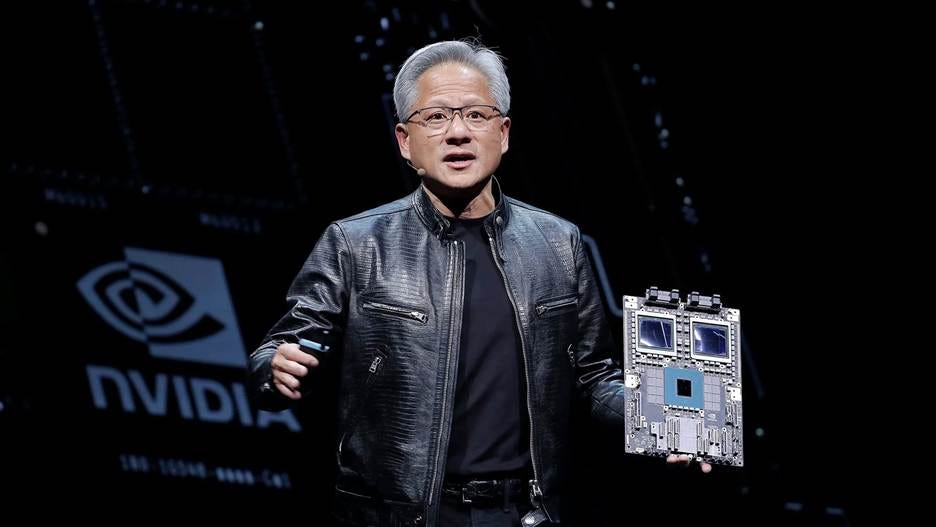
Jensen Huang was born Jen-Hsun Huang on February 17, 1963, in Taipei, Taiwan, the son of a chemical engineer and a schoolteacher. His family subsequently moved to Thailand, and in 1973 Huang and his older brother were sent to the United States, where they attended the Oneida Baptist Institute in Kentucky. His parents later immigrated to the United States and reunited the family in Oregon. As a teenager Huang became a nationally ranked junior table-tennis player and worked at Denny’s, beginning as a dishwasher and later working as a busboy and waiter.
Huang studied electrical engineering at Oregon State University, where he met his future wife, Lori Mills, as his engineering-lab partner. After graduating with highest honors in 1984, he worked briefly as a microprocessor designer at AMD before joining LSI Logic in 1985. Over the next eight years he moved through engineering, marketing, and management positions at LSI, eventually becoming Director of Coreware. While working full time he continued his education at Stanford University, receiving an M.S. in electrical engineering in 1992.
In 1993 Huang founded NVIDIA with engineers Chris Malachowsky and Curtis Priem. The three believed that increasingly sophisticated computer graphics would create a large market for specialized processors, particularly as video games moved from two-dimensional to three-dimensional environments. Huang became president and CEO, a position he has retained throughout the company’s history.
NVIDIA nearly failed during its first few years. Its original NV1 graphics processor and the planned NV2 relied upon curved quadratic surfaces at a moment when Microsoft and the computer industry were standardizing three-dimensional graphics around polygons composed of triangles. By 1996 Huang recognized that NVIDIA had committed itself to the wrong architecture. He abandoned the approach, substantially reduced the workforce, and persuaded Sega—then helping finance NVIDIA—to release the company from its commitment to develop a processor for Sega’s next-generation game console while continuing enough financial support to keep NVIDIA alive.
The RIVA 128 graphics processor, released in August 1997, rescued the company. NVIDIA followed with increasingly competitive graphics processors, went public in January 1999, and introduced the GeForce 256 later that year, marketing it as the first “GPU,” or graphics processing unit. Microsoft selected NVIDIA to provide important processors for the original Xbox, and the acquisition of assets from rival 3dfx further strengthened the company’s position in PC graphics.
Success did not eliminate large technological mistakes. NVIDIA’s GeForce FX 5800, introduced in 2003, arrived late and was widely criticized for excessive heat, noise, and disappointing performance relative to ATI’s competing Radeon products. Huang responded by accelerating a replacement architecture, and the GeForce 6800 restored NVIDIA’s competitive position the following year. Another serious problem emerged in 2008 when packaging defects caused failures in certain notebook GPUs, ultimately requiring hundreds of millions of dollars in warranty and related charges.
The more consequential transformation of NVIDIA began while the company was still primarily identified with video games. Researchers had discovered that GPUs, originally designed to render graphics, could perform many mathematical calculations simultaneously. NVIDIA hired Stanford researcher Ian Buck in 2004 and developed CUDA, a programming environment that allowed scientists and programmers to use NVIDIA GPUs for general-purpose parallel computing. The GeForce 8800 GTX, based on NVIDIA’s G80 architecture and released in November 2006, supplied the hardware foundation for this strategy; CUDA became publicly available in 2007.
This decision gradually moved NVIDIA beyond computer graphics. GPUs were adopted for scientific simulation and high-performance computing, while NVIDIA continued developing architectures increasingly suited to general computational workloads. The decisive demonstration came in 2012, when Alex Krizhevsky, Ilya Sutskever, and Geoffrey Hinton used two NVIDIA GTX 580 GPUs to train AlexNet, a neural network that dramatically outperformed competitors in the ImageNet image-recognition competition. Huang recognized that the result pointed toward a much larger market for GPU computing.
NVIDIA subsequently committed substantial resources to deep learning. The company developed the cuDNN software library for neural networks and introduced its Pascal architecture and first DGX deep-learning computer in 2016. Volta followed in 2017 with Tensor Cores specifically designed to accelerate artificial-intelligence calculations. NVIDIA increasingly sold not simply graphics chips but an integrated computing platform comprising GPUs, networking hardware, systems, software libraries, and the CUDA developer ecosystem.
Huang also pursued several strategies that proved less successful. NVIDIA attempted to establish its Tegra processors in smartphones and acquired cellular-modem specialist Icera in 2011, but Qualcomm’s integrated mobile processors proved difficult to dislodge. NVIDIA closed the Icera operation in 2015 and redirected Tegra toward automotive and embedded computing. The cryptocurrency boom of 2017–2018 created another problem when demand from cryptocurrency miners distorted NVIDIA’s assessment of its gaming market; after cryptocurrency prices collapsed, excess graphics-card inventory contributed to a sharp revenue slowdown.
In 2020 Huang attempted NVIDIA’s largest acquisition, agreeing to purchase semiconductor-design company Arm from SoftBank for approximately $40 billion. Regulators in the United States, United Kingdom, and European Union objected that NVIDIA’s ownership could compromise Arm’s position as a neutral supplier of processor technology to much of the semiconductor industry. NVIDIA abandoned the acquisition in February 2022.
By then, however, the company’s long investment in accelerated computing was converging with rapid advances in artificial intelligence. NVIDIA acquired networking specialist Mellanox in 2020, introduced its Ampere GPU architecture the same year, and announced the Hopper architecture and H100 accelerator in 2022. The release of ChatGPT in November 2022 triggered an enormous increase in demand for the computing infrastructure required to train and operate generative-AI models.
NVIDIA became the principal hardware beneficiary of the generative-AI boom. In May 2023 the company stunned financial markets by forecasting quarterly revenue of approximately $11 billion, far above prevailing expectations. Within days NVIDIA’s market capitalization reached $1 trillion. Huang introduced the Blackwell architecture in March 2024, while technology companies, governments, and data-center operators committed increasingly large sums to AI infrastructure. NVIDIA briefly became the world’s most valuable publicly traded company in June 2024 and subsequently crossed the $4 trillion and $5 trillion market-capitalization thresholds.
The company’s importance also placed Huang at the center of geopolitical disputes over advanced technology. Beginning in 2022, the United States imposed increasingly restrictive export controls on NVIDIA’s advanced AI processors to China. NVIDIA repeatedly redesigned products to comply with changing rules, while Huang argued that excluding American technology from China could accelerate the development of competing Chinese hardware and software ecosystems. The dispute transformed NVIDIA’s products from ordinary commercial semiconductors into technology increasingly treated by governments as a strategic resource.
Huang’s management style is unusually personal for the chief executive of a company of NVIDIA’s scale. In the company’s earliest quarters, he positioned his workspace beside the kitchen, where employees repeatedly had to pass him during the day. Decades later he continued the same principle at NVIDIA’s modern headquarters, largely foregoing the isolation of a conventional executive office in favor of working from a centrally located conference room. His organizational structure similarly emphasizes direct communication, broad information sharing, and an unusually large number of executives reporting directly to him.
Public recognition increased alongside NVIDIA’s rise. Huang was named Fortune’s Businessperson of the Year in 2017 and ranked first on Harvard Business Review’s list of the world’s best-performing CEOs in 2019. Time included him among its 100 most influential people in 2021. The Computer History Museum named him a Fellow in 2024 for his leadership in computer graphics, accelerated computing, and artificial intelligence. In 2026 he received the IEEE Medal of Honor, the organization’s highest distinction, and was appointed to the President’s Council of Advisors on Science and Technology.
Huang and his wife, Lori, have two children, Spencer and Madison, both of whom eventually joined NVIDIA. Through the Jen-Hsun and Lori Huang Foundation, the family has made substantial gifts to educational and scientific institutions, including Oregon State University and Stanford University. When Huang received the IEEE Medal of Honor in April 2026, he donated its $2 million monetary award to scholarship programs, with the family foundation matching the contribution.
More than three decades after NVIDIA’s founding, Huang remains its CEO and the central figure in its technological strategy. The company he helped establish as a supplier of graphics processors for video games evolved first into the dominant PC-GPU company, then into a platform for parallel scientific computing, and finally into one of the principal suppliers of the hardware and software infrastructure underlying modern artificial intelligence.
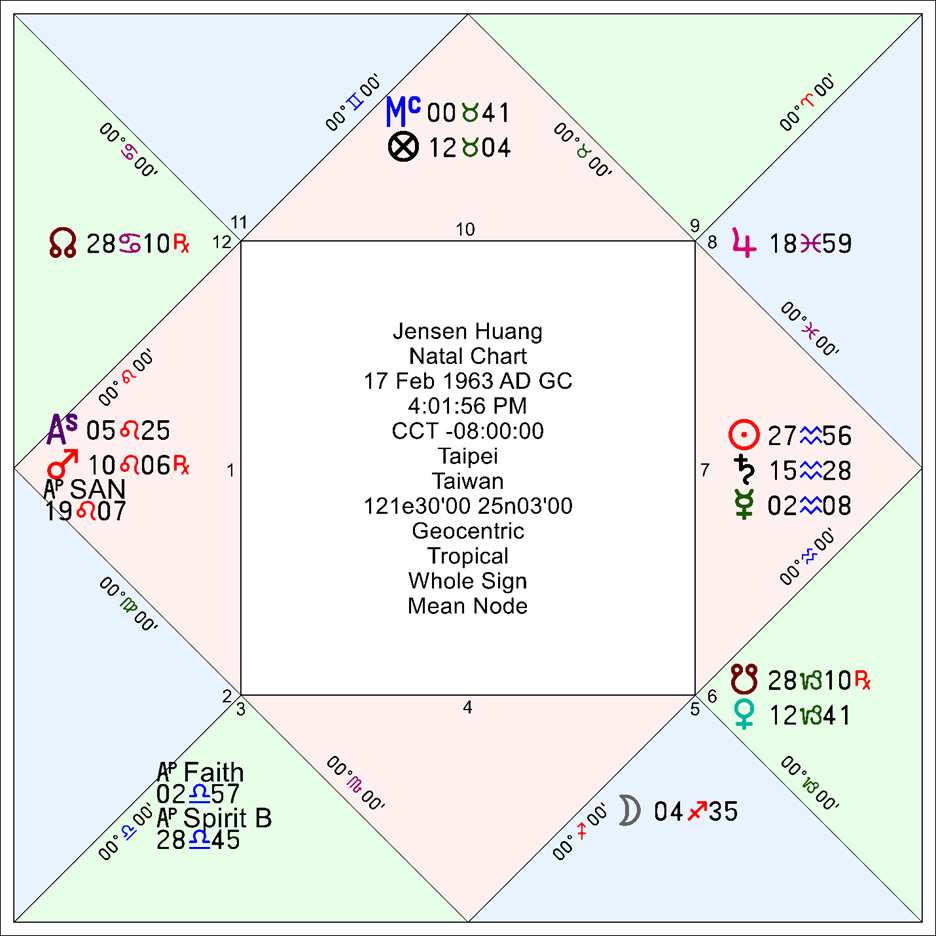
No Astrodatabank Record
Proposed Rectification: 4:01:56 PM, ASC 5LE25’10”
The analytical models used in the sections below are part of a larger research program developed across longer white papers and case studies, where the historical sources, rules, and testing methodology are laid out in full. These database entries show the models in practice; readers who want the theoretical foundations can start with the background papers below:
Rectification Hub (I wrote the book on it!)
Soul Hub (white paper, Victor model statistical tests, Moon’s Configuration studies)
Physiognomy Hub (white paper, examples)
Victor Model Factors favoring Saturn/Aquarius
Sign rulership: Sun, Sun-ruled Ascendant, Sun-ruled Prenatal Syzygy
Bound rulerhsip: Sun
Saturn/Aquarius is victor of the horoscope, placed in the 7th house and ruling both the 6th and 7th houses. Saturn signifies structure, architecture, systems, and durable frameworks; in Aquarius these qualities are directed toward technology, engineering, and networks. Its rulership of the 6th connects this purpose to labor, employees, and the organization of work, while its placement in and rulership of the 7th makes other people the arena in which Huang exercises that authority. NVIDIA’s defining achievement was not simply the manufacture of graphics chips, but Huang’s construction of an increasingly comprehensive technological system: the programmable GPU, CUDA, scientific parallel computing, and eventually the integrated hardware-and-software infrastructure supporting modern AI. The 7th-house placement is also visible in his management style: rather than governing from an isolated executive office, Huang repeatedly places himself amid employees and information flows, making continual interaction with others part of the structure through which he directs the company. The diurnal Saturn Firdaria of 2003–2014 provides strong confirmation, encompassing NVIDIA’s recovery from the GeForce FX failure, development of G80 and CUDA, expansion into general-purpose computing, and finally the 2012 AlexNet breakthrough that revealed the larger purpose of the architecture NVIDIA had built.
Physiognomy Model Factors favoring Leo, Aquarius
Rising sign and decan: Leo
Ruler of Rising sign and Rising decan: Sun/Aquarius
Planets in rising sign: Mars/Leo-retro
Huang has a broad, compact head whose most conspicuous feature is the rounded contour of the crown and upper face. The forehead and upper cranium form a pronounced arc, while the face becomes progressively more rectilinear below the cheekbones. Prominent jawbones define a compact, nearly square lower face, with relatively straight sides and a short rather than elongated chin. The resulting geometry combines a rounded upper head with an angular, squared lower face. Huang’s customary glasses add another strong geometric element: their lenses are horizontally elongated and predominantly rectangular, imposing a conspicuous rectilinear form across the middle of the face.
The rounded upper contour accords with Leo, Huang’s rising sign and rising decan. The ruler of the Ascendant, the Sun in Aquarius, introduces the contrasting compact and rectangular construction visible particularly through the jaw and lower face; Aquarius is reinforced by Saturn in Aquarius, ruler of the Sun and victor of the horoscope. His rectangular eyewear provides an acquired repetition of the Aquarian geometry.
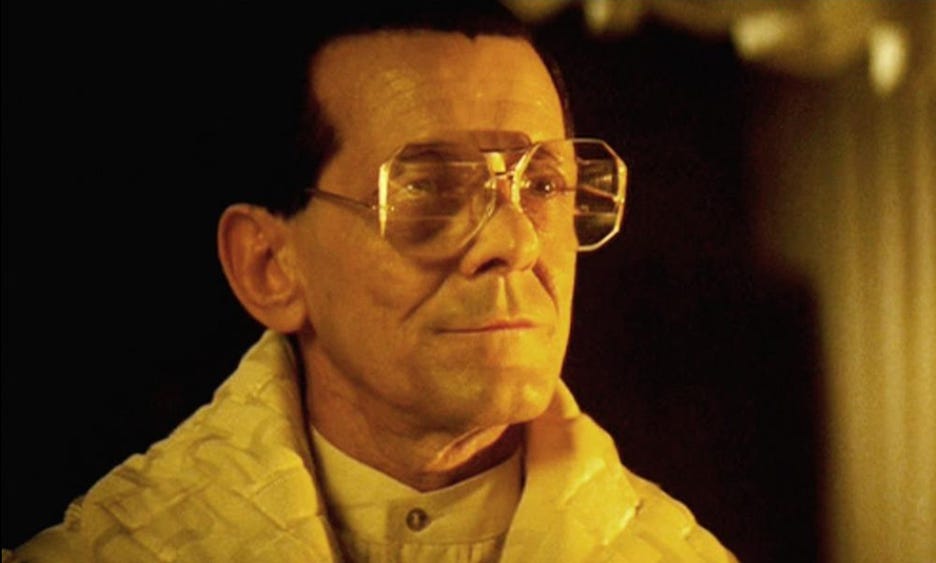
There is even an apt cultural prototype in Blade Runner: Eldon Tyrell, the technology magnate responsible for manufacturing the replicants, is visually defined by enormous geometric eyeglasses. Huang thus presents the two principal physiognomic significators with unusual clarity—Leo in the rounded upper head and Aquarius in the squared lower construction and rectilinear eyewear.
Moon’s Configuration
Stage 1 — Separation from Mercury (Aquarius, 7th)
Delineation. The Moon at 4°35′ Sagittarius in the 5th house separates from Mercury at 2°08′ Aquarius in the 7th. The Moon in Sagittarius signifies optimism, expansion, and confidence in possibilities, while its placement in the 5th connects these qualities with recreation and gaming. Mercury/Aquarius signifies computer technology and, more specifically in Huang’s horoscope, the semiconductor and computer chip. The separating aspect joins an expansive and recreational Moon to the technology that became the foundation of Huang’s career.
Biographical Match. Huang’s technological career began with computer chips, first as a microprocessor designer at AMD and subsequently at LSI Logic, before he cofounded NVIDIA in 1993. Yet NVIDIA was conceived specifically around the rapidly expanding market for three-dimensional videogame graphics. Gaming therefore joins the two significations unusually closely: Mercury/Aquarius supplies the chip, while the Moon/Sagittarius in the 5th supplies an expanding recreational market in which increasingly powerful chips could be deployed. What began as a graphics company serving videogames eventually became something much larger, consistent with the Moon in Sagittarius repeatedly pushing the technological significations it carries from Mercury toward greater scale.
Stage 2 — Application to Mars (Leo, retrograde, 1st)
Delineation. The Moon next applies by trine to retrograde Mars at 10°06′ Leo in the 1st house. Mars in the 1st makes aggression personal, conspicuous, and closely associated with Huang’s own behavior; retrograde Mars in Leo also acts through Aquarius, making technology itself an important field for Martian disruption. Yet Mars does not operate independently. By retrogradation into Aquarius it is enclosed between Mercury at 2°08′ Aquarius and Saturn at 15°28′ Aquarius: Mercury signifies the chip, while Saturn, victor of the horoscope, signifies the larger technological architecture and system. The disruptive malefic is therefore contained between two planets working constructively for Huang. Moreover, once the Moon perfects its trine to Mars at 10°06′ Leo, it is only another 5°22′ from perfecting its sextile to Saturn, comfortably within the Moon–Saturn moiety. Mars consequently represents a genuine danger in the sequence, but not its conclusion: Martian disruption is immediately followed by Saturnian containment, correction, and restructuring.
Biographical Match. Mars is readily visible in Huang’s explosive temper and his willingness to criticize employees publicly, sometimes before large groups, using humiliation and confrontation as instruments for correcting mistakes. The same symbolism appears technologically in NVIDIA’s recurring crises: the mistaken NV1/NV2 architecture, the GeForce FX failure, the notebook-GPU packaging defect, and other occasions when technological decisions created serious problems for the company. Yet these failures repeatedly produced correction rather than collapse. Huang abandoned the original NV1/NV2 architecture and rebuilt NVIDIA around the industry standard; the GeForce FX failure was followed by corrected architectures; and technological setbacks became occasions for imposing tighter discipline on engineering and execution. The Mercury–Mars–Saturn enclosure describes this pattern well: Mars disrupts the technology signified by Aquarius, but Mercury and Saturn bring the disruption back within the requirements of the chip and the larger technological system. Employee contention likewise never produced the destructive outcome that an isolated application to Mars might suggest. Huang’s demanding and sometimes abrasive management instead remained embedded within an organization whose structure and technological mission proved unusually durable.
Stage 3 — Saturn, Jupiter, and Sun
After Mars, the Moon proceeds by sextile to Saturn at 15°28′ Aquarius in the 7th, square to Jupiter at 18°59′ Pisces in the 8th, and finally sextile to the Sun at 27°56′ Aquarius in the 7th. Saturn brings the sequence under the authority of the horoscope’s victor: technological experimentation and disruption are converted into durable architecture, organization, and systems—the programmable GPU, CUDA, accelerated computing, and ultimately NVIDIA’s integrated AI platform. Jupiter, strongly dignified in Pisces, then expands the resources available to this system through the 8th house of other people’s money and resources, corresponding less to ordinary debt than to NVIDIA’s eventual ability to attract enormous investment capital, undertake multibillion-dollar transactions, and command extraordinary financial resources; Huang’s philanthropy provides a secondary expression. The final sextile to the Sun/Aquarius brings the configuration to visibility and social status. The sequence therefore culminates not with the contention of Mars but with Saturnian structure, Jupiterian abundance, and solar prominence: the technological system Huang constructed ultimately becomes the source of his exceptional public visibility.
Influence of Sect
Sect. Huang’s is a diurnal horoscope, placing Saturn and Jupiter in sect while leaving Mars and Venus out of sect. Saturn/Aquarius, the victor, benefits from sect and manifests constructively through the scale, durability, and extraordinary reach of the technological architecture Huang built around the GPU, CUDA, and accelerated computing. Jupiter/Pisces in the 8th, also in sect and strongly dignified, expands his command of other people’s resources, visible in NVIDIA’s ability to attract enormous amounts of investment capital and undertake multibillion-dollar corporate transactions. The out-of-sect planets are more problematic. Mars/Leo retrograde in the 1st makes Huang’s anger and episodes of publicly humiliating employees particularly harsh and disruptive, even though the larger configuration ultimately contains Mars. Venus/Capricorn in the 6th describes an ambitious, career-oriented workforce attracted to advancement and material reward: employees willing to work intensely for the prize, with NVIDIA’s rising share price and equity compensation turning employment itself into a powerful vehicle for wealth creation. Thus sect reinforces the basic structure of the horoscope: the in-sect Saturn and Jupiter enlarge Huang’s technological and financial reach, while the out-of-sect Mars and Venus make the human costs of achieving those ambitions more pronounced.
Complete biographical chronology, rectification and time lord studies available in Excel format as a paid subscriber benefit. File is behind the paywall.