

Tomorrow, November 27, marks the birthday of Jimi Hendrix, born with the Sun in Sagittarius and Jupiter in Cancer retrograde — a sky configuration that mirrors the current positions of both Sun and Jupiter. Hendrix continues this series of horoscopes featuring Jupiter in Cancer retrograde, inaugurated last week with Thomas Chatterton. Retrograde planets do not merely “interrupt energy,” as modern clichés suggest; they behave as though placed in their opposite sign. Thus Jupiter in Cancer retrograde does not nourish, comfort, or support as a direct Cancer placement would. Instead, it acts like Jupiter in Capricorn, withdrawing softness and replacing it with the Capricornian drive to climb, compress timelines, and chase rapid success without the emotional foundations that make such progress sustainable. For Hendrix, Jupiter — the planet that should have provided care — created instead the conditions of ambition born from abandonment: a life accelerated rather than secured.
This reversal becomes the key to understanding Hendrix’s lifelong need to escape into music. Jupiter in Cancer retrograde denied the stability and nourishment that normally anchor emotional development, while the Moon in late Cancer — placed in Saturn’s bound with Saturn retrograde in Gemini as bound lord — added porous boundaries and a lack of structural containment. The result was a fragile emotional base that fed a Capricorn-style urgency: the pressure to achieve quickly, to keep performing, and above all, to keep touring even when exhausted — the clearest expression of Jupiter functioning through Capricorn rather than Cancer. Deprived of Cancer’s support, Hendrix sought expansion, escape, and transcendence through music, fame, sex, and drugs under the propulsion of his Sagittarian stellium. His genius rose from this contradiction, and ultimately, so did his burnout.
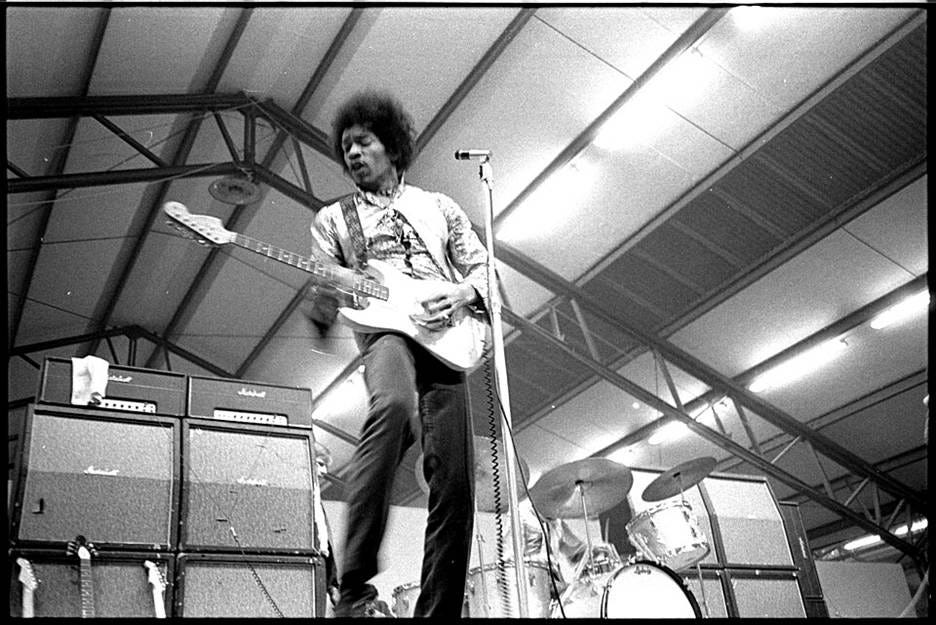
Jimi Hendrix was born Johnny Allen Hendrix on November 27, 1942, in Seattle, Washington, into a turbulent household marked by poverty, instability, and frequent separations. His parents, Al Hendrix and Lucille Jeter, struggled with alcoholism and financial hardship, and Jimi spent parts of his childhood shuffled among relatives and temporary caretakers. Despite the chaos around him, he developed an early fascination with sound, rhythm, and makeshift instruments, famously carrying a broom or a one-string ukulele before receiving his first real guitar as a teenager. Music quickly became both refuge and identity, offering a sense of continuity that family life did not.
By his mid-teens Hendrix was playing in local bands around Seattle, absorbing blues, R&B, and early rock influences. In 1961 he enlisted in the U.S. Army, partly as an alternative to legal trouble, but military life proved incompatible with his temperament and physical limitations. He was discharged in 1962 and soon began touring the Black “Chitlin’ Circuit,” performing behind artists such as Little Richard, the Isley Brothers, and Curtis Knight. These years were formative: grueling travel, long nights, and constant gigging sharpened his technique and stage presence, while his flamboyant style often clashed with the strict expectations of bandleaders. Restless and ambitious, he left for New York City, where he honed his approach in Greenwich Village clubs and attracted a small circle of admirers impressed by his innovative guitar work.
Hendrix’s international breakthrough came in 1966, when former Animals bassist Chas Chandler discovered him in New York and brought him to London. There, he formed the Jimi Hendrix Experience with bassist Noel Redding and drummer Mitch Mitchell. London’s music scene embraced him immediately: audiences were stunned by his ferocity, virtuosity, and experimentalism. Within months he became a central figure in the British rock explosion, releasing hits such as “Hey Joe,” “Purple Haze,” and “The Wind Cries Mary.” His 1967 debut album Are You Experienced established him as one of the most original artists of his generation, blending blues, psychedelic rock, and studio innovation with unparalleled guitar technique.
Hendrix’s fame grew rapidly in 1967 and 1968, propelled by legendary performances at the Monterey Pop Festival and subsequent tours across the U.S. and Europe. His stage presence — playing with his teeth, behind his back, wielding feedback like an instrument, setting his guitar on fire — became iconic. Yet behind the artistry, the pressures of fame, relentless touring, and a chaotic management environment created mounting stress. In 1969 he formed a new group, Gypsy Sun & Rainbows, for his celebrated Woodstock performance, followed by the Band of Gypsys with Buddy Miles and Billy Cox. These projects reflected his evolving musical ambitions, moving beyond psychedelic rock toward funk, soul, and expansive improvisation.
The final year of his life was marked by increasing fatigue, legal battles, overwork, and interpersonal strain. Despite these pressures, Hendrix continued pursuing new musical directions, recording at his Electric Lady Studios in New York with plans for a more mature, genre-spanning sound. On September 18, 1970, while in London, he died at age 27 after aspirating vomit during sleep following a combination of barbiturates and alcohol. His death shocked the music world and cemented his place in the so-called “27 Club.”
Though his recording career lasted only four years, Hendrix permanently transformed the landscape of modern music. His innovations in guitar technique, tone manipulation, and studio production remain foundational influences across genres. More than a virtuoso, he was a cultural and artistic force whose work continues to inspire musicians, scholars, and listeners more than five decades after his passing.
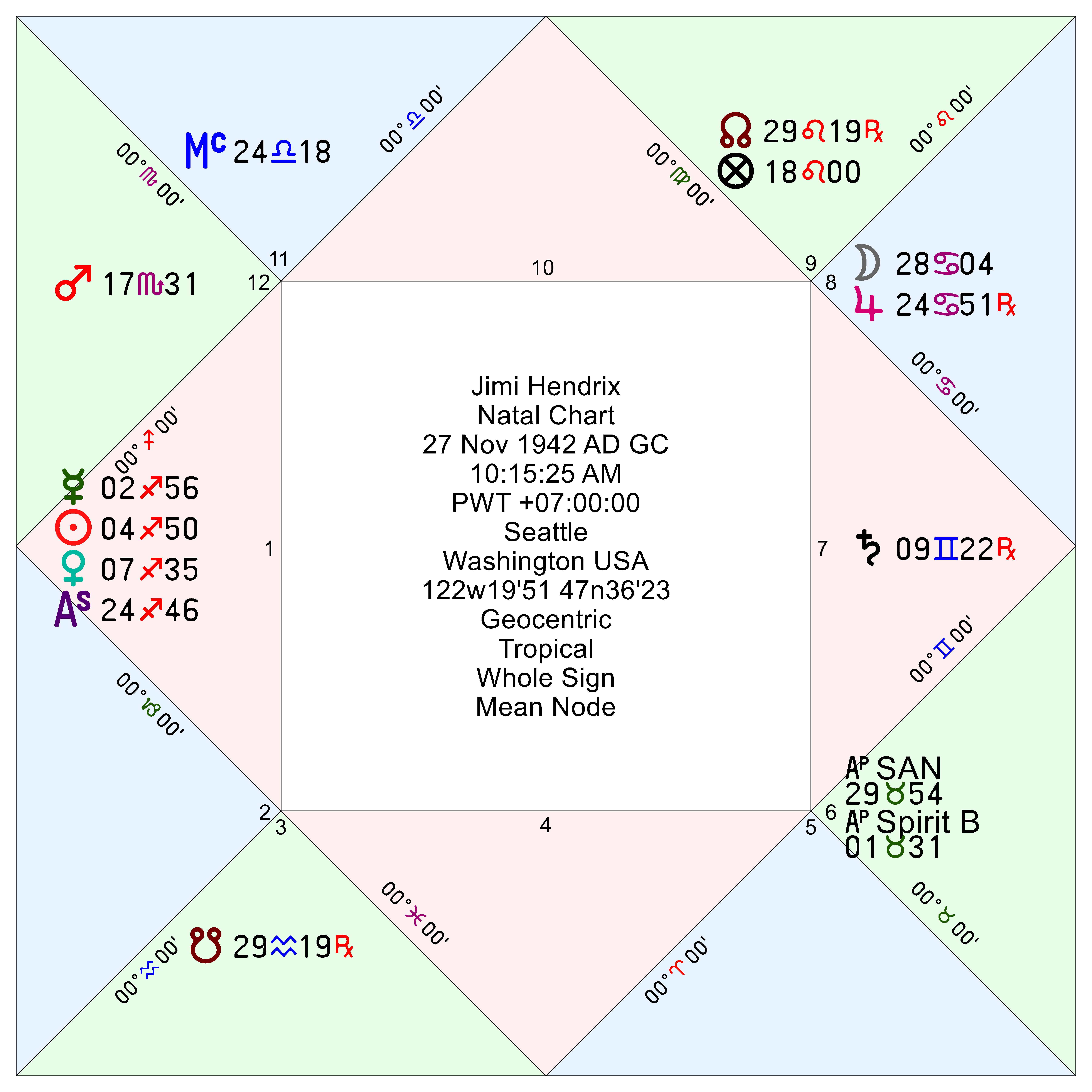
Rodden Rating AA, BC/BR in hand, 10:15 AM, ASC 24SA41
Proposed Rectification: 10:15:25 AM, ASC 24SA46’05”
The analytical models used in the sections below are part of a larger research program developed across longer white papers and case studies, where the historical sources, rules, and testing methodology are laid out in full. These database entries show the models in practice; readers who want the theoretical foundations can start with the background papers below:
Rectification Hub (I wrote the book on it!)
Soul Hub (white paper, Victor model statistical tests, Moon’s Configuration studies)
Physiognomy Hub (white paper, examples)
Victor Model Factors favoring Venus/Sagittarius
Sign ruler of MC, Lot of Spirit, Prenatal Syzygy
Bound ruler of MC, Lot of Spirit
Angular in the Ascendant
Venus in Sagittarius stands as the victor of Hendrix’s horoscope because it converts private suffering into a quest for freedom, exploration, and transcendence. By quadrant houses Venus falls in the 12th, suggesting that many of the forces driving his creativity operated outside ordinary awareness: loneliness, escapism, dreams, altered states, and the persistent feeling of being an outsider looking in. Yet by whole-sign houses Venus occupies the 1st, making those same themes impossible to hide. Hendrix did not merely create music; he embodied a Sagittarian ideal of artistic liberation. His stage persona, psychedelic imagery, fascination with science fiction and distant worlds, constant touring, and refusal to remain confined within conventional musical boundaries all reflect Venus seeking beauty through expansion rather than stability. The placement describes an artist who transformed 12th-house isolation into a 1st-house identity, projecting a vision of freedom so compelling that it became inseparable from the man himself. Venus on the threshold between these houses helps explain why Hendrix appeared simultaneously elusive and intensely present: a private dreamer whose inner world was broadcast to millions through sound.
Physiognomy Model Factors favoring Sagittarius, Leo
Rising sign: Sagittarius
Ruler of rising sign: Jupiter/Cancer-retrograde
Planets in rising sign (whole sign houses): Mercury, Sun, Venus all in Sagittarius
Rising decan: Leo
Ruler of rising decan: Sun/Sagittarius
The surviving photographs and performance images of Hendrix present a remarkably consistent physical type. He stood approximately 5 feet 11 inches tall, slightly above average for an American male of his generation, but appeared even taller because of his exceptionally long limbs, narrow frame, and upright posture on stage. His face was elongated rather than broad, with a long nose, prominent jawline, high cheekbones, and a relatively narrow chin. The eyes were deep-set and alert, often conveying a distant or contemplative quality. In performance photographs, the combination of long arms, long fingers, and extended reach across the guitar neck becomes especially noticeable. His physique was lean and wiry rather than muscular, emphasizing agility and flexibility over physical mass. Even when seated, as in many publicity photographs from the late 1960s, the visual impression is one of vertical extension, with the neck, torso, and limbs appearing stretched and elongated. The famous Afro hairstyle further enlarged his silhouette, making him appear physically larger than his actual height and contributing to an unmistakable stage presence.
Astrologically, Sagittarius and Leo emerge as the principal physiognomic significators. Sagittarius rules the Ascendant and receives additional emphasis through the Sun, ruler of the rising decan, being placed in Sagittarius itself. Furthermore, three planets occupy Sagittarius in the eastern sector of the horoscope, concentrating Sagittarian symbolism around the body and appearance. Classical descriptions of Sagittarius frequently emphasize height, long limbs, athletic movement, and an elongated facial structure, all traits readily visible in Hendrix. The sign’s tendency toward length and extension appears not only in the proportions of the face but also in the unusually long arms and fingers that became integral to his guitar technique. Leo, the rising decan, contributes a secondary but highly visible influence. While Hendrix lacks the broad, rectangular facial structure often associated with the solar signs, the rounded silhouette of his Afro hairstyle strongly evokes the leonine image of a mane surrounding the head. In photographs and concert footage, the hair functions almost as a solar halo, framing the face and creating a circular outline that balances the otherwise elongated Sagittarian form. The result is a distinctive combination: the tall, stretched proportions of Sagittarius crowned by the dramatic leonine display that became one of the defining visual signatures of Hendrix’s public image.
Moon’s Configuration
While we are most interested in the effect of the Moon’s separation from Jupiter and application to Mercury, the Moon’s sweep through Cancer and Leo touches all natal planets and establishes its own narrative biography. What follows is the Moon’s complete aspect sequence.
Phase I. Moon Cancer Ingress
Phase II. Mercury Sagittarius Ingress
Phase III. Moon Trine Mars (Scorpio, 11th/12th)
Formation of Emotional Survival Instincts
Delineation. The Moon’s first significant aspect — a trine to Mars in Scorpio — imprints the emotional body with intensity, danger, and the expectation of conflict. Mars rules the 4th house, so early family life becomes the source of volatility, aggression, or abandonment. In Scorpio, Mars carries secrecy, suppressed rage, survival instincts, and the possibility of experiencing love and pain as intertwined. By quadrant Mars is in the 11th, but by whole sign in the 12th: alliances and “families of choice” later in life are colored by hidden power struggles, betrayals, and subterranean tension. The trine is flowing, but what flows is dark water.
Biographical Match. This is a delineation match to Hendrix’s childhood: exposure to domestic violence, alcoholism, instability, and emotional unpredictability. The Moon–Mars trine becomes the internal rule: attachment is dangerous, love can wound, security is always conditional. As an adult, this Mars signature re-emerges in band conflicts, manager disputes, and intense, combustible relationships. He repeatedly reenacts childhood dynamics: seeking family (11th) but finding sabotage (12th). Mars in Scorpio also resonates with the raw, erotic, and physically extreme style of his guitar performance — emotion fused with danger.
Phase IV. Moon Conjunct Jupiter (Cancer, Retrograde, 7th/8th)
The Crisis Born From the Negation of Care
Delineation. The Moon’s conjunction with Jupiter in Cancer would ordinarily promise protection, nourishment, and emotional abundance. But Jupiter is retrograde in Cancer and placed in the 8th house, and retrograde motion forces Jupiter to operate as though in its opposite sign — Capricorn. Instead of offering care, Jupiter withdraws it; instead of emotional continuity, it delivers scarcity. This is not simply “lack of care causes crisis,” but the deeper dynamic of Jupiter-in-Capricorn functioning through deprivation, pushing the native toward self-reliance far earlier than developmentally appropriate. Emotional safety is removed from the environment and replaced with Capricornian pressure: survive, adapt, grow quickly, compensate for what is missing. In the 8th house, this negation of Cancerian care becomes fused with themes of fear, loss, instability, and premature exposure to adult crises. The Moon seeks Jupiter’s warmth but finds Capricorn’s cold — a conjunction that magnifies need but denies fulfillment, planting the roots of urgency and emotional hunger.
Biographical Match. This describes Hendrix’s early world with precision. Parenting was inconsistent, food and shelter unstable, and emotional reassurance largely absent — a textbook expression of Jupiter-in-Cancer retrograde acting like Jupiter-in-Capricorn in the 8th. His mother’s death, separations from siblings, and constant movement among relatives all reflect Jupiter’s withdrawal of nurture and replacement with Capricorn-style hardship. This deprivation became the psychological engine behind his later life: the drive to advance quickly, to seize opportunities, to keep moving, to perform even when depleted. Yet the emotional need underlying that urgency remained unfulfilled. Adult relationships carry the same pattern: deep hunger for connection, intense bonding with lovers and bandmates, and persistent searching for the care that Jupiter failed to provide. Drugs became a distorted Jupiterian substitute — an attempt to generate warmth, quiet, or safety chemically, since the natal Jupiter could not supply them.
Phase V. Birth Moment
Moon in Late Cancer in the Bound of Saturn
Delineation. At birth the Moon stands at 28° Cancer, in Saturn’s bound — the final degrees where care becomes burden and nurturing turns heavy, conditional, or structurally compromised. Emotional sensitivity is maximal, but containment minimal because Saturn’s bound lord is placed in the sign of Gemini but retrograde. Saturn in Gemini when direct signifies regulation; however in this case, Saturn in Gemini is retrograde which flips Saturn’s behavior to one of de-regulation and lack of control.
Biographical Match. For Hendrix, this means the emotional system formed under conditions of hyper-responsiveness but weak boundaries. Throughout his life he feels everything too intensely — conflict, love, music, drugs, expectations — and lacks the internal Saturnian structure to keep these forces organized. Saturn’s bound explains why Hendrix could be both tender and overwhelmed, charismatic yet vulnerable to manipulation, brilliant yet fragile. His adult relationships show the same pattern: he absorbs moods, energies, and pressures without effective filters. Saturn’s bound is the final crystallization of the childhood deprivation described in the Jupiter phase.
Phase VI. Moon Leo Ingress
Breaking From Trauma / The Out-of-Sign Reach Toward Mercury
Delineation. For the Moon to break from the Jupiterian trauma imprinted in Cancer, she must change signs. The entry into Leo marks a decisive emotional shift: a new mode of expression, a need to shine, and a movement away from the internal world of Cancer. Crucially, this sign change occurs while the Moon is still within moiety of orb to Mercury, meaning the Moon begins an application to Mercury out of sign. This is subtle but important: Cancer’s emotional memory reaches toward Sagittarius’ expansive mind before the Moon possesses the fire of Leo. The result is a hybrid condition: longing for expressive freedom while still carrying the residue of Cancerian pain into the Leo phase.
Biographical Match. This turning point maps to Hendrix’s artistic breakthrough: the need to escape childhood deprivation by becoming someone larger, brighter, mythic. The Moon’s entrance into Leo mirrors the shift from emotional hunger to creative radiance — the transformation of vulnerability into spectacle. But because the application to Mercury begins out of sign, the Cancer residue remains under the Leo bravado: Hendrix shines, but from a foundation still scarred. His heroic stage persona represents the Leo solution; the insecurity beneath it represents the lingering Cancer wound.
Phase VII. Moon applies to the trine of Mercury (Sagittarius, 1st/12th houses)
The Emotional Body Finds Its Voice
Delineation. Now the out-of-sign application “catches fire.” The Moon in Leo trines Mercury in Sagittarius, linking emotional drive with visionary intellect and rapid physical technique. Mercury in Sagittarius exaggerates, invents, imagines, and reaches for the cosmic. The trine makes the guitar an emotional instrument: the nervous system and the feelings become one. This is the most important expressive aspect in Hendrix’s chart — the channel through which wounded Cancerian memory becomes Leonine performance and Sagittarian imagination.
Biographical Match. This is Hendrix’s musical genius: the ability to translate emotion into sound with unprecedented fluidity. His improvisational brilliance, poetic language, mystical imagery, and narrative self-invention all come from the Moon–Mercury pipeline. The out-of-sign start to this trine explains why the creative channel always carried an undertow of vulnerability: he could express anything but not necessarily stabilize it. His entire stage persona — charismatic, visionary, emotional — is the fusion of Moon-in-Leo performance with Mercury-in-Sagittarian imagination.
Phase VIII. Moon Trines the Sun (Sagittarius, 1st/12th houses)
The Mythic Self-Projection
Delineation. The trine to the Sun in Sagittarius solidifies the heroic, exploratory persona. Emotional life fuels identity; identity energizes emotional expression. Sagittarius adds myth-making, risk-taking, and the hunger for transcendence. With the Sun in the 1st/12th, the persona is radiant on stage yet private struggles linger behind it. The trine creates coherence between inner and outer life — but only as long as the individual can keep performing.
Biographical Match. This is the Hendrix legend: sexuality, charisma, transcendence through sound, and the creation of a mythic self. The Sun trine confirms the “electric gypsy” archetype — a persona built on exploration and self-invention. But the 12th-house component explains the isolation, exhaustion, and sense of being misunderstood even at the height of fame.
Phase IV. Moon Trines Venus (Sagittarius, 1st/12th houses)
Ecstasy, Excess, Aesthetic Fire
Delineation. Venus in Sagittarius offers pleasure, laughter, sensuality, adventure, and artistic play. The Moon–Venus trine heightens emotional warmth and erotic magnetism. But Venus in a fire sign inclines toward stimulants, thrill-seeking, and “upper” experiences — chemically, artistically, sexually. The trine magnifies intensity but weakens restraint. Pleasure becomes an open gate.
Biographical Match. Hendrix’s love life, aesthetic flamboyance, psychedelic exploration, and sensual immersion come directly from this aspect. Groupies, colors, fabrics, psychedelia, passionate affairs — all the Venus–Sagittarius signatures appear in full force. But this aspect also accelerates the drift toward excess: emotional fulfillment sought through sensation rather than stability. Pleasure becomes both inspiration and vulnerability.
Phase X. Moon Sextile Saturn (Gemini, Retrograde, 6th/7th houses)
The Failed Containment
Delineation. The Moon’s final applying aspect is to Saturn retrograde in Gemini in the 6th/7th — the attempt to bring order, discipline, health management, legal clarity, or contractual structure. But retrograde Saturn represents systems that fail, contracts that weaken, and boundaries that collapse. The sextile gives opportunity but not strength; structure is attempted but cannot hold.
Biographical Match. This perfectly describes Hendrix’s final period: chaotic touring, legal disputes, multiple managers, exhaustion, health deterioration, and failed attempts to establish boundaries or routines. The people meant to protect him lacked authority or competence; Saturn retrograde offered frameworks that did not hold. The Moon’s final gesture is toward structure — but the structure is too weak. The emotional system seeks a wall and finds a sieve.
Interpretive Summary
The Moon enters Cancer and absorbs the world before she can name it. Nothing shields her, and nothing steadies her. When Mars comes, he comes sharply: not as instruction, but as intrusion. The Moon adapts by tightening, bracing, expecting impact. Tenderness forms under pressure, not safety — a childhood shaped by threat.
Jupiter offers no relief. Retrograde in Cancer, he behaves like Jupiter in Capricorn: withholding, austere, demanding. What should have been care becomes its opposite. The Moon’s conjunction with Jupiter amplifies need but denies satisfaction. Placed in Saturn’s bound at birth, the Moon carries this deprivation as a permanent condition: hunger without containment, emotion without structure.
Relief arrives only when the Moon leaves Cancer. Crossing into Leo, she abandons the interior world for the stage. Before the new sign fully settles, Mercury in Sagittarius reaches across the boundary — an out-of-sign signal that imagination, not home, will be her refuge. This becomes Hendrix’s defining move: convert pain into sound, overwhelm into voltage.
The Sun reinforces this shift. The Moon–Sun trine forms the public self: the performer, the visionary, the figure who turns experience into spectacle. Venus joins and widens the aperture — color, desire, sensation — and the same forces that animate his art begin to thin his reserves. The Leo Moon can expand, but she cannot endure indefinitely without structure.
Saturn’s return exposes the weakness in the foundation. Retrograde in Gemini, he cannot hold what needs holding. Routines fail, contracts break, schedules overrun, health declines. The Moon seeks order and finds only collapse. What began as emotional scarcity ends as structural exhaustion.
The arc is direct:
a child formed by deprivation,
a performer elevated by intensity,
a man undone by the same forces that drove his ascent.
He returns to the 8th-house depths from which his story began.
Influence of Sect
The diurnal nature of the figure places Jupiter and Saturn in-sect while Mars and Venus operate out-of-sect. Jupiter in Cancer retrograde signifies a deficit of care, comfort, and emotional security, visible in Hendrix’s unstable childhood, family disruptions, and the absence of consistent nurturing influences. Because Jupiter belongs to the sect in power, however, these deficiencies did not permanently limit his opportunities. Instead, the broader culture rewarded his determination to transcend them. Jupiter’s in-sect condition widened the social scope of his ambitions, allowing a young Black musician from modest circumstances to overcome barriers of race, class, and geography in pursuit of success. Saturn in Gemini retrograde signifies a lack of control, discipline, and effective boundaries. Yet Saturn’s placement in a day chart softens its harsher qualities, reducing its capacity to impose restraint. One consequence was that the colleagues, managers, friends, and bandmates symbolized by the 6th house lacked the authority or willingness to control Hendrix’s increasingly dangerous lifestyle. Mars in Sagittarius, operating out-of-sect, acquires additional sharpness and volatility, amplifying the conflicts, recklessness, and self-destructive tendencies discussed elsewhere in this study. Venus in Sagittarius, though the victor of the horoscope, is likewise out-of-sect. This condition limited the extent to which Hendrix’s artistic message could become fully integrated into mainstream society, while simultaneously strengthening his identification with the counterculture. Both astrology and Hendrix occupied a similar cultural position during the late 1960s: enormously influential within their spheres, yet existing outside the institutions and values of the dominant social order. Hendrix became not merely a popular musician but an enduring symbol of a cultural movement that defined itself in opposition to convention.
Early/Late Bloomer Thesis
Jimi Hendrix was born just after a Full Moon, placing him in the waning phase—a configuration associated with “late bloomers,” whose major achievements tend to emerge in the second half of life. Hendrix lived 10,157 days, which sets the midpoint of his lifespan at 22 October 1956, just before his fourteenth birthday. What follows immediately after this midpoint is decisive. In 1957, he received a small ukulele and began imitating Elvis Presley by ear—his very first musical expression. By 1958, after the death of his mother, he obtained his first real guitar. None of these formative developments appear in the first half of his life; they all begin only once he crosses into the second.
His career trajectory reinforces the late-bloomer pattern with remarkable clarity. Hendrix’s true breakthrough arrives a full decade after the midpoint, when Chas Chandler brings him to London in 1966. His defining work—Are You Experienced, Monterey Pop, Electric Ladyland, Woodstock—was produced between 1967 and 1970, the final 10–15% of his entire life. His musical genius, cultural impact, and iconic status emerge almost entirely in this compressed final phase. Hendrix therefore stands as a vivid example of the waning-Moon profile: a late bloomer whose most important developments and achievements appear only after the life’s midpoint.
AI Notice: This post created with assistance from ChatGPT.
Complete biographical chronology, rectification and time lord studies available in Excel format as a paid subscriber benefit. Files are behind the paywall.