

We now return to the Jupiter in Cancer horoscope series with John Maynard Keynes, who does double duty for the Regulus Astrology LLC natal database by also influencing the policy actions of Marriner Eccles (to be posted April 1) in the Financial Astrology track. This is the third horoscope in the series featuring Jupiter in Cancer in the 12th house, following earlier studies of Fulton J. Sheen and Robert Browning. In both of those cases, Jupiter in Cancer served as the victor of the horoscope, and its placement in the 12th house described lives oriented toward inward development, moral or spiritual insight, and the shaping of collective consciousness from behind the scenes. For Sheen, this manifested as a public religious figure translating spiritual doctrine into mass communication; for Browning, it appeared in poetic explorations of interior life, faith, and moral psychology. In both charts, Jupiter/Cancer in the 12th signified a deep engagement with unseen forces shaping human experience, with the native acting as the primary vessel of that expression.
Keynes presents a crucial variation. Jupiter in Cancer remains in the 12th house and retains its importance—but it is not the victor. That role belongs to Mercury in Gemini (retrograde, 11th house), shifting the emphasis away from embodiment toward interpretation and discovery. In this chart, Jupiter does not describe Keynes himself so much as the system he came to understand. It signifies crowd psychology operating through financial markets, and more specifically through currency markets, because Jupiter is ruled by the Moon in Gemini in the 11th house. This rulership is decisive: the Moon in Gemini focuses attention on the constant stream of transactional information—prices, flows, expectations—circulating through markets, while the 11th house, traditionally associated with the king’s money, points directly to national currencies and monetary systems. The result is a highly specific delineation: Jupiter/Cancer becomes not just collective sentiment, but collective sentiment expressed through the trading and valuation of currencies, where confidence is continuously formed and re-formed through circulating data.
The placement of Jupiter in the bound of Mars in Taurus introduces the instability Keynes would later describe in Chapter 12 of The General Theory of Employment, Interest and Money: moments when confidence breaks and prices detach from value. Mars in Taurus disrupts stored wealth and undermines valuation, creating the “crack” through which panic and loss emerge. Yet this condition is neither permanent nor terminal. The proximity of the South Node suggests that such disruptions exhaust themselves over time, while Venus in Taurus—strong in her own sign—restores alignment between perceived and intrinsic value. Keynes’s “beauty contest” analogy can be read directly through this configuration: markets oscillate between distorted, socially mediated judgments of value and a more grounded, Venusian standard that eventually reasserts itself. His achievement was not to embody this system, but to recognize it—to understand that markets are governed not by stable valuation, but by the fragile psychology of crowds moving through time.
Returning to the victor, Mercury in Gemini (retrograde, 11th house) defines Keynes as a speculator, investor, researcher, writer, and advisor operating within networks of exchange rather than at their head. He was never the sovereign authority of a major institution, but instead the figure who interpreted, critiqued, and influenced them. Based on my research, retrograde planets often act as if they are placed in the opposite sign; here Mercury in Gemini behaves like Mercury in Sagittarius—philosophically expansive and optimistic, yet carrying an inherently inflationary tendency. Gemini signifies transactions, turnover, and circulation, making Mercury a natural co-significator of “animal spirits,” especially alongside the Moon in Gemini. Keynes’s program of stimulus can thus be understood as Mercurial in nature: an effort to increase activity, exchange, and confidence within the system, while remaining aware that the same forces driving recovery also introduce heightened risks of inflation.
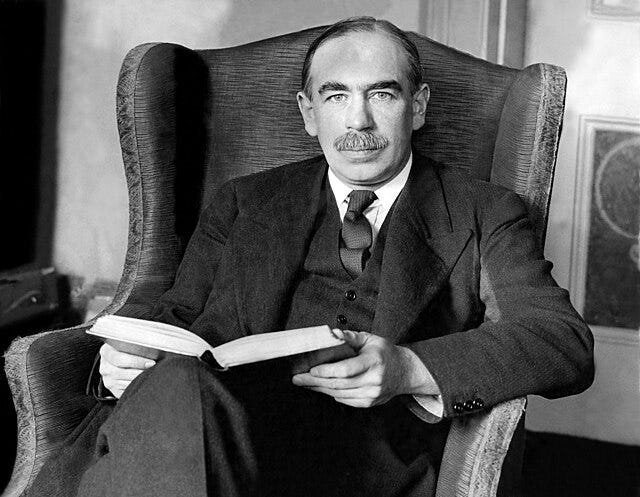
John Maynard Keynes was a British economist, policymaker, and investor whose ideas reshaped modern economic theory and the practical management of economies during crisis. Born in Cambridge into an academic family—his father, John Neville Keynes, was a noted economist and philosopher—Keynes was educated at Eton College and later at King’s College Cambridge. Initially trained in mathematics, he turned to economics under the influence of Alfred Marshall and A. C. Pigou, developing an approach that fused analytical rigor with a deep concern for real-world instability.
He worked in the British civil service, including the India Office, and rose to prominence during World War I as a Treasury official involved in war finance and international negotiations. His first major book, The Economic Consequences of the Peace (1919), grew out of his participation in the Paris Peace Conference. In it, he warned that punitive reparations imposed on Germany would destabilize Europe—an early example of his ability to connect financial arrangements with broader economic and political outcomes.
A crucial but often overlooked foundation of Keynes’s later work lies in his Treatise on Probability (1921), where he argued that much of human decision-making occurs under fundamental uncertainty, not measurable risk. This distinction became central to his later analysis of financial markets. Throughout the 1920s, Keynes was also deeply engaged as an investor, managing both his own funds and, eventually, the endowment of King’s College. His early experience in currency speculation was marked by significant losses, but over time he adapted—shifting toward longer-term, concentrated equity investing with considerable success. This evolution paralleled his intellectual development: markets, he came to believe, could not be understood purely through fundamentals, but required an appreciation of expectations, confidence, and collective behavior.
These insights culminated in The General Theory of Employment, Interest and Money (1936), published in the aftermath of the Great Depression. In Chapter 12, Keynes famously described financial markets as systems governed by crowd psychology, where investors attempt to anticipate not intrinsic value but the expectations of others—the “beauty contest” analogy. He also popularized the term “animal spirits” within economics, capturing the role of spontaneous optimism and pessimism in driving investment decisions. For Keynes, markets were inherently unstable because they depended on fragile conventions and shifting confidence, making prolonged downturns possible when private investment collapsed.
This diagnosis informed his policy prescriptions. Keynes argued that governments must play an active role in stabilizing economic activity, particularly during crises, by supporting demand through public spending. Unlike abstract theorists, however, Keynes was directly involved in implementing such ideas. During World War II, he returned to the Treasury and became a central figure in Britain’s financial strategy. His influence extended to the international stage at the Bretton Woods Conference, where he sought to design a stable postwar system. His proposal for an international clearing union and a global currency (the “bancor”) aimed to prevent the imbalances that had contributed to earlier crises. Although not fully adopted, his ideas shaped the institutions that emerged, including the International Monetary Fund and the World Bank.
Keynes’s intellectual project was ultimately moral as well as economic. He believed capitalism was flawed but redeemable, and that effective management of economic instability could create the conditions for a richer cultural and social life. This perspective was closely tied to his involvement in the Bloomsbury Group, where he associated with leading writers and artists, including Virginia Woolf. Keynes admired artists and their work, seeing aesthetic experience as central to human flourishing. His commitment extended beyond admiration: he played a key role in establishing and supporting the Cambridge Arts Theatre, helping to create a lasting institution for performance and artistic expression.
His personal life reflected both complexity and transformation. In his early years, Keynes had romantic relationships with men within the Bloomsbury circle. After marrying Russian ballerina Lydia Lopokova in 1925, however, he entered into a devoted and affectionate heterosexual marriage. Contemporary accounts and later biographies describe the relationship as loving and fully consummated, marking a genuine shift rather than a matter of social convention.
Keynes died in 1946, but his influence endures across economics, finance, and public policy. His enduring contribution lies in recognizing that economic systems are shaped not only by material forces, but by uncertainty, expectations, and human psychology. By integrating these elements into both theory and practice, Keynes became not merely an economist, but an architect of modern economic governance.
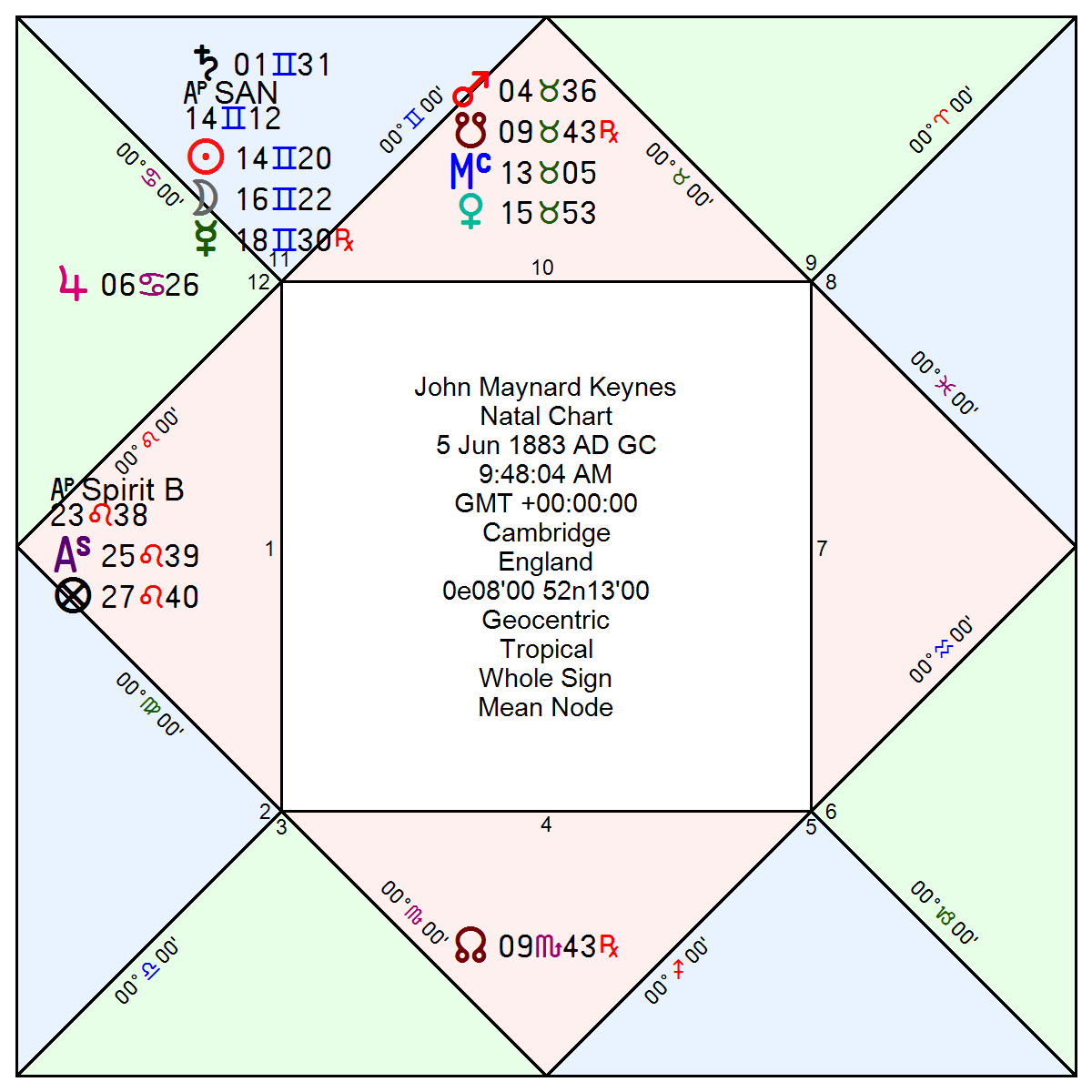
Rodden Rating AA, Quoted BC/BR, 9:45 AM, ASC 25LE08
Proposed rectification: 9:48:04 AM, ASC 25LE39’23”
The analytical models used in the sections below are part of a larger research program developed across longer white papers and case studies, where the historical sources, rules, and testing methodology are laid out in full. These database entries show the models in practice; readers who want the theoretical foundations can start with the background papers below:
Rectification Hub (I wrote the book on it!)
Soul Hub (white paper, Victor model statistical tests, Moon’s Configuration studies)
Physiognomy Hub (white paper, examples)
Victor Model Factors favoring Mercury/Gemini – retrograde
Sign ruler: Sun, Moon, Prenatal Syzygy (and Saturn)
Bound ruler: Midheaven, Lot of Spirit
Sign of rulership
As victor of the horoscope, Mercury in Gemini (retrograde, 11th house) defines John Maynard Keynes not as a ruler of institutions, but as an interpreter operating within networks of exchange. Mercury signifies the speculator, investor, researcher, writer, and policy advisor—one engaged with currency, information, and institutional systems without ever fully embodying sovereign authority. The retrograde condition is crucial: based on my research, retrograde planets often act as if they are placed in the opposite sign. Here, Mercury in Gemini behaves like Mercury in Sagittarius—philosophically expansive and optimistic, but also inherently inflationary. This helps explain both Keynes’s intellectual breadth and the inflationary implications embedded within his policy prescriptions.
Gemini, as the sign of transactions, turnover, and circulation, makes Mercury a natural co-significator of “animal spirits,” especially when reinforced by the Moon in Gemini. In this sense, Keynes’s entire program can be read through Mercury: the deliberate stimulation of activity—of exchange, confidence, and participation—designed to increase economic turnover. Yet the same mechanism carries its own limit. The more successfully Mercury accelerates circulation, the more it risks tipping into Sagittarius-like excess, where expansion becomes inflation. Keynes’s genius was not simply in advocating stimulus, but in recognizing that the restoration of confidence and activity must be balanced against the instability inherent in the very forces that generate recovery.
Physigonomy Model Factors favoring Taurus and Gemini
Rising sign: Leo
Ruler of rising sign: Sun/Gemini
Rising decan: Aries
Ruler of rising decan: Mars/Taurus
Keynes presents with a well-proportioned, above-average frame, consistent with contemporary accounts that describe him as relatively tall and physically imposing without being heavy. His posture is upright yet relaxed, suggesting both confidence and intellectual ease. The face is especially striking: broad through the jaw and cheekbones, yet softened rather than angular, with a balanced symmetry between width and length. The forehead is high and expansive, indicating strong mental orientation, while the cheeks and jawline avoid sharp definition, giving the overall impression of a soft rectangular structure rather than a narrow or triangular form. The features—particularly the eyes and mouth—are composed and controlled, reinforcing an image of deliberation rather than impulsiveness.
From an astrological standpoint, this physiognomy aligns closely with a Leo rising sign in the Aries decan, where the decan ruler Mars is placed in Taurus and co-present with Venus in Taurus. In John Willner’s model, Taurus is associated with a soft rectangular facial shape, and that signature is clearly visible here: the breadth of the face is grounded in Taurus, with Venus refining and softening the overall appearance. His above-average height can be attributed to the strong Gemini emphasis, including both luminaries, as Gemini (along with Sagittarius) is traditionally associated with taller stature. The result is a compelling blend: a Gemini-driven verticality of body combined with a Taurus-influenced solidity and softness of face, anchored by a Leo ascendant that gives presence and composure.
Moon’s Configuration
Phase I — Moon ingress into Gemini and conjunction with Saturn (Gemini, 11th House)
The Moon’s ingress into Gemini followed immediately by conjunction with Saturn establishes the opening condition of Keynes’s life: circulation constrained by contraction. Gemini signifies exchange, transactions, and the flow of information—yet Saturn imposes limits, austerity, and restriction upon that flow. This combination is a precise symbolic match for Keynes’s lifelong engagement with periods of economic contraction, most notably the interwar years and the Great Depression, where breakdowns in credit, trade, and confidence dominated the global system. His early professional life inside the Treasury during and after World War I placed him directly in the machinery of financial constraint—war debts, reparations, and deflationary pressures. The Saturn–Moon contact reflects both the reality he confronted and the problem he sought to solve: how to restore circulation in a system locked into contraction.
Phase II — Moon conjunct Sun (Gemini, 11th House)
The Moon’s application to the Sun brings Keynes into visibility and authority, marking the emergence of a public intellectual whose ideas carry weight within elite networks. The Sun signifies prominence, recognition, and alignment with centers of power, and in Gemini this authority is expressed through analysis, communication, and intellectual exchange. This phase corresponds to Keynes’s early rise through Cambridge and the British establishment, culminating in his role at the Paris Peace Conference and the publication of The Economic Consequences of the Peace. There, Keynes did not merely participate—he asserted a coherent intellectual position that challenged prevailing policy. The Moon’s conjunction with the Sun thus reflects his emergence as a recognized authority on economic matters, particularly those involving currency, debt, and international finance.
Phase III — Birth Moment: New Moon (New Moon/Gemini separating from Sun,11th house)
At birth, the Moon has just separated from the Sun, producing a New Moon configuration, traditionally considered a debility due to the Moon’s reduced light and independence. In Keynes’s case, this does not manifest as weakness, but as intense fixation. The Gemini emphasis directs that fixation toward economics, trade, and currency systems—areas requiring continuous mental engagement and analysis. However, the New Moon condition also suggests limitations in translating vision into fully realized external outcomes. This is visible in two major episodes: Keynes’s failure to persuade the Allies to significantly reduce German reparations after World War I, and his inability to secure adoption of the bancor proposal at the Bretton Woods Conference. In both cases, Keynes clearly perceived systemic flaws, yet the full realization of his proposals was constrained. The New Moon thus signifies a mind oriented toward systemic insight, but operating within limits when confronting entrenched political structures.
Phase IV — Moon applying to Mercury (Gemini, 11th House, retrograde)
Following separation from the Sun, the Moon applies to Mercury, the victor of the horoscope, completing the configuration with a return to Gemini’s core theme: circulation of thought, information, and exchange. Mercury retrograde indicates a process of continual revision, learning, and adaptation, and in Gemini this becomes a life devoted to analyzing systems of trade and communication. This phase corresponds directly to Keynes’s evolution as both investor and theorist. His early losses in currency speculation gave way to later success as he refined his understanding of market behavior, ultimately culminating in the insights of Chapter 12 of The General Theory of Employment, Interest and Money. There, Keynes articulates markets as recursive systems of expectation—precisely the kind of Mercurial process suggested by this configuration. The Moon’s application to Mercury thus completes the cycle: from constrained circulation (Saturn), to public authority (Sun), to inward fixation (New Moon), and finally to adaptive intelligence operating within systems of exchange, which became Keynes’s enduring contribution to economic thought.
Influence of Sect
With a diurnal chart, John Maynard Keynes places both Jupiter and Saturn in-sect, giving their significations greater clarity and effectiveness within the world he operated in. Saturn in Gemini signifies economic contraction, constrained circulation, and a structural preference for fiscal austerity, themes that dominated the interwar environment Keynes confronted and sought to reform. At the same time, Jupiter in Cancer—also in-sect—signifies animal spirits, crowd psychology, and collective sentiment, and the fact that it is in-sect helps explain why these arguments were ultimately persuasive and well received within the policy and intellectual circles of his day. By contrast, Venus and Mars are out-of-sect, shifting their expression outside the mainstream. Venus in Taurus reflects Keynes’s artistic commitments and friendships within the Bloomsbury Group—an avant-garde circle operating at the margins of conventional society. Mars in Taurus, out-of-sect and in detriment, points to the damaging role of banking and financial market disruptions on the broader macroeconomy, a force Keynes repeatedly analyzed and attempted to counter. Although Mars is mitigated by reception from Venus in Taurus, softening its effects, it remains fundamentally destabilizing—consistent with Keynes’s view that financial markets, left unchecked, could exert severe negative pressure on economic stability.
Early/Late Bloomer Thesis
John Maynard Keynes was born on 5 June 1883 and died on 21 April 1946, giving him a lifespan of approximately 63 years. The midpoint of his life therefore falls around age 31, or roughly 1914 when rounded. Under the working thesis, a New Moon birth should incline toward early development, with the essential shape of life established before the midpoint. Keynes does show signs of early emergence: he achieved distinction at Cambridge, entered the Treasury, and published Indian Currency and Finance (1913) before age 31. By the midpoint, he was already operating within elite policy circles and had demonstrated unusual intellectual promise.
However, when judged by the milestones that define his historical significance, Keynes appears to be a clear exception to the early-bloomer rule. His most important achievements occur after the midpoint: The Economic Consequences of the Peace (1919), his interventions during the Depression, A Treatise on Money (1930), The General Theory (1936), and his role at the Bretton Woods Conference in 1944. Even his success as an investor seems to follow a similar pattern, improving after earlier setbacks. The result is a life where early promise is undeniable, but lasting impact is concentrated in the second half. This aligns with a broader pattern observed in the research: births close to the New Moon or Full Moon often violate the early/late bloomer distinction, suggesting that these extreme lunar conditions produce more complex developmental timelines than the waxing/waning model alone would predict.
AI Notice: ChatGPT contributed to this article.
Complete biographical chronology, rectification and time lord studies available in Excel format as a paid subscriber benefit. Files are behind the paywall.