

This post belongs to the Jupiter in Cancer series, but not all such horoscopes operate in the same way. In the chart of John Wayne, Jupiter in Cancer functions as the victor, and here it does produce the familiar effect: a figure who comes to embody the people. This places Wayne alongside William Jennings Bryan, the progressive Democrat known as “The Great Commoner,” who expressed the same planetary signature through speech and political rhetoric. Wayne’s medium is different—performance rather than oratory—but the underlying mechanism is similar: authority derived from a perceived alignment with the emotional life of the public. What sharpens Wayne’s version of this signature is the placement of Jupiter in the bound of Mercury in Cancer, adding a layer of “thinking of the people.” This is not merely identification, but the ability to read an audience, anticipate its reactions, and shape performance accordingly—an essential attribute in sustaining his long career.
That Mercurial layer leads directly to Mercury in Gemini, joined by the Sun, which in this chart signifies John Ford, the director who shaped Wayne’s acting style and whom Wayne regarded as a father figure. If Jupiter in Cancer supplies the public mandate, Mercury in Gemini supplies the method—the capacity to adapt, repeat, and refine roles within a narrative system largely constructed by Ford. Wayne does not invent himself in isolation; he is formed within a framework, one that channels his Jupiterian appeal into recognizable and repeatable patterns.
If Jupiter in Cancer makes Wayne an embodiment of the people, the Moon—Jupiter’s ruler—describes which people respond most strongly. With the Moon in Scorpio, the bond is formed with those who experience the world as unstable, unjust, or insufficiently governed—people inclined toward grievance, anger, and the expectation of conflict. They are drawn to a figure who can enter situations where institutions fail, and through the disciplined, effective use of force, restore a workable order. That restoration is never presented as permanent and often comes at a cost, requiring sacrifice or withdrawal by the one who acts.
In the balance of this post, I recap Wayne’s biography and break down the astrological models responsible for Wayne’s rank as one of the top 25 male greatest screen legends in a 1999 survey by the American Film Institute.
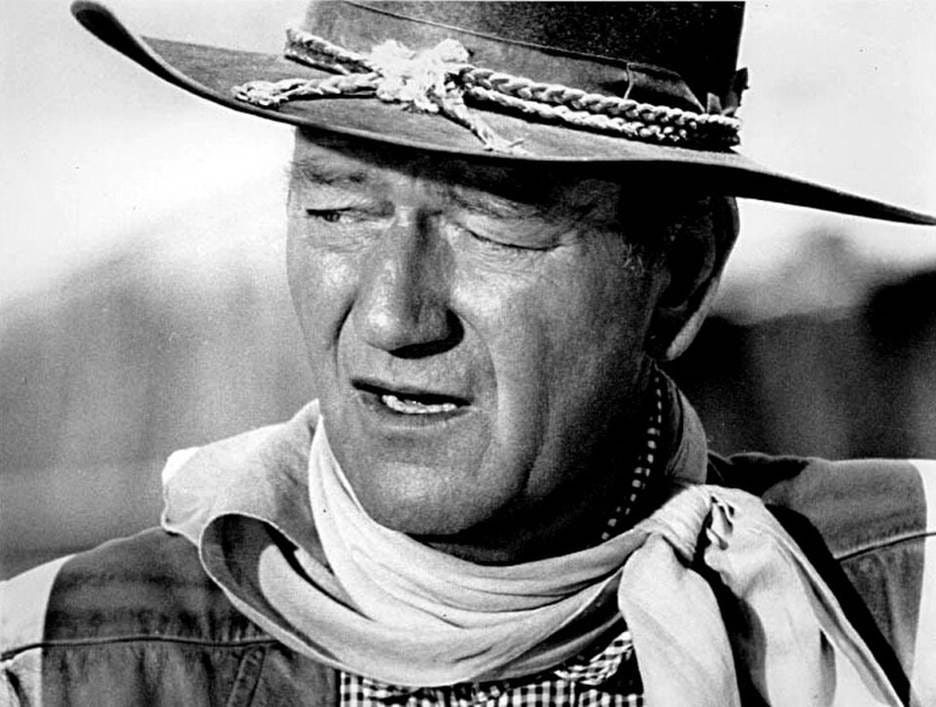
John Wayne did not arrive in American culture fully formed; he built himself, piece by piece, into something larger than an actor—a figure who came to embody a particular vision of the United States. His life reads less like a sequence of roles and more like a gradual consolidation of identity, forged through discipline, collaboration, conviction, and contradiction.
Born Marion Robert Morrison in 1907 and raised in Southern California, Wayne’s early ambitions were athletic rather than artistic. At the University of Southern California, he pursued football until a shoulder injury around 1926–1927 ended that path. What might have been a conventional life instead fractured at that point, forcing him into the margins of the film industry. He began at the lowest levels—moving props, appearing in uncredited roles—absorbing the mechanics of filmmaking without yet possessing a clear identity within it.
The decisive influence on his development came through John Ford, who recognized in Wayne not a finished actor but a physical presence that could be shaped. Ford did not immediately elevate him; instead, he refined him, teaching him how to use stillness, how to let silence carry authority, and how to communicate through posture rather than speech. This apprenticeship culminated in Stagecoach, where Wayne’s entrance as the Ringo Kid instantly established him as a star. The performance introduced a persona that would define him: a man of action governed by an internal code, capable of violence but restrained by principle.
From that moment, Wayne’s career unfolded as a steady expansion of that persona. In Red River, he moved beyond the straightforward hero into more complex territory, portraying Thomas Dunson as both builder and tyrant—a man whose authority becomes oppressive. The performance revealed that Wayne’s strength as an actor lay not only in projecting certainty, but in exposing the consequences of it. This duality reached its peak in The Searchers, where his portrayal of Ethan Edwards brought together heroism and alienation, courage and obsession, suggesting that the very qualities that define the American frontier myth also contain the seeds of exclusion and violence.
Alongside these darker explorations, Wayne continued to anchor films that reinforced his public image. In Rio Bravo, he returned to a more controlled and confident authority, playing a sheriff who maintains order through competence rather than dominance. By the end of the 1950s, Wayne was no longer simply participating in the Western genre—he had become one of its central architects, a figure through whom audiences understood its moral landscape.
It was at this point that Wayne attempted to take full control of the myth he had helped define. The Alamo was his most personal project, one he pursued for years with a level of commitment that bordered on obsession. Producing, directing, and starring in the film, Wayne sought to present the Alamo as a story of sacrifice and national purpose. The narrative resonated deeply with him: men choosing death not out of desperation, but out of conviction. In Davy Crockett, Wayne created a version of himself that fused historical legend with personal belief—a figure who meets annihilation with clarity and resolve. Though the film received mixed reviews and strained his finances, it stands as the clearest statement of his inner mythology.
As the 1960s progressed, Wayne’s public identity increasingly aligned with his political views. He became an outspoken advocate for conservative principles, emphasizing anti-communism, military strength, and traditional social values. These convictions culminated in The Green Berets, a film that openly supported U.S. involvement in Vietnam at a time when the country was sharply divided. The film was widely criticized and often dismissed as propaganda, but it revealed Wayne’s willingness to risk artistic credibility in defense of his beliefs. His support for conservative politics extended beyond film; he was a visible backer of Republican figures, including Ronald Reagan, whom he regarded as a kindred figure in the defense of American identity.
If Wayne’s public life suggested coherence and certainty, his private life told a different story. He married three times—first to Josephine Saenz, then to Esperanza Baur, and finally to Pilar Pallete—and each relationship reflected tensions between his constructed persona and his lived reality. His marriages were marked by infidelity, emotional distance, and instability, and his second marriage in particular descended into volatility and conflict. Wayne’s identity required independence and control, qualities that translated poorly into domestic life. Even his longest marriage eventually gave way to separation, suggesting that the demands of his public role consistently undermined private stability.
In his later years, Wayne’s work took on a reflective quality. His performance in True Grit, which earned him an Academy Award, presented an aging lawman whose effectiveness persists despite visible decline. The role acknowledged the passage of time without surrendering the core of his persona. His final film, The Shootist, went further, portraying a dying gunfighter confronting mortality with dignity and inevitability. In these performances, Wayne did not abandon the myth he had built; he allowed it to age, weather, and conclude on its own terms.
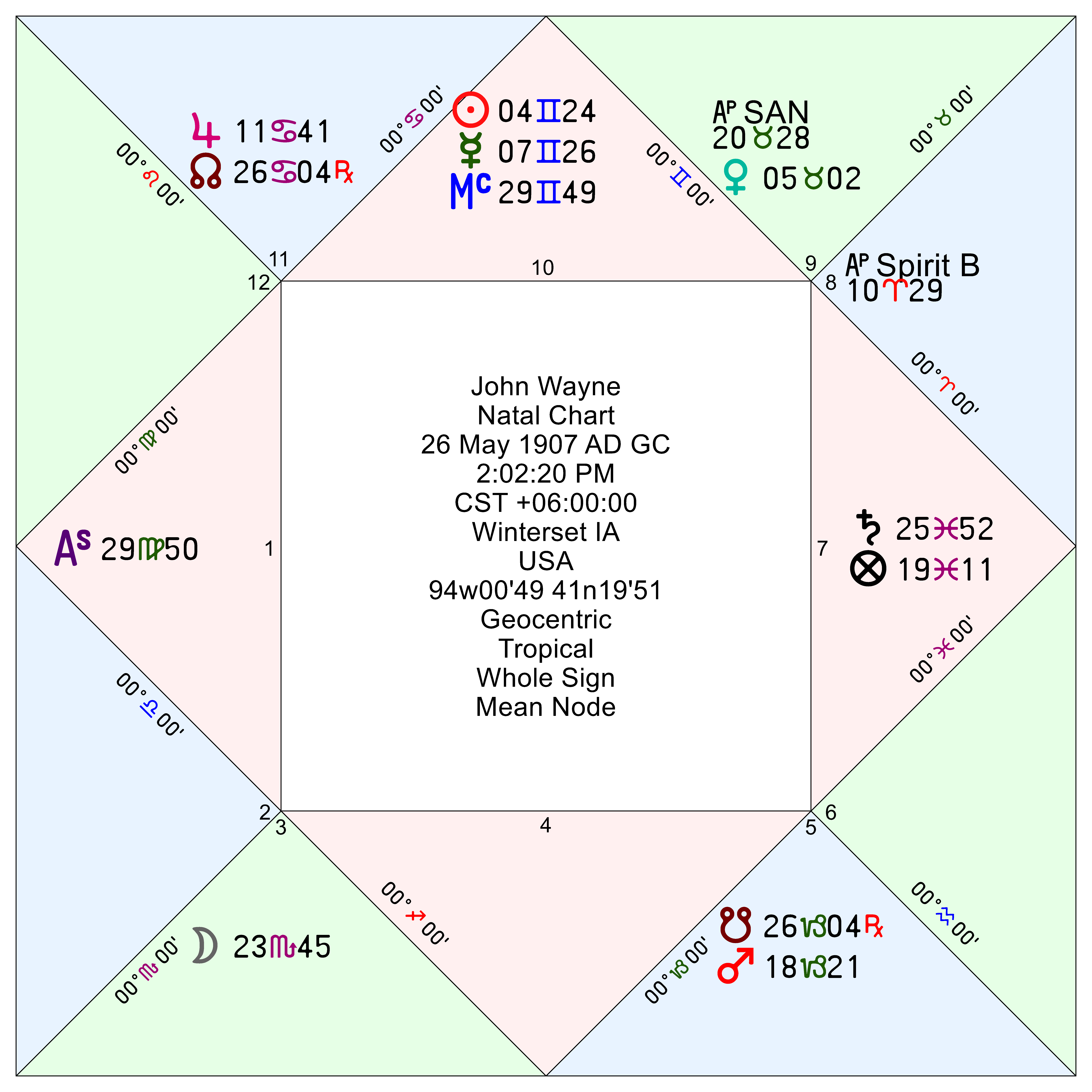
Rodden Rating C, Rectified from approx time, 5:00 AM, ASC 5GE47.
Proposed Rectification 2:02:19 PM, ASC 29VI50’43”
The analytical models used in the sections below are part of a larger research program developed across longer white papers and case studies, where the historical sources, rules, and testing methodology are laid out in full. These database entries show the models in practice; readers who want the theoretical foundations can start with the background papers below:
Rectification Hub (I wrote the book on it!)
Soul Hub (white paper, Victor model statistical tests, Moon’s Configuration studies)
Physiognomy Hub (white paper, examples)
Victor Model Factors favoring Jupiter/Cancer
Sign ruler: Lot of Fortune
Bound ruler: Moon, Prenatal Syzygy
Sign of exaltation
House of Joy
Jupiter in Cancer as the victor of John Wayne’s horoscope signifies a figure who embodies the protective, expansive spirit of the homeland, identifying himself with the people and their need for continuity, security, and belonging. In its basic form, Jupiter/Cancer elevates themes of guardianship, emotional allegiance, and the preservation of a way of life, making Wayne not merely a performer but a vessel for collective identity. Yet this promise of protection is not naïve or automatic; it is conditioned by the Moon’s configuration. With the Moon in Scorpio separating from Mars in Capricorn and applying to Saturn in Pisces (in the bound of Mars), the expansive ideal of Jupiter/Cancer is forced to pass through a cycle of crisis, violence, and fragile restoration. The homeland is not simply protected—it must be reclaimed, often through decisive force, and stabilized only temporarily through sacrifice. In this way, Jupiter/Cancer does not signify a permanent state of security, but rather a recurring need to defend and rebuild the community, aligning Wayne with an audience that experiences belonging as something that must be continually fought for and re-established.
Physiognomy Model Factors favoring Gemini (body) and Taurus (face)
Rising sign: Virgo
Ruler of rising sign: Mercury/Gemini
Rising decan: Taurus
Ruler of rising decan: Venus/Taurus
Planets placed in sign of rising decan: Venus/Taurus
John Wayne’s physical presence is built on scale, structure, and endurance rather than delicacy or refinement. In early photographs, his face carries a balanced, softly structured shape—broad through the forehead and jaw, with gently rounded edges rather than sharp angles. The features sit evenly within the frame, producing a sense of cohesion rather than fragmentation. As he ages, that same structure does not change so much as it thickens and settles. The jaw becomes wider and more squared, the neck fuller, and the entire lower face takes on a weight-bearing quality, as if designed to carry strain rather than express nuance. His eyes remain steady and slightly hooded, often conveying watchfulness, skepticism, or controlled appraisal, while the mouth tends toward restraint. Across decades, the impression is of a man whose face does not fluctuate—it accumulates, gaining density and permanence rather than altering its underlying form.
Astrologically, this physiognomy is best understood by separating body from face. Wayne’s recorded height of 6’4” supports a Mercury/Gemini influence in bodily proportion, consistent with the traditional association of Gemini with vertical extension and above-average stature. But that Mercurial signature does not carry into the face, where variability and lightness are notably absent. Instead, the facial structure aligns more convincingly with the Taurus expression assigned to the third decan of Virgo rising. In youth, this appears as a soft rectangular form—structured but slightly rounded at the edges—while in later life it manifests as thickened mass, density, and structural permanence. Venus/Taurus does not show here as softness in the conventional sense, but as cohesion and accumulation of form over time, producing the heavy jaw, full neck, and grounded presence that define Wayne’s mature appearance. The result is a physiognomy in which Mercury shapes the frame, but Taurus ultimately defines the substance.
Moon’s Configuration
Phase I — Moon separating from Mars (Capricorn, 5th House)
Delineation. The Moon at 23° Scorpio separates from Mars at 18° Capricorn in the 5th house, and this phase establishes the method by which conflict is addressed. Mars in Capricorn, its sign of exaltation, signifies precision, discipline, and highly effective application of force. This is force that is controlled, purposeful, and executed with competence. However, because the chart is diurnal, Mars is out of sect, and therefore this force is not inherently supported or endorsed by the social order. It operates independently of institutional authority, often emerging precisely when such authority is insufficient.
Placed in the 5th house, this Mars becomes visible and performed—force is not hidden but enacted in a way that defines identity. The Moon’s separation indicates that this principle is internalized early and carried forward as the emotional baseline: conflict is expected, and its resolution depends on the presence of an individual capable of applying disciplined, effective force, whether or not that force is formally sanctioned.
Biographical Match. This phase is reflected in Wayne’s repeated portrayal of the gunman, soldier, and enforcer across films such as Red River, Rio Bravo, and The Green Berets. In each case, Wayne’s characters act with competence and decisiveness, but often outside or ahead of institutional authority. The out-of-sect Mars is especially visible in The Green Berets, where Wayne’s commitment to military action reflects personal conviction rather than consensus, reinforcing the idea that effective force may be necessary even when it is not broadly supported. This phase establishes the core image: the man who acts when others cannot or will not.
Phase II — Moon applying to Saturn (Pisces, 7th House; bound of Mars)
Delineation. The Moon applies to Saturn at 25° Pisces near the 7th house cusp, and this placement must be understood through three distinct layers.
First, Saturn in Pisces signifies the underlying condition: ineffective or unreliable enforcement institutions. Saturn, a planet of structure and boundary, cannot operate effectively in Pisces, a mutable water sign ruled by its enemy Jupiter. The result is a social environment where law exists, but lacks clarity, consistency, and enforcement power.
Second, Saturn is placed in the bound of Mars in Pisces, which modifies how this weakness is addressed. Mars in Pisces signifies sacrifice and martyrdom—action that requires loss, endurance, or self-offering. This introduces a style of enforcement that is not bureaucratic, but personal and costly.
Third, the bound ruler of Mars in Pisces is Mars in Capricorn, which supplies the mechanism of action. Mars in Capricorn provides precision, discipline, and highly effective application of force, translating the sacrificial impulse of Mars/Pisces into controlled and decisive enforcement.
Taken together, these three layers produce a single expression:
Where institutions fail to enforce the law, the individual intervenes—willing to sacrifice himself, if necessary, using disciplined and effective force to restore order.
Because Saturn rules Mars by sign, this configuration also has a looping character. The restoration of order is never final; the very act of enforcement can generate new instability, requiring the process to repeat. Order is maintained, but only through ongoing cycles of challenge and response.
Biographical Match. This pattern appears consistently across Wayne’s films. In Rio Bravo, the sheriff sustains a weak system through personal resolve rather than institutional strength. In The Searchers, Ethan Edwards restores the family but cannot enter the social order he has preserved. In The Alamo, institutional failure leads to total sacrifice, where enforcement becomes martyrdom. And in True Grit, the law is upheld through a figure who absorbs the cost of that enforcement in his own body.
Across these examples, the sequence holds: weak institutions require intervention; intervention demands sacrifice; and the resulting order remains provisional, subject to renewal through further conflict.
Influence of Sect
In a diurnal chart, sect clarifies which themes are broadly supported and which operate with friction in the life of John Wayne. With both Saturn and Jupiter in sect, their effects are not softened but stabilized and made pervasive. Saturn in Pisces, already signifying weak or ineffective enforcement, becomes a reliable background condition—not an occasional breakdown, but a recurring feature of the social landscape Wayne inhabits and dramatizes. This gives continuity to the Moon’s configuration: the need for intervention is not exceptional, but constant. At the same time, Jupiter in Cancer in sect amplifies Wayne’s identification with the public, extending his reach as a kind of “Great Commoner” figure whose appeal cuts across wide segments of society. By contrast, Mars out of sect intensifies and sharpens its expression, pushing the application of force outside formal approval, as already discussed. The more difficult piece is Venus in Taurus (8th/9th) out of sect, which does not disappear but becomes less able to deliver ease, harmony, or integration. Instead of smoothing relationships or providing stable emotional bonds, Venus operates in a more limited and situational way, contributing to themes of strained partnerships, separation, and imbalance between public life and private attachment. In this way, sect organizes the chart cleanly: Jupiter expands his public role, Saturn normalizes the conditions that require it, Mars enforces it under strain, and Venus fails to fully humanize or stabilize the personal sphere.
Early/Late Bloomer Thesis
At first glance, John Wayne appears to fit the early/late bloomer framework. He is born after a New Moon, placing the nativity in the waxing phase (New → Full), which in this model would normally indicate an early bloomer—a life in which direction is established relatively early and major achievements tend to cluster before the midpoint. However, the Moon’s condition complicates this expectation. Although waxing, the Moon is positioned close to its opposition with the Sun, placing it under the Sun’s bond, a condition that has, in other cases, coincided with departures from the phase-based timing pattern. This introduces uncertainty at the outset as to whether the waxing Moon signal will operate cleanly.
Using an exact life midpoint clarifies how the pattern unfolds in practice. Wayne’s midpoint falls on June 3, 1943, dividing the life into two distinct periods. Before this date, the career is marked by extended formation rather than early consolidation: an initial starring role in The Big Trail (1930) that failed to establish him, followed by nearly a decade in B-Westerns, and a breakthrough only with Stagecoach (1939) at age 31. While this places him on the map before the midpoint, the main body of defining work—Red River (1948), The Searchers (1956), Rio Bravo (1959), and True Grit (1969)—belongs to the second half of life.
The Moon at 23°45′ Scorpio is 10°39′ shy of perfecting a Full Moon to the Sun at 4°24′ Gemini. Yet this distance is close enough to place the Moon under the Sun’s bond using Hellenistic criteria of 15 degrees before and after the exact Full Moon. For Wayne, this means the Moon’s waxing phase does not translate into substantive early career achievements as the New Moon/early bloomer thesis predicts; instead, the life pattern shows extended development followed by a more substantial second-half realization.
Complete biographical chronology, rectification and time lord studies available in Excel format as a paid subscriber benefit. Files are behind the paywall.