

This essay continues the current Jupiter-in-Cancer series, drawing on my own research into the behavior of Jupiter retrograde in Cancer, which often functions less like a benefic in domicile and more like Jupiter in Capricorn: care is constrained, protection is uneven, and support arrives inconsistently or is withdrawn altogether. Kurt Cobain joins Janis Joplin and Jimi Hendrix in sharing the same Moon–Jupiter configuration in Cancer, a pattern that emphasizes nourishment, belonging, and emotional shelter, yet in all three lives the promise of care is compromised by affliction, circumstance, or reversal. What differs is the house through which this Cancerian promise is tested: Joplin’s Moon–Jupiter in the 6th ties nourishment and care to illness and bodily affliction; Hendrix’s placement in the 8th binds the same promise to danger and mortality; and Cobain’s Moon–Jupiter in the 11th places the question of care within friendships, bands, and alliances.
Cobain’s case is especially instructive because the 11th house is traditionally the place of benefactors, friends, and supportive alliances—the very container in which Jupiter in Cancer should promise protection. Yet with Jupiter retrograde, care from friends and alliances proves unreliable at critical moments. His relationships within Nirvana become strained as touring intensifies and conflicts over direction and exhaustion mount; bandmates and management repeatedly express concern but are unable to halt the pressures of touring and promotion that exacerbate his condition. Following the Rome incident in March 1994, those closest to him attempt to intervene, yet alliances fracture rather than consolidate: he leaves a treatment facility early, slips away from supervision, and becomes increasingly isolated from the very network meant to protect him. Even the broader alternative music scene that once functioned as a surrogate family becomes emotionally distant as fame magnifies scrutiny and reduces the intimacy of support.
The manner of Cobain’s death by gunshot accords with the Moon’s configuration, which links Mars to Mercury. In traditional delineation, Mars–Mercury combinations signify figures who act through weapons or instruments—highwaymen, robbers, and gunmen—where Mars signifies violence and Mercury the hand or means by which it is carried out. In this chart, the Moon carries the influence of Mars, ruler of the 8th house of death, forward to Mercury, ruler of the Ascendant and victor of the horoscope, symbolically linking the agent of the act with the instrument of death in the final outcome.

Kurt Cobain emerged from a childhood marked by family rupture and unstable living arrangements into the center of a musical movement that reshaped popular culture in the early 1990s. After drifting between relatives and friends’ homes as a teenager in Aberdeen, Washington, he immersed himself in the punk and underground scenes of Olympia and Seattle, forming Nirvana in 1987. The band’s first album, Bleach, released on 15 June 1989, established his voice within the regional alternative circuit, followed later that summer by raw, informal recording sessions of Lead Belly songs with musicians from Nirvana and Screaming Trees on 20 and 28 August 1989. These early years were shaped by constant movement between rehearsal spaces, small venues, and touring routes, building a reputation through circulation rather than institutional support. The unexpected success of “Smells Like Teen Spirit” in the autumn of 1991 transformed Nirvana from a touring band into an international act almost overnight, and the release of Nevermind on 24 September 1991 marked a decisive turning point in both Cobain’s public standing and the scale of demands placed upon him.
The period that followed the breakthrough, roughly 1992 through 1993, proved to be one of suspension rather than consolidation. Cobain married Courtney Love on 24 February 1992, and the birth of their daughter later that year briefly suggested the possibility of a settled domestic life, yet professional obligations and public scrutiny intensified instead of easing. Touring schedules were repeatedly interrupted by cancellations, public appearances became erratic, and conflicts with journalists and industry figures multiplied. Despite expanding recognition and a widening audience, there was no stable reorganization of his daily life; periods of withdrawal alternated with renewed obligations, and attempts by those around him to impose durable structure on his circumstances repeatedly failed to take hold. These years were marked by drift rather than development, with creative work continuing but personal conditions remaining unresolved.
The release of In Utero on 21 September 1993 returned Nirvana to a harsher, less polished sound and coincided with a further narrowing of Cobain’s tolerance for the pressures of touring and publicity. Written statements, interviews, and lyrics increasingly became the primary means through which he articulated conflict with the public world, even as those communications deepened misunderstandings with the press and segments of his audience. In March 1994, following a serious incident in Rome and a brief attempt at treatment upon returning to the United States, supervision and protective efforts by those around him broke down. He left a treatment facility in Los Angeles in early April and returned to Seattle, where isolation deepened in the final days of his life. Cobain died on 5 April 1994, closing a career that had, in less than a decade, moved from marginal underground recognition to global cultural influence, leaving behind a body of work that continued to shape music and youth culture long after his death, even as the personal conflicts that accompanied his rise remained unresolved.
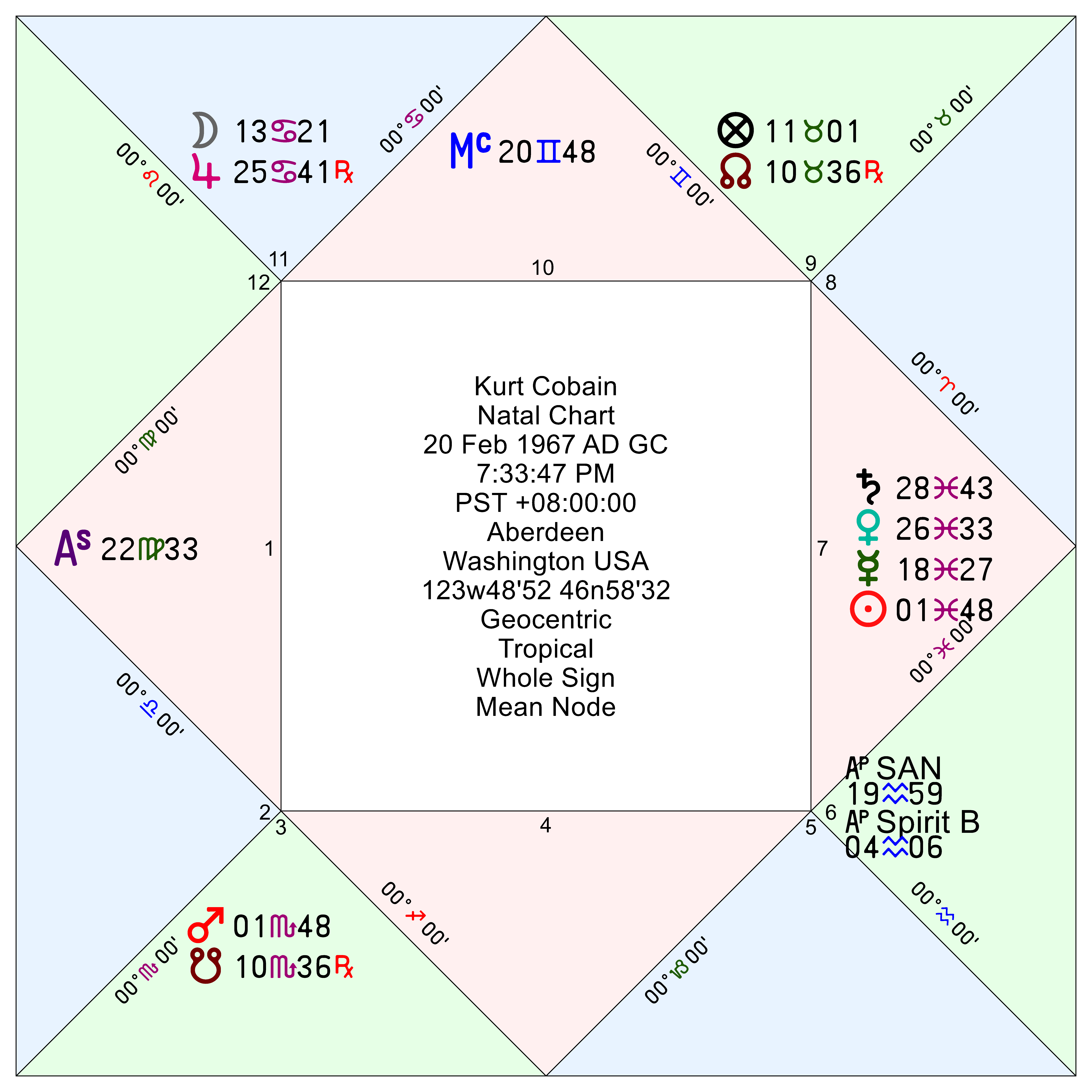
Rodden Rating AA, 7:38 PM, ASC 23VI21
Proposed rectification: 7:33:47 PM, ASC 22VI33’42”
The analytical models used in the sections below are part of a larger research program developed across longer white papers and case studies, where the historical sources, rules, and testing methodology are laid out in full. These database entries show the models in practice; readers who want the theoretical foundations can start with the background papers below:
Rectification Hub (I wrote the book on it!)
Soul Hub (white paper, Victor model statistical tests, Moon’s Configuration studies)
Physiognomy Hub (white paper, examples)
Victor Model Factors favoring Mercury/Pisces
Sign ruler: ASC, MC
Bound ruler: Moon, Lot of Fortune, Lot of Spirit
Angular in 7th house
Cobain’s victor is best read as Mercury in Pisces, ruler of the Ascendant, fallen and in detriment in the 7th house. This is not the Mercury of cleverness or craft alone, but the Mercury of psychic permeability—language flooded by emotion, identity shaped through conflict with others, and a mind that repeatedly turns against itself. His life is ruled by expression, but expression that wounds its bearer.
Venus in Pisces, though exalted and placed on the 7th cusp, cannot serve as victor because she is besieged between a weak Mercury and a malefic Saturn. Love, beauty, and intimacy are central themes in Cobain’s life, but they are consistently damaged by confusion and Saturnian affliction. Venus does not govern the life; she is what the life repeatedly loses.
Physiognomy Model Factors favoring Pisces
Rising sign: Virgo
Ruler of rising sign: Mercury/Pisces
Rising decan: Taurus
Ruler of rising decan: Venus/Pisces
Cobain’s physiognomy is better explained by the condition of the Ascendant rulers and decan rulers than by Virgo rising alone. While Virgo rising can produce narrowness of frame and delicacy of build, Cobain lacks the typical neatness, precision, and fine-featured clarity associated with Virgo physiognomy. Instead, the dominant visual signature comes from Mercury and Venus in Pisces applying to Saturn in Pisces, which softens and blurs facial definition while introducing Saturnian roughness, neglect, and irregularity in presentation. His long, stringy, uneven hair frames the face in curved outlines consistent with Piscean enclosure, while Saturn’s influence is visible in the frayed, unkempt, and deliberately crude aesthetic that defined the “grunge” image. The result is a body and face that appear under-structured and drooping rather than sharply delineated, with Pisces and Saturn overriding Virgo’s usual precision.
Moon’s Configuration
Phase I – Moon Separating from Mars (Scorpio, 2nd/4rd houses QS/WS)
Delineation. The Moon separating from Mars signifies a life pattern initially shaped by strife, contention, haste, and harmful conditions that leave a lasting imprint on the emotional life. Mars in Scorpio is a malefic in its own sign, signifying extremes, wounds, danger, and actions taken under compulsion. Placed in the 3rd house by whole sign, Mars brings strain through movement, travel, circulation among peers, disputes arising from communication, and the pressures of repeated journeys. As ruler of the 8th house of death, Mars further ties these conditions to mortal danger, so that strife and harmful circumstances are not merely incidental but structurally bound to the life narrative. The Moon’s separation from Mars describes a departure from a life governed by these harsh conditions, even though their effects continue to shape subsequent developments.
Biographical Match. This phase corresponds to Cobain’s formative and early career years, from the mid-1980s through the breakthrough of Nevermind in 1991. These years are marked by unstable living conditions, constant movement between Olympia, Aberdeen, and Seattle, contentious relationships within early band lineups, and the strain of rapid circulation through clubs, venues, and touring routes. The pressures of emerging fame intensify rather than relieve these conditions, so that even as success approaches, the life remains governed by haste, conflict, and exhausting movement. The Moon’s separation from Mars is shown in the transition out of this period of struggle and circulation, as Cobain moves from underground hardship into public recognition, carrying with him the imprint of Mars’s earlier conditions.
Phase II – Void of Course Moon (Cancer, 11th house)
Delineation. After separating from Mars, the Moon becomes void of course in Cancer. Being in domicile, the Moon retains some capacity to act, yet no new stable condition is formed; affairs do not advance toward resolution, and circumstances tend to drift or repeat without arriving at a settled outcome. This phase signifies a liminal condition in which the prior pattern of strife has ended, but no coherent new order replaces it. The Moon remains sensitive and exposed, yet without a directing contact to anchor the life in a durable configuration. Background aspects perfecting during this interval indicate that benefits and pressures may increase simultaneously, yet the emotional condition remains suspended and unable to consolidate these changes into stability.
Biographical Match. This phase corresponds most closely to the period following Nirvana’s sudden global success, roughly 1992 through 1993. During these years, Cobain’s earlier conditions of struggle and circulation have ended, yet no stable replacement emerges. Marriage, public recognition, and commercial success do not produce a settled order; instead, touring becomes erratic, public appearances are inconsistent, and legal and media disputes multiply without resolution. Creative direction stalls and withdraws from public coherence, while personal circumstances fail to stabilize. This period is marked by suspension rather than development: despite increased visibility and support, affairs do not proceed toward durable resolution, matching closely the traditional significations of a void of course Moon in Cancer.
Phase III – Moon Applying to Mercury (Pisces, 7th House)
Delineation. The Moon’s application to Mercury signifies that the emotional life seeks resolution through matters governed by Mercury: speech, writing, messages, negotiations, publicity, and the execution of deliberate acts. Mercury, as ruler of the Ascendant, governs the direction of the life itself; placed in Pisces, in detriment and fall, Mercury is weakened, diffuse, and unstable in judgment. The Moon’s application to such a Mercury does not promise firm settlement but rather the transfer of the Moon’s prior conditions into Mercury-ruled activities. Because the Moon carries the influence of Mars forward to Mercury, this application also links earlier conditions of strife and danger to acts and instruments governed by Mercury, in accordance with traditional doctrine concerning Mars–Mercury linkages.
Biographical Match. This phase corresponds to the final years of Cobain’s life, from 1993 into 1994. During this period, letters, statements, interviews, lyrics, and public declarations increasingly dominate the narrative of his life. The release of In Utero and subsequent public communications become the principal means through which his condition is expressed, while disputes with the press and industry intensify. Written notes and messages assume particular prominence in the final months, and decisive acts governed by Mercury bring the biography to its conclusion. The Moon’s application to Mercury thus corresponds to a period in which the life becomes increasingly mediated through words, statements, and deliberate actions, culminating in the final enactment of conditions previously shaped by Mars.
Interpretive Summary
Kurt Cobain’s Moon’s Configuration describes a life that begins under the imprint of strife and harmful conditions, passes through a prolonged interval in which no stable new order takes hold, and ends with the transfer of those earlier conditions into acts and expressions governed by Mercury. Apart from Mercury-signified literary expressions, Mercury also signifies the hands which pulled the trigger which ended his life. This completes the the Moon’s Configuration one last time: from Mars, ruler of the 8th of death, to Mercury, ruler of the 1st and victor of the horoscope in a tragic suicide death by gunshot.
Influence of Sect
Cobain’s chart is nocturnal, placing Saturn and Jupiter out of sect and Mars and Venus in sect, and this division is borne out clearly in the biography. Saturn out of sect signifies a harsher and more destructive expression of Saturnian themes, seen in the severity and persistence of illness, constraint, and adversity that attend his adult life rather than functioning as constructive discipline or durable authority. Jupiter out of sect has its capacity to protect and sustain diminished, and with Jupiter retrograde in Cancer this weakening is further emphasized: support from benefactors, institutions, and audiences is present but unreliable, uneven, and ultimately incapable of providing durable relief from affliction, despite moments of public favor and acclaim. By contrast, Venus in Pisces in sect operates effectively, granting Cobain an unusually wide aesthetic reach and the ability to attract large and devoted audiences, with his music achieving rapid diffusion across cultural and social boundaries; this is well attested by the swift global reception of Nevermind and the enduring appeal of Nirvana’s sound and image. Mars in Scorpio in sect likewise operates according to its own nature without exceptional distortion, and the strenuous touring schedules, harsh performance environments, and abrasive public encounters characteristic of Cobain’s career are consistent with what was common among his contemporaries in the early 1990s alternative scene, indicating that Mars, though malefic, functions as a prevailing condition of the milieu rather than as a singular or extraordinary deviation in his case.
Early/Late Bloomer Thesis
Kurt Cobain was born on 20 February 1967 and died on 5 April 1994, giving him a lifespan of 27 years and about 44 days. The midpoint of his life therefore falls around late December 1980 / early January 1981 (roughly age 13 years, 10–11 months). Under the Early/Late Bloomer thesis, a birth just after a New Moon predicts an early bloomer whose defining developments and outward emergence should occur predominantly before the midpoint of life, with the second half showing fewer formative advances. Biographically, Cobain’s life fits this pattern unevenly but more strongly than not: by the midpoint (age 13–14), his life trajectory is already set in decisive ways—his parents’ divorce, prolonged instability in living arrangements, withdrawal from school, and early immersion in punk music establish the core conditions and direction of his later career. After the midpoint, the life accelerates outward rather than inward: Nirvana forms in his late teens, Bleach is released at 22, and global fame arrives at 24, yet these are expansions of a direction already fixed well before the midpoint rather than a new developmental phase. In this sense, Cobain functions as an early bloomer in structure rather than in public visibility: the defining orientation of the life is established early, and the later years consist primarily of rapid amplification and exhaustion of a pattern already formed, rather than a second, distinct period of maturation or consolidation.
Complete biographical chronology, rectification and time lord studies available in Excel format as a paid subscriber benefit. Files are behind the paywall.