

Mark Twain enters this series as another striking example of Jupiter in Cancer, now in its retrograde form. His chart mirrors the current sky unusually closely—Sun in Sagittarius, Mars in Sagittarius, Venus in Sagittarius, Mercury in Scorpio, and Jupiter in Cancer retrograde—making him a particularly apt figure for examining how this combination operates in real life. Like the other horoscopes in this project, Twain demonstrates that Jupiter in Cancer retrograde behaves as though placed in Capricorn, directing its imaginative force toward older historical periods, institutional structures, and the moral contradictions of inherited traditions.
This same Capricorn-shadow theme links Twain to Thomas Chatterton, whose forged Rowley manuscripts were attempts to resurrect a medieval England that never existed. Both men wrote fiction anchored in earlier eras: Chatterton through imposture (Mercury in Sagittarius), Twain through satire and moral contrast (Mercury in Scorpio). Twain’s The Prince and the Pauper, A Connecticut Yankee in King Arthur’s Court, and Joan of Arc all project contemporary concerns onto antiquated settings, using the past as a mirror for the present—a classic expression of Jupiter retrograde’s tendency to seek wisdom, legitimacy, or critique by inverting time.
Twain also joins Jimi Hendrix in the growing catalogue of Jupiter/Cancer/retrograde figures who began life in poor households and sought upward mobility through talent and relentless work. But where Hendrix relied on discipline and steady ambition, Twain mixed honest hard labor with get-rich-quick schemes, the very speculative antics he loved to mock in The Gilded Age and other works. This post examines how his Moon’s configuration—Sun, Mars, Jupiter, and Venus all tied to the 2nd house—reveals a life oscillating between wealth and loss, satire and sincerity, collapse and recovery, all under the watchful eye of Jupiter in Cancer retrograde behaving, unmistakably, like Capricorn.
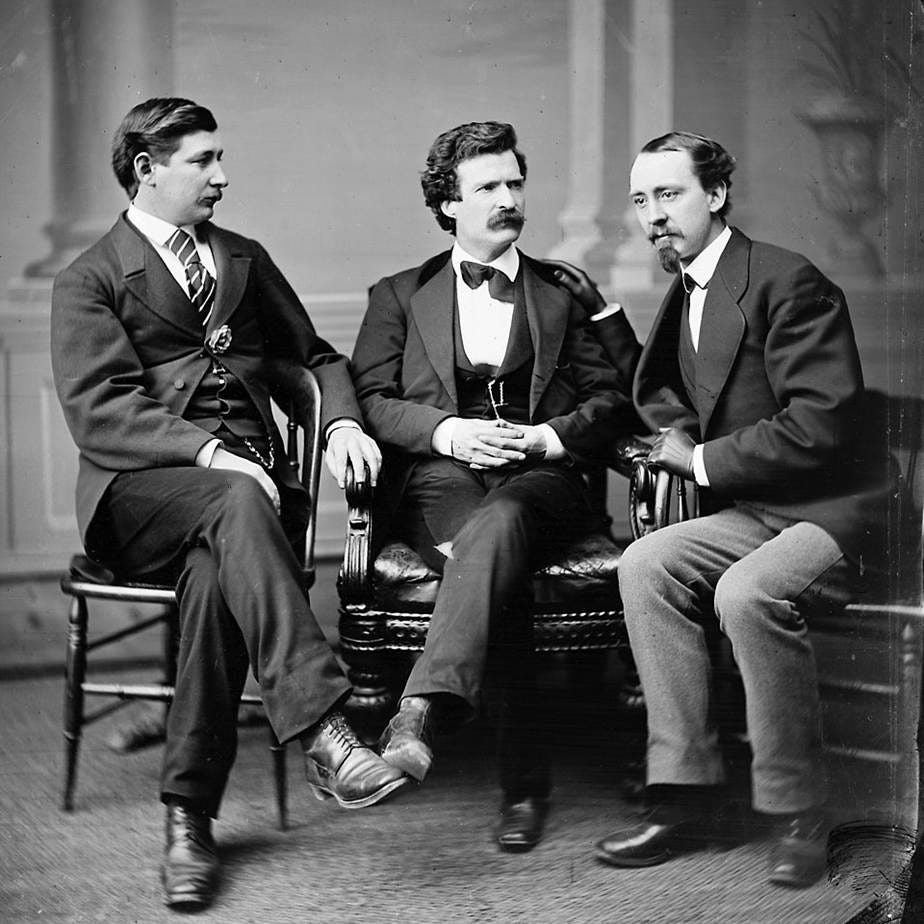
Mark Twain (Samuel Langhorne Clemens) emerged as one of the central figures of American literature, a writer whose humor, social criticism, and linguistic innovation helped define the national voice. He grew up in Hannibal, Missouri, a small Mississippi River town whose rhythms, hierarchies, and racial tensions—particularly the presence of slavery—made a lasting imprint on his imagination. After his father’s death in 1847, Twain left school to work as a printer’s apprentice, then as a typesetter and contributor for local newspapers, acquiring early familiarity with language, typography, and the mechanics of publishing.
At nineteen he traveled widely as an itinerant printer, observing American regional cultures from St. Louis to New York. In 1857, he fulfilled a long-held dream by training to become a Mississippi steamboat pilot, a profession demanding precision, memory, and intuition. He earned his pilot’s license in 1859 and later adopted the river pilot’s cry “mark twain” (“two fathoms”) as his pen name. The Civil War abruptly ended his river career when traffic on the Mississippi was suspended. After a brief, ambivalent attempt to join a Confederate militia, he fled west with his brother Orion to the Nevada Territory in 1861.
In the mining towns of Virginia City and later San Francisco, Twain reinvented himself as a journalist and satirist. His 1865 sketch, “The Celebrated Jumping Frog of Calaveras County,” brought him national recognition for its blend of frontier humor, vernacular speech, and deadpan delivery. To capitalize on his growing fame, Twain embarked on lecture tours and began transforming his travel experiences into literature. The resulting book, The Innocents Abroad (1869), a sharp and commercial success, lampooned American tourists’ encounters with European high culture and established him as a major literary figure.
Twain married Olivia Langdon in 1870 after a courtship grounded in letters and shared intellectual interests. Settling in Hartford, Connecticut, he entered his most productive period. With Livy’s editorial guidance and a stable domestic environment, Twain wrote Roughing It (1872), The Gilded Age (1873, co-authored with Charles Dudley Warner), A Tramp Abroad (1880), and his two masterpieces: The Adventures of Tom Sawyer (1876) and Adventures of Huckleberry Finn (1884). The latter, with its exploration of race, conscience, and freedom, would later be hailed as the first distinctly American novel in voice and spirit.
Twain’s prosperity, however, was undermined by a series of disastrous business decisions. His deep faith in technological progress led him to invest heavily in the Paige typesetting machine, a promising but ultimately unworkable invention. When the venture collapsed, Twain was left with massive debts. His own publishing house, Charles L. Webster & Co., also failed. Facing financial ruin, he embarked on a worldwide lecture tour (1895–1896) to repay creditors. His efforts were successful: by the end of the decade he had cleared all debts, though personal tragedy overshadowed this achievement.
The later years of Twain’s life were marked by loss and increasing pessimism. His daughter Susy Clemens died of meningitis in 1896 while he was abroad; his wife Livy died in 1904; another daughter, Jean, died in 1909. These events deepened the philosophical severity of his late writings, including Following the Equator (1897), essays against imperialism, critiques of organized religion, and the posthumously published The Mysterious Stranger, which wrestled with themes of illusion, morality, and cosmic indifference.
Twain became a global celebrity—instantly recognizable in his white suit—and a public moralist whose lectures and essays scrutinized American expansion, industrial capitalism, and human hypocrisy. He died in 1910, shortly after the return of Halley’s Comet, having famously predicted that he would “go out with it.” Today he remains a foundational figure in world literature, celebrated for his unmatched comic timing, his piercing social observation, and his shaping of an authentic American idiom.
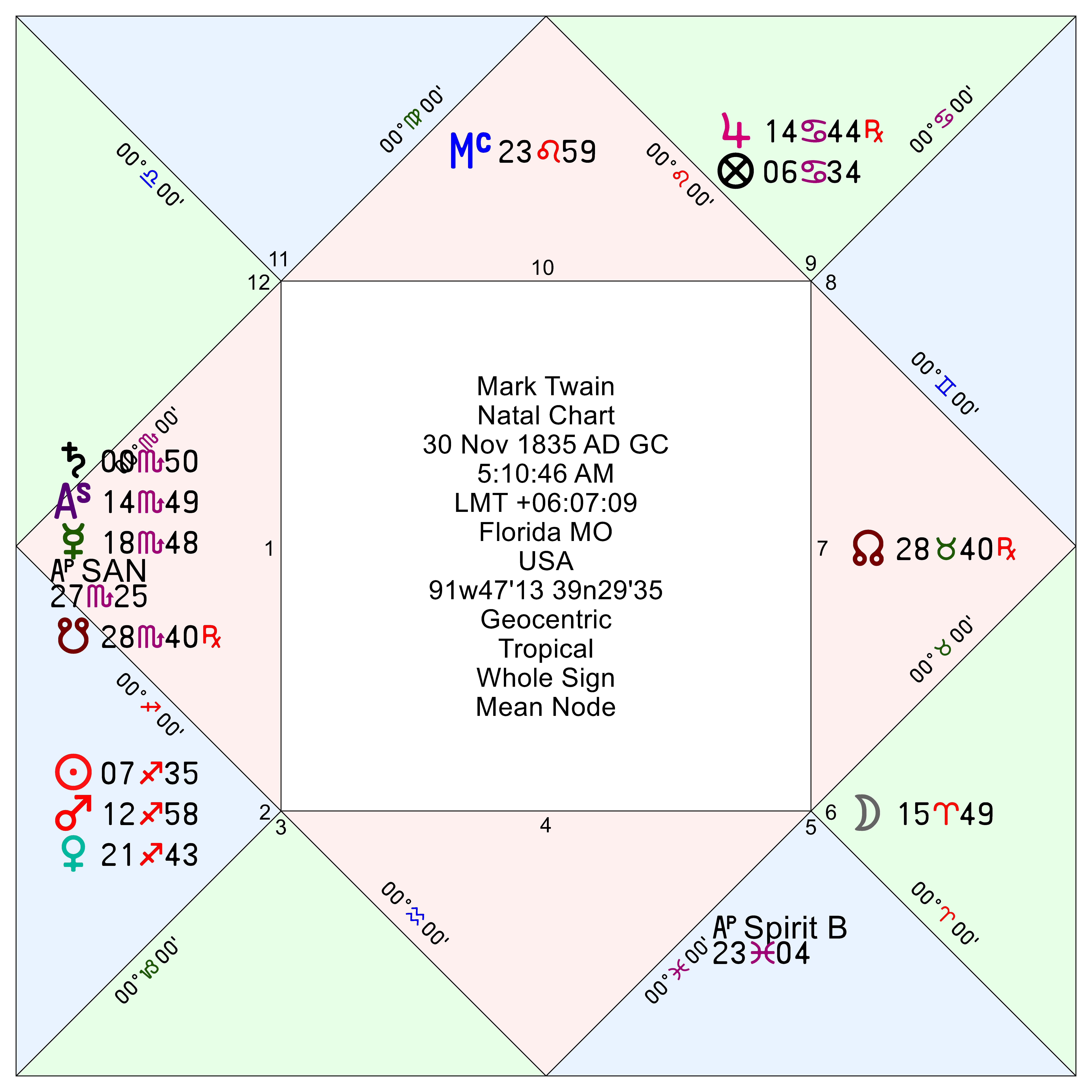
Rodden Rating C, original source not known, 4:45 AM, ASC 9SC49’32”
Proposed Rectification: 5:10:46 AM, ASC 14SC49
The analytical models used in the sections below are part of a larger research program developed across longer white papers and case studies, where the historical sources, rules, and testing methodology are laid out in full. These database entries show the models in practice; readers who want the theoretical foundations can start with the background papers below:
Rectification Hub (I wrote the book on it!)
Soul Hub (white paper, Victor model statistical tests, Moon’s Configuration studies)
Physiognomy Hub (white paper, examples)
Victor Model factors favoring Mercury/Scorpio
Bound lord: Ascendant, Midheaven, and Moon
Angular in 1st house, closely conjunct Ascendant degree
Mercury in Scorpio as victor of the horoscope signifies a mind that penetrates beneath appearances and takes little interest in official explanations. Throughout his career, Twain displayed a remarkable ability to expose pretension, hypocrisy, and human folly, whether directed at politicians, religious authorities, imperial ambitions, financial speculators, or the conventions of polite society. Mercury supplied the powers of observation and expression, while Scorpio encouraged him to look beneath the surface in search of concealed motives and uncomfortable truths. His humor was rarely content with simple entertainment; it often functioned as a tool of investigation, revealing the gap between what individuals claimed to believe and how they actually behaved. This tendency became even more pronounced in his later years, when his writings adopted a darker and more skeptical tone. Mercury in Scorpio did not merely describe the world as it appeared. It sought to uncover what was hidden behind the mask, exposing contradictions that others preferred to ignore.
Physiognomy Model factors favoring Scorpio, Cancer
Rising sign: Scorpio
Ruler of rising sign: Mars/Sagittarius
Planets in the rising sign: Saturn and Mercury in Scorpio
Rising decan: Pisces
Ruler of rising decan: Jupiter/Cancer-retrograde, partile trine to Ascendant degree
Mark Twain stood approximately 6 feet (183 cm) tall according to multiple biographical sources, making him taller than average for nineteenth-century America. Contemporary accounts frequently describe him as lean, broad-shouldered, and physically vigorous during his years as a river pilot, journalist, lecturer, and world traveler. The photographs from his middle years reveal a strongly rectangular face, prominent cheekbones, a broad forehead, and a substantial jawline. Particularly striking are the thick, luxuriant hair and large moustache that became central features of his public image. The moustache dominates the lower face, while the eyes project alertness, skepticism, and intelligence. Unlike many literary figures whose appearance softened with age, Twain retained a rugged and masculine presence that conveyed confidence, independence, and a willingness to challenge convention. Even in photographs where he is posed formally, there is an unmistakable sense of vitality and defiance.
From an astrological perspective, the physiognomy corresponds closely to Scorpio rising and the Cancer rising decan. The overall rectangular shape of the face is consistent with John Willner’s facial-sign model for Scorpio, while the thick hair and prominent moustache further reinforce the sign’s symbolism. The moustache is especially noteworthy because its broad lateral spread resembles the pincers of a scorpion, creating a visual motif frequently encountered in Scorpio physiognomies. The penetrating gaze and strong bone structure likewise contribute to the impression of intensity traditionally associated with the sign. A secondary influence appears through the Cancer rising decan. In later life Twain became famous for his white linen suits, a distinctive sartorial choice that harmonizes with Cancer’s traditional association with the color white. Together, Scorpio and Cancer produce a physiognomy that combines strength and intensity with a softer, more familiar public presentation, helping to explain how Twain could simultaneously project the image of a feared social critic and a beloved national storyteller.
Moon’s Configuration
While our primary interest is the Moon’s separation from Jupiter and application to Venus, I present the entire sweep of the Moon’s aspects during her Aries Ingress. There are no void-of-course or out-of-sign conditions in this horoscope.
Phase I – Moon in Aries (6th House)
Delineation. The Moon in Aries in the 6th house gives Twain a temperament of restless labor, impulsive work rhythms, and a tendency to expend physical and emotional energy quickly. This placement ties the body and the daily schedule to immediate action: bursts of effort, rapid change in routine, and alternating periods of feverish productivity and exhaustion. The 6th house also introduces themes of illness, overwork, and the chronic depletion that accompanies a life of constant deadlines, travel, and performance.
Biographical Match. Twain’s life shows the unmistakable imprint of a 6th-house Aries Moon. His early years included periods of ill health and exposure to the deaths of siblings, imprinting the 6th-house signature from childhood. As an adult, Twain repeatedly subjected himself to grueling workloads: intense writing binges, ceaseless lecture tours, and frenetic travel across the United States and later the globe. The Moon’s Aries impulsiveness made him a tireless worker when inspired but left him prone to burnout, nervous strain, and the cumulative physical toll of overextension. The world tour of 1895–1896, undertaken to repay bankruptcy debts, perfectly expresses the Moon’s 6th-house function: the body becomes the instrument through which mercurial creation and financial necessity are satisfied.
Phase II – Moon Trine Sun (Sagittarius, 2nd House)
Delineation. The Moon’s first application is a trine to the Sun in Sagittarius in the 2nd house, a configuration that channels vitality and visibility into financial affairs. The Sun in the 2nd signifies wealth derived from personal identity, reputation, and charismatic self-presentation. In Sagittarius, the Sun’s light is expansive, optimistic, and tied to themes of publishing, storytelling, and moral performance. The trine from the Moon indicates that Twain’s daily work, health, and physical energy are readily converted into material gain, with the Sun acting as a source of public recognition and financial reward. The ruler of the Sun is Jupiter in the 9th, linking wealth to travel, publishing, and global readership.
Biographical Match. Twain’s major earnings consistently flowed through Sun-in-Sagittarius channels: fame, performance, and authorship. His early lecture tours, the remarkable success of The Innocents Abroad, and the popular appeal of Tom Sawyer and Huckleberry Finn all reflect the Sun’s capacity to turn personality and storytelling into income. The Moon–Sun trine also describes the public’s delight in Twain’s humor; his confidence, showmanship, and philosophical warmth were as monetizable as his books. Even late in life, when debts overwhelmed him, it was the Sun in the 2nd—his fame and personal charisma—that enabled the successful world lecture tour which restored his financial standing.
Phase III – Moon Trine Mars (Sagittarius, 2nd House)
Delineation. Next, the Moon trines Mars in Sagittarius in the 2nd house, introducing volatility, impulsiveness, and loss into financial affairs. While Mars is the in-sect malefic in a nocturnal chart, Mars is close enough to the Sun to render his condition combust by traditional authorities, increasing his intemperance. Mars in the 2nd is traditionally a destroyer of wealth, especially through rash spending, poorly judged investments, or speculative ventures that appear promising but unravel. In Sagittarius, Mars does not act with stealth but with enthusiasm—grand opportunities, big ideas, and a spirit of adventure mark the financial risks. The trine from the Moon indicates that Twain’s work and health were frequently drawn into cycles of expenditure, repair, and renewed expenditure, with materially disruptive consequences.
Biographical Match. Twain’s history of financial misjudgment reflects the Mars-in-2nd symbolism almost perfectly. His speculative ventures in Nevada’s silver-mining economy were early expressions of this signature, but the most dramatic case came later with the Paige typesetting machine, into which he poured vast resources. The project appealed to Mars-in-Sagittarius enthusiasm: a technological revolution, an inspiring promise, and a belief that one bold invention could yield a fortune. Instead, it destroyed his capital. Mars also governs overgenerous instincts, and Twain’s lavish household spending—furniture, artwork, and constant improvements—further strained his finances. The Moon’s trine shows that each destructive cycle fed directly back into his 6th-house toil: the more Mars burned, the more he was forced to work, travel, and perform to make good the losses.
Phase IV – Moon Square Jupiter (Cancer, Retrograde, 9th House)
Delineation. The square to Jupiter in Cancer, retrograde, in the 9th house is the most philosophically and morally complex feature of Twain’s configuration. Jupiter in Cancer promises abundance through publishing, travel, and moral narrative, but retrograde Jupiter behaves like its opposite sign, Capricorn—linking Jupiter’s largesse to get-rich-quick schemes, pretentious elites, political corruption, and speculative overreach. The Moon’s square indicates tension between daily life (6th) and grand visions (9th): big ideas, expansive projects, and moral crusades repeatedly strain Twain’s health, finances, and work rhythms. Yet this Jupiter is the ruler of the Sun, Mars, and Venus in Sagittarius, making it the engine of the entire 2nd-house complex and the authorial imagination.
Biographical Match. Twain’s life story is inseparable from Jupiter’s 9th-house influence. His rise as a travel writer, his mastery of the lecture stage, and his global fame all bear the mark of a strong Jupiter. Yet every major crisis—failed investments, financial ruin, and the need to circle the globe to pay debts—reflects Jupiter’s retrograde Capricorn-side: large schemes that collapse under their own weight. His literary output mirrors this duality: The Gilded Age, The Prince and the Pauper, and later political essays critique the hypocrisy, corruption, and speculative mania that he personally experienced. The Moon’s square expresses how these Jupiterian forces—publishing success and speculative folly—perpetually destabilized his daily life, pulling his health and labor into the service of vast moral, financial, and imaginative undertakings.
<<Birth Moment>>
Phase V – Moon Trine Venus (Sagittarius, 2nd House)
Delineation. The Moon’s final application before leaving Aries is a trine to Venus in Sagittarius in the 2nd house, linking emotional life and daily routine to pleasure, aesthetic taste, wealth, and partnership-based income. Venus in Sagittarius is exuberant, joyful, full of humor and play; she signifies wealth through entertainment, charm, and storytelling. In the 2nd house, she spends freely on beauty—artwork, furnishing, large homes—and can create income through socially appealing or morally uplifting products. Venus rules the 7th house, where the North Node sits in Taurus in the bound of Mars, tying partnership and contracts to wealth, including partnerships that arise through illness.
Biographical Match. Venus perfectly describes Twain’s great financial highs: the joyful humor of his literature, the public’s affection for him, and the aesthetic and emotional warmth surrounding his most successful books. His Hartford home, lavishly decorated, stands as a physical embodiment of Venus in the 2nd—beauty purchased in abundance. Venus’s rulership of the 7th shows most dramatically in his contract with President Ulysses S. Grant. Through the Memoirs, Venus brought extraordinary wealth to both Twain and the Grant family; yet the Node in the bound of Mars ties this partnership to suffering—Grant’s throat cancer, the mortal condition that made the book urgent and monumental. Late in life, Venus also presides over his financial rescue: Henry Huttleston Rogers’s management (7th-house partnership) and the popularity of his lecture tour allowed Twain to pay his debts and regain stability. The Moon’s trine to Venus ensures that joy, humor, storytelling, and relationship remain the sources of financial recovery even after Mars and Jupiter have done their worst.
Interpretive Summary
Mark Twain’s Moon’s Configuration reveals a life in which daily labor (Moon/Aries/6th) is continually drawn into the orbit of financial fortune and misfortune through the planets clustered in Sagittarius in his 2nd house. The Moon’s trines to the Sun and Mars show how the same impulses that made Twain wealthy through fame, storytelling, and public charisma (Sun) also subjected him to loss through overconfidence, spendthrift habits, and speculative overreach (Mars). The square to Jupiter retrograde in Cancer anchors his entire career in the 9th house of publishing and global travel, tying moral critique, literary ambition, and catastrophic investments together in a single cycle of expansion and collapse. Finally, the Moon’s trine to Venus in Sagittarius brings joy, humor, charm, and partnership-based fortune, culminating in the immense success of Grant’s Memoirs and the late-life rescue facilitated by friends and admirers. The entire chain complements Mercury/Scorpio and Saturn/Scorpio positioned in the rising sign: a writer’s mind and a satirist’s eye directing a life where work, wealth, and worldly experience continually fuel the mercurial vocation.
Influence of Sect
The figure is nocturnal, placing Venus in-sect and Jupiter out-of-sect. Venus in-sect softens the financial volatility shown elsewhere in the horoscope by ensuring that opportunities for recovery repeatedly emerge through publishing, personal relationships, and the public’s enduring affection for Twain’s work. Even after severe financial reversals, benefactors, successful books, lecture tours, and ventures such as the publication of Grant’s Memoirs restored both his finances and reputation. Jupiter, by contrast, operates out-of-sect, increasing the intemperance of its naturally expansive character. Rather than limiting Twain’s success as an author or lecturer, it encouraged excessive confidence in speculative investments, ambitious business ventures, and grand financial schemes that repeatedly exceeded prudent judgment. The result was a life marked by alternating cycles of extraordinary literary success and self-inflicted financial crisis, with Jupiter remaining the engine of both his greatest triumphs and his most costly mistakes.
Early/Late Bloomer thesis
The early/late bloomer thesis holds that individuals born under a waxing Moon—between the New Moon and the Full Moon—tend to establish the core of their identity, career, and public role in the first half of life, while those born under a waning Moon tend to blossom later. Mark Twain, born with a waxing Aries Moon only a few days before the Full Moon, should therefore be an early bloomer, and the evidence strongly supports this. He lived 74 years, making the midpoint of his lifespan roughly age 37, and nearly all of the decisive events that shaped his persona and career occurred before or very near that threshold. By his early thirties he had already worked as a Mississippi river pilot, forged his satirical voice in the Nevada and California newspapers, attained national fame with the 1865 “Jumping Frog” story, and achieved international success with The Innocents Abroad. By age thirty-five he had married Olivia Langdon, moved into the Hartford circle that nourished his best work, and set the tone and direction for the masterpieces of his forties. In every respect, Twain’s major breakthroughs and the formation of his enduring public identity took place well before midlife, perfectly matching the prediction of the early bloomer profile indicated by his waxing Moon.
AI Notice: This post created with assistance from ChatGPT.
Complete biographical chronology, rectification and time lord studies available in Excel format as a paid subscriber benefit. Files are behind the paywall.