

Mark Zuckerberg enters the Tech Bros series from a somewhat different direction. Unlike several of the figures examined previously, he does not require a prominent planet in Aquarius to establish the Aquarian theme. Instead, the Lot of Fortune is in Aquarius, placed in the 7th house of partnerships, agreements, opponents, and legal conflict. Zuckerberg has encountered plenty of difficulty in this area—from the Winklevoss/ConnectU dispute that accompanied Facebook’s beginnings to later confrontations with regulators and other adversaries—but he has generally emerged with his control of the company and its central assets intact. The placement of Fortune suggests that partnerships and conflicts with others, however contentious, have repeatedly worked to his ultimate advantage.
The horoscope also contains what might be called the social-media signature: Venus/Gemini. Venus signifies friendship, attraction, relationships, and social exchange; Gemini supplies communication, information, and networks. Zuckerberg has the North Node in Gemini in the 11th house of friends, placed in the bound of Venus/Gemini. It is difficult to imagine a more concise description of Facebook’s original proposition: use a communications network to connect friends, then allow that network to expand almost without limit. What began among Harvard students eventually became an infrastructure through which billions of people maintain relationships, exchange information, and construct public versions of themselves.
But neither Aquarius nor Venus/Gemini provides the principal key to Zuckerberg’s horoscope. That belongs to Mercury, the victor, appropriately enough for a programmer whose career has been built upon code, communications, networks, and information systems. Zuckerberg’s famous early Facebook motto, “Move fast and break things,” turns out to be an unusually literal description of his Mercury placement. Why it describes both the extraordinary speed of Facebook’s development and the problems that repeatedly followed that development requires looking more closely at Mercury’s sign, bound, and house position.
That Mercury also provides a useful thread connecting the Zuckerberg of 2004 with the Zuckerberg of today. Facebook began as a rapidly coded college social network; two decades later Meta is committing enormous resources to large language models, AI assistants, data-center infrastructure, and AI-enabled glasses. The technologies have changed, but the underlying emphasis upon information, communication, programming, and rapid technological deployment has not. The horoscope helps explain both the continuity—and why Zuckerberg’s latest turn toward artificial intelligence may be more characteristic of him than the metaverse project that preceded it.
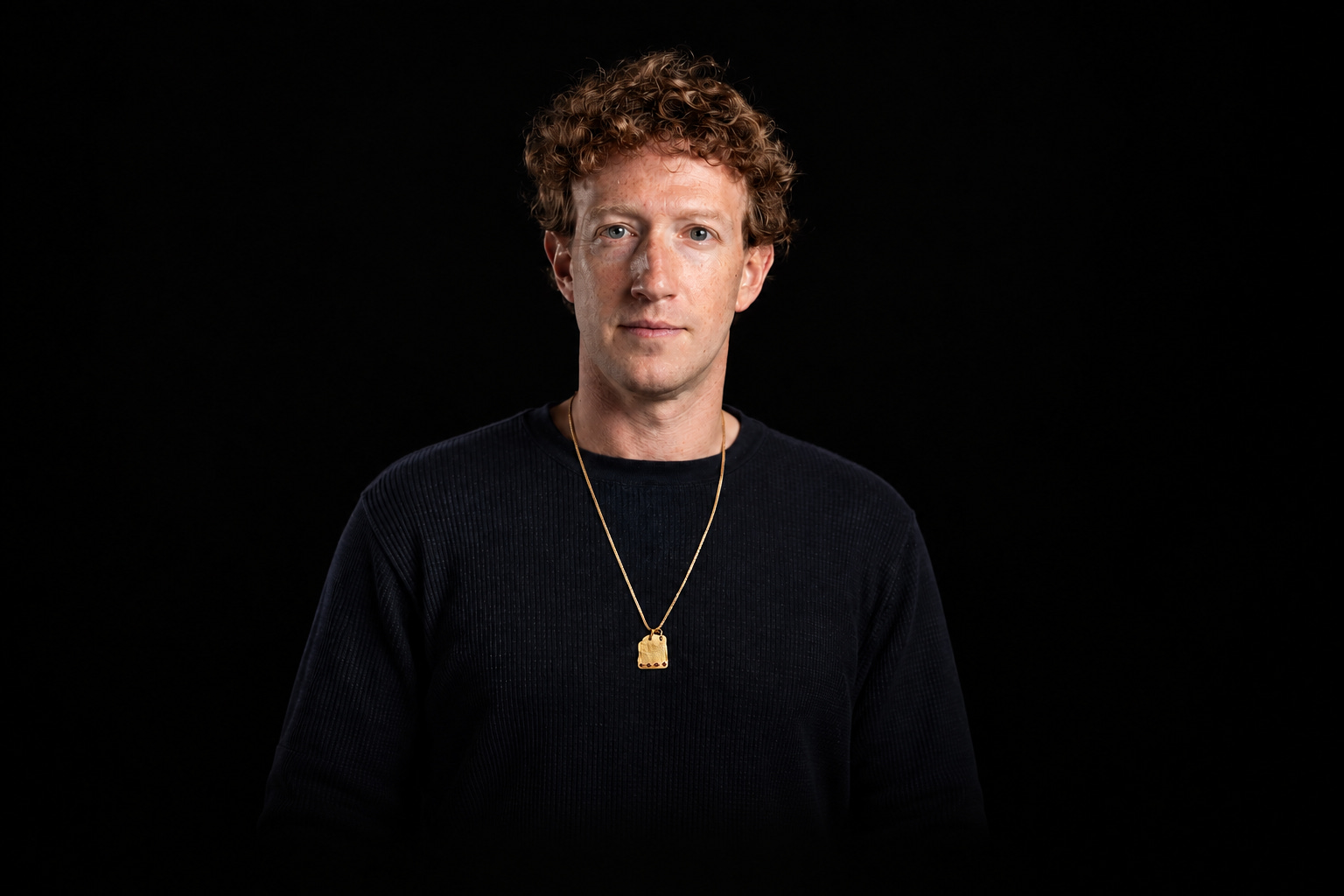
Mark Elliot Zuckerberg was born on 14 May 1984 in White Plains, New York, and grew up in nearby Dobbs Ferry. His father, Edward Zuckerberg, was a dentist and his mother, Karen Kempner, a psychiatrist. An early interest in computers developed into programming: while still a child, Zuckerberg created ZuckNet, a messaging system connecting computers in the family home with his father’s dental office. As a teenager he developed Synapse Media Player, music software that reportedly attracted interest from AOL and Microsoft.
Zuckerberg entered Harvard University in 2002 to study computer science and psychology. The university provided both the setting and the raw material for the project that would define his life. In 2003 he created CourseMatch, followed by Facemash, a site that invited Harvard students to compare the attractiveness of fellow students using photographs obtained from university directories. Facemash generated immediate attention but also complaints over privacy and unauthorized use of photographs, bringing Zuckerberg before Harvard’s Administrative Board.
At roughly the same time, Cameron and Tyler Winklevoss and Divya Narendra recruited Zuckerberg to work on HarvardConnection, a proposed campus social network later renamed ConnectU. Zuckerberg instead developed his own project. On 4 February 2004, he launched TheFacebook from his Harvard dormitory room. Within weeks it expanded beyond Harvard to other universities, and that summer Zuckerberg left for Palo Alto, where Facebook established its headquarters. Peter Thiel provided an early $500,000 investment, while Sean Parker, the co-founder of Napster, became an important early adviser.
The circumstances surrounding Facebook’s creation produced a dispute that followed Zuckerberg for years. The ConnectU founders accused him of delaying their project while developing a competing network using ideas and information obtained through their collaboration. Litigation began in 2004 and eventually ended in a settlement reached in February 2008, reportedly worth about $65 million in cash and Facebook shares. Subsequent attempts by the ConnectU founders to overturn the agreement failed.
Meanwhile Facebook expanded at extraordinary speed. It moved from universities to high schools and workplaces before opening to the general public in September 2006. Features such as Photos, the Wall, News Feed, photo tagging and the Like button gradually transformed it from an online directory into an environment in which users documented their relationships and everyday lives. Sheryl Sandberg joined as chief operating officer in 2008 and helped develop the advertising business that converted Facebook’s enormous audience into profits.
By July 2010 Facebook had 500 million users. Zuckerberg had also become a cultural figure independent of the company. The Social Network, released that October, presented a dramatized and largely unflattering account of Facebook’s creation; two months later, TIME named the twenty-six-year-old Zuckerberg its Person of the Year.
Facebook filed for its initial public offering in February 2012. In April it agreed to acquire Instagram for approximately $1 billion, and on 18 May Facebook began trading publicly at a valuation exceeding $100 billion. The following day Zuckerberg married his longtime girlfriend, Priscilla Chan, whom he had met at Harvard. Facebook subsequently acquired WhatsApp for approximately $19 billion in 2014 and Oculus VR for about $2 billion, extending Zuckerberg’s control over several of the largest communications platforms while beginning his investment in virtual reality.
Zuckerberg and Chan later had three daughters: Maxima, August and Aurelia. Following Maxima’s birth in December 2015, they announced the Chan Zuckerberg Initiative, pledging eventually to direct most of their Facebook wealth toward philanthropy. Its activities have concentrated on science, education and community initiatives.
As Facebook grew, however, the collection and use of personal information became increasingly controversial. Questions over privacy, political advertising, misinformation and content moderation intensified following the 2016 U.S. election. The Cambridge Analytica disclosures of 2018 produced one of the largest crises in Facebook’s history after it emerged that data associated with tens of millions of users had been obtained through a third-party application and subsequently used for political purposes. Zuckerberg testified before Congress in April 2018, and the following year Facebook agreed to a $5 billion privacy settlement with the Federal Trade Commission. Later controversies over moderation, political content and internal research reinforced a persistent tension in Zuckerberg’s creation: a system designed to connect people had also accumulated an immense quantity of information about them.
By then Zuckerberg was already looking beyond the conventional social network. Facebook had acquired Oculus in 2014, but during the early 2020s he elevated virtual and augmented reality into the company’s central long-term strategy. On 28 October 2021, Facebook Inc. became Meta Platforms. Zuckerberg argued that the “metaverse”—persistent digital environments experienced through virtual and augmented reality—would become the successor to mobile computing.
The commitment was expensive. Meta poured billions of dollars annually into Reality Labs while products such as Horizon Worlds struggled to achieve widespread adoption. The $1,499 Quest Pro, introduced in October 2022, received a substantial price cut less than five months later. At the same time, slowing growth in Meta’s established businesses contributed to a severe retrenchment. Zuckerberg eliminated more than 11,000 jobs in November 2022 and another 10,000 positions in 2023 as part of what he called the “Year of Efficiency.”
Artificial intelligence then began to alter the direction of the company.
Meta released the first LLaMA large-language model in February 2023, followed by Llama 2 in July. Unlike the predominantly closed models developed by several competitors, Meta made Llama weights broadly available to researchers and developers under its licensing terms. Subsequent generations expanded the strategy: Llama 3 arrived in April 2024, followed by the 405-billion-parameter Llama 3.1 that July. By the end of 2024, Meta reported that Llama and its derivatives had been downloaded more than 650 million times.
AI also supplied a possible bridge between Zuckerberg’s newer ambitions and the enormous social infrastructure he had already built. Meta AI was incorporated into Facebook, Instagram, Messenger and WhatsApp, while the company’s partnership with EssilorLuxottica brought AI directly into Ray-Ban smart glasses. Rather than requiring users to retreat into a virtual world, AI-enabled glasses could accompany them through the physical one—seeing and hearing aspects of the user’s surroundings and responding through a conversational assistant. Meta’s current filings still describe augmented and virtual reality as part of a future computing platform, but increasingly characterize that ecosystem as powered by AI.
The competition intensified in 2025. After Meta’s AI program encountered setbacks, Zuckerberg personally became heavily involved in recruiting researchers and reorganizing the effort. In June Meta made a $14.3 billion investment in Scale AI and recruited its founder, Alexandr Wang, to lead a new AI organization. Zuckerberg subsequently consolidated the effort into Meta Superintelligence Labs, with Wang serving as chief AI officer and former GitHub chief executive Nat Friedman taking a major role in AI products and applied research.
On 30 July 2025 Zuckerberg gave the strategy a broader philosophical formulation: “personal superintelligence.” Rather than envisioning superintelligent AI primarily as a centralized system that automates human labor, Zuckerberg argued that it should be placed in the hands of individuals to help them create, communicate, pursue personal goals and increase their own capabilities. He specifically connected this vision to wearable devices—particularly glasses able to see and hear what their users experience.
The argument echoes an older theme in Zuckerberg’s career. Facebook began as an exclusive Harvard network but progressively dismantled its barriers until virtually anyone could participate. Meta similarly presented Llama as a model ecosystem that could be widely used by developers rather than confined entirely within the company. Zuckerberg now describes superintelligence in comparable terms: not simply as a corporate resource, but as technology that should increase the capabilities of individual users. Whether Meta can deliver that vision remains uncertain, but the company has committed enormous resources to the attempt.
By 2026 Meta was describing itself as building the physical and financial infrastructure for the next decade of computing, including data centers, energy systems and global connectivity required for frontier AI. Zuckerberg has simultaneously resisted proposals for a coordinated industry-wide slowdown in advanced AI development, arguing that individual laboratories have incentives and responsibilities to develop their systems safely; in September 2026 he cited Meta’s own decision to delay an AI agent for additional security work as an example.
More than two decades after creating Facebook in a Harvard dormitory, Zuckerberg therefore finds himself pursuing a second attempt to define the dominant interface between people and computers. The first connected billions of people through profiles, photographs, messages and networks of friends. The current project is more ambitious: combining artificial intelligence, social platforms and wearable computing into systems intended to accompany individuals throughout their daily lives. Zuckerberg remains Meta’s founder, chairman and chief executive, responsible for its overall direction, product strategy and core technological development.
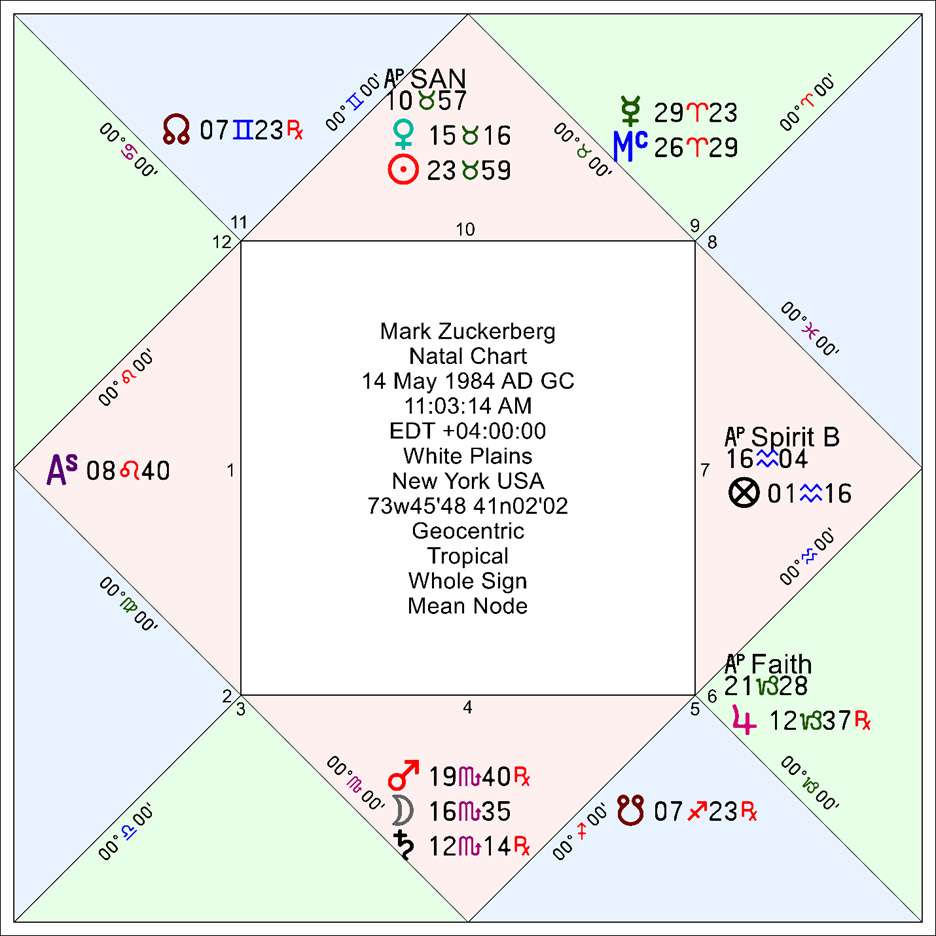
Rodden Rating X. Date w/o time.
Proposed Rectification: 11:03:14 AM, ASC 8LE40’26”
Permission: I grant the unlimited use of this rectified horoscope by the public. Credit ‘Regulus Astrology LLC’ and include an accompanying link to this webpage.
The analytical models used in the sections below are part of a larger research program developed across longer white papers and case studies, where the historical sources, rules, and testing methodology are laid out in full. These database entries show the models in practice; readers who want the theoretical foundations can start with the background papers below:
Rectification Hub (I wrote the book on it!)
Soul Hub (white paper, Victor model statistical tests, Moon’s Configuration studies)
Physiognomy Hub (white paper, examples)
Victor Model Factors favoring Mercury/Aries
Bound ruler: Moon, Lot of Fortune, Prenatal Syzygy
Position: within 3 degrees of MC degree, next planet to meed MC by primary motion
Mercury/Aries is the victor of Zuckerberg’s horoscope, placed at 29°23′ Aries in the 9th house by whole sign and the 10th by quadrant houses. The placement describes the programmer, entrepreneur, and information architect whose career was built through code, communications, and the rapid deployment of new technologies. Zuckerberg’s original Facebook motto, “Move fast and break things,” is an unusually literal expression of this Mercury. Aries is the cardinal fire sign associated with speed, initiative, competition, and the physical type of the track athlete—“move fast.” Mercury is also placed in the bound of Saturn/Aries, where Saturn is poorly equipped to exercise command and control. The result is not Saturn actively breaking things, but insufficient Saturnian restraint, oversight, and structure to prevent things from breaking as Mercury/Aries moves at speed. The 9th-house placement is equally descriptive: Facebook originated at Harvard, where Zuckerberg transformed a college programming project into the foundation of his career. By quadrant houses Mercury moves into the 10th, carrying the same Mercurial activities—programming, networks, information systems, and technological experimentation—directly into his profession and public reputation.
Physigonomy Model Factors favoring Leo
Rising sign and rising decan: Leo
Ruler of rising sign and rising decan: Sun/Taurus
Physically, Zuckerberg is of medium height and compact-to-medium build, with a relatively straight, upright carriage and a torso that appears proportionate rather than elongated. Contemporary full-body photographs show fairly square shoulders, a narrow waist, straight limbs, and a generally balanced frame; an early New Yorker profile similarly described him as of “medium build” and noted his conspicuously upright posture. The face is comparatively long but strongly structured: a broad, fairly rectangular forehead, straight sides through the upper face, prominent nose, moderately high cheekbones, and a firm, squared lower jaw and chin. The most distinctive feature in recent photographs is the dense, curly hair, which substantially enlarges and rounds the outline of the head when allowed to grow.
The physiognomy significator is Leo, both the rising sign and the rising decan. In John Willner’s model, Leo produces the rectangular facial type, which accords reasonably well with Zuckerberg’s broad forehead, relatively straight facial sides, and defined lower face. The hair supplies the more immediately recognizable Leo signature: when grown out, its thick curls spread outward around the head, visually mimicking the rays of the Sun, the ruler of Leo. This solar quality is less apparent in older photographs in which Zuckerberg kept his hair cropped close, but becomes conspicuous in his more recent appearance; it provides a useful physical confirmation of Leo rising independent of the biographical rectification.
Moon’s Configuration
Stage I — Moon Separates from Venus
Moon 16°35′ Scorpio separating from Venus 15°16′ Taurus
Delineation. The Moon separates from an opposition with Venus, placing relationship, attraction, popularity, social connection, aesthetics, and the desire to bring people together immediately behind the Moon. Venus is exceptionally strong by domicile in Taurus and occupies the 10th house, giving these Venusian subjects public and professional importance. Yet Venus is out of sect, while the opposition indicates that what attracts people can simultaneously provoke disagreement over social boundaries. Because the Moon is otherwise surrounded by Mars and Saturn in Scorpio, its separation from a strong benefic also provides an important mitigation: the Moon is not simply besieged by the malefics. Venus supplies the attractive and socially connective principle that repeatedly gives Zuckerberg’s more difficult Scorpio placements something productive to build around.
Biographical Match. Facebook itself is the clearest expression. Zuckerberg built his career around friendship, photographs, relationships, popularity, “likes,” and the presentation of identity to other people. Facemash provides an unusually literal early manifestation: directed Venus reached the MC as Zuckerberg created a website devoted specifically to judging physical attractiveness. But the out-of-sect Venus and opposition describe the problem embedded in the idea—the Venusian subject was pursued in a manner that violated prevailing expectations concerning privacy and consent. The same tension followed Facebook on a much larger scale: its ability to attract people and encourage them to share their lives became inseparable from controversies concerning what happened to the personal information they supplied.
Stage II — Moon Applies to Mars
Moon 16°35′ Scorpio applying to Mars 19°40′ Scorpio
Delineation. After separating from Venus, the Moon applies to Mars in Scorpio. Mars is exceptionally strong by domicile and, although retrograde, is at acronycal rising; under the method used here, it therefore behaves substantially according to its direct-motion expression. The sequence is significant: Venus attracts and connects; Mars introduces competition, conflict, aggression, rupture, and the struggle for control. Both the Moon and Mars occupy the 4th house, placing the conflict at the foundations of the life rather than making it merely incidental to later success. Mars also rules the 9th house containing Mercury, the victor, connecting the conflict directly with Zuckerberg’s college years, programming, and the creation of Facebook.
Biographical Match. The sequence appears almost immediately. Zuckerberg develops a socially attractive product at Harvard, but its creation becomes entangled with the Winklevoss twins and Divya Narendra, who alleged that he delayed work on HarvardConnection while developing his competing network. The resulting ConnectU litigation began in 2004 and continued through settlement and subsequent challenges for years. The pattern subsequently recurred on a larger scale as Facebook’s success generated conflicts over privacy, data ownership, competition, regulation, and responsibility for what occurred on the platform. The Cambridge Analytica crisis is a particularly strong later expression: the social network’s enormous Venusian attraction had produced an equally enormous repository of personal information, and disputes over the control and use of that information became one of the defining conflicts of Zuckerberg’s career. Facebook ultimately paid a record $5 billion FTC privacy penalty in 2019, and litigation arising from the episode continued years later.
Stage III — Full Moon Debility
Full Moon with the Moon within the Sun’s bond
The Full Moon adds a separate debility to the configuration. Its fundamental problem is polarization: Sun and Moon stand opposed, creating two competing positions that can become locked against one another. Rather than allowing the native to pivot as circumstances change, the Full Moon can preserve the opposition until it becomes a standoff. The individual becomes “stuck” between two alternatives, continuing to expend effort on a conflict that cannot readily be reconciled. It can also produce overextension at culmination, difficulty retreating from a publicly established position, and a tendency for problems to become highly visible before they can be corrected. With the Moon additionally within the Sun’s bond, its independent capacity to respond to circumstances is further impaired.
This may describe one of Zuckerberg’s recurring weaknesses: once a large conceptual framework has been established, he can remain committed to it beyond the point at which others believe a change of course is warranted. The metaverse is the clearest example. Zuckerberg elevated it into Meta’s defining corporate strategy, renamed the company around the concept, and committed enormous resources to Reality Labs even as adoption lagged expectations and criticism mounted. The problem was not an absence of technical intelligence—the Mercurial side of the horoscope is exceptionally effective—but difficulty reconciling two opposing realities: the technological future Zuckerberg believed should emerge and the behavior consumers were actually demonstrating. The Full Moon can therefore help explain why some Zuckerberg projects leave observers puzzled: a powerful initial conception becomes polarized against external resistance, producing a standoff in which changing direction is more difficult than continuing forward. His eventual pivot toward AI is particularly interesting because it may represent not abandonment of the original objective, but an attempt to resolve the impasse by giving the same glasses and wearable-computing strategy a different technological foundation.
Influence of Sect
Because the horoscope is diurnal, Jupiter and Saturn are the in-sect benefic and malefic, giving their significations greater scope and allowing their effects to operate broadly through society. Jupiter at 12°37′ Capricorn is retrograde in the 6th house and approaching its station direct; until that transition, it functions according to the opposite-sign behavior of Jupiter/Cancer. Rather than reinforcing Capricornian hierarchy and established class structures, this Jupiter favors a more populist philosophy of inclusion, community, and broadly distributed access. Facebook’s progression from an exclusive Harvard network to a communications platform available to virtually anyone fits this symbolism, as does Zuckerberg’s later preference for making Meta’s Llama models broadly available rather than restricting advanced AI entirely to closed systems. In sect, Jupiter gives these ideas social reach: the underlying proposition is that communications and technological capabilities should be extended across large populations.
Saturn at 12°14′ Scorpio is also retrograde, but is far enough from acronycal rising to function in its flipped-sign position of Taurus. When direct, Saturn/Scorpio manages security, secrecy, boundaries, and control of access to sensitive information. For Zuckerberg, however—as confirmed by events timed by Saturn solar arc directions to the ASC and MC (available for paid subscribers to review in the paywalled workbook)—Saturn/Scorpio retrograde functions like Saturn/Taurus, undermining the foundations of the images and personal information central to social media platforms. Saturn also rules the 7th house of opponents and conflict, connecting these issues with regulatory authorities, lawsuits, and other parties challenging Meta’s control or use of information. As the in-sect malefic, Saturn’s difficulties are not necessarily eliminated; rather, they acquire enormous scope, becoming questions of privacy, data security, platform governance, and institutional responsibility debated across society. By contrast, Venus and Mars are out of sect, reducing the breadth of their influence while tending to pervert their effects within the narrower areas where they operate. Venus produces attraction, friendship, and popular social products but also violations of privacy, consent, and accepted social boundaries; Mars produces competitive drive and decisive action but also litigation, hostility, and conflict. Sect thus separates the planets into two levels: Jupiter and Saturn describe large societal consequences of Zuckerberg’s work, while Venus and Mars operate more narrowly but with greater potential for distortion and trouble.
Complete biographical chronology, rectification and time lord studies available in Excel format as a paid subscriber benefit. File is behind the paywall.