

Niccolò Machiavelli is remembered today as the great anatomist of political power — the man who stripped away the moral language of kingship and examined the state as it actually functioned beneath the surface. Yet the horoscope suggests that Machiavelli did not arrive at this realism naturally. Rather, it emerged from progressive disillusionment with the political class of Renaissance Italy itself. His chart closes the long-running Jupiter in Cancer series explored on this Substack, but with an important modification: Machiavelli’s Jupiter occupies the final four degrees of Cancer, the bound of Saturn/Cancer, where Jupiter’s normal promise of civic morality, humane governance, and political cohesion becomes compromised by fear, corruption, dynastic struggle, and institutional decay.
This distinction matters because few figures lived more directly inside the machinery of diplomacy, negotiation, and statecraft than Machiavelli. During his career he traveled among popes, princes, ambassadors, military commanders, and ruling families, observing the political systems of Renaissance Europe at close range. In a pure Jupiter/Cancer expression, such experiences might have strengthened faith in moral governance and civic order. Instead, Machiavelli’s horoscope repeatedly points toward the collapse of those ideals. The political world he encountered was dominated not by virtue, but by hidden enemies, unstable alliances, dynastic self-interest, and military weakness — themes deeply consistent with Jupiter ruling both the 3rd and 12th houses while placed in Saturn’s melancholic bound.
The Moon’s configuration captures this intellectual evolution with unusual precision. The Moon first separates from Jupiter in Cancer, symbolizing gradual alienation from the ruling elites and diplomatic institutions he once served. After changing signs into Aquarius, the Moon applies to a square of Saturn in Taurus near the foundation of the chart, directing the life toward harsher realities of territorial insecurity, political collapse, exile, and ultimately the destruction of the Italian political order itself. The result is a figure who increasingly abandons comforting theories about morality and government in favor of strategic realism grounded in force, necessity, and survival.
At the center of the horoscope stands a powerful Mercury in Gemini functioning as victor of the chart, overcome by Mars in Pisces. This is not the signature of a contemplative philosopher removed from public life, but of a political diagnostician whose intellect became inseparable from warfare, strategy, military organization, and the mechanics of state survival. Machiavelli’s writings on militias, coercion, diplomacy, and political necessity emerge directly from this Mercury-Mars dynamic. In the pages that follow, we will examine how the horoscope describes not only Machiavelli’s career and writings, but the broader collapse of Renaissance Italy that shaped the birth of modern political realism itself.
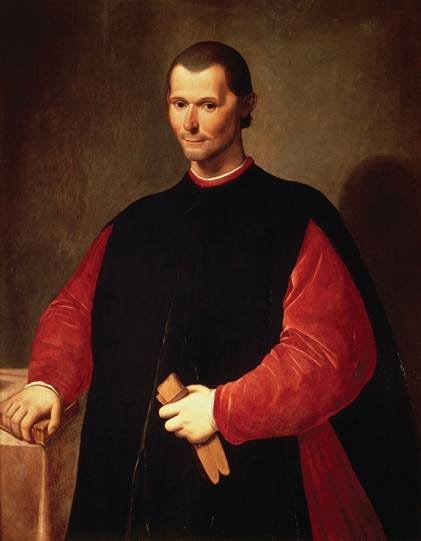
Niccolò Machiavelli stands at the dividing line between the medieval and modern worlds. A diplomat, historian, playwright, political theorist, and civil servant of the Florentine Republic, he became one of the first major European thinkers to describe politics not as moral theology, but as the struggle for power among ambitious and often dangerous human beings. Long before modern political science existed, Machiavelli examined states the way a physician studies disease: by observing what rulers actually do rather than what philosophers say they ought to do. His reputation eventually became so controversial that his name entered the language itself. To call someone “Machiavellian” came to mean cunning, manipulative, ruthless, and strategically deceptive. Yet this later caricature often obscures the complexity of the man himself.
He was born in Florence on May 3, 1469, into an old but financially diminished family. Machiavelli later summarized his childhood with characteristic bluntness: “I was born in poverty and at an early age learned how to endure hardship rather than flourish.” His father, Bernardo Machiavelli, was a lawyer with intellectual interests and possessed a modest library containing classical Roman historians, philosophers, and works of Italian history. Through this environment Machiavelli absorbed the literature that would shape his political imagination for the rest of his life. Livy, Tacitus, Plutarch, and Thucydides became permanent reference points in his thought. Unlike many Renaissance humanists who admired antiquity primarily for moral refinement or literary elegance, Machiavelli admired the ancients for their understanding of conflict, military organization, ambition, and civic power.
Florence during Machiavelli’s youth was unstable, wealthy, artistic, and politically violent. The city oscillated between republican government, oligarchic rule, and Medici domination. Foreign powers increasingly intervened in Italian affairs, especially France and Spain, while the Papacy acted less like a spiritual authority and more like another territorial state competing for influence. The collapse of older medieval structures convinced Machiavelli that Italy’s political weakness stemmed not from bad fortune alone, but from institutional fragility, military dependence on mercenaries, and the inability of rulers to adapt to changing circumstances.
His political career began in 1498 shortly after the dramatic fall and execution of the Dominican reformer Girolamo Savonarola. Savonarola had attempted to transform Florence into a Christian republic governed by religious austerity and prophetic fervor. His downfall left a vacuum in government, and Machiavelli, then only twenty-nine years old, was appointed secretary to the Florentine Republic’s Second Chancery and the Ten of War. The position placed him at the center of diplomacy and military administration for the next fourteen years.
These years shaped Machiavelli more profoundly than any university education could have done. He traveled widely on diplomatic missions across Europe and Italy, observing kings, generals, popes, and mercenary captains at close range. He visited the court of King Louis XII in France, met Emperor Maximilian I in Germany, and repeatedly dealt with the Papal court in Rome. Most important was his encounter with Cesare Borgia, the son of Pope Alexander VI. Borgia attempted to carve out a centralized state in central Italy through calculated brutality, deception, military efficiency, and political theater. Machiavelli admired neither his morality nor his cruelty for their own sake, but rather his effectiveness. Borgia became the living example behind many passages in The Prince: a ruler capable of acting decisively in a world where hesitation often meant destruction.
At the same time, Machiavelli became obsessed with military reform. He believed the Italian states had grown weak because they depended upon mercenaries who lacked loyalty and courage. One of his proudest accomplishments was helping organize a Florentine citizen militia that successfully assisted in the reconquest of Pisa in 1509. He later declared it “the finest thing that had ever been arranged for Florence.” The issue was not merely military but political: republics survived only when citizens themselves were willing to defend them.
Everything collapsed in 1512 when Spanish-backed Medici forces returned to power in Florence. The republic fell, Machiavelli was dismissed from office, accused of conspiracy, imprisoned, and tortured repeatedly using the strappado, in which a prisoner was suspended by ropes tied behind the back and violently dropped. In prison he wrote bitterly of the ordeal, remarking that “so the poets are treated.” Although eventually released, he was exiled from political life and sent to his small farm outside Florence at Sant’Andrea in Percussina.
This political ruin unexpectedly produced his greatest intellectual achievements. Cut off from public office, Machiavelli entered a period of intense literary productivity. In letters he described spending the day in rough country clothes arguing with peasants and innkeepers, then changing into formal garments at night to converse spiritually with the ancient authors in his study. During these years he wrote The Prince, the Discourses on Livy, The Art of War, plays such as Mandragola, and eventually the Florentine Histories.
The Prince, probably written in 1513 and later dedicated to the Medici, was partly an attempt to regain employment. Machiavelli openly admitted he hoped to make himself “useful to our Medici lords.” Yet the work became far more than a job application. It argued that rulers must learn “how not to be good” when circumstances require it. Politics, he insisted, could not be governed solely by Christian morality because states exist in conditions of insecurity, violence, and competition. Men, he wrote, are “wicked at bottom unless they are made good by some compulsion.”
Several of Machiavelli’s formulations became among the most famous political aphorisms in Western history. It is “safer to be feared than loved” if a ruler cannot be both. Injuries should be inflicted all at once, benefits distributed gradually. Armed prophets succeed while unarmed prophets fail. Such statements scandalized later readers because Machiavelli seemed to separate politics from morality entirely. Yet his deeper concern was stability. Cruelty, if unavoidable, should be swift and limited rather than endless and chaotic. Weakness, indecision, and sentimental idealism could produce even greater suffering.
Despite his reputation, Machiavelli was not simply an advocate of tyranny. In the Discourses on Livy, many scholars find a stronger expression of his true political sympathies. There he praised republican government, civic participation, institutional conflict, and the Roman Republic as a model of political vitality. Unlike medieval thinkers who saw conflict as destructive, Machiavelli argued that tension between social classes could strengthen a state by preventing stagnation. Conflict, properly managed, generated energy, adaptability, and liberty.
His later years were marked by partial reconciliation with the Medici. By 1519 he again received minor governmental assignments and intellectual commissions, including the writing of the Florentine Histories. He participated in the discussions of the Rucellai Gardens, where Florentine intellectuals debated politics, philosophy, and classical history. Yet his political position remained precarious. Republicans distrusted him for cooperating with the Medici, while the Medici never fully trusted the former republican secretary.
Machiavelli died in Florence on June 21, 1527, only weeks after the catastrophic Sack of Rome by mutinous imperial troops shocked Europe and symbolized the collapse of Renaissance Italy. The timing carried tragic irony. Throughout his life Machiavelli had warned that Italy’s divisions, military weakness, and dependence on foreign powers would eventually produce disaster. Few listened seriously while he lived.
Much of Machiavelli’s modern fame emerged only after his death. During the later sixteenth century his writings spread across Europe and rapidly became objects of fascination, fear, and condemnation. In 1564 the Catholic Church placed his works on the Index of Prohibited Books. Counter-Reformation writers portrayed him as a teacher of atheism, fraud, and political evil. Protestant polemicists associated him with corruption and moral decay. Even many readers who had never opened The Prince came to believe Machiavelli advocated treachery for its own sake.
His posthumous reputation entered literature as well as politics. Shakespeare’s villains repeatedly invoke “Machiavel” as a symbol of manipulation and cunning. In Henry VI, Part III, the future Richard III boasts that he can “set the murderous Machiavel to school.” The character of Iago in Othello later embodied many of the traits associated with the stereotype of the calculating Machiavellian schemer. By the seventeenth century, “Machiavel” had become almost a stock dramatic figure representing cold political intelligence detached from morality.
Yet the persistence of his influence reveals something deeper than notoriety. Modern political thinkers continued returning to Machiavelli because he confronted permanent realities of political life: ambition, fear, public opinion, military force, institutional weakness, fortune, and the instability of states. Philosophers as different as Thomas Hobbes, Jean-Jacques Rousseau, Friedrich Nietzsche, and Antonio Gramsci all wrestled with his legacy. Some viewed him as a patriot and republican, others as a cynic or proto-authoritarian realist. The ambiguity itself helps explain his enduring power.
Today Machiavelli remains difficult to classify neatly. He admired republican liberty but also strong rulers. He condemned corruption but accepted deception as politically necessary. He wrote elegant comedies while analyzing torture, conspiracy, and war with clinical detachment. More than almost any Renaissance thinker, he forced later generations to confront the uncomfortable possibility that politics obeys its own laws — laws often indifferent to conventional morality, yet impossible to ignore.
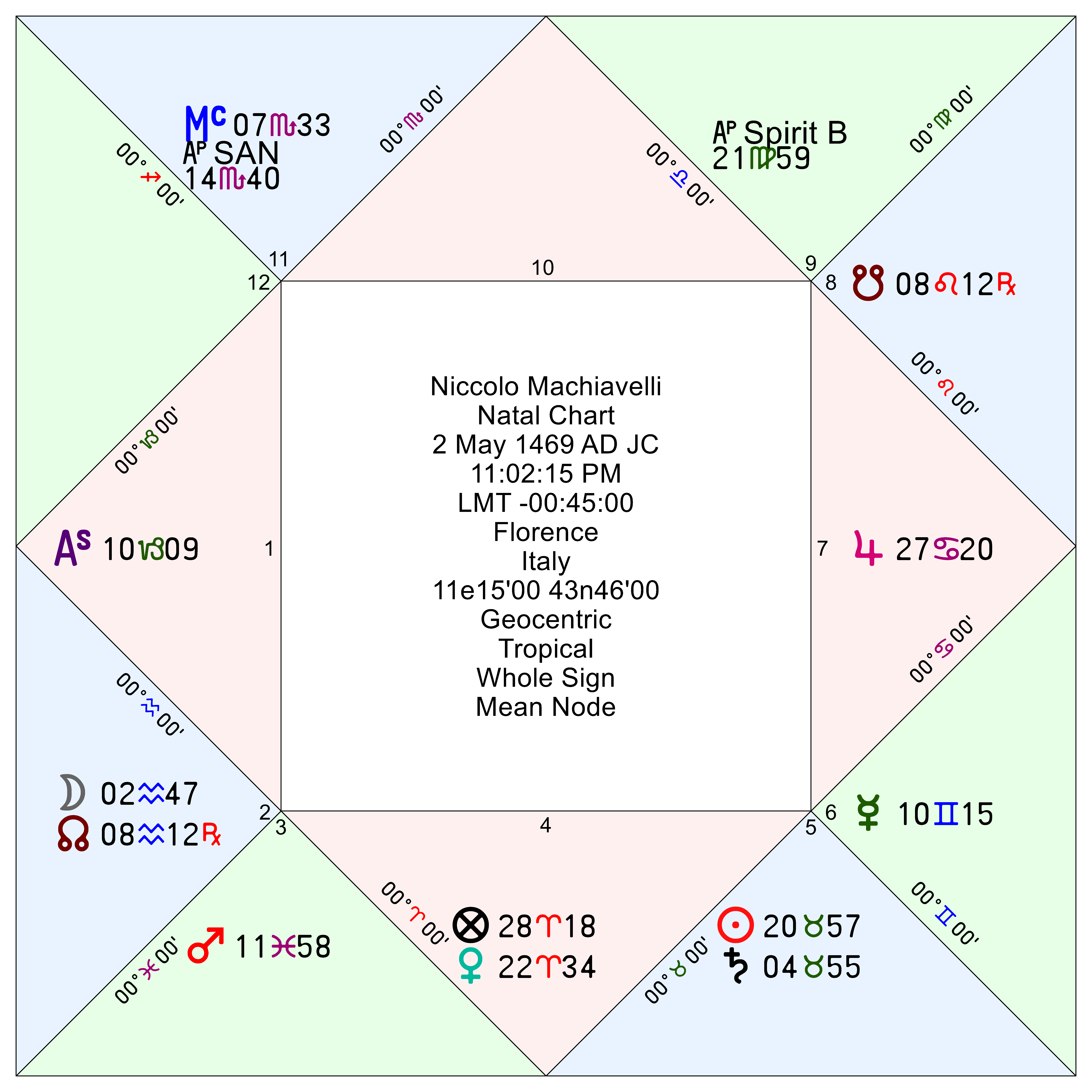
Rodden Rating AA, BC/BR in hand, 11:07 PM, ASC 11CP22
Proposed rectification: 11:02:15 PM, ASC 10CP08’54”
Complete biographical chronology, rectification and time lord studies available in Excel format as a paid subscriber benefit.
The analytical models used in the sections below are part of a larger research program developed across longer white papers and case studies, where the historical sources, rules, and testing methodology are laid out in full. These database entries show the models in practice; readers who want the theoretical foundations can start with the background papers below:
Rectification Hub (I wrote the book on it!)
Soul Hub (white paper, Victor model statistical tests, Moon’s Configuration studies)
Physiognomy Hub (white paper, examples)