

Paul Allen, co-founder of Microsoft, is the latest subject in our Tech Bros series and provides an appropriate introduction to our examination of Bill Gates next Wednesday. Although Gates became the more publicly recognized of the two founders, Allen played a central role in developing Microsoft’s early software products and securing the business agreements that established the company’s commercial success. Following his departure from Microsoft in 1983, Allen pursued an independent career as an investor, owner of professional sports franchises, patron of scientific research, and financier of aerospace technology. His involvement in private spaceflight also anticipated the commercial space tourism ventures associated with Jeff Bezos and Richard Branson. In 2004, Allen-financed SpaceShipOne became the first privately funded crewed spacecraft to reach space and subsequently won the Ansari X Prize, establishing a technological foundation for Virgin Galactic years before Bezos personally flew aboard Blue Origin’s New Shepard in 2021.
The proposed rectifications of Allen and Gates reveal a notable astrological resemblance: both have Cancer rising and the Moon in Aries in the tenth whole-sign house. Yet their respective Moons apply to different malefics. Gates’s Moon applies to Mars, while Allen’s Moon applies to Saturn. Mars and Saturn are traditional planetary enemies, and their contrasting influences suggest an underlying source of conflict between two men whose shared enthusiasm for computer programming initially brought them together. Gates’s Mars signifies a more aggressive, competitive approach to business, while Allen’s Saturn emphasizes institutional stability, rules, and the obligations of partnership. Their eventual rupture over Microsoft’s ownership and management illustrates how these opposing planetary influences could become incompatible despite their considerable intellectual affinity.
Explore the complete collection of natal horoscope studies of mathematicians, scientists, and technology leaders in the Math, Science, and Technology Index.

Paul Gardner Allen was born on 21 January 1953 in Seattle, Washington. His father, Kenneth Allen, was a librarian at the University of Washington, while his mother, Edna Faye Allen, was a schoolteacher. Encouraged by his parents to pursue his intellectual interests, Allen developed an early fascination with science, technology, and music. In 1965, he enrolled at Lakeside School, where he met Bill Gates in 1968. Their shared enthusiasm for computer programming led to a lifelong association that would transform the computer industry.
Allen and Gates established Traf-O-Data in 1971, a venture that developed software for processing traffic data. Allen subsequently attended Washington State University but left without graduating, eventually taking a programming position with Honeywell in Boston. In late 1974, Allen recognized the commercial possibilities of the Altair 8800 microcomputer and persuaded Gates to collaborate on a BASIC programming language for the machine. Their work led to the founding of Microsoft on 4 April 1975, with Gates receiving 60% ownership and Allen 40%. In February 1977, Gates renegotiated the arrangement to 64–36, a change Allen reluctantly accepted and later recalled with considerable resentment.
Allen played a central role in Microsoft’s early technological development, including BASIC and the Z-80 SoftCard, which enabled Apple II computers to run software written for the CP/M operating system. He also helped identify and acquire the operating system that became MS-DOS, supplying the foundation for Microsoft’s agreement with IBM and the introduction of the IBM Personal Computer in August 1981.
Microsoft’s extraordinary commercial success was accompanied by growing tension between its founders. In September 1982, Allen was diagnosed with Hodgkin’s lymphoma and underwent radiation treatment. Several months later, he overheard Gates and Steve Ballmer discussing ways to reduce his Microsoft ownership because of his diminished participation in the company. Deeply offended, Allen resigned from executive management on 18 February 1983, retaining his substantial equity interest. Microsoft’s public offering in March 1986 made him one of America’s wealthiest individuals.
Allen subsequently established Vulcan Inc. to manage his growing portfolio of investments and philanthropic activities. His interests ranged from software and telecommunications to professional sports, entertainment, scientific research, and aerospace technology. He purchased the Portland Trail Blazers in 1988 and financed construction of the $262 million Rose Garden arena, which opened in October 1995. The project combined private financing with municipal support and gave the franchise a modern home.
In 1997, Allen purchased the Seattle Seahawks, preventing the franchise from relocating to California. He made the acquisition conditional on obtaining a new stadium to replace the aging Kingdome and financed the campaign for a statewide referendum authorizing a public-private financing arrangement. Washington voters narrowly approved the measure on 17 June 1997. The Kingdome was demolished on 26 March 2000, clearing the site for a $430 million football and soccer stadium and exhibition center. Allen led the $130 million private financing commitment and agreed to cover construction cost overruns. The new Seahawks Stadium opened on 20 July 2002, providing Seattle with a modern professional sports facility. Allen subsequently joined the ownership group that established Seattle Sounders FC, which began Major League Soccer play in 2009 and shared the stadium with the Seahawks. Under his ownership, the Seahawks won Super Bowl XLVIII in February 2014, while the Sounders captured their first MLS Cup in December 2016.
Not all his investments succeeded. Beginning in 1998, Allen committed billions of dollars to Charter Communications, envisioning a nationwide broadband network. Rapid acquisitions, extensive borrowing, management disputes, and deteriorating financial conditions eventually culminated in Charter’s Chapter 11 bankruptcy in March 2009. Its subsequent reorganization eliminated approximately $8 billion of corporate debt and largely extinguished Allen’s ownership position.
Among Allen’s most celebrated achievements was financing SpaceShipOne, the privately developed spacecraft designed by Burt Rutan. On 4 October 2004, SpaceShipOne won the $10 million Ansari X Prize after completing two qualifying crewed flights into space. The technology subsequently provided the foundation for Richard Branson’s Virgin Galactic venture. On 5 October 2005, Allen formally presented SpaceShipOne to the Smithsonian National Air and Space Museum in Washington, D.C., an occasion he described as among the proudest of his life. He later established Stratolaunch Systems in 2011 to develop an enormous carrier aircraft capable of launching rockets from high altitude.
Allen devoted an increasingly substantial portion of his fortune to scientific research. He founded the Allen Institute for Brain Science in 2003, followed by the Allen Institute for Artificial Intelligence and the Allen Institute for Cell Science in 2014. These organizations emphasized ambitious, interdisciplinary research and the public availability of scientific data. His other philanthropic interests included environmental conservation, education, public health, and humanitarian relief.
Music remained another lifelong passion. An enthusiastic guitarist and admirer of Jimi Hendrix, Allen performed with several bands, amassed an extensive collection of musical memorabilia, and financed the Experience Music Project, which opened in Seattle in June 2000. His interests also extended to film production, art collecting, ocean exploration, and the restoration of historic aircraft.
Allen never married and had no children. In 2009, he was diagnosed with non-Hodgkin’s lymphoma, a distinct illness from the Hodgkin’s lymphoma he had survived in 1982. Following successful treatment, he entered remission in 2010. The disease returned in 2018, and he died in Seattle on 15 October 2018, aged 65. His estate and principal philanthropic interests subsequently came under the administration of his sister, Jody Allen.
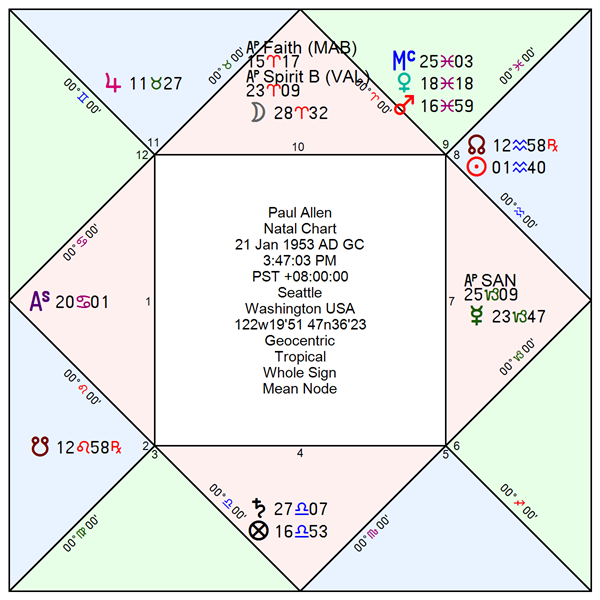
No Astrodatabank Record
Proposed Rectification: 3:47:03 PM, ASC 20CA01’46”
Permission: I grant the unlimited use of this rectified horoscope by the public. Credit ‘Regulus Astrology LLC’ and include an accompanying link to this webpage.
The analytical models used in the sections below are part of a larger research program developed across longer white papers and case studies, where the historical sources, rules, and testing methodology are laid out in full. These database entries show the models in practice; readers who want the theoretical foundations can start with the background papers below:
Rectification Hub (I wrote the book on it!)
Soul Hub (white paper, Victor model statistical tests, Moon’s Configuration studies)
Physiognomy Hub (white paper, examples)
Big Three (Sun sign = Aquarius, Moon sign = Aries, Rising sign = Cancer)
Victor Model Factors favoring Mercury/Capricorn
Bound ruler: Sun
House placement: 7th from the Ascendant and 4th from the Lot of Fortune
Mercury/Capricorn is proposed as the victor of Paul Allen’s diurnal horoscope. Mercury’s placement in the seventh whole-sign house is particularly appropriate for a man whose fortune originated in business partnerships, commercial negotiations, and licensing agreements involving computer software. Allen’s collaboration with Bill Gates established Microsoft, while subsequent agreements with MITS, Apple, IBM, and other computer manufacturers transformed programming languages and operating systems into extraordinarily profitable commercial products. Mercury/Capricorn signifies methodical, rational reasoning and the practical application of technical knowledge, precisely the qualities Allen demonstrated in developing BASIC, conceiving the Z-80 SoftCard, and recognizing the commercial potential of MS-DOS. The seventh-house placement also captures the difficulties of partnership: Gates’s successive demands for a larger ownership share and the eventual rupture that ended Allen’s active involvement with Microsoft. The counterfactual test further supports Mercury as victor. Removing events governed by Mercury’s major and minor Firdaria periods eliminates not only Microsoft’s formative years but also later technological undertakings, including Interval Research and Stratolaunch. Jupiter/Taurus supplied the capacity to accumulate and deploy enormous financial resources, while Saturn/Libra contributed institutional structure and public standing. Nevertheless, Mercury/Capricorn best explains the distinctive intellectual and commercial activities that established Allen’s historical identity.
Physiognomy Model Factors favoring Taurus, Cancer, Pisces
Rising sign: Cancer
Ruler of rising sign: Moon/Aries
Rising decan: Pisces
Ruler of rising decan: Jupiter/Taurus
Planets in sign of rising decan: Mars/Pisces and Venus/Pisces
Paul Allen presents a broad, full face with a soft rectangular shape, high forehead, low cheeks, and an absence of prominent bony structure. The jawline is gently rounded rather than sharply angular, while the cheeks and lower face exhibit considerable fullness. His nose is relatively broad, although neither the nose nor lips are disproportionately large. The overall impression is of a substantial, fleshy face with softened contours rather than the lean, sharply defined rectangle associated with Scorpio. His body is similarly broad and heavyset, with a thick neck and rounded shoulders. The facial structure bears a notable resemblance to George H. W. Bush, particularly in the high forehead, broad upper face, and softly rectangular outline.
The proposed rectification places the Ascendant in the third decan of Cancer, corresponding to Pisces, whose ruler Jupiter is positioned in Taurus. According to the rising-decan physiognomy model, Jupiter/Taurus supplies the underlying soft rectangular facial structure, characterized by a high forehead, low cheeks, and relatively little visible bone definition. However, Allen’s face is considerably fuller than a pure Taurus type because both Cancer, the rising sign, and Pisces, the rising decan, contribute additional roundness and fleshiness. This combination explains why the face retains a rectangular foundation while appearing unusually soft and full through the cheeks and lower jaw. George H. W. Bush provides a useful comparison: his proposed Virgo Ascendant in the first decan is ruled by Mercury/Taurus, producing a similar underlying facial structure despite a different rising sign and planetary ruler. Thus, both examples illustrate the importance of the sign placement of the rising-decan ruler, while the Ascendant and rising decan modify the resulting physiognomy.
Moon’s Configuration
1. Moon Separates from Mercury (Capricorn, 7th)
Delineation: The Moon at 28AR32 in the tenth house separates from a square with Mercury at 23CP47 in the seventh house. The configuration begins with Mercury/Capricorn, signifying methodical reasoning, programming, and the practical application of technical knowledge. Mercury’s placement in the seventh house emphasizes business partnerships, contracts, and commercial negotiations. The square suggests that intellectual and commercial accomplishments arise through demanding work, competition, and disagreements with business associates.
Biographical Match: Allen’s career began with computer programming and his partnership with Bill Gates. Together they developed BASIC and founded Microsoft, transforming technical expertise into a highly profitable software business. Allen subsequently helped develop the Z-80 SoftCard and acquire the operating system that became MS-DOS. Yet the partnership was frequently contentious, particularly over Gates’s demands for larger ownership interests. Mercury/Capricorn describes both the practical intelligence that established Allen’s fortune and the contractual disputes that ultimately contributed to his departure from Microsoft.
2. Moon Separates from Saturn (Libra, 4th)
Delineation: The Moon next separates from an opposition with Saturn at 27LI07 in the fourth house. Saturn is exalted in Libra, signifying the establishment of durable institutions, adherence to rules, fair judgment, and the responsible exercise of authority. Its fourth-house placement emphasizes permanent foundations, buildings, real estate, and matters concerning the end of life or the end of an undertaking. Saturn also rules the eighth house of death, introducing the possibility of life-threatening illness, mortality, and profound personal loss. The Moon’s opposition to Saturn suggests tension between personal independence and the demands of duty, authority, and enduring obligations. Although Saturn’s exaltation provides the capacity to establish lasting institutions and administer fair judgments, it does not eliminate the planet’s more difficult significations of illness, separation, and endings.
Biographical Match: Saturn/Libra finds a particularly striking expression through primary directions. Saturn directed to the IC coincided with Allen’s diagnosis of Hodgkin’s lymphoma in September 1982 and his departure from Microsoft in February 1983. As ruler of the eighth house of death, Saturn signifies the potentially fatal illness, while its direction to the fourth-house cusp, traditionally associated with the end of matters, corresponds to the termination of Allen’s active career at Microsoft. Before the development of modern cancer treatments, Hodgkin’s lymphoma carried a substantially greater risk of death, making Allen’s survival an important part of this correspondence. Saturn’s exaltation in Libra also finds expression in Allen’s subsequent establishment of enduring institutions. He financed the Rose Garden arena for the Portland Trail Blazers and the new Seattle Seahawks stadium, negotiating complex public-private agreements and securing voter approval. His scientific research institutes were similarly designed to continue their work beyond his lifetime. Saturn/Libra also signifies fair judgment and institutional accountability, illustrated by the disciplinary and legal controversies involving Trail Blazers players. Together, these events express Saturn’s association with mortality, endings, permanent foundations, institutional authority, and the rule of law.
3. Moon Changes Signs from Aries to Taurus
Delineation: After separating from Saturn, the Moon leaves Aries and enters Taurus, the sign of its exaltation. This marks a substantial change in the configuration. Aries signifies initiative, competition, pioneering activity, and the determination to establish oneself through personal effort. Taurus, by contrast, emphasizes stability, material security, accumulation, comfort, and the enjoyment of established resources. The Moon’s entrance into exaltation suggests a transition from strenuous activity toward greater personal independence and the freedom to pursue one’s own interests.
Biographical Match: Allen’s departure from Microsoft in February 1983 provides a compelling illustration. His early career had been dominated by the demanding, competitive environment of software development and his increasingly difficult relationship with Gates, whose natal Moon is also in Aries. Following his diagnosis of Hodgkin’s lymphoma and the deterioration of their partnership, Allen withdrew from Microsoft’s daily operations while retaining his substantial ownership interest. The company’s subsequent public offering secured his financial independence. Rather than continuing to compete for corporate authority, Allen increasingly devoted his resources to activities he personally valued: scientific research, professional sports, music, art, aerospace exploration, and philanthropy. The Moon’s passage from Aries into exalted Taurus describes the movement from entrepreneurial struggle toward material security and the enjoyment of an independently directed life.
4. Moon Applies to the Sun (Aquarius, 7th/8th)
Delineation: Having entered Taurus, the Moon applies to a square with the Sun at 1AQ40, positioned near the boundary of the seventh and eighth houses. The Sun signifies public recognition, authority, and the establishment of an enduring reputation. Aquarius emphasizes scientific inquiry, technological innovation, and institutions organized around collective objectives. The eighth-house connection introduces the financing of large enterprises through accumulated capital, investments, and shared financial resources. Significantly, the Sun occupies the bound of Mercury/Aquarius. Thus, Mercury governs both the beginning and the conclusion of the Moon’s Configuration: the Moon first separates from Mercury/Capricorn and ultimately applies to the Sun in Mercury’s bound. This reinforces Mercury’s importance as the proposed victor of the horoscope.
Biographical Match: Allen’s mature career transformed the wealth accumulated through Microsoft into scientific and technological enterprises that brought him substantial public recognition. He financed SpaceShipOne, which won the Ansari X Prize in October 2004, and subsequently presented the spacecraft to the Smithsonian National Air and Space Museum, an occasion he considered among the proudest of his life. He later founded Stratolaunch Systems and established research institutes devoted to brain science, artificial intelligence, and cell science. These undertakings depended upon Allen’s financial resources but remained fundamentally technological and scientific in purpose. The Sun/Aquarius describes the public recognition earned through these achievements, while Mercury’s bound rulership returns the configuration to the intellectual interests that originally distinguished Allen. His fortune was created through software, but his lasting reputation extended to the financing of scientific discovery and technological innovation.
Influence of Sect
Paul Allen’s horoscope is diurnal, placing Jupiter/Taurus and Saturn/Libra in-sect, while Venus/Pisces and Mars/Pisces are out-of-sect. Jupiter/Taurus signifies the accumulation and deployment of substantial resources, while exalted Saturn/Libra signifies durable institutions, public authority, and the enforcement of rules. Both planets functioned prominently throughout Allen’s life. Venus/Pisces, although exalted, is out-of-sect and finds expression in Allen’s extensive cultural interests, particularly music, art collecting, and entertainment, as well as the personal relationships that sometimes proved difficult to sustain. Mars/Pisces, also out-of-sect, rules the fifth house of recreation, entertainment, and competitive sports. Its unfavorable influence is particularly evident in Allen’s ownership of the Portland Trail Blazers, whose numerous player misconduct scandals earned the franchise the notorious nickname “Jail Blazers.” The team’s deteriorating reputation alienated fans, contributed to declining attendance, and coincided with severe financial difficulties, culminating in the 2004 bankruptcy of the Rose Garden arena operating company. Mars/Pisces thus describes the contentious and financially destructive side of Allen’s otherwise successful involvement in professional sports. Both out-of-sect planets also figured prominently in transits associated with Allen’s departure from Microsoft and episodes of serious illness, although these events require separate examination of their timing and circumstances.
Early/Late Bloomer Assessment
Paul Allen was born after a New Moon, predicting an early bloomer. He lived approximately 66 years, placing the midpoint of his life at age 33, or late 1985. By that time, Allen had co-founded Microsoft, helped develop BASIC and MS-DOS, participated in the IBM PC revolution, and accumulated the equity that would make him one of America’s wealthiest individuals. Although he left Microsoft’s executive management in 1983 following his first battle with lymphoma, his defining contribution to the computer industry had already been completed before the midpoint of his life.
The second half of Allen’s life was nevertheless productive and remarkably varied. He purchased the Portland Trail Blazers and Seattle Seahawks, financed professional sports stadiums, invested in telecommunications, supported the development of SpaceShipOne and Stratolaunch, and established research institutes devoted to brain science, artificial intelligence, and cell science. Several of these achievements, particularly SpaceShipOne, were personally more satisfying to Allen than his earlier work at Microsoft. Yet the financial resources that enabled these activities originated in the software business he established during the first half of his life. The early-bloomer thesis is therefore supported, with qualifications. Allen’s historical identity and financial independence were established before his lifespan midpoint, while the second half was devoted to deploying that wealth across a wider range of technological, scientific, cultural, and commercial interests.
Complete biographical chronology, rectification and time lord studies available in Excel format as a paid subscriber benefit. File is behind the paywall.