

Paul Volcker entered the chairmanship of the Federal Reserve at a moment when inflation in the United States had moved beyond policy error into something closer to a systemic condition. By the late 1970s, the problem was no longer episodic but entrenched in expectations, sustained by wage demands, fiscal expansion, and a regulatory framework unable to impose discipline. In the language developed across this series, inflation is best understood as a Sagittarius phenomenon—expansive, self-reinforcing, and resistant to moderation once it gains momentum. Volcker did not create these conditions. He inherited them at their peak, following the drift of the Burns era and the administrative interlude of G. William Miller, where the tools of monetary control proved either politically constrained or structurally ineffective. His significance lies not in diagnosis, but in resolution—in taking a system defined by excess and forcing it back within limits.
The horoscope reflects this mandate. The Moon at 29° Sagittarius in the 10th house, conjunct the South Node and placed in the bound of Mars, describes a public environment dominated by runaway expansion under pressure. With the Moon ruling the 6th house, the symbolism flows directly into the wage–cost spiral that defined 1970s inflation, where labor demands fed aggregate demand in a cycle that became increasingly difficult to arrest. The South Node removes restraint, while Mars injects urgency, producing a condition that is not merely inflationary but excessive to the point of instability. Volcker’s role emerges from this configuration: not to fine-tune policy, but to break a system that had lost its internal limits.
The mechanism by which this occurs is equally visible. The Moon separates from Mars in Virgo in the 8th house, pointing to demand-push pressure applied to a leveraged financial system, and then applies—after changing signs—to the square of Jupiter in Aries, retrograde, which functions as victor of the horoscope. Mars supplies the force: the compression of demand through aggressive tightening, the willingness to apply pressure to a fragile system. Jupiter supplies the style: unilateral, directive, and institutional in its authority. These are not sequential but simultaneous expressions of the same policy. The October 6, 1979 “Saturday Night Special”—the Federal Reserve’s abrupt shift in operating procedure—was timed by both Mars activation and Jupiter direction, reflecting this fusion of action and authority. The result is a policy that works on two levels at once: it suppresses domestic inflation while simultaneously exporting stress into the global system, culminating in the Latin American debt crisis.
Volcker’s tenure thus marks the point at which Sagittarius excess meets its limit. Where earlier policy accommodated expansion, his imposed contraction. Where inflation had been allowed to propagate through wages, demand, and credit, it was forcibly reversed through a combination of Mars-driven pressure and Jupiter-defined authority. The outcome was not without cost—deep recession, financial dislocation, and political backlash—but it achieved what had eluded his predecessors: the restoration of credible limits to a system that had lost them.
Subscribe for complete access to model discussion for the victor, physiognomy, Moon’s Configuration, influence of sect, and the early/late bloomer thesis.
Complete biographical chronology, rectification and time lord studies available in Excel format as a paid subscriber benefit.

Paul Volcker was a Federal Reserve Chairman whose tenure came at a moment when U.S. monetary policy faced a loss of credibility and a deeply entrenched inflation problem. Appointed Chairman of the Federal Reserve by Jimmy Carter in August 1979—just days after Carter’s nationally televised “malaise” address—Volcker inherited an American economy beset by entrenched inflation, weak credibility, and policy drift dating back to the “guns and butter” fiscal expansion of the 1960s and the politically constrained monetary policies of Arthur Burns. Prices were rising at double-digit rates, and expectations of inflation had become embedded in both markets and public psychology.
Volcker’s response was radical by the standards of the time. Rather than directly targeting interest rates, he shifted the Fed’s operating procedure toward controlling the growth of money supply—an approach influenced by monetarist thinking associated with Milton Friedman. In practice, this allowed interest rates to rise to whatever level was necessary to restrain inflation. The result was a dramatic tightening of financial conditions: the federal funds rate surged, at times exceeding 20% in 1981. This policy framework gave Volcker a degree of political insulation—rates were not the stated target, but the consequence of enforcing monetary discipline—yet the economic pain was immediate and severe.
The tightening triggered the deep recession of 1981–1982, the most severe downturn since the Great Depression. Unemployment climbed above 10%, industrial production contracted sharply, and interest-sensitive sectors such as housing and construction collapsed. Volcker became a lightning rod for public anger; protests were common, and in one vivid episode, unemployed construction workers mailed pieces of lumber to the Federal Reserve in symbolic protest. Yet the policy achieved its objective: inflation, which had exceeded 13% in 1980, was decisively broken, and the long-term credibility of U.S. monetary policy was restored. By the time Volcker stepped down in 1987 under Ronald Reagan, he had reestablished the Federal Reserve as an institution willing to impose short-term pain to secure long-term stability.
Volcker’s intellectual and professional trajectory foreshadowed this defining role. Born in Cape May, New Jersey, and raised in Teaneck, he was the son of a municipal administrator whose career in public service left a lasting imprint on his values. His imposing physical presence—standing 6 feet 7 inches tall—was matched by a reserved demeanor and a reputation for personal frugality. After undergraduate study at Princeton University, where he wrote a senior thesis on postwar Federal Reserve policy, Volcker continued his education at the London School of Economics, comparing U.S. and British central banking systems. This early academic focus effectively set the course for his life’s work.
His career unfolded almost entirely within public institutions. After early roles at the Federal Reserve Bank of New York and the U.S. Treasury, Volcker rose to prominence as Under Secretary of the Treasury for Monetary Affairs, where he played a key role in the 1971 decision to suspend the dollar’s convertibility into gold—effectively ending the Bretton Woods system. A brief period in the private sector at Chase Manhattan Bank in the late 1960s stands as the exception in an otherwise public-service career that spanned decades.
After leaving the Federal Reserve, Volcker became a trusted figure for complex, high-stakes assignments requiring independence and credibility. He helped broker settlements between Holocaust survivors and Swiss banks over dormant accounts, chaired oversight bodies including the International Accounting Standards Board, and led investigations into corruption in the United Nations’ Oil-for-Food Program. His name later became synonymous with the “Volcker Rule,” a key provision of post-2008 financial reforms designed to restrict proprietary trading by commercial banks and reduce systemic risk.
Volcker’s personal life reflected the same themes of discipline and reserve that marked his public career. He was first married to Barbara Bahnson, with whom he had two children, Janice and James; Bahnson struggled with chronic illness and died in 1998. In 2010, Volcker married his longtime assistant, Anke Dening. Throughout his life, he maintained a reputation for modest living, intellectual seriousness, and an almost old-fashioned sense of duty—traits that, in an era of increasing financial complexity and political pressure, gave him unusual authority.
In sum, Volcker’s legacy rests on a single, decisive achievement: he broke the back of inflation at a moment when doing so required not just technical skill but institutional courage. In restoring credibility to the Federal Reserve, he reshaped the boundaries of central banking, establishing a precedent that monetary authorities must sometimes act against both political pressure and public opinion to secure long-term economic stability.
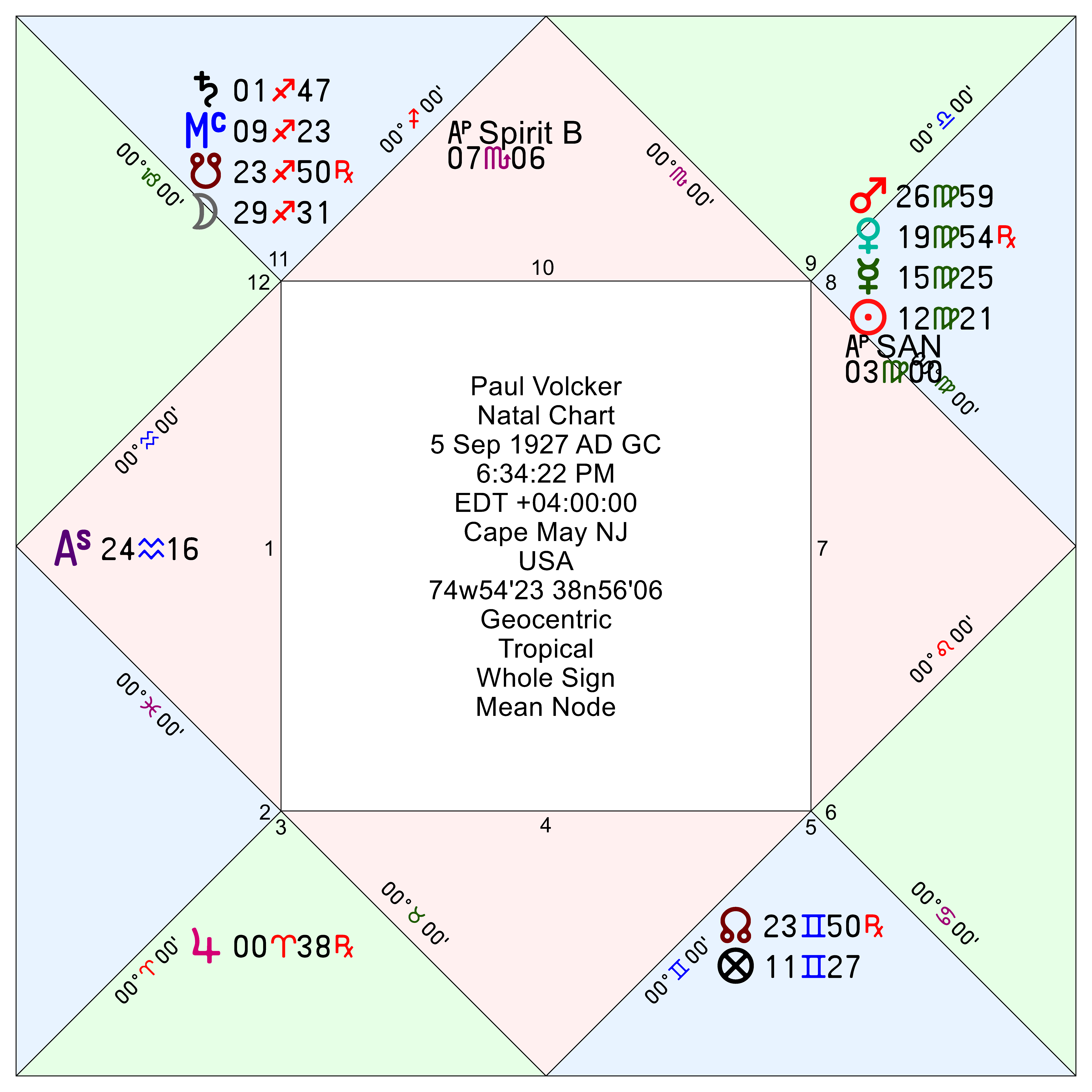
Rodden Rating AA, Quoted BC/BR, 10:30 AM, ASC 29LI10
Proposed rectification 6:34:22 PM, ASC 24AQ16’55”
As the proposed rectification varies substantially from the AA rated birthtime, I have prepared a special subscriber-only video which features rectification highlights.
The analytical models used in the sections below are part of a larger research program developed across longer white papers and case studies, where the historical sources, rules, and testing methodology are laid out in full. These database entries show the models in practice; readers who want the theoretical foundations can start with the background papers below:
Rectification Hub (I wrote the book on it!)
Soul Hub (white paper, Victor model statistical tests, Moon’s Configuration studies)
Physiognomy Hub (white paper, examples)
Victor Model Factors favoring Jupiter/Aries-retrograde as Victor
Sign ruler: Moon, MC
Bound ruler: MC, Lot of Fortune
Solar phase: morning heliacal setting
With Jupiter at 0°41′ Aries, retrograde, functioning as victor of the horoscope, the starting point is not Aries but its opposite sign. In most circumstances, this Jupiter operates as if placed in Libra—measured, procedural, and attentive to balance within institutional frameworks. In practice, this is visible in Volcker’s willingness to work through the Federal Open Market Committee, to tolerate dissent, and to allow policy discussions to unfold without constant intervention. The baseline is not impulsive leadership, but structured deliberation.
The crucial modification comes from Jupiter’s morning heliacal setting relative to the Sun at 12°01′ Virgo. Here, Jupiter’s light is increasing, and during this interval the retrograde condition is temporarily set aside. Jupiter reasserts its direct-nature expression, and in Aries this takes the form of decisive, executive authority. Volcker’s tenure at the Federal Reserve illustrates this rhythm with unusual clarity. Periods of restraint and process are punctuated by moments in which he sets direction unilaterally, most notably in the October 1979 shift to reserve targeting. That decision did not emerge from incremental consensus; it imposed a framework that forced outcomes, allowing interest rates to rise as a consequence rather than as an explicit policy target.
This produces a distinct management style: baseline diplomacy, punctuated by decisive intervention. Volcker could appear patient—even reserved—in discussion, but this was not hesitation. It was timing. When conditions required it, he acted in a manner consistent with Jupiter in Aries at full strength, establishing policy direction and holding it in place despite sustained political and public pressure. The result was not constant assertion of authority, but strategic deployment of authority at critical junctures.
The timing reinforces the delineation. The major Jupiter Firdaria beginning 5-Sep-1978, lasting twelve years, encompasses the peak of Volcker’s influence, including his appointment as Federal Reserve Chairman and the execution of his anti-inflation program. What appears, at first glance, to be a contradiction—retrograde Jupiter in Aries—resolves into a coherent pattern: institutional balance in the background, decisive authority when the moment demands it.
Physiognomy
Rising sign: Aquarius
Ruler of rising sign: Saturn/Sagittarius
Rising decan: Libra
Ruler of rising decan: Venus/Virgo-retro
Volcker’s physical presence is defined first by extraordinary height, standing 6′7″, which gives him a natural prominence in any setting. His build is large and substantial rather than lean, with a tendency toward stoutness, particularly in later years, producing a frame that carries weight without compactness. The body reads as broad through the torso yet elongated overall, more vertical than dense. His face is long and ovate, with a high forehead, thinning hair, and a softly contoured jawline that avoids sharp angularity. The cheeks show a noticeable fullness and roundness, especially with age, lending a mild, approachable quality to his appearance. His features are muted rather than sharply defined—a longer nose that does not flare widely, relatively thin lips, and eyes set behind large glasses that convey reserve, patience, and observational distance. Despite his size, he does not project physical dominance; instead, the overall impression is one of scale combined with restraint, presence without force.
Under an Aquarius rising at 24°, with Saturn in Sagittarius as ruler, the height and overall vertical extension of the body are readily explained, not through compact strength but through elongation and scale. The Libra decan introduces a moderating influence, but the key to the face lies in Venus in Virgo, retrograde, operating here as though placed in Pisces. This produces a visible softening of features: fuller cheeks, rounded contours, and a pleasant, approachable demeanor that tempers what might otherwise be a more austere Saturnine presentation. The result is a layered physiognomy—Saturn/Sagittarius establishing structure and height, while Venus/Pisces overlays softness and humanity onto the face. What emerges is not severity, but a gentle, avuncular quality, where physical scale is balanced by an unexpectedly mild and composed outward expression.
Moon’s Configuration
Phase I – Moon separating from Mars (Virgo, 8th House)
Delineation. The Moon at 29° Sagittarius in the 10th house, conjunct the South Node and in the bound of Mars, separates from Mars in Virgo in the 8th house. This is a configuration of excess under pressure. The Moon signifies the public environment and, as ruler of the 6th house, labor and wage conditions. In Sagittarius, the tendency is toward expansion and escalation, while the South Node removes restraint, producing runaway conditions that demand correction. The Mars bound intensifies the situation further, introducing heat, urgency, and force.
Mars in Virgo in the 8th provides the underlying structure: demand-push inflation acting upon a leveraged financial system. Virgo signifies economic throughput, allocation, and imbalance in flows, while the 8th house brings in debt, systemic fragility, and interdependence. The result is not merely inflation, but a self-reinforcing wage–cost spiral, where labor demands (Moon ruling the 6th) feed aggregate demand, pushing prices higher in a cycle that becomes increasingly difficult to control.
Biographical Match. This phase corresponds to the inflationary environment of the 1970s, particularly the entrenched wage–cost spiral that defined the late decade. By the time Volcker assumes the chairmanship in 1979, inflation is no longer episodic but structural, embedded in expectations and reinforced by labor dynamics. The system reflects precisely the configuration: demand pressure (Mars/Virgo) applied to a debt-sensitive structure (8th house), producing conditions that require intervention at the highest level (Moon in the 10th).
Phase II – Transition: Moon enters Capricorn (10th House)
Delineation. The Moon’s ingress from Sagittarius into Capricorn marks a decisive shift from expansion to contraction, from diagnosis to enforcement. Capricorn, ruled by Saturn, demands discipline, structure, and measurable outcomes. The excessive, inflationary condition of the prior phase cannot continue; it must be contained and reversed.
Crucially, the Moon does not leave Mars behind. The separation indicates that the cause has been identified, but the Mars condition—pressure applied to a fragile system—remains embedded in what follows. The shift into Capricorn signals that this pressure will now be systematically applied as policy, rather than merely experienced as economic imbalance.
Biographical Match. This phase aligns with Volcker’s appointment as Federal Reserve Chairman in August 1979 and the rapid movement toward decisive policy change. The environment transitions from recognizing inflation as a problem to accepting the necessity of harsh corrective measures. The groundwork is laid for the structural shift that follows.
Phase III – Moon applying to Jupiter (Aries, retrograde; 2nd/3rd House)
Delineation. The Moon applies by square to Jupiter at 0° Aries, retrograde, a configuration that defines the mode of resolution. Jupiter in Aries signifies unilateral authority, decisive direction, and system-imposing action. In its retrograde condition, but operating under increasing light, Jupiter reasserts its direct-nature expression, allowing for clear, forceful execution of policy.
Mars and Jupiter here operate as a linked system, reinforced by their antiscia relationship. Mars supplies the force and mechanism—the application of pressure through interest rates, the compression of demand, and the transmission of stress through debt structures. Jupiter supplies the framework and authority—the policy architecture that defines, justifies, and sustains that force. This is not a sequence but a fusion: action and authority expressed simultaneously.
Biographical March. This phase is exemplified by the October 5, 1979 “Saturday Night Surprise”, where the Federal Reserve shifted to targeting money supply. The event is timed both by Jupiter solar arc directions (authority, policy framework) and Mars’ transit 10th from the Lot of Spirit (force, execution), illustrating their joint operation. The same mechanism unfolds over time: aggressive rate hikes suppress domestic inflation while simultaneously creating external stress, culminating in the 1982 Latin American debt crisis. Virgo’s association with these economies and Mars’ role in both the tightening cycle and the crisis itself confirm that the cure and the consequence arise from the same source.
Phase IV – Synthesis: Force and Authority as a Single System
Delineation. This configuration does not resolve into a simple progression from Mars to Jupiter. Instead, it reveals a compound structure in which:
Mars (Virgo, 8th) defines the economic reality: demand-push inflation, labor pressure, and systemic debt vulnerability
The Moon (Sagittarius → Capricorn, 10th, South Node) converts this into a public mandate for decisive action, intensified and uncompromising
Jupiter (Aries, retrograde) defines the mode of execution: unilateral, directive, and sustained
The result is a policy approach in which force is applied through structure. Mars does not disappear as Jupiter takes over; it is carried forward and expressed through Jupiter’s authority. This explains why Volcker’s actions appear simultaneous in effect: inflation is suppressed at the same time that financial stress is exported into the global system.
Biographical Match. Volcker’s tenure is defined by this dual outcome. The same policy framework that breaks the back of inflation also contributes to international debt crises, particularly in Latin America. These are not separate events but two expressions of a single configuration, unfolding across different time horizons. The Moon’s placement on the South Node ensures that the response is excessive but necessary, producing results that are both effective and far-reaching.
Influence of Sect
In a diurnal figure, both Jupiter and Saturn are in-sect, while Mars and Venus are out-of-sect, and this distribution sharpens rather than softens the overall pattern. Jupiter in-sect, already established as victor, is strengthened in its capacity to operate within the system rather than against it. Volcker’s authority is not revolutionary but institutional, moving through established channels—first under Jimmy Carter and then Ronald Reagan—with a degree of operational freedom that allows him to impose policy without being structurally blocked. Jupiter’s in-sect condition ensures that his unilateral style is still recognized as legitimate, even when politically painful. Saturn in Sagittarius, however, remains problematic. Saturn in a fire sign ruled by Jupiter struggles to command and control, and here that translates into weak or ineffective financial regulation and an inability to restrain monetary aggregates during the inflationary buildup of the 1970s. Its in-sect status does not meaningfully mitigate this weakness; instead, it allows these deficiencies to become systemic, extending Saturn’s reach across the broader economy. If there is any benefit, it is a limit condition—the system deteriorates into double-digit inflation, but does not collapse into hyperinflation, suggesting Saturn still imposes a boundary even if it cannot enforce discipline cleanly.
By contrast, the out-of-sect planets sharpen their malefic or problematic expression. Mars in Virgo, already central to the Moon’s configuration, carries additional sting and severity, intensifying the impact of Volcker’s rate hikes and amplifying their consequences, most notably in the 1982 Latin American debt crisis, where pressure applied to a leveraged system produces delayed but forceful rupture. Mars out-of-sect does not merely act—it overacts, ensuring that the cure is as harsh as the disease. Venus in Virgo, retrograde, and out-of-sect likewise points to dysfunction in areas of agreement, valuation, and exchange. Its expression is not harmonious but distorted, showing up in financial and institutional breakdowns that intersect with Volcker’s later career, including the Arthur Andersen scandal and the United Nations Oil-for-Food Programme scandal. In both cases, Venus—normally a planet of balance and accord—operates under strain, reflecting compromised systems of trust and valuation. Taken together, sect does not soften this chart; it clarifies the division of labor: Jupiter and Saturn define the system within which Volcker operates—functional but flawed—while Mars and Venus, unchecked by sect, introduce the intensity and distortion that make both his solutions and their consequences so pronounced.
Early/Late Bloomer Thesis
Paul Volcker was born 5 September 1927 and died 8 December 2019, giving him a longevity of 92 years. The midpoint falls at age 46, which corresponds to approximately September 1973. Because Volcker was born after a New Moon, the thesis would classify him as an early bloomer, meaning the expectation is that the majority of defining life and career milestones should occur before the midpoint.
The record does not support that expectation. Prior to age 46, Volcker’s career is formative but not defining: education at Princeton and the London School of Economics, followed by roles at the Federal Reserve Bank of New York and the U.S. Treasury, including his position as Under Secretary for Monetary Affairs and involvement in the 1971 suspension of gold convertibility. These are important credentials, but they do not represent the peak expression of his life’s work. That comes decisively after the midpoint: appointment as Chairman of the Federal Reserve in 1979 (age 52), the October 1979 policy shift, the breaking of inflation in the early 1980s, and his full tenure through 1987. Even his post-Fed influence—international commissions, regulatory reforms, and the “Volcker Rule”—extends well into later life. On balance, Volcker aligns much more closely with a late bloomer profile, despite being born after a New Moon.